
In today’s rapidly evolving digital landscape, businesses are constantly searching for competitive advantages that can propel them ahead of the competition. The answer lies in artificial intelligence—a transformative technology that’s no longer just for tech giants and Fortune 500 companies. AI can help you grow your business in ways that were unimaginable just a few years ago, offering solutions that are both accessible and remarkably effective for companies of all sizes.
Whether you’re a startup founder, small business owner, or managing an established enterprise, understanding how AI can help you grow your business is no longer optional—it’s essential. From automating mundane tasks to uncovering insights hidden deep within your data, artificial intelligence is revolutionizing how companies operate, compete, and scale.
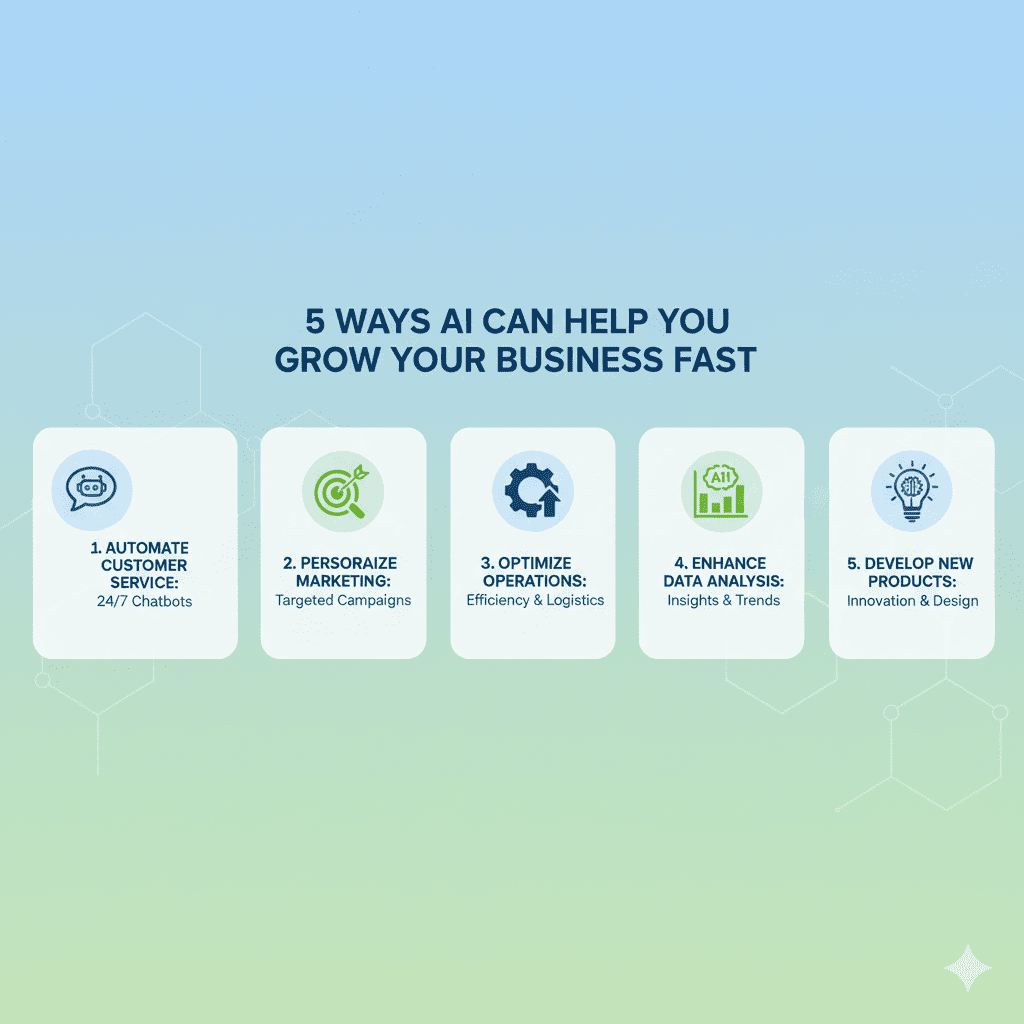
This comprehensive guide explores five powerful ways that AI can help you grow your business fast, providing you with actionable strategies and real-world applications that you can implement starting today. Let’s dive into the transformative potential of artificial intelligence and discover how it can become your most valuable business asset.
1. Automate Repetitive Tasks and Boost Productivity
One of the most immediate and impactful ways AI can help you grow your business is through intelligent automation. Every business, regardless of industry, grapples with repetitive, time-consuming tasks that drain resources and prevent teams from focusing on high-value activities. Artificial intelligence excels at handling these routine operations with speed, accuracy, and consistency that far exceeds human capabilities.
Understanding AI-Powered Automation
AI-powered automation goes far beyond simple rule-based systems. Modern artificial intelligence can learn from patterns, adapt to new situations, and make decisions based on complex data sets. This means that AI can help you grow your business by handling tasks that previously required human judgment, while freeing your team to focus on strategic initiatives that drive growth.
Key Areas for AI Automation
Email Management and Communication: AI-powered email assistants can automatically sort, prioritize, and even respond to routine correspondence. These systems learn your communication style and can handle customer inquiries, schedule meetings, and filter spam with remarkable accuracy. For businesses receiving hundreds of emails daily, this alone can save dozens of hours per week.
Data Entry and Processing: Manual data entry is not only tedious but also prone to human error. AI systems can extract information from documents, invoices, receipts, and forms with near-perfect accuracy. They can automatically populate databases, update CRM systems, and ensure data consistency across multiple platforms. This capability means AI can help you grow your business by eliminating bottlenecks in data processing and reducing costly errors.
Scheduling and Calendar Management: AI assistants can manage complex scheduling requirements, coordinating across multiple time zones, considering participant preferences, and automatically rescheduling when conflicts arise. They can also prepare meeting agendas, send reminders, and even take notes during calls.
Invoice Processing and Financial Tasks: Accounts payable and receivable departments can leverage AI to process invoices, match purchase orders, flag discrepancies, and even predict cash flow issues before they become critical. This financial automation ensures faster payment cycles and better financial visibility.
The Productivity Multiplier Effect
When you implement AI automation strategically, you create a productivity multiplier effect throughout your organization. Employees who previously spent 30-40% of their time on administrative tasks can now dedicate that energy to innovation, customer relationships, and strategic planning. This shift doesn’t just save time—it transforms your company culture and accelerates growth.
Research shows that businesses implementing AI automation see productivity gains of 20-40% within the first year. More importantly, employee satisfaction increases as team members focus on meaningful work rather than repetitive tasks. This combination of increased efficiency and improved morale creates the perfect environment for rapid business growth.
Real-World Implementation Strategy
To successfully leverage AI automation, start by conducting a comprehensive audit of repetitive tasks across your organization. Identify processes that consume significant time but don’t require complex decision-making or creative thinking. Prioritize automation opportunities based on potential time savings and implementation complexity.
Begin with pilot projects in specific departments, measure results carefully, and scale successful implementations across the organization. Remember that AI can help you grow your business most effectively when you pair technological solutions with proper change management and employee training.
2. Enhance Customer Experience with AI-Powered Personalization
In an era where customers expect personalized experiences at every touchpoint, AI can help you grow your business by delivering individualized interactions at scale. Artificial intelligence analyzes vast amounts of customer data to understand preferences, predict needs, and create tailored experiences that drive engagement, loyalty, and revenue.
The Power of Personalization
Generic, one-size-fits-all marketing is dead. Today’s customers expect businesses to understand their unique needs, preferences, and behaviors. AI makes this level of personalization possible even for businesses with thousands or millions of customers. By analyzing browsing history, purchase patterns, demographic data, and engagement metrics, AI can help you grow your business by creating experiences that feel individually crafted for each customer.
AI-Driven Personalization Strategies
Intelligent Product Recommendations: AI recommendation engines analyze customer behavior, purchase history, and preferences to suggest products or services with uncanny accuracy. These systems continuously learn and improve, delivering increasingly relevant suggestions that drive higher conversion rates and average order values. E-commerce giants credit recommendation engines for 35% or more of their total revenue.
Dynamic Content Customization: AI can automatically adjust website content, email messages, and marketing materials based on individual customer profiles. Headlines, images, product displays, and calls-to-action can all be optimized in real-time to match each visitor’s interests and stage in the buying journey. This level of customization was once impossible without massive manual effort, but AI can help you grow your business by making it automatic and scalable.
Predictive Customer Service: AI systems can predict customer needs before issues arise. By analyzing usage patterns and historical data, these systems can proactively reach out with solutions, tutorials, or special offers precisely when customers need them. This anticipatory service creates “wow” moments that build lasting customer loyalty.
Chatbots and Virtual Assistants: AI-powered chatbots provide instant, 24/7 customer support that feels remarkably human. Modern conversational AI understands context, remembers previous interactions, and can handle complex queries across multiple channels. These systems resolve up to 80% of routine customer inquiries without human intervention, while seamlessly escalating complex issues to human agents.
Segmentation and Micro-Targeting
Traditional customer segmentation divides audiences into broad categories based on basic demographics. AI takes this to an entirely new level, creating micro-segments or even segments of one. Machine learning algorithms identify subtle patterns and correlations in customer data that humans would never spot, enabling AI can help you grow your business through incredibly precise targeting.
This granular understanding allows you to craft marketing messages, product offerings, and service experiences that resonate deeply with specific customer groups. The result is higher engagement rates, improved conversion, and stronger customer relationships.
Building Customer Loyalty Through AI
Personalization isn’t just about making sales—it’s about building relationships. When customers feel understood and valued, they become loyal advocates for your brand. AI helps you maintain this personal touch even as your business scales. Automated yet personalized birthday messages, anniversary rewards, loyalty program optimization, and proactive problem resolution all contribute to customer retention.
The financial impact of AI-driven personalization is substantial. Studies show that personalized experiences can increase marketing ROI by 5-8 times and boost sales by 10% or more. For businesses focused on rapid growth, these improvements in customer acquisition and retention are game-changing.
3. Make Data-Driven Decisions with AI Analytics
Data is often called the new oil, but raw data alone isn’t valuable—it’s the insights extracted from that data that drive business growth. AI can help you grow your business by transforming massive amounts of information into actionable intelligence that guides strategic decisions.
Beyond Traditional Business Intelligence
Traditional analytics tools require humans to know what questions to ask. AI analytics, on the other hand, proactively identifies patterns, anomalies, and opportunities hidden within your data. These systems can process structured and unstructured data from countless sources—sales figures, customer feedback, market trends, social media sentiment, and competitor activities—to provide comprehensive business intelligence.
Predictive Analytics for Strategic Planning
One of the most powerful ways AI can help you grow your business is through predictive analytics. Machine learning models analyze historical data to forecast future trends with remarkable accuracy. This capability transforms business planning from educated guesswork into data-driven strategy.
Sales Forecasting: AI models consider seasonality, market conditions, promotional activities, and countless other variables to predict sales with precision. This enables better inventory management, resource allocation, and revenue planning.
Customer Churn Prevention: AI identifies customers at risk of leaving before they actually depart. By analyzing engagement patterns, support tickets, usage frequency, and payment behaviors, predictive models flag at-risk accounts, allowing your team to intervene with retention offers or personalized outreach.
Market Trend Analysis: AI continuously monitors market dynamics, competitor activities, and emerging trends. It identifies opportunities and threats far faster than human analysts, giving your business crucial time to adapt and capitalize on changes.
Pricing Optimization: Dynamic pricing algorithms analyze demand patterns, competitor pricing, inventory levels, and customer willingness to pay to recommend optimal pricing strategies. This sophisticated approach maximizes both revenue and market share.
Real-Time Business Intelligence
Traditional reporting provides historical snapshots, but AI can help you grow your business through real-time intelligence dashboards that update continuously. These systems monitor key performance indicators, alert you to significant changes, and even suggest corrective actions when metrics deviate from targets.
Imagine having a virtual business analyst working 24/7, constantly monitoring your operations and alerting you the moment something requires attention. This level of vigilance ensures you never miss critical opportunities or allow small problems to escalate into major crises.
Uncovering Hidden Opportunities
AI excels at identifying non-obvious correlations and opportunities that human analysts might overlook. Perhaps certain customer segments are highly profitable but underserved, or maybe specific product combinations have unusually high cross-sell potential. Machine learning algorithms surface these insights automatically, enabling you to capitalize on opportunities you didn’t even know existed.
Democratizing Data Access
Historically, accessing business intelligence required specialized skills in data analysis and visualization. AI-powered analytics platforms use natural language processing to let anyone in your organization ask questions in plain English and receive instant, accurate answers. This democratization of data empowers every team member to make informed decisions, creating a truly data-driven culture.
When your entire organization has access to AI-powered insights, AI can help you grow your business through countless micro-optimizations and strategic improvements across all departments. Marketing becomes more targeted, operations more efficient, product development more aligned with customer needs, and leadership more confident in strategic decisions.
4. Optimize Marketing and Sales with AI-Powered Tools
Marketing and sales are perhaps the most transformed business functions in the AI revolution. AI can help you grow your business by making every marketing dollar work harder and every sales conversation more effective. From lead generation to conversion optimization, artificial intelligence is reshaping how businesses attract, engage, and convert customers.
AI-Enhanced Lead Generation and Qualification
Finding and qualifying leads has traditionally been one of the most resource-intensive aspects of business growth. AI changes this equation dramatically by automating and optimizing the entire lead generation funnel.
Intelligent Prospecting: AI tools analyze millions of data points across the internet to identify potential customers who match your ideal customer profile. These systems consider industry, company size, technology usage, hiring patterns, funding events, and countless other signals to build highly targeted prospect lists.
Lead Scoring and Prioritization: Not all leads are created equal. AI-powered lead scoring evaluates each prospect based on behavioral signals, engagement history, demographic fit, and likelihood to convert. This ensures your sales team focuses energy on the highest-potential opportunities rather than wasting time on low-quality leads.
Automated Outreach: AI can craft personalized outreach messages, determine optimal send times, and even handle follow-up sequences based on prospect behavior. These systems learn which messages resonate with different audience segments and continuously optimize for better results.
Content Creation and Optimization
Content marketing is essential for business growth, but creating high-quality content at scale is challenging. AI can help you grow your business by augmenting your content creation capabilities and ensuring every piece performs optimally.
AI Writing Assistants: Modern AI can help draft blog posts, social media updates, email campaigns, and even video scripts. While human oversight and editing remain important, AI dramatically accelerates content production and helps maintain consistency across all channels.
SEO Optimization: AI-powered SEO tools analyze search intent, identify keyword opportunities, optimize content structure, and even predict how content will perform in search results. These systems ensure your content reaches the widest possible audience and drives sustainable organic traffic growth.
Content Performance Analysis: AI continuously monitors content performance across all channels, identifying what resonates with your audience and what falls flat. These insights inform future content strategy, creating a virtuous cycle of continuous improvement.
Programmatic Advertising and Campaign Optimization
Digital advertising platforms increasingly rely on AI to maximize return on ad spend. AI can help you grow your business through sophisticated advertising optimization that would be impossible manually.
Automated Bid Management: AI algorithms adjust advertising bids in real-time based on likelihood of conversion, competition, and business objectives. This ensures you never overpay for clicks while maximizing visibility for high-intent searches.
Audience Targeting: Machine learning identifies the most responsive audience segments and automatically allocates budget to high-performing demographics, interests, and behaviors. These systems continuously test new audiences and optimize targeting parameters.
Creative Optimization: AI can test countless ad variations simultaneously, identifying which headlines, images, calls-to-action, and formats drive the best results. Some advanced systems even generate ad creative automatically based on performance data.
Sales Enablement and Conversion Optimization
AI can help you grow your business by transforming your sales process from art to science. Modern sales enablement platforms use artificial intelligence to guide representatives through every customer interaction.
Conversation Intelligence: AI-powered tools analyze sales calls in real-time, providing representatives with relevant information, suggesting responses, and flagging potential objections. After calls, these systems provide detailed feedback on what went well and areas for improvement.
Next-Best-Action Recommendations: AI examines each customer’s history, behavior, and profile to suggest the optimal next step in the sales process. Should you send a case study, offer a demo, introduce a specific feature, or provide pricing? AI recommendations dramatically improve conversion rates.
Contract and Proposal Automation: AI can generate customized proposals, contracts, and presentations based on customer needs and previous successful deals. This acceleration of the sales cycle means your team can handle more opportunities simultaneously.
Measuring and Maximizing ROI
Perhaps most importantly, AI provides unprecedented visibility into marketing and sales performance. Attribution models powered by machine learning accurately track customer journeys across multiple touchpoints, revealing which marketing activities truly drive revenue. This clarity allows you to confidently invest in high-performing channels while eliminating waste.
Companies leveraging AI in marketing and sales typically see 10-20% increases in lead generation, 15-25% improvements in conversion rates, and 20-30% reductions in customer acquisition costs. These improvements compound over time, creating exponential growth trajectories.
5. Improve Operational Efficiency and Reduce Costs
While revenue growth captures attention, AI can help you grow your business equally through operational efficiency and cost reduction. Artificial intelligence optimizes processes, eliminates waste, and ensures resources are deployed where they create maximum value.
Supply Chain and Inventory Optimization
Supply chain management involves countless variables and trade-offs. AI excels at managing this complexity, balancing cost, speed, reliability, and flexibility in ways human managers cannot match.
Demand Forecasting: AI analyzes historical sales, seasonality, market trends, weather patterns, economic indicators, and even social media sentiment to predict demand with exceptional accuracy. This prevents both stockouts and excess inventory, optimizing working capital.
Inventory Management: AI determines optimal stock levels for each product and location, considering lead times, storage costs, and service level requirements. These systems automatically trigger reorders at precisely the right moment.
Logistics Optimization: AI plans delivery routes, consolidates shipments, selects optimal carriers, and adjusts in real-time to disruptions. Companies using AI-powered logistics see 10-15% reductions in transportation costs while improving delivery times.
Supplier Management: AI evaluates supplier performance, identifies risks, and recommends alternative sources when issues arise. Predictive models flag potential supply disruptions before they impact operations.
Quality Control and Process Optimization
AI can help you grow your business by ensuring consistent quality while identifying opportunities for continuous improvement.
Automated Quality Inspection: Computer vision systems inspect products with superhuman accuracy and speed, identifying defects that human inspectors might miss. This ensures consistent quality while reducing inspection costs by 30-50%.
Process Mining: AI analyzes how work actually flows through your organization, identifying bottlenecks, inefficiencies, and deviations from optimal processes. These insights enable targeted improvements that can dramatically accelerate operations.
Predictive Maintenance: Rather than maintaining equipment on fixed schedules or waiting for breakdowns, AI predicts when maintenance is actually needed. This prevents costly unplanned downtime while eliminating unnecessary preventive maintenance, typically reducing maintenance costs by 20-25%.
Workforce Optimization
Optimizing human resources is critical for scaling businesses. AI helps ensure you have the right people in the right roles at the right times.
Scheduling Optimization: AI creates optimal staff schedules considering employee preferences, skills, labor regulations, and demand forecasts. This ensures adequate coverage while controlling labor costs.
Talent Acquisition: AI screens resumes, schedules interviews, and even conducts initial candidate assessments. This dramatically reduces time-to-hire while improving candidate quality by eliminating unconscious bias.
Training and Development: AI-powered learning platforms adapt to each employee’s knowledge, learning style, and pace, delivering personalized training that maximizes retention and minimizes time away from productive work.
Financial Operations
AI can help you grow your business through more efficient financial management and better cash flow control.
Expense Management: AI automatically categorizes expenses, flags policy violations, and identifies spending patterns that warrant attention. This reduces processing costs while improving compliance.
Credit and Collections: AI predicts payment behavior, recommends credit limits, and optimizes collection strategies for delinquent accounts. This improves cash flow while reducing bad debt.
Fraud Detection: Machine learning identifies suspicious transactions and activities with far greater accuracy than rule-based systems, protecting your business from financial losses.
Energy and Resource Management
For businesses with significant physical operations, AI optimizes energy consumption, reducing costs while supporting sustainability goals. Smart building systems use AI to control heating, cooling, and lighting based on occupancy, weather, and usage patterns, typically reducing energy costs by 15-30%.
The Cumulative Impact
When implemented across multiple operational areas, the efficiency gains from AI are transformative. Companies leveraging AI for operational optimization typically see 15-30% reductions in operating costs within two years. These savings can be reinvested in growth initiatives, creating a virtuous cycle where AI can help you grow your business both by reducing costs and funding expansion.
Making AI Work for Your Business: Implementation Strategies
Understanding how AI can help you grow your business is just the beginning. Successful implementation requires strategic planning, thoughtful execution, and continuous optimization.
Start with Clear Objectives
Before implementing any AI solution, define what success looks like. Are you trying to reduce costs, increase revenue, improve customer satisfaction, or accelerate operations? Clear objectives ensure you select appropriate AI tools and can measure their impact.
Begin with Quick Wins
Build organizational confidence in AI by starting with projects that deliver rapid results with minimal disruption. Chatbots for customer service, email automation, or basic analytics dashboards are excellent starting points that demonstrate value quickly.
Invest in Data Infrastructure
AI is only as good as the data it processes. Ensure your data is clean, organized, and accessible. Many businesses discover that their biggest AI challenge isn’t the technology itself but the underlying data infrastructure.
Prioritize Change Management
Technology alone doesn’t drive business transformation—people do. Invest in training, communicate benefits clearly, and involve employees in the implementation process. Address concerns about job displacement by emphasizing how AI can help you grow your business by augmenting human capabilities rather than replacing people.
Choose the Right Partners
Unless you’re a large enterprise with extensive technical resources, partnering with AI vendors and consultants accelerates implementation and reduces risk. Look for providers with experience in your industry and proven track records of successful deployments.
Measure, Learn, and Iterate
AI implementation is not a one-time project but an ongoing journey. Continuously measure results against your objectives, learn from what works and what doesn’t, and iterate accordingly. The most successful AI implementations evolve constantly, improving over time.
The Future Is Now
The question is no longer whether AI can help you grow your business—the evidence is overwhelming that it can and does. The real question is how quickly you’ll embrace these technologies and integrate them into your operations.
Businesses that successfully leverage AI gain significant competitive advantages: lower costs, higher revenue, better customer experiences, and more engaged employees. These advantages compound over time, creating increasingly insurmountable leads over competitors who lag in AI adoption.
The barriers to AI adoption have never been lower. Cloud-based AI services, no-code platforms, and affordable software-as-a-service solutions make sophisticated artificial intelligence accessible to businesses of all sizes. You don’t need a team of data scientists or massive budgets to benefit from AI—you need vision, commitment, and willingness to embrace change.
AI can help you grow your business fast, but only if you act. The companies that will dominate their industries five years from now are the ones implementing AI today. Every day you delay is a day your competitors gain ground.
Start small, think big, and move fast. Identify one area where AI could create immediate value—perhaps customer service automation, marketing optimization, or operational efficiency—and begin implementation today. As you see results and build confidence, expand AI across your organization.
The AI revolution isn’t coming—it’s already here. The only question is whether you’ll be among the businesses that harness its power to achieve extraordinary growth, or among those left behind wondering what happened.
The opportunity is massive. The technology is available. The time is now. Let AI can help you grow your business be more than just words on a page—let it be the catalyst that transforms your company’s trajectory and unlocks the growth you’ve been seeking.
Your competitors are already implementing AI. Your customers expect AI-powered experiences. Your employees deserve AI tools that make their work more meaningful. Most importantly, your business deserves every advantage it can get in today’s hyper-competitive marketplace.
Also read this:
Subscription-Box Side Hustle: How to Start Online with Low Risk
sell online workshops and webinars: Turn Expertise Into Income
Offer Virtual Assistant Services to Global Clients from India:Building a Profitable Remote Career