
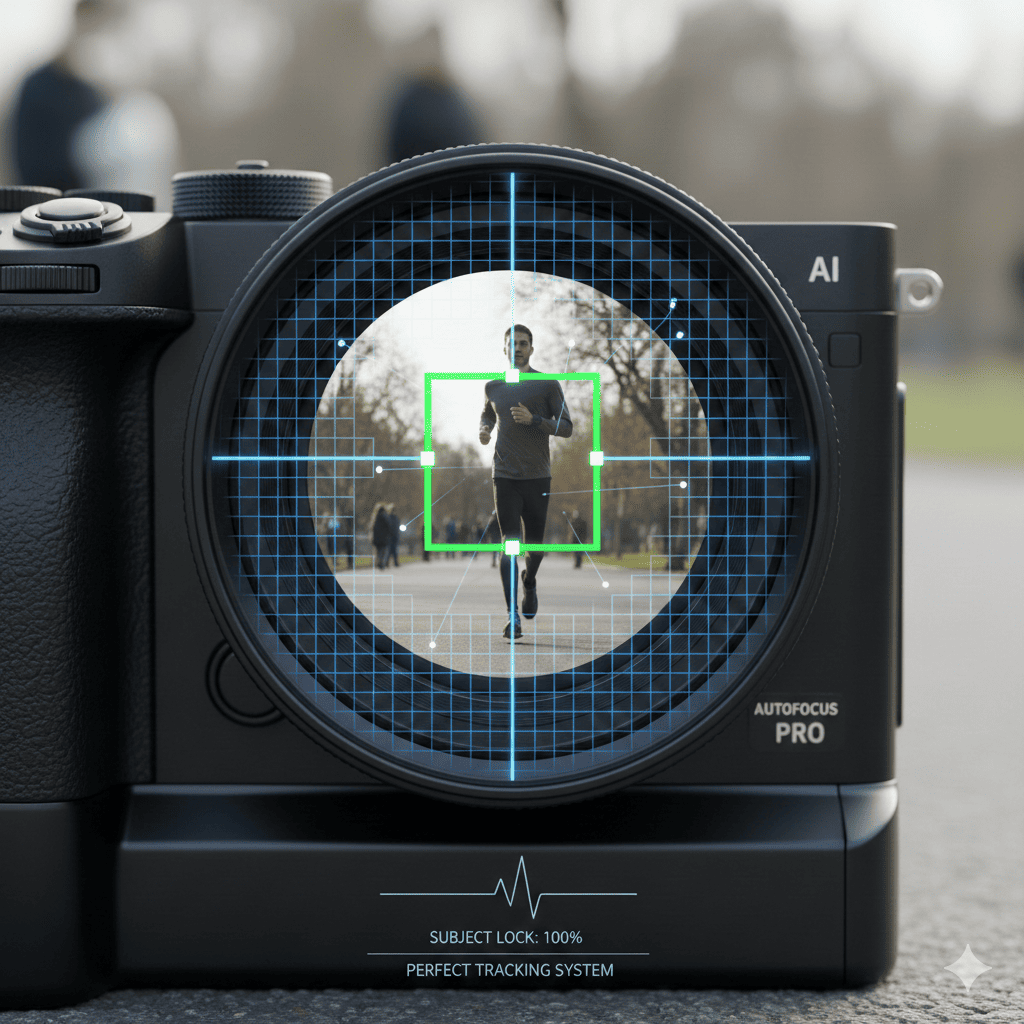
Photography has undergone a revolutionary transformation in recent years, and at the heart of this evolution lies artificial intelligence. Gone are the days when photographers struggled with manual focus or relied on basic contrast-detection systems that couldn’t keep up with fast-moving subjects. Today’s AI autofocus systems represent a quantum leap in imaging technology, delivering precision and reliability that seemed impossible just a few years ago.
Whether you’re a professional wildlife photographer tracking birds in flight, a sports photographer capturing split-second action, or a wedding photographer ensuring every precious moment stays in perfect focus, understanding AI autofocus systems that track subjects perfectly has become essential knowledge for modern image-makers.
This comprehensive guide explores how artificial intelligence has revolutionized autofocus technology, which cameras and lenses offer the best AI-powered focusing capabilities, and how you can leverage these systems to capture perfectly sharp images in even the most challenging situations.
Understanding the Evolution of Autofocus Technology
Before appreciating the remarkable capabilities of modern AI autofocus systems, it’s important to understand the journey that brought us here. Traditional autofocus relied on phase-detection and contrast-detection methods that, while effective for static subjects, struggled with complex scenarios involving multiple subjects, unpredictable movement, or challenging lighting conditions.
These conventional systems followed simple rules: detect contrast edges, measure phase differences, and adjust focus accordingly. They worked well when subjects remained relatively still and occupied the center of the frame, but they faltered when photographers needed to track erratic movement, maintain focus on specific subjects within crowds, or anticipate where a subject would move next.
The integration of artificial intelligence fundamentally changed this paradigm. Instead of following rigid algorithms, AI-powered systems learn to recognize subjects, predict movement patterns, and make intelligent decisions about focus priority in complex scenes. This cognitive approach to autofocus represents not just an incremental improvement, but a complete reimagining of how cameras understand and respond to the photographic scene.
1. How AI Autofocus Systems Actually Work
Understanding the technology behind AI autofocus systems that track subjects perfectly helps photographers maximize these powerful tools.
Neural Network Processing
Modern AI autofocus relies on deep learning neural networks trained on millions of images. These networks learn to identify and distinguish between different types of subjects—humans, animals, vehicles, and more—with remarkable accuracy. The camera’s processor runs these neural networks in real-time, analyzing each frame to detect subjects and predict their movement.
The system doesn’t just detect that something is present; it understands what that something is and how it’s likely to behave. A running cheetah will be tracked differently than a flying bird or a moving car, with the AI adjusting its prediction algorithms based on subject type.
Real-Time Subject Recognition
AI autofocus systems can now identify and categorize subjects instantly. Advanced cameras can detect human eyes, faces, and bodies, animal eyes and bodies, vehicles, and even specific animals like birds, cats, and dogs. This recognition happens at astonishing speeds—often processing hundreds of times per second.
The system maintains focus on the intended subject even when it temporarily moves behind obstacles, leaves the frame, or becomes partially obscured. The AI remembers the subject and reacquires focus when it reappears, creating seamless tracking that manual focusing could never achieve.
Predictive Focus Algorithms
Perhaps the most impressive aspect of modern AI autofocus systems is their ability to predict where a subject will be moments before they arrive there. By analyzing movement patterns, acceleration, and trajectory, these systems can anticipate subject position and pre-adjust focus accordingly.
This predictive capability eliminates the lag that plagued older autofocus systems, where the camera was always playing catch-up to subject movement. Instead, AI systems can maintain perfect focus even on subjects moving at high speeds or changing direction unpredictably.
2. Leading Camera Manufacturers and Their AI Autofocus Technologies
Different manufacturers have developed unique approaches to AI autofocus systems that track subjects perfectly, each with distinct strengths and characteristics.
Sony’s Real-Time Tracking and AI-Based Recognition
Sony pioneered many AI autofocus technologies and continues to lead in several areas. Their Real-Time Tracking uses artificial intelligence to identify and follow subjects across the frame with remarkable tenacity. The system analyzes subject color, pattern, distance, and face/eye data simultaneously, creating a comprehensive tracking profile.
Sony’s AI-based subject recognition can detect and prioritize human eyes, faces, animal eyes, birds, insects, cars, trains, and airplanes. The Alpha 1, A9 III, and A7R V showcase these capabilities with focusing systems that rarely lose their target, even in chaotic scenes with multiple potential subjects.
Canon’s Deep Learning Autofocus
Canon’s AI autofocus systems in the EOS R3, R5, R6 Mark II, and R1 employ deep learning technology trained on vast datasets of human and animal subjects. Their system excels at detecting and tracking subjects even when they’re partially obscured, moving erratically, or occupying small portions of the frame.
Canon’s implementation includes eye control autofocus in some models, allowing photographers to select focus points simply by looking at them—a remarkable fusion of AI with biometric control. The system’s ability to track motorsports subjects and recognize specific vehicle types demonstrates the breadth of its training.
Nikon’s 3D Tracking and Subject Detection
Nikon’s Z9 and Z8 cameras feature sophisticated AI autofocus systems that combine 3D tracking with nine different subject detection modes. The system can recognize and track people, dogs, cats, birds, cars, motorcycles, bicycles, trains, and airplanes with exceptional reliability.
Nikon’s implementation is particularly praised for its ability to maintain focus during rapid composition changes, making it ideal for dynamic shooting situations where photographers need to reframe quickly while maintaining perfect subject sharpness.
Fujifilm’s AI-Powered Predictive AF
Fujifilm’s X-H2S and other recent models incorporate AI-based subject detection that recognizes animals, birds, cars, motorcycles, bicycles, airplanes, and trains. Their AI autofocus systems excel in video applications, providing smooth, natural focus transitions that enhance cinematic quality.
Olympus/OM System’s AI Computational Focus
OM System cameras employ artificial intelligence not just for subject detection but for computational focus stacking and extended depth-of-field techniques. Their AI autofocus systems are particularly effective for macro photography and situations requiring exceptional depth of field control.
3. Subject Detection Categories and Their Applications
Modern AI autofocus systems that track subjects perfectly offer specialized detection modes for different subject types, each optimized for specific photographic scenarios.
Human Detection
Human detection represents the most mature AI autofocus technology, with systems now capable of detecting and prioritizing eyes, faces, heads, and full bodies at remarkable distances. The AI can distinguish between multiple people and maintain focus on a selected individual even in crowded environments.
Advanced systems detect eyes even when subjects wear glasses, are backlit, or are partially obscured. Some cameras can recognize and maintain focus on a specific person throughout a shoot, ignoring other people who enter the frame—invaluable for wedding and event photography.
Animal Detection
AI autofocus systems have revolutionized wildlife photography by recognizing and tracking animal eyes and bodies with the same precision as human subjects. The systems can detect animals at great distances, maintain focus as they move unpredictably, and prioritize eyes over other body parts for optimal sharpness.
Advanced implementations distinguish between different animal types, adjusting tracking algorithms for the movement patterns of cats versus dogs, or land animals versus birds. This specialized approach produces higher success rates in challenging wildlife scenarios.
Bird Detection
Bird photography presents unique challenges due to rapid, erratic flight patterns and small subject sizes at distance. Specialized bird detection in modern AI autofocus systems addresses these challenges with algorithms trained specifically on avian movement patterns.
The systems can detect and track birds in flight even when they occupy only small portions of the frame, maintain focus as birds weave through branches or change direction suddenly, and prioritize the bird’s eye when visible. This technology has made in-flight bird photography accessible to photographers who previously found it frustratingly difficult.
Vehicle Detection
For motorsports, aviation, and transportation photography, AI autofocus systems now recognize cars, motorcycles, trains, and airplanes. The systems understand that these subjects move differently than living creatures and adjust tracking algorithms accordingly.
Vehicle detection algorithms can maintain focus on specific parts of vehicles—like the driver’s helmet in racing or the cockpit in aviation—providing creative control beyond simple subject tracking.
4. Real-World Performance in Challenging Scenarios
The true test of AI autofocus systems that track subjects perfectly comes in demanding real-world situations where traditional autofocus fails.
Low Light Performance
Modern AI autofocus can detect and track subjects in remarkably dim conditions, often functioning effectively at light levels where human photographers struggle to see clearly. The combination of sensitive sensors and intelligent subject recognition allows these systems to maintain focus in nightclubs, evening events, and astronomical twilight conditions.
The AI compensates for reduced contrast by relying on subject recognition rather than purely contrast-based focusing, enabling reliable performance where older systems would hunt endlessly or fail completely.
Fast-Moving Action
Sports, wildlife, and action photography demand autofocus that can keep pace with subjects moving at high speeds—sometimes approaching or receding directly along the lens axis, which presents the greatest challenge to focusing systems.
AI autofocus systems analyze velocity, trajectory, and acceleration to predict subject position microseconds in the future, ensuring focus arrives exactly when the shutter fires. Professional sports photographers report dramatically improved keeper rates when photographing everything from basketball to Formula 1 racing.
Cluttered Backgrounds
Traditional autofocus often struggles when distracting elements appear between the camera and intended subject, or when busy backgrounds contain high-contrast elements competing for focus attention. AI subject recognition solves this by understanding what the subject is and maintaining focus regardless of foreground or background distractions.
A bird behind tree branches, a person behind a fence, or an athlete partially obscured by other players—these scenarios that once required careful focus point selection and constant photographer intervention now work reliably with AI autofocus systems that track subjects perfectly.
Subjects Moving Toward or Away from Camera
The most challenging autofocus scenario involves subjects moving directly toward or away from the camera, requiring continuous rapid focus adjustment. AI predictive algorithms excel here, analyzing acceleration patterns and adjusting focus at rates far exceeding human reaction time.
Wildlife photographers photographing charging animals, sports photographers capturing approaching athletes, and aviation photographers tracking landing aircraft all benefit enormously from this capability.
5. Configuring AI Autofocus for Optimal Performance
While AI autofocus systems are remarkably capable out of the box, understanding configuration options helps photographers extract maximum performance.
Subject Priority Settings
Most advanced cameras allow photographers to specify which subject types should receive focus priority and how the system should respond when multiple detected subjects occupy the frame. These settings determine whether the camera focuses on the nearest subject, the subject closest to the selected focus point, or a manually designated subject.
Understanding and configuring these priorities prevents situations where the camera focuses on unintended subjects, ensuring reliable performance in complex scenes.
Tracking Sensitivity Adjustments
AI autofocus systems typically offer tracking sensitivity settings that control how readily the system switches focus to new subjects entering the frame. Higher sensitivity allows quick focus transitions to new subjects, while lower sensitivity maintains focus on the original subject even when obstacles temporarily intervene.
Sports photographers covering multiple athletes often prefer higher sensitivity, while wildlife photographers tracking a single animal through vegetation typically prefer lower sensitivity to prevent focus from jumping to foreground branches or background elements.
Focus Area Customization
While AI subject detection works across the entire frame, photographers can often specify focus areas that limit or prioritize detection zones. This becomes particularly useful in situations where unimportant subjects consistently appear in certain frame areas.
Combining AI detection with customized focus areas gives photographers both the power of intelligent subject recognition and creative control over where the system searches for subjects.
Video-Specific Considerations
AI autofocus systems that track subjects perfectly operate somewhat differently in video mode, where smooth, natural focus transitions matter more than the instantaneous focus changes acceptable in still photography. Most cameras offer video-specific AF settings controlling transition speed, sensitivity to new subjects, and face/eye detection behavior.
Understanding these video-specific options ensures cinematic focus pulling rather than the potentially distracting rapid focus changes that work fine for stills but appear jarring in motion footage.
6. Lens Compatibility and Performance Factors
The performance of AI autofocus systems depends significantly on lens characteristics and compatibility.
Native Lens Advantages
Lenses designed specifically for cameras with AI autofocus typically incorporate fast, quiet focus motors and optimized communication protocols that maximize system performance. Native lenses provide the fastest focus acquisition, smoothest tracking, and most reliable subject detection.
Manufacturers increasingly design lenses with AI autofocus in mind, incorporating features like linear focus motors that enable precise focus adjustments at the speeds AI systems demand.
Adapted Lens Limitations
While many cameras support lens adapters, adapted lenses typically don’t achieve the same autofocus performance as native options. The adapter introduces communication delays, and older lenses may have focus motors designed for previous-generation autofocus algorithms.
Some adapters work better than others, with manufacturers increasingly offering sophisticated adapters that preserve significant autofocus capability, but native lenses remain ideal for maximizing AI autofocus systems that track subjects perfectly.
Teleconverter Considerations
Teleconverters extend lens reach but typically reduce maximum aperture, which can impact autofocus performance in challenging light. Modern AI autofocus systems often function effectively with teleconverters that older systems couldn’t support, but performance varies by camera, lens, and teleconverter combination.
Understanding your system’s teleconverter limitations helps you make informed decisions about when extended reach justifies potential autofocus compromises.
7. Practical Techniques for Maximum Success
Even with remarkable AI autofocus systems, photographers can employ techniques that maximize focus accuracy and reliability.
Initial Subject Designation
While AI systems can detect subjects automatically, explicitly designating your intended subject by placing a focus point on it and half-pressing the shutter provides clearer direction and typically results in more reliable tracking.
This initial designation is particularly important in scenes with multiple potential subjects, ensuring the system tracks your intended target rather than an unintended alternative.
Understanding System Limitations
AI autofocus systems that track subjects perfectly are remarkably capable but not infallible. Extremely fast erratic movement, severe backlighting, subjects with very low contrast against backgrounds, or subjects smaller than a few pixels in the frame can still challenge even the best systems.
Recognizing these limitations helps photographers anticipate situations where manual focus or alternative techniques might be necessary, preventing frustration and missed shots.
Continuous Shooting Strategies
When using AI autofocus systems with continuous shooting, understanding your camera’s buffer capacity and how autofocus calculations impact frame rates helps you optimize shooting strategies. Some cameras maintain full frame rates with continuous AF, while others reduce shooting speed slightly when performing intensive subject tracking.
Balancing frame rate, autofocus performance, and buffer capacity ensures you capture critical moments without filling your buffer prematurely or missing shots due to insufficient frame rate.
Backup Focus Techniques
Professional photographers using AI autofocus typically configure custom buttons for quick access to alternative focus modes, allowing rapid switching when circumstances demand different approaches. Having manual focus, single-point AF, or zone AF available as backups ensures you’re never limited by a single focusing methodology.
8. Post-Capture Focus Assessment and Workflow
Even with perfect AI autofocus systems, photographers benefit from workflows that quickly assess focus accuracy and manage the high volume of images these systems enable.
In-Camera Focus Verification
Modern cameras offer focus peaking, magnified review, and focus point indicators that help photographers verify focus accuracy immediately after capture. Developing habits around quickly checking critical shots prevents disappointment later.
Many cameras can display detected subjects and active focus areas during image review, helping photographers understand what the AI autofocus system was tracking and why particular focus results occurred.
Software-Based Focus Analysis
Photo management software increasingly offers AI-powered focus analysis that can automatically identify and flag out-of-focus images, potentially saving hours of manual culling. These tools analyze sharpness across the frame and can learn your preferences for what constitutes acceptable focus.
Managing High-Volume Workflows
AI autofocus systems that track subjects perfectly dramatically increase keeper rates, but this often means managing higher volumes of quality images. Developing efficient culling and selection workflows becomes essential for photographers leveraging these powerful systems.
9. Future Developments in AI Autofocus
The evolution of AI autofocus systems continues rapidly, with several exciting developments on the horizon.
Expanded Subject Recognition
Future systems will likely recognize increasingly specific subject categories—particular species of animals, types of vehicles, specific sports activities, and more. This expanded recognition will enable even more specialized tracking algorithms optimized for each subject type’s unique movement characteristics.
Improved Low-Light Capabilities
As sensor technology advances and AI algorithms become more sophisticated, AI autofocus systems will function reliably in progressively dimmer conditions, potentially approaching the light sensitivity of human vision.
Intention Recognition
Emerging systems may incorporate photographer intention recognition, learning individual shooting styles and preferences to predict which subject a photographer wants to track based on past behavior, composition choices, and shooting context.
Computational Focus Techniques
Future AI autofocus systems that track subjects perfectly may increasingly incorporate computational photography techniques, combining multiple focus points across time to create images with extended depth of field or to ensure critical focus even when subject movement exceeds tracking capabilities.
10. Choosing the Right AI Autofocus System for Your Needs
With multiple excellent AI autofocus systems available, selecting the right camera system depends on your specific photographic priorities.
For Wildlife Photography
Wildlife photographers should prioritize systems with robust animal and bird detection, excellent predictive tracking for erratic movement, and reliable performance with long telephoto lenses. Current leaders include Sony’s Alpha 1 and A9 III, Canon’s R5 and R3, and Nikon’s Z9 and Z8.
For Sports and Action
Sports photographers benefit most from AI autofocus systems offering fast refresh rates, minimal lag, extensive buffer capacity, and human eye detection that works reliably with athletes in motion. The ability to track subjects across the entire frame without requiring center-point focus is particularly valuable.
For Portrait and Event Photography
Portrait and event photographers should prioritize systems with exceptional human eye detection that works reliably in varied lighting, smooth focus transitions for video, and the ability to recognize and maintain focus on specific individuals throughout an event.
For General Photography
Generalists benefit from systems offering the broadest subject detection capabilities, intuitive controls that enable quick mode switching, and reliable performance across diverse shooting scenarios. The most versatile AI autofocus systems that track subjects perfectly excel across multiple subject types rather than specializing in any single area.
Conclusion: The AI Autofocus Revolution
The development of AI autofocus systems that track subjects perfectly represents one of the most significant technological advances in photography history. These systems haven’t just improved autofocus—they’ve fundamentally changed what’s possible photographically, making previously difficult or impossible shots routine.
The democratizing effect cannot be overstated. Techniques that once required years of practice, perfect timing, and significant luck are now accessible to photographers at all skill levels. A bird photographer can capture sharp images of small birds in flight. A sports photographer can maintain focus on a specific player throughout a game. A wildlife photographer can track unpredictable animal behavior with confidence.
Yet technology never eliminates the need for photographer skill, vision, and creativity. AI autofocus systems handle the technical challenge of maintaining focus, freeing photographers to concentrate on composition, moment, light, and storytelling—the elements that transform technically sharp images into compelling photographs.
As these systems continue evolving, the boundary between possible and impossible in photography will keep shifting. What seems remarkable today will become standard tomorrow, and entirely new creative possibilities will emerge.
For photographers working today, understanding and mastering AI autofocus systems isn’t optional—it’s essential. These systems represent the current state of the art and the foundation upon which future photographic technology will build. The cameras in your hands today contain focusing capabilities that would have seemed like science fiction just a decade ago.
Also read this:
AI Tools That Transform Online Courses Into Actionable Skills: Your Complete 2025 Guide
Procedural Generation: How AI Creates Entire Game Worlds That Feel Alive and Endless
Voice AI for Gamers: Realistic Character Voice Effects – Transform Your Gaming Experience