
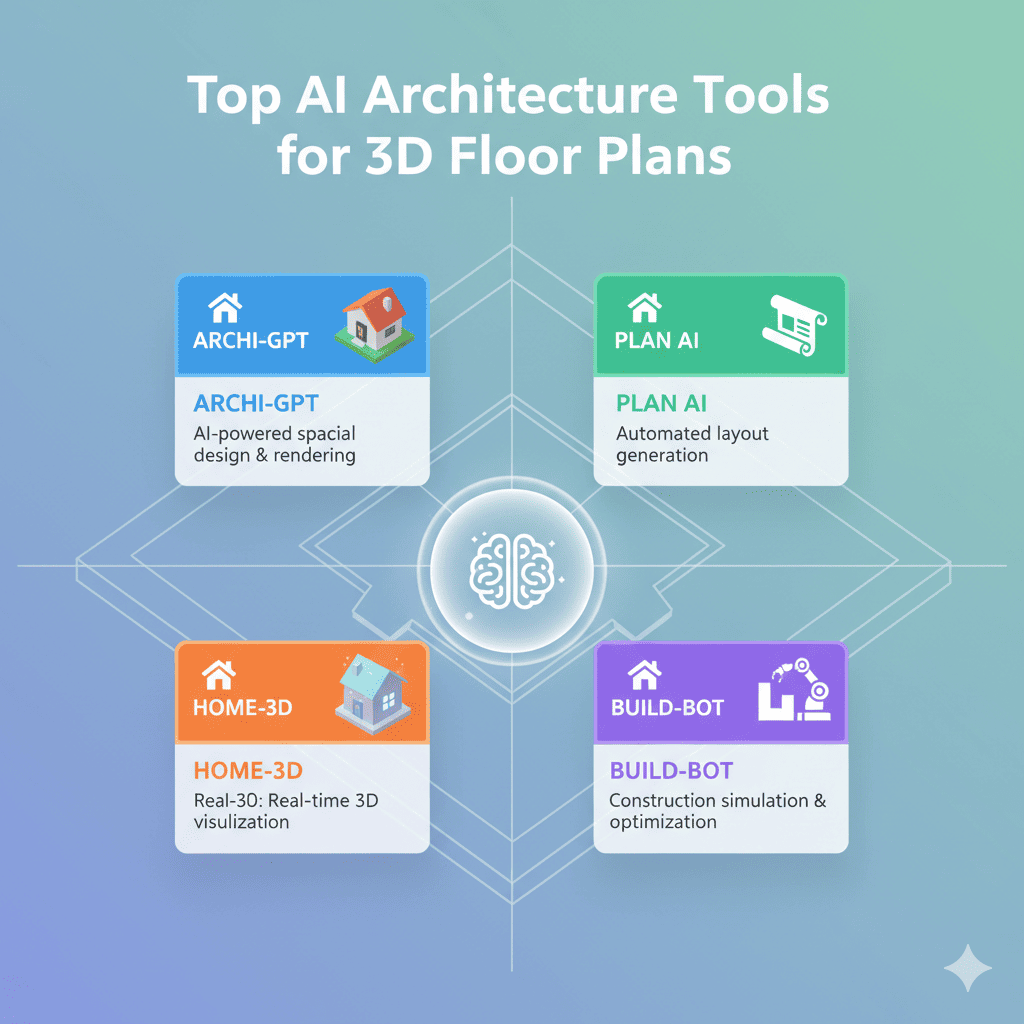
The architecture and design industry is experiencing a revolutionary transformation with artificial intelligence integration. AI Architecture Tools for 3D Floor Plans are reshaping how architects, interior designers, and real estate professionals visualize and create spatial designs. These cutting-edge technologies are not just improving efficiency—they’re fundamentally changing what’s possible in architectural visualization.
Whether you’re a seasoned architect or a design enthusiast, understanding the landscape of AI Architecture Tools for 3D Floor Plans is essential for staying competitive in today’s market. This comprehensive guide explores the most powerful tools available, their capabilities, and how they can elevate your design process.
Why AI Architecture Tools Are Game-Changers for Floor Plan Design
Traditional floor plan creation has always been time-intensive, requiring extensive technical knowledge and countless hours of manual drafting. AI Architecture Tools for 3D Floor Plans are dramatically accelerating this process while improving accuracy and creativity.
These intelligent systems can analyze spatial requirements, suggest optimal layouts, and generate photorealistic visualizations in minutes rather than days. They learn from millions of existing designs, understanding architectural principles, building codes, and design best practices to create functional, aesthetically pleasing spaces.
The integration of artificial intelligence in architectural design offers several transformative benefits:
Unprecedented Speed: What once took days or weeks can now be accomplished in hours or even minutes. AI algorithms can generate multiple design variations simultaneously, allowing architects to explore far more creative possibilities than traditional methods allowed.
Enhanced Accuracy: Machine learning models trained on vast datasets of successful designs can identify potential issues before they become costly mistakes. These tools automatically check for building code compliance, spatial efficiency, and structural feasibility.
Cost Efficiency: By reducing the time spent on initial design iterations, firms can allocate resources more effectively. Smaller studios can compete with larger firms by leveraging AI to amplify their capabilities.
Improved Client Communication: 3D visualizations generated by AI tools help clients understand spatial concepts more intuitively than traditional 2D drawings, reducing misunderstandings and revision cycles.
1. Planner 5D: Intuitive AI-Powered Design Platform
Planner 5D stands out as one of the most accessible yet powerful AI Architecture Tools for 3D Floor Plans available today. This platform combines sophisticated artificial intelligence with an intuitive interface that makes professional-grade design accessible to users of all skill levels.
The AI Smart Wizard feature is particularly impressive, allowing users to generate complete floor plans by simply describing their requirements. The system interprets natural language inputs and creates functional layouts that consider traffic flow, furniture placement, and spatial relationships.
Key Features:
- AI Smart Wizard that generates instant floor plans from text descriptions
- Extensive library of over 5,000 design elements and furniture items
- Photorealistic rendering capabilities that produce publication-quality images
- Cross-platform compatibility (web, iOS, Android, Windows)
- Virtual reality mode for immersive client presentations
- Automated furniture arrangement based on room purpose and dimensions
The platform excels at creating residential designs, from single-room renovations to complete home layouts. Its AI algorithms understand contextual relationships between spaces, ensuring that kitchens connect logically to dining areas and bedrooms maintain privacy from common spaces.
Best For: Homeowners, interior designers, and real estate agents who need quick, professional visualizations without extensive technical training.
2. Foyr Neo: Professional-Grade AI Architecture Solution
Foyr Neo represents the professional tier of AI Architecture Tools for 3D Floor Plans, offering sophisticated capabilities that appeal to architecture firms and experienced designers. This cloud-based platform combines powerful AI with comprehensive design tools to streamline the entire design-to-presentation workflow.
What distinguishes Foyr Neo is its focus on commercial viability. The platform understands that designs must not only look beautiful but also function within real-world constraints. Its AI engine considers factors like building codes, accessibility requirements, and construction feasibility when generating recommendations.
Advanced Capabilities:
- AI-driven floor plan generation with customizable parameters
- Automated material selection based on design style and budget
- Real-time collaboration features for team projects
- Integration with professional CAD software for technical drawings
- Extensive material and finish library with accurate specifications
- Cost estimation tools that update dynamically as designs evolve
- Lighting simulation that models natural and artificial light throughout the day
The rendering engine produces exceptionally realistic images that rival professional photography. This capability proves invaluable for marketing presentations, client approvals, and design competitions.
Best For: Professional architects, interior design firms, and commercial property developers requiring high-end visualizations and technical precision.
3. Cedreo: Specialized AI Tool for Residential Architecture
Cedreo has carved out a unique niche among AI Architecture Tools for 3D Floor Plans by focusing specifically on residential construction and home design. This specialization allows the platform to offer deeply optimized features for house planning, from initial concept through construction documentation.
The AI assistant in Cedreo understands the specific requirements of home design, including room relationships, circulation patterns, and residential building codes. It can automatically generate compliant floor plans that meet local regulations while maintaining aesthetic appeal.
Standout Features:
- Automated roof design that adapts to floor plan configurations
- One-click 3D model generation from 2D floor plans
- Terrain modeling for site-specific designs
- Automatic generation of elevation views and section drawings
- Material takeoff and costing tools
- Client presentation mode with virtual walkthrough capabilities
- Library of pre-designed home templates that can be customized
The platform shines in its ability to rapidly iterate through design options. Architects can present multiple layout variations to clients in a single meeting, making real-time adjustments based on feedback.
Best For: Home builders, residential architects, and remodeling contractors who need specialized tools for housing projects.
4. SketchUp with AI Plugins: Flexible and Expandable
SketchUp has long been a favorite among architects for its intuitive modeling approach. When enhanced with AI-powered plugins, it becomes one of the most versatile AI Architecture Tools for 3D Floor Plans available. The combination of SketchUp’s familiar interface with cutting-edge AI extensions creates a powerful hybrid workflow.
Several AI plugins transform SketchUp into an intelligent design assistant:
TestFit automates site planning and massing studies, rapidly generating hundreds of layout options based on zoning requirements and project parameters. This plugin is particularly valuable for commercial and multi-unit residential projects.
Archistar brings AI-powered feasibility analysis, helping architects understand development potential before investing significant design time. It analyzes regulatory constraints, shadow studies, and financial viability simultaneously.
Generative Design Plugins explore thousands of design variations based on specified parameters, optimizing for factors like daylighting, views, efficiency, and structural economy.
Notable Advantages:
- Extensive library of third-party extensions and plugins
- Strong community support and learning resources
- Compatible with industry-standard file formats
- Free version available for basic functionality
- Integration with rendering engines like V-Ray and Enscape
- Parametric design capabilities through extensions
- BIM integration for technical documentation
The platform’s flexibility allows architects to create custom workflows that match their specific needs, combining traditional modeling techniques with AI automation where it provides the most value.
Best For: Architects seeking flexibility, extensive customization options, and the ability to scale capabilities through plugins.
5. Autodesk Revit with Generative Design
Autodesk Revit, enhanced with generative design capabilities, represents the enterprise-level solution among AI Architecture Tools for 3D Floor Plans. This Building Information Modeling (BIM) platform integrates AI to explore design alternatives while maintaining full technical documentation.
Generative design in Revit works differently from simple automation. The system considers multiple objectives simultaneously—structural efficiency, cost, energy performance, daylighting, and aesthetic goals—generating solutions that optimize across these variables.
Enterprise-Level Features:
- Comprehensive BIM integration for complete project lifecycle management
- AI-powered generative design that explores thousands of options
- Automated clash detection preventing construction conflicts
- Energy analysis and sustainability optimization
- Collaborative workflows for large, distributed teams
- Detailed quantity takeoffs and cost estimation
- Integration with construction management platforms
- Compliance checking against building codes and standards
The platform’s AI capabilities extend beyond initial design into construction administration, using machine learning to predict potential issues and suggest solutions based on similar past projects.
Best For: Large architecture firms, engineering companies, and enterprises managing complex, multi-stakeholder projects requiring comprehensive documentation.
6. HomeByMe: Consumer-Friendly AI Design Tool
HomeByMe demonstrates that powerful AI Architecture Tools for 3D Floor Plans can be accessible to non-professionals without sacrificing capability. Developed by Dassault Systèmes, the company behind professional CAD software, HomeByMe brings enterprise-grade technology to the consumer market.
The platform’s AI analyzes user preferences and automatically suggests furniture arrangements, color schemes, and decorative elements that create cohesive designs. It understands design principles like balance, proportion, and style consistency, guiding users toward professional-looking results.
User-Friendly Features:
- Drag-and-drop interface requiring no technical knowledge
- AI-powered design suggestions based on room purpose
- Extensive catalog of real furniture from major manufacturers
- Photorealistic rendering in minutes
- 360-degree virtual tours for immersive exploration
- Direct purchasing links for featured furniture and decor
- Mobile app for on-the-go design work
- Social sharing capabilities for feedback gathering
The platform bridges the gap between professional design software and simple room planners, offering enough sophistication for serious planning while remaining approachable for first-time users.
Best For: Homeowners planning renovations, real estate staging professionals, and furniture retailers offering design services to customers.
7. Roomstyler 3D Home Planner: Web-Based AI Visualization
Roomstyler represents the new generation of browser-based AI Architecture Tools for 3D Floor Plans that require no installation or specialized hardware. This entirely web-based platform leverages cloud computing to deliver sophisticated design capabilities through any modern browser.
The AI in Roomstyler focuses on spatial optimization and style consistency. It can analyze uploaded photos of existing spaces and suggest redesigns, or create entirely new layouts based on described requirements.
Browser-Based Advantages:
- Zero installation required—works on any device with internet
- AI style matching that maintains design cohesion
- Community-shared designs for inspiration
- Real product integration from major retailers
- Instant rendering without local computing power
- Automatic scale and proportion checking
- Multi-room project management
- Export options for presentations and sharing
The platform’s accessibility makes it ideal for quick concept development and client presentations, particularly when working remotely or on various devices.
Best For: Designers needing quick mockups, remote collaboration scenarios, and situations where software installation isn’t feasible.
8. Coohom: AI-Powered Commercial Design Platform
Coohom has emerged as a leading solution among AI Architecture Tools for 3D Floor Plans specifically tailored for commercial interior design and furniture retail applications. The platform combines AI automation with an extensive product library to accelerate the design-to-sale process.
The AI engine in Coohom excels at creating shoppable designs—visualizations where every element can be purchased directly. This feature transforms the platform into a sales tool as much as a design tool, closing the gap between visualization and implementation.
Commercial-Focused Features:
- One-minute rendering technology for rapid client presentations
- AI furniture arrangement optimized for retail displays
- Panoramic and 360-degree views for immersive experiences
- Direct integration with e-commerce platforms
- Material and lighting simulation with accurate photorealism
- Template library for common commercial spaces
- Team collaboration tools with role-based permissions
- Analytics on design engagement and conversion
The platform’s speed advantage becomes particularly valuable when working with clients who need to visualize multiple options quickly, such as retail chains planning multiple locations.
Best For: Commercial interior designers, furniture retailers, hospitality designers, and companies requiring rapid design visualization for sales purposes.
9.Infurnia: AI-Enhanced Custom Furniture and Space Planning
Infurnia occupies a unique position among AI Architecture Tools for 3D Floor Plans by bridging architectural planning with custom furniture design. This specialized platform uses AI to optimize both spatial layouts and furniture configurations simultaneously.
The AI understands the relationship between architecture and furniture, ensuring that custom pieces fit perfectly within designed spaces while maintaining aesthetic and functional harmony. This integrated approach prevents the common problem of designing spaces that later prove incompatible with desired furniture.
Specialized Capabilities:
- Parametric furniture design with AI optimization
- Automated manufacturing drawings for custom pieces
- Material optimization reducing waste in production
- Real-time costing as designs evolve
- Integration with CNC machinery for fabrication
- Space efficiency analysis and suggestions
- Style consistency checking across furniture and architecture
- Client approval workflows with version tracking
For designers working on custom residential or boutique commercial projects where furniture and architecture must be perfectly harmonized, Infurnia provides capabilities unavailable in general-purpose tools.
Best For: Custom furniture designers, bespoke residential architects, and boutique hospitality projects requiring integrated space and furniture planning.
10. Morpholio Board: AI-Enhanced Mood Boarding and Space Planning
Morpholio Board brings AI capabilities to the conceptual phase of design, where ideas are still fluid and exploration is paramount. This tool represents a different approach among AI Architecture Tools for 3D Floor Plans—focusing on ideation and presentation rather than technical documentation.
The AI in Morpholio analyzes design boards, understanding color relationships, style consistency, and spatial arrangements. It can suggest complementary materials, identify style trends, and even predict how design choices will be perceived by clients.
Creative Features:
- AI-powered image curation and organization
- Style analysis and consistency checking
- Automatic layout suggestions for presentations
- Material and finish library with AI recommendations
- Sketch-to-3D conversion capabilities
- Collaborative mood boarding for team ideation
- Client presentation mode with annotation tools
- Integration with professional design software
The platform excels in the critical early stages of projects, helping designers communicate concepts clearly before moving into technical development.
Best For: Designers emphasizing conceptual development, client presentations, and firms with extensive design research phases.
Key Considerations When Choosing AI Architecture Tools
Selecting the right AI Architecture Tools for 3D Floor Plans requires careful consideration of your specific needs, workflow, and project types. Here are essential factors to evaluate:
Project Scale and Complexity: Simple residential renovations have different requirements than large commercial developments. Ensure your chosen tool handles the scale of your typical projects without unnecessary complexity or limiting constraints.
Technical Skill Level: Some platforms assume extensive architectural knowledge, while others guide novices through the process. Match the tool’s sophistication to your team’s capabilities and training capacity.
Integration Requirements: Consider how the AI tool fits within your existing workflow. Does it export to your preferred formats? Can it import existing drawings? Does it integrate with your documentation and project management systems?
Rendering Quality: If client presentations are critical to your business, prioritize tools with exceptional visualization capabilities. The quality difference between adequate and exceptional renderings can significantly impact project approvals.
Budget and Licensing: AI tools range from free platforms to enterprise subscriptions costing thousands annually. Calculate the return on investment based on time saved, additional projects secured, and efficiency improvements.
Learning Curve and Support: Consider implementation time. Tools with gentler learning curves get your team productive faster, while platforms with excellent training resources and support can justify more complex interfaces.
Collaboration Features: For teams, real-time collaboration, version control, and role-based permissions become essential features that dramatically improve efficiency and reduce errors.
The Future of AI Architecture Tools for 3D Floor Plans
The trajectory of AI Architecture Tools for 3D Floor Plans points toward even more sophisticated capabilities in the near future. Several emerging trends will shape the next generation of these tools:
Augmented Reality Integration: Future tools will allow architects to overlay designs directly onto physical spaces using smartphones or AR glasses, making spatial relationships more intuitive and reducing interpretation errors.
Voice-Controlled Design: Natural language processing will enable designers to create and modify floor plans through conversational commands, dramatically accelerating the iteration process.
Predictive Analytics: AI will analyze past project data to predict potential issues, optimal layouts for specific use cases, and even client preferences based on demographic and psychographic factors.
Sustainability Optimization: Future AI will automatically optimize designs for energy efficiency, carbon footprint, and environmental impact, making sustainable architecture the default rather than an afterthought.
Automated Regulatory Compliance: As building codes and regulations become increasingly digitized, AI tools will automatically ensure compliance across jurisdictions, reducing costly errors and approval delays.
Generative AI Enhancement: The integration of large language models and image generation AI will allow even more intuitive interfaces and creative exploration, potentially revolutionizing how architects conceptualize spaces.
Maximizing ROI from AI Architecture Tools
Investing in AI Architecture Tools for 3D Floor Plans delivers returns beyond simple time savings. To maximize value:
Standardize Workflows: Develop consistent processes that leverage AI capabilities at optimal points in your design workflow rather than treating AI as an occasional add-on.
Continuous Training: As these tools evolve rapidly, regular training ensures your team exploits new features and capabilities that can provide competitive advantages.
Client Education: Help clients understand visualizations and provide clearer feedback by explaining what they’re seeing, reducing revision cycles and improving satisfaction.
Portfolio Development: Use AI tools to rapidly develop portfolio pieces exploring innovative concepts, demonstrating your creative range to prospective clients.
Competitive Differentiation: Market your AI capabilities as a unique value proposition—faster turnarounds, more design options, and better visualizations can justify premium pricing.
Conclusion: Embracing the AI Revolution in Architecture
The landscape of AI Architecture Tools for 3D Floor Plans offers unprecedented opportunities for architects, designers, and developers to elevate their work. These intelligent systems aren’t replacing human creativity—they’re amplifying it, handling tedious technical tasks while freeing designers to focus on innovation and client relationships.
Whether you’re a solo practitioner seeking to compete with larger firms, an established practice looking to improve efficiency, or an enthusiast exploring architectural design, there’s an AI tool suited to your needs and budget. The key is matching capabilities to requirements and committing to the learning process.
The future of architecture is undeniably intertwined with artificial intelligence. Early adopters of AI Architecture Tools for 3D Floor Plans are already seeing competitive advantages in win rates, project profitability, and client satisfaction. As these tools continue evolving, the gap between AI-enabled practices and traditional workflows will only widen.
Start exploring these powerful platforms today. Begin with free trials or entry-level tiers, gradually expanding capabilities as you discover what works best for your unique practice. The investment in learning these tools today will pay dividends throughout your career as AI becomes increasingly central to architectural practice.
Also read this:
Best AI Tools for Website Performance Optimization: Boost Speed and User Experience in 2025
Top AI Tools for Real Estate Lead Generations: Transform Your Business in 2025
Best AI Cybersecurity Tools for Maximum Protection: Your Complete 2025 Guide