
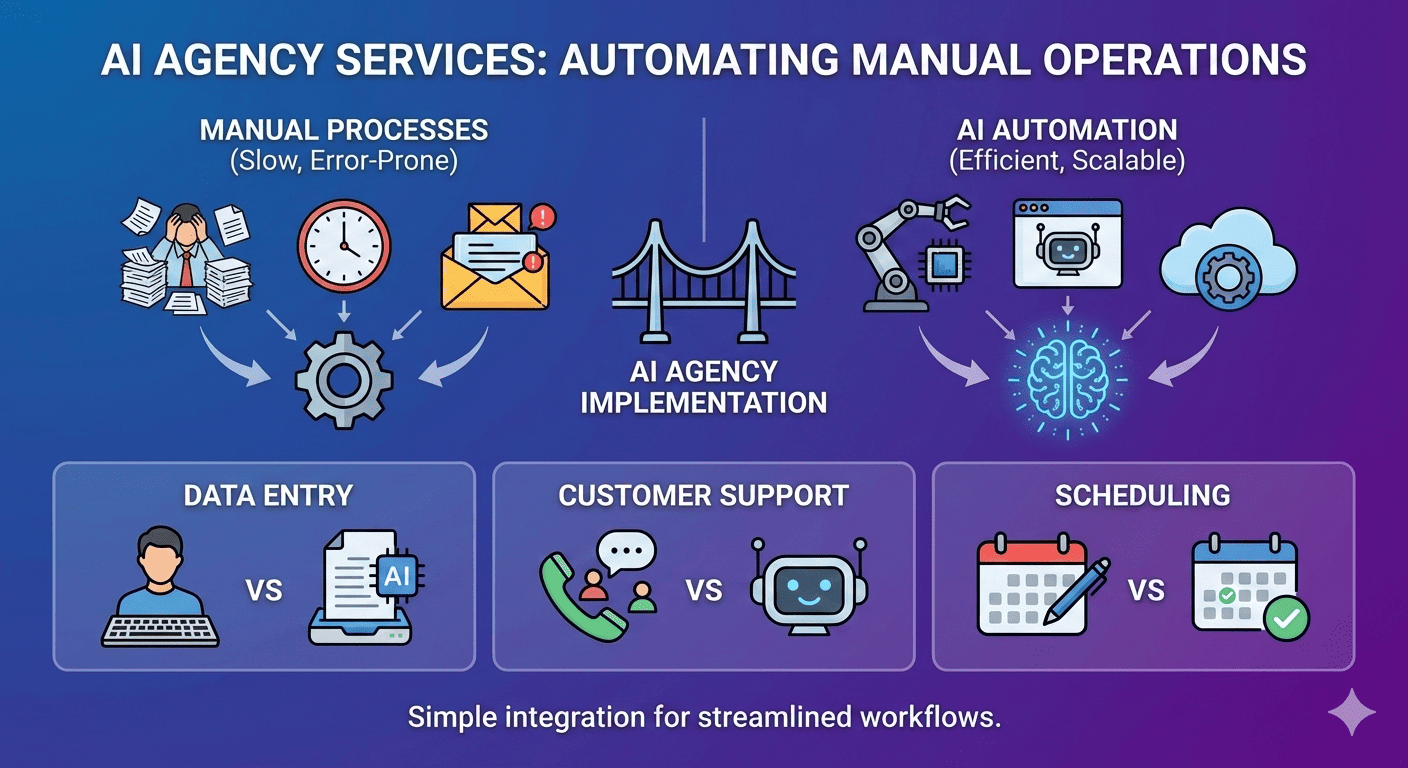
AI Agency Services That Automate Manual Operations Businesses are drowning in manual work. Employees spend hours on repetitive data entry, customer inquiries flood support inboxes, sales teams manually qualify leads, accounting departments reconcile expenses by hand, and marketing teams struggle to personalize content at scale. These operational inefficiencies don’t just waste time—they limit growth, inflate costs, and create employee frustration.
This operational reality creates an enormous opportunity for AI agencies. While many consultants focus on strategic advisory or complex custom development, the most immediate and scalable opportunity lies in delivering AI agency services that automate manual operations. These services solve obvious, painful problems that businesses readily pay to eliminate.
This comprehensive guide reveals the most profitable automation services you can offer, how to deliver them reliably, and strategies for building a thriving practice around operational AI. Whether you’re starting a new agency or expanding existing offerings, these automation services provide clear value propositions, predictable delivery, and strong recurring revenue potential.
1. Intelligent Document Processing and Data Entry Automation
Manual document processing consumes countless hours across nearly every industry. Companies receive invoices via email, contracts through various channels, forms from customers, and reports from partners—all requiring human review and data extraction.
The document processing opportunity
Businesses spend thousands of monthly hours on document-related work including extracting data from invoices and receipts, processing customer applications and forms, reviewing and categorizing contracts, handling insurance claims documentation, and processing shipping and logistics paperwork. AI agency services that automate manual operations in document processing deliver immediate, measurable ROI that’s easy to quantify and justify.
AI technologies enabling document automation
Modern optical character recognition extracts text from images and PDFs with high accuracy. Natural language processing identifies key information like dates, amounts, and entities. Machine learning models classify documents by type and extract structured data. Computer vision handles complex layouts and handwritten text. These technologies have matured to the point where implementation is straightforward and results are reliable.
Implementing document processing solutions
Effective implementations follow a consistent pattern. First, analyze current document workflows identifying volumes, types, and processing time. Second, design automation architecture using appropriate tools and platforms. Third, train models on client-specific document formats. Fourth, implement validation workflows for exception handling. Finally, integrate with existing business systems for seamless data flow.
Most document automation projects achieve 70-90% straight-through processing, with remaining documents requiring minimal human review. A company processing 1,000 invoices monthly at 10 minutes each saves 150+ hours monthly—easily justifying $5,000-$10,000 monthly fees.
Packaging document automation services
Offer tiered packages based on document volume and complexity. A basic package might handle standard invoices and receipts up to 500 documents monthly for $3,000. Professional tiers add complex document types, higher volumes, and custom integrations for $8,000-$15,000 monthly. Position these as subscriptions including ongoing model improvement and support rather than one-time implementations.
2. Customer Service Automation and AI Chatbots
Customer service teams face overwhelming inquiry volumes, especially for growing businesses. The same questions arrive repeatedly through multiple channels, forcing companies to choose between slow response times or expensive staffing.
The customer service automation market
Customer service automation addresses universal pain points including answering common questions 24/7, qualifying support requests before human handoff, providing instant responses during peak periods, handling multilingual customer inquiries, and escalating complex issues appropriately. These AI agency services that automate manual operations in customer service reduce support costs while improving customer satisfaction—a rare combination that makes them highly attractive.
Designing effective customer service automation
Successful chatbot implementations start with analyzing common inquiry types and frequencies, identifying questions suitable for automation, designing conversation flows for typical scenarios, establishing clear handoff criteria to human agents, and integrating with knowledge bases and business systems.
Avoid the mistake of trying to automate everything. Focus on the 60-80% of inquiries that are routine and predictable, ensuring those are handled exceptionally well. Complex or sensitive issues should route to humans immediately.
Technology stack for customer service AI
Modern customer service automation leverages conversational AI platforms that handle natural language understanding, integration capabilities connecting to CRM and helpdesk systems, multichannel deployment across websites, messaging apps, and social media, analytics tracking performance and identifying improvement opportunities, and continuous learning mechanisms that improve responses over time.
Platforms like Intercom, Zendesk, and specialized chatbot builders provide robust foundations that you can customize for client needs without building from scratch.
Monetizing customer service automation
Price based on inquiry volume and complexity. A small business package handling 1,000 monthly inquiries might be $2,500 monthly including setup, training, and optimization. Mid-market clients with 10,000+ monthly inquiries and multichannel requirements justify $10,000-$20,000 monthly fees. Include ongoing optimization in pricing—chatbots improve continuously with proper maintenance, creating value that justifies recurring fees.
3. Sales Process Automation and Lead Qualification
Sales teams waste enormous time on unqualified leads, manual data entry, follow-up scheduling, and administrative tasks that don’t directly generate revenue. AI can handle much of this operational work, letting salespeople focus on actual selling.
Opportunities in sales automation
Sales automation addresses critical inefficiencies including automatically qualifying inbound leads, enriching contact data from multiple sources, scheduling meetings without back-and-forth emails, personalizing outreach at scale, scoring leads for priority handling, and automating follow-up sequences based on engagement.
These AI agency services that automate manual operations in sales directly impact revenue, making them easy to sell and justify with clear ROI calculations.
Lead qualification and scoring systems
Implement AI systems that automatically evaluate leads based on demographic fit with ideal customer profiles, behavioral signals like website engagement, technographic data about tools they use, intent signals from content consumption, and historical patterns from won and lost deals.
Sophisticated lead scoring reduces wasted sales effort by 40-60% by ensuring reps focus on high-potential opportunities rather than unqualified prospects.
Sales data enrichment and intelligence
AI-powered enrichment automatically supplements CRM records with company information, contact details, technology stack, recent news and funding events, social media presence, and competitive intelligence.
This automation eliminates hours of manual research, letting sales teams arrive at conversations fully informed and prepared.
Implementing sales automation solutions
Effective implementations integrate with existing CRM systems like Salesforce or HubSpot, connect to multiple data sources for enrichment, use AI for predictive analytics and recommendations, automate routine tasks and workflows, and provide dashboards tracking automation impact on pipeline velocity and conversion rates.
Charge setup fees of $10,000-$25,000 plus monthly retainers of $3,000-$8,000 for ongoing optimization and support. Position pricing against the cost of sales headcount—automation that saves even half an FTE easily justifies substantial fees.
4. Content Creation and Marketing Automation
Marketing teams struggle to produce enough high-quality content to fuel their strategies. Blog posts, social media updates, email campaigns, product descriptions, and ad copy all require significant time investment that limits marketing velocity.
The content automation opportunity
Marketing automation through AI addresses creation of blog posts and articles at scale, social media content for multiple platforms, email campaign copy and personalization, product descriptions for e-commerce catalogs, ad copy variations for testing, and SEO-optimized content targeting specific keywords.
While human oversight remains important, AI agency services that automate manual operations in content creation can increase output 3-5x while maintaining quality standards.
Building content automation workflows
Design systems that use AI for initial draft creation based on briefs and parameters, maintain brand voice consistency through training, incorporate SEO requirements automatically, generate variations for testing, and route content through human review and approval workflows.
The key is positioning AI as productivity multiplier for human creators rather than complete replacement. This hybrid approach delivers superior results while being more acceptable to clients concerned about quality.
Implementing marketing automation platforms
Effective marketing automation combines AI writing tools for content generation, content management systems for publishing, analytics platforms tracking performance, social media scheduling tools, and email marketing platforms with AI-driven personalization.
Create integrated stacks that automate entire workflows from content creation through distribution and performance tracking.
Pricing content automation services
Offer packages based on content volume and complexity. A small business package might include 12 blog posts, 60 social media posts, and 8 email campaigns monthly for $4,000. Enterprise packages handling higher volumes with advanced personalization can command $15,000-$30,000 monthly. Include strategy and performance optimization in pricing to justify premium rates beyond pure content production.
5. Accounts Payable and Financial Process Automation
Finance departments perform countless manual tasks that are perfect automation candidates. Invoice processing, expense reconciliation, payment approvals, and financial reporting consume significant time with minimal value creation.
Financial automation opportunities
Financial process automation addresses invoice receipt and data extraction, payment approval workflow management, expense report processing and reconciliation, vendor management and communication, fraud detection and anomaly identification, and financial reporting and dashboard generation.
These AI agency services that automate manual operations in finance deliver hard-dollar savings that CFOs readily approve since the ROI is immediate and measurable.
Accounts payable automation systems
Implement solutions that automatically capture invoices from email and portals, extract relevant data using OCR and AI, validate against purchase orders and contracts, route for appropriate approvals based on rules, schedule payments optimally, and record transactions in accounting systems.
Effective AP automation reduces processing costs by 60-80% while accelerating payment cycles and improving vendor relationships.
Expense management automation
Create systems where employees photograph receipts that are automatically categorized and expense types identified, policy compliance is checked automatically, managers receive only exceptions requiring attention, reimbursements are processed faster, and financial reporting reflects real-time data.
This automation eliminates the dreaded monthly expense report process while ensuring policy compliance and speedy reimbursement.
Implementing financial automation solutions
Partner with established platforms like Bill.com, Expensify, or SAP Concur rather than building custom solutions. Your value comes from configuring these tools for client workflows, managing implementation and change management, creating custom integrations with accounting systems, and providing ongoing optimization.
Charge implementation fees of $15,000-$40,000 for mid-sized companies plus monthly management fees of $2,000-$5,000. Financial automation justifies these investments quickly through hard-cost savings.
6. Recruitment and HR Process Automation
Human resources teams are overwhelmed with administrative work that takes time away from strategic people initiatives. Recruitment especially involves repetitive tasks perfect for automation.
HR automation service opportunities
HR automation addresses resume screening and candidate matching, interview scheduling coordination, onboarding documentation and workflows, employee query handling, performance review administration, and compliance documentation tracking.
Offering AI agency services that automate manual operations in HR helps companies scale their people operations without proportional headcount growth.
Recruitment automation systems
Implement AI solutions that parse and analyze resumes automatically, match candidates to job requirements, screen applications using predictive models, automate initial communication and scheduling, assess candidate responses for fit, and generate shortlists for human review.
Quality recruitment automation reduces time-to-hire by 40-60% while improving candidate quality through consistent, unbiased evaluation.
Employee service automation
Create chatbots and automated systems handling common HR inquiries about policies and benefits, PTO requests and approvals, document requests, onboarding task completion, and basic troubleshooting.
This automation lets HR teams focus on strategic initiatives rather than answering the same questions repeatedly.
Implementing HR automation solutions
Leverage platforms like Lever, Greenhouse, or BambooHR that provide automation foundations. Customize these systems for client processes, implement AI enhancements for screening and matching, integrate with existing HRIS systems, and ensure compliance with employment regulations.
Price based on company size and hiring volume. Small companies might pay $3,000-$5,000 monthly while enterprises with significant recruitment needs justify $15,000-$30,000 monthly fees for comprehensive recruitment automation.
7. Inventory and Supply Chain Optimization
Retail, e-commerce, and manufacturing businesses wrestle with inventory management complexity. Manual processes lead to stockouts, overstocking, inefficient ordering, and poor supplier coordination.
Supply chain automation opportunities
Inventory and supply chain automation addresses demand forecasting and prediction, automated reordering and purchase order generation, inventory level optimization across locations, supplier performance monitoring, shipment tracking and exception management, and warehouse operations optimization.
These AI agency services that automate manual operations in supply chain deliver substantial working capital improvements and operational efficiency gains.
Demand forecasting and inventory optimization
Implement AI systems that analyze historical sales patterns, incorporate seasonality and trends, factor in promotional activities, consider external signals like weather and events, and generate optimized reorder points and quantities.
Effective demand forecasting reduces inventory costs by 15-30% while improving in-stock rates, creating immediate ROI.
Automated procurement workflows
Create systems where inventory triggers generate purchase orders automatically, preferred suppliers are selected based on performance and pricing, approval workflows route based on dollar thresholds, and supplier communications are automated.
This automation reduces procurement cycle times and ensures optimal inventory levels without manual monitoring.
Implementing supply chain automation
Build solutions integrating with existing inventory management systems, e-commerce platforms like Shopify or BigCommerce, ERP systems, and supplier portals. Use AI for forecasting and optimization while automating routine processes.
Charge based on inventory value and complexity. Companies with $1-5M in inventory might pay $5,000-$10,000 monthly while those with $20M+ in inventory justify $20,000-$40,000 monthly for comprehensive supply chain automation.
8. Appointment Scheduling and Calendar Management
Scheduling appointments manually wastes hours weekly for service businesses, healthcare practices, and professional services firms. The back-and-forth coordination frustrates both staff and customers.
Scheduling automation opportunities
Automated scheduling addresses online booking without phone calls, intelligent calendar management avoiding conflicts, automated reminders reducing no-shows, rescheduling and cancellation handling, resource allocation for multi-person appointments, and waitlist management for cancellations.
These AI agency services that automate manual operations in scheduling improve customer experience while reducing administrative burden.
Implementing intelligent scheduling systems
Deploy solutions that sync with existing calendars, offer customer-facing booking interfaces, apply business rules and availability constraints, send automated confirmations and reminders, handle payments for appointments, and integrate with CRM and practice management systems.
Platforms like Calendly, Acuity, or industry-specific solutions provide foundations that you customize for client workflows.
Advanced scheduling intelligence
Add AI capabilities that predict no-show likelihood and overbook accordingly, optimize appointment sequencing for efficiency, suggest optimal appointment types based on history, dynamically adjust availability based on demand, and identify scheduling patterns for resource planning.
These intelligent features transform basic scheduling automation into strategic operational tools.
Monetizing scheduling automation
Price based on appointment volume and complexity. Small service businesses might pay $500-$1,500 monthly for basic automation. Healthcare practices or multi-location businesses with complex scheduling justify $5,000-$15,000 monthly for sophisticated systems with advanced features and integrations.
9. Data Analytics and Reporting Automation
Businesses need regular reports and analytics but often rely on manual data extraction, spreadsheet manipulation, and repetitive report generation consuming hours weekly.
Reporting automation opportunities
Automated analytics addresses scheduled report generation and distribution, dashboard updates with real-time data, anomaly detection and alerting, trend analysis and forecasting, competitive intelligence gathering, and executive summary generation from raw data.
Providing AI agency services that automate manual operations in reporting transforms how businesses consume insights, enabling faster and better decision-making.
Building automated reporting systems
Create solutions that extract data from multiple business systems, clean and normalize data automatically, perform analytical calculations and visualizations, generate narrative summaries of key findings, distribute reports to stakeholders automatically, and alert teams to significant changes or anomalies.
The goal is replacing hours of manual reporting work with automated systems that deliver insights continuously.
Implementing business intelligence automation
Use platforms like Tableau, Power BI, or Looker as foundations. Add AI-powered natural language generation for narrative insights, predictive analytics for forecasting, and automated anomaly detection. Integrate with all relevant data sources from CRM to accounting to operations systems.
Effective BI automation reduces reporting time by 70-90% while improving data accuracy and insight quality.
Pricing analytics automation services
Charge based on complexity and data sources. Small businesses with simple reporting needs might pay $2,000-$4,000 monthly. Mid-market companies with complex analytics requirements justify $8,000-$20,000 monthly for comprehensive automated analytics and reporting systems.
10. Quality Control and Inspection Automation
Manufacturing, logistics, and service businesses perform repetitive quality checks that are time-consuming, inconsistent, and error-prone when done manually.
Quality control automation opportunities
Visual inspection automation addresses product defect detection, packaging verification, label reading and validation, damage assessment, assembly verification, and compliance documentation.
These AI agency services that automate manual operations in quality control improve consistency, reduce errors, and accelerate throughput while lowering labor costs.
Computer vision for quality inspection
Implement AI systems using cameras to capture product images, computer vision models to identify defects, automated measurement and verification, real-time defect classification, and rejection or flagging of non-conforming items.
Modern computer vision achieves higher accuracy than human inspection for many tasks while operating continuously without fatigue.
Implementing quality automation solutions
Deploy systems with appropriate camera and lighting infrastructure, trained computer vision models for client products, integration with manufacturing execution systems, real-time dashboards showing quality metrics, and exception handling workflows for borderline cases.
Quality automation often requires more hardware integration than pure software solutions, but the ROI for high-volume operations is compelling.
Pricing quality control automation
Charge based on inspection volume and complexity. Implementation fees typically range from $25,000-$100,000 depending on hardware requirements and model training needs. Ongoing monitoring and optimization services generate $3,000-$10,000 monthly recurring revenue.
Building Your Automation Service Practice
Successfully delivering AI agency services that automate manual operations requires systematic approaches to sales, delivery, and scaling.
Identifying ideal automation clients
Target businesses with high-volume repetitive processes, clear pain from manual operations, sufficient scale to justify automation investment, existing systems to integrate with, and stakeholder commitment to change management.
Small businesses with limited volumes rarely justify comprehensive automation, while enterprises have resources and needs making them ideal clients.
Conducting effective automation assessments
Offer discovery engagements that analyze current manual processes, quantify time and cost investments, identify automation opportunities, estimate potential savings and efficiency gains, assess technical feasibility, and recommend prioritized initiatives.
These assessments generate consulting revenue while building pipeline for implementation projects.
Delivering automation projects reliably
Follow consistent project methodologies including detailed requirements gathering and workflow mapping, solution design with appropriate technology selection, phased implementation reducing risk, thorough testing with real scenarios, comprehensive training for users, and measured deployment with success metrics.
Reliable delivery builds referrals and case studies driving growth.
Creating recurring revenue from automation
Transform one-time implementations into ongoing relationships through monitoring and optimization services, continuous improvement and model retraining, expansion to additional processes, technical support and troubleshooting, and strategic advisory for automation roadmap.
Monthly recurring fees of 10-20% of implementation cost are reasonable for ongoing optimization and support.
Getting Started With Automation Services
Begin building your automation practice systematically. Choose one automation service area aligned with your background and interests. Develop expertise through online learning and experimentation with relevant tools. Create detailed service packages with clear deliverables and pricing. Identify 10-20 target companies that would benefit from your chosen automation. Reach out offering free process assessments to generate pipeline.
Your first few automation projects establish case studies and refine delivery processes. Use these early wins to build reputation and attract larger opportunities. As you prove results, expand to additional automation service areas and larger clients.
The demand for operational automation is enormous and growing. Businesses recognize they can’t scale efficiently with manual processes, yet most lack internal expertise implementing automation effectively. This gap creates perfect conditions for agencies delivering practical, results-focused automation services.
The opportunity to provide AI agency services that automate manual operations has never been stronger. Businesses need these services urgently, the technology is mature and accessible, and the ROI is clear and compelling. Your success depends on choosing promising automation areas, delivering reliable implementations, and building systematic practices that scale.
Start today by selecting your first automation service offering. The businesses struggling with manual operations are waiting for someone to provide the automation solutions they desperately need. That someone can be you.
Also read this:
How to Build a Reliable AI Service Business From Scratch (Beginner to Pro)
High-Value AI Agency Services That Depend on Thinking, Not Programming
Recurring Revenue for AI Agencies: How to Create Predictable Monthly Income