
In 2026, AI applications are no longer just about generating text—they are about generating accurate, contextual, and up-to-date responses. That’s exactly where RAG (Retrieval-Augmented Generation) comes into play.
If you want to create powerful AI tools like chatbots, research assistants, or content engines, learning how to Build a RAG System from Scratch is one of the most valuable skills today.
This guide is written like a real SEO expert would craft it—clear, structured, and optimized—so you not only understand the concept but can also implement it step by step.
1. What is a RAG System?
A RAG (Retrieval-Augmented Generation) system combines two powerful components:
- Retriever → Finds relevant data
- Generator (LLM) → Generates responses based on that data
Simple Explanation:
Instead of relying only on pre-trained knowledge, a RAG system fetches real-time or stored information and then generates accurate answers.
Sub-Points:
- Reduces hallucinations in AI responses
- Improves accuracy with real data
- Allows custom knowledge integration
- Works great for private/internal data
When you Build a RAG System from Scratch, you essentially connect knowledge retrieval with intelligent generation.
2. Why You Should Build a RAG System from Scratch in 2026
2.1 High Demand Skill
- Companies want custom AI solutions
- RAG is used in enterprise AI systems
2.2 Better Than Fine-Tuning
- No need to retrain models
- Easy to update knowledge
2.3 Cost Efficient
- Lower compute compared to training models
- Scalable architecture
2.4 Real-Time Knowledge
- Fetch latest information instantly
- Keeps AI relevant
3. Core Components of a RAG System
To Build a RAG System from Scratch, you need to understand its architecture.
3.1 Data Source
- PDFs, websites, databases
- Internal documents
3.2 Chunking System
- Breaks data into smaller pieces
- Improves retrieval accuracy
3.3 Embeddings
- Converts text into vectors
- Enables semantic search
3.4 Vector Database
- Stores embeddings
- Retrieves relevant chunks
3.5 Retriever
- Finds most relevant data
3.6 Generator (LLM)
- Produces final answer
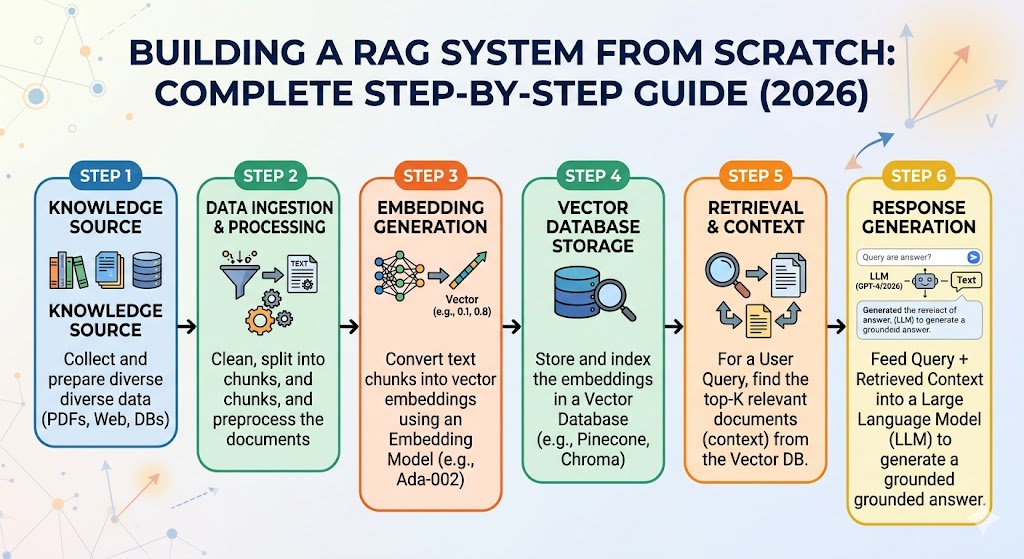
4. Step-by-Step Guide to Build a RAG System from Scratch
4.1 Step 1: Collect Your Data
Start by gathering the data you want your AI to use.
Sub-Points:
- Blog content
- PDFs
- Knowledge base
- FAQs
Tip: Clean your data before using it.
4.2 Step 2: Data Preprocessing & Chunking
Break large documents into smaller chunks.
Sub-Points:
- 300–500 words per chunk
- Maintain context overlap
- Remove noise
Why this matters:
Better chunks = better retrieval.
4.3 Step 3: Generate Embeddings
Convert text into vector format.
Sub-Points:
- Use embedding models
- Store vectors efficiently
- Ensure consistency
This is the backbone when you Build a RAG System from Scratch.
4.4 Step 4: Store in Vector Database
Save embeddings in a vector DB.
Popular Options:
- Pinecone
- Weaviate
- FAISS
Sub-Points:
- Fast similarity search
- Scalable storage
- Real-time retrieval
4.5 Step 5: Build the Retriever
Retriever fetches relevant chunks based on user query.
Sub-Points:
- Use cosine similarity
- Top-K retrieval
- Ranking optimization
4.6 Step 6: Connect to LLM (Generator)
Pass retrieved data to the language model.
Sub-Points:
- Combine query + context
- Use prompt engineering
- Generate accurate responses
4.7 Step 7: Build the Pipeline
Now connect everything.
Flow:
- User query
- Convert to embedding
- Retrieve relevant chunks
- Send to LLM
- Generate response
This is the complete workflow when you Build a RAG System from Scratch.
4.8 Step 8: Optimize the System
Sub-Points:
- Improve chunk quality
- Fine-tune prompts
- Adjust retrieval settings
- Add caching
5. Example Architecture (Simplified)
User Query → Embedding → Vector DB → Retrieved Data → LLM → Response
Key Insight:
The better your retrieval, the better your output.
6. Best Practices to Build a RAG System from Scratch
6.1 Use High-Quality Data
- Garbage in = garbage out
6.2 Optimize Chunk Size
- Too small → loss of context
- Too big → poor retrieval
6.3 Use Hybrid Search
- Combine keyword + semantic search
6.4 Monitor Performance
- Track accuracy
- Improve continuously
7. Common Mistakes to Avoid
7.1 Poor Chunking
- Leads to irrelevant results
7.2 Weak Prompts
- Reduces output quality
7.3 Ignoring Evaluation
- No improvement over time
7.4 Overloading Context
- Too much data confuses the model
8. Real-World Use Cases
8.1 AI Chatbots
- Customer support automation
8.2 Knowledge Assistants
- Internal company tools
8.3 Content Generation Tools
- Blog writing with factual accuracy
8.4 Research Tools
- Summarize large documents
9. Tools & Tech Stack for 2026
9.1 Programming Languages
- Python (most popular)
9.2 Libraries
- LangChain
- LlamaIndex
9.3 Vector Databases
- Pinecone
- FAISS
9.4 LLM Providers
- OpenAI
- Open-source models
10. Future of RAG Systems
The demand to Build a RAG System from Scratch will continue growing.
Trends:
- Multi-agent RAG systems
- Real-time streaming data integration
- Personalized AI assistants
- Enterprise-grade AI platforms
Conclusion
If you’re serious about building modern AI applications, learning how to Build a RAG System from Scratch is essential in 2026.
It gives you:
- Control over data
- Better accuracy
- Scalable AI solutions
Instead of relying on generic AI, you can create systems tailored to your exact needs.
FAQ (Frequently Asked Questions)
1. What does it mean to Build a RAG System from Scratch?
It means creating a system that retrieves relevant data and uses it to generate accurate responses using AI models.
2. Is RAG better than fine-tuning?
In most cases, yes. It’s faster, cheaper, and easier to update.
3. Do I need coding skills?
Basic Python knowledge is helpful, but tools are making it easier for beginners.
4. Which database is best for RAG?
Pinecone and FAISS are popular choices depending on your needs.
5. Can beginners Build a RAG System from Scratch?
Yes, by following step-by-step guides like this one.
Also read this:
Agentic Platform Engineering with GitHub Copilot: Build Autonomous Systems Faster in 2026
How to Make Money With AI Without Investment (Step-by-Step Guide for 2026)
How to Use ChatGPT to Get Freelance Clients in 2026 (Complete Guide)