
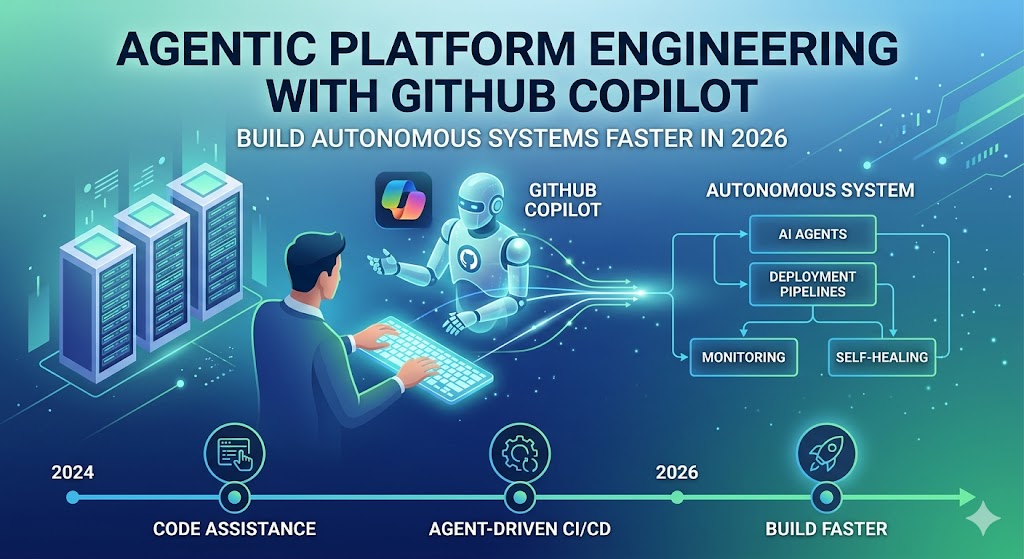
The software development landscape in 2026 is evolving faster than ever. Traditional development workflows are no longer enough to keep up with the increasing demand for intelligent, scalable, and autonomous systems. This is where Agentic Platform Engineering steps in as a game-changing paradigm.
Instead of simply writing code, developers are now designing systems that can think, adapt, and act independently. When combined with tools like GitHub Copilot, this approach allows teams to build powerful autonomous platforms faster, smarter, and with fewer resources.
In this blog, we’ll explore how Agentic Platform Engineering works, why it’s trending in 2026, and how you can leverage GitHub Copilot to build next-generation autonomous systems.
1. What is Agentic Platform Engineering?
Agentic Platform Engineering is the practice of designing platforms powered by autonomous agents that can make decisions, execute tasks, and continuously improve without constant human intervention.
Key Characteristics:
- Systems are goal-driven, not just rule-based
- Agents can learn from data and interactions
- Platforms are built for automation and adaptability
- Focus on end-to-end intelligence, not isolated features
Sub-Points:
- Autonomous Agents: Software entities that act independently
- Decision Engines: Systems that evaluate and choose optimal actions
- Continuous Learning: Feedback loops that improve performance
- Platform Thinking: Building reusable, scalable infrastructures
This approach shifts development from “write and deploy” to “design, train, and evolve.”
2. Why Agentic Platform Engineering is Trending in 2026
The rise of AI-native applications has made Agentic Platform Engineering one of the hottest trends in tech.
Reasons Behind the Growth:
2.1 Explosion of AI Capabilities
- Large Language Models (LLMs) enable reasoning and planning
- AI can now handle complex workflows
2.2 Demand for Automation
- Businesses want systems that reduce manual work
- Autonomous agents increase efficiency
2.3 Developer Productivity Pressure
- Faster delivery cycles are required
- Teams are smaller but expected to do more
2.4 Rise of Platform-Based Architectures
- Companies prefer reusable systems over one-off apps
- Platforms reduce long-term costs
3. Role of GitHub Copilot in Agentic Development
GitHub Copilot is no longer just a coding assistant—it’s becoming a co-engineer in the era of Agentic Platform Engineering.
How Copilot Accelerates Development:
3.1 Intelligent Code Generation
- Writes boilerplate and complex logic instantly
- Suggests optimized solutions
3.2 Context-Aware Assistance
- Understands your project structure
- Provides relevant suggestions
3.3 Rapid Prototyping
- Build MVPs of agent systems quickly
- Test ideas without heavy setup
3.4 Automation of Repetitive Tasks
- Reduces manual coding effort
- Improves consistency
4. Core Components of an Agentic Platform
To successfully implement Agentic Platform Engineering, you need to understand its building blocks.
4.1 Autonomous Agents
- Perform tasks independently
- Can communicate with other agents
4.2 Memory Systems
- Store past interactions
- Enable learning and personalization
4.3 Decision Engines
- Analyze data
- Choose best actions
4.4 Tool Integration Layer
- Connect agents to APIs, databases, and services
4.5 Feedback Loops
- Continuously improve system performance
5. Step-by-Step Guide: Building an Agentic Platform with GitHub Copilot
5.1 Define Your Use Case
Start with a clear problem:
- Customer support automation
- Content generation systems
- AI-powered trading bots
Sub-Points:
- Identify repetitive tasks
- Define success metrics
- Determine automation scope
5.2 Design the Agent Architecture
Create a blueprint of how agents will interact.
Sub-Points:
- Single-agent vs multi-agent systems
- Communication protocols
- Task distribution logic
5.3 Use GitHub Copilot for Code Generation
Leverage Copilot to speed up development.
Sub-Points:
- Generate API integrations
- Build agent logic
- Create data pipelines
5.4 Implement Memory and Learning
Agents need memory to improve over time.
Sub-Points:
- Short-term memory (session-based)
- Long-term memory (database/vector storage)
- Learning mechanisms
5.5 Integrate Tools and APIs
Agents become powerful when connected to tools.
Sub-Points:
- Payment systems
- CRM platforms
- External APIs
5.6 Test and Iterate
Continuous improvement is key in Agentic Platform Engineering.
Sub-Points:
- Run simulations
- Analyze agent decisions
- Optimize workflows
6. Benefits of Agentic Platform Engineering
6.1 Increased Productivity
- Faster development cycles
- Reduced manual effort
6.2 Scalability
- Systems can grow without major redesign
- Agents handle increasing workloads
6.3 Cost Efficiency
- Less need for large teams
- Automation reduces operational costs
6.4 Smarter Systems
- Continuous learning improves outcomes
- Better decision-making
7. Real-World Use Cases
7.1 AI Customer Support Platforms
- Agents handle queries automatically
- Reduce response time
7.2 Autonomous Content Creation
- Generate blogs, videos, and scripts
- Optimize for SEO
7.3 Smart Trading Systems
- Analyze markets
- Execute trades autonomously
7.4 Workflow Automation Tools
- Automate business processes
- Improve efficiency
8. Challenges in Agentic Platform Engineering
Despite its benefits, there are challenges.
8.1 Complexity
- Designing autonomous systems is difficult
8.2 Debugging Issues
- Hard to trace agent decisions
8.3 Security Risks
- Autonomous systems can be exploited
8.4 Data Dependency
- Requires high-quality data
9. Best Practices for Success
9.1 Start Small
- Build simple agents first
- Scale gradually
9.2 Focus on Modularity
- Design reusable components
9.3 Monitor Performance
- Track agent behavior
- Optimize continuously
9.4 Ensure Security
- Implement safeguards
- Validate inputs
10. Future of Agentic Platform Engineering
The future is clearly leaning toward autonomous systems.
Key Trends:
- AI agents replacing traditional apps
- Self-improving platforms
- Fully automated businesses
- Human-AI collaboration
In 2026 and beyond, Agentic Platform Engineering will become a standard approach in software development.
Conclusion
The shift toward Agentic Platform Engineering marks a new era in technology. By combining autonomous agents with powerful tools like GitHub Copilot, developers can build intelligent systems faster than ever before.
This approach is not just about coding—it’s about designing systems that can think, adapt, and evolve.
If you want to stay ahead in 2026, mastering Agentic Platform Engineering is no longer optional—it’s essential.
FAQ (Frequently Asked Questions)
1. What is Agentic Platform Engineering?
It is a development approach focused on building autonomous systems using intelligent agents that can act independently.
2. How does GitHub Copilot help in building agentic systems?
GitHub Copilot assists with code generation, automation, and rapid prototyping, making development faster and more efficient.
3. Are agentic platforms suitable for beginners?
Yes, but it’s recommended to start with simple projects and gradually move to complex systems.
4. What industries benefit the most from Agentic Platform Engineering?
Industries like finance, healthcare, e-commerce, and content creation benefit greatly from automation and intelligent systems.
5. Is Agentic Platform Engineering the future of software development?
Yes, it is rapidly becoming the standard approach due to its efficiency, scalability, and intelligence.
Also read this:
How to Make Money With AI Without Investment (Step-by-Step Guide for 2026)
How to Use ChatGPT to Get Freelance Clients in 2026 (Complete Guide)
How to Use AI to Generate Leads for Free (Step-by-Step Guide for 2026)