
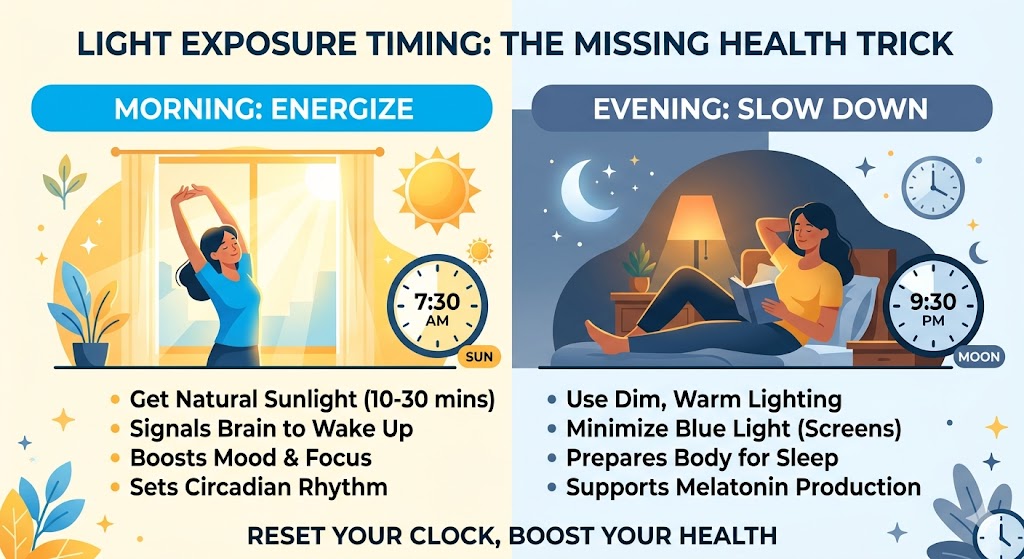
Most people focus on diet, exercise, and sleep—but ignore one of the most powerful health factors: light. The truth is, Light Exposure Timing plays a critical role in your energy levels, mood, sleep quality, and overall health.
If you’ve been struggling with fatigue, poor sleep, or low focus, optimizing your Light Exposure Timing could be the missing piece.
In this guide, you’ll learn how Light Exposure Timing works, why it matters, and how to use it to transform your daily performance.
1. What Is Light Exposure Timing
Light Exposure Timing refers to when and how your body is exposed to natural and artificial light throughout the day.
Your body uses light as a signal to regulate its internal clock (circadian rhythm).
Sub Points:
- Controls sleep-wake cycles
- Influences hormone release
- Affects energy levels
- Impacts mood and focus
Timing is more important than intensity.
2. Why Light Exposure Timing Is Important
Light directly affects your biology.
Key Benefits:
Sub Points:
- Better sleep quality
- Increased daytime energy
- Improved mood
- Enhanced focus
Optimizing Light Exposure Timing can significantly improve your health.
3. How Light Affects Your Body
Understanding the science helps.
Key Mechanisms:
Sub Points:
- Morning light boosts cortisol (energy hormone)
- Evening light suppresses melatonin (sleep hormone)
- Blue light affects circadian rhythm
This is why Light Exposure Timing is so powerful.
4. Morning Light Exposure: The Most Important Step
Start your day right.
Sub Points:
- Get sunlight within 30 minutes of waking
- Spend 5–15 minutes outdoors
- Avoid sunglasses initially
Morning light sets your internal clock.
5. Daytime Light Exposure
Stay energized throughout the day.
Sub Points:
- Work near windows
- Take outdoor breaks
- Avoid staying in dark environments
Consistent exposure supports your Light Exposure Timing.
6. Evening Light Management
Prepare your body for sleep.
Sub Points:
- Reduce bright lights after sunset
- Avoid screens 1–2 hours before bed
- Use warm lighting
Evening habits are crucial for proper Light Exposure Timing.
7. Nighttime Light Habits
Protect your sleep.
Sub Points:
- Keep your room dark
- Avoid phone usage in bed
- Use blackout curtains
Darkness is just as important as light.
8. Common Mistakes to Avoid
Many people unknowingly disrupt their rhythm.
Sub Points:
- Skipping morning sunlight
- Excessive screen time at night
- Staying indoors all day
- Using bright lights before sleep
Avoiding these mistakes improves Light Exposure Timing.
9. How Long It Takes to See Results
Consistency is key.
Timeline:
Sub Points:
- 2–3 days: Better sleep onset
- 1 week: Improved energy
- 2–3 weeks: Stable circadian rhythm
Stick to your Light Exposure Timing routine.
10. Long-Term Benefits of Light Exposure Timing
Over time, the benefits grow.
Sub Points:
- Improved sleep quality
- Better mental health
- Increased productivity
- Balanced hormones
A proper Light Exposure Timing routine can transform your life.
Conclusion
Light Exposure Timing is one of the simplest yet most powerful health strategies. By aligning your light exposure with your body’s natural rhythm, you can improve your sleep, energy, mood, and overall well-being.
Start with small changes—get morning sunlight, reduce evening light, and stay consistent. Over time, you’ll notice a significant improvement in how you feel and perform every day.
FAQs
1. What is Light Exposure Timing?
It’s the practice of controlling when you’re exposed to light to optimize health.
2. How much morning light do I need?
5–15 minutes daily.
3. Can artificial light replace sunlight?
It helps, but natural sunlight is best.
4. Does blue light affect sleep?
Yes, it suppresses melatonin.
5. How quickly will I see results?
Within days to weeks.
6. Is it suitable for everyone?
Yes, it’s a universal health practice.
7. Do I need special equipment?
No, just access to natural light.
More Related Topics:
Cognitive Hygiene: Clean Your Mental Environment