
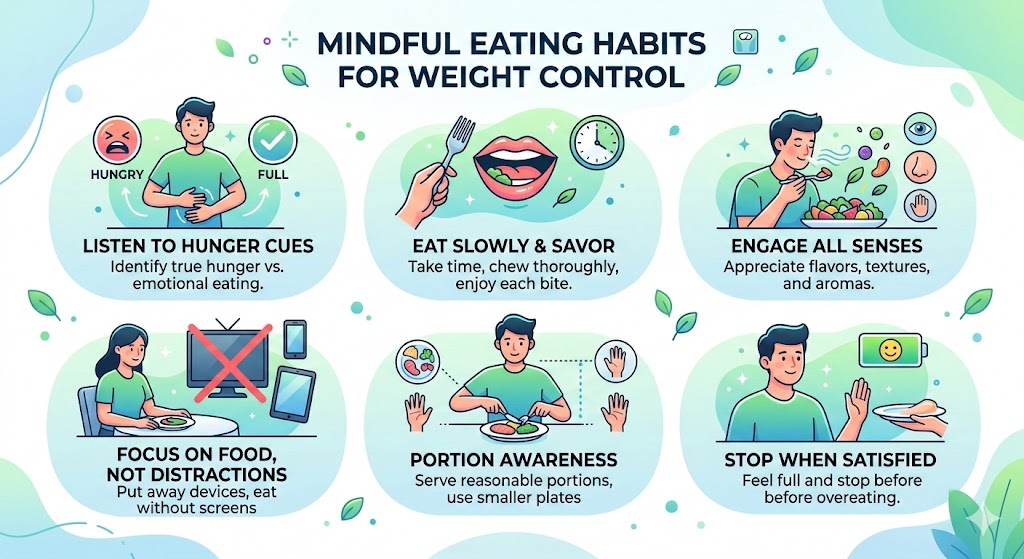
Mindful Eating Habits Weight control has become more complicated than ever. Calorie tracking, restrictive diets, and extreme food rules often lead to burnout, emotional eating, and weight regain. Yet one of the most effective and sustainable approaches to managing weight doesn’t involve cutting food groups or obsessing over numbers.
It involves awareness.
Mindful Eating Habits focus on how you eat rather than what you eat. By tuning into hunger, fullness, and emotional cues, mindful eating helps regulate intake naturally—without deprivation. This guide explains how mindful eating works, why it supports long-term weight control, and how to practice it in everyday life.
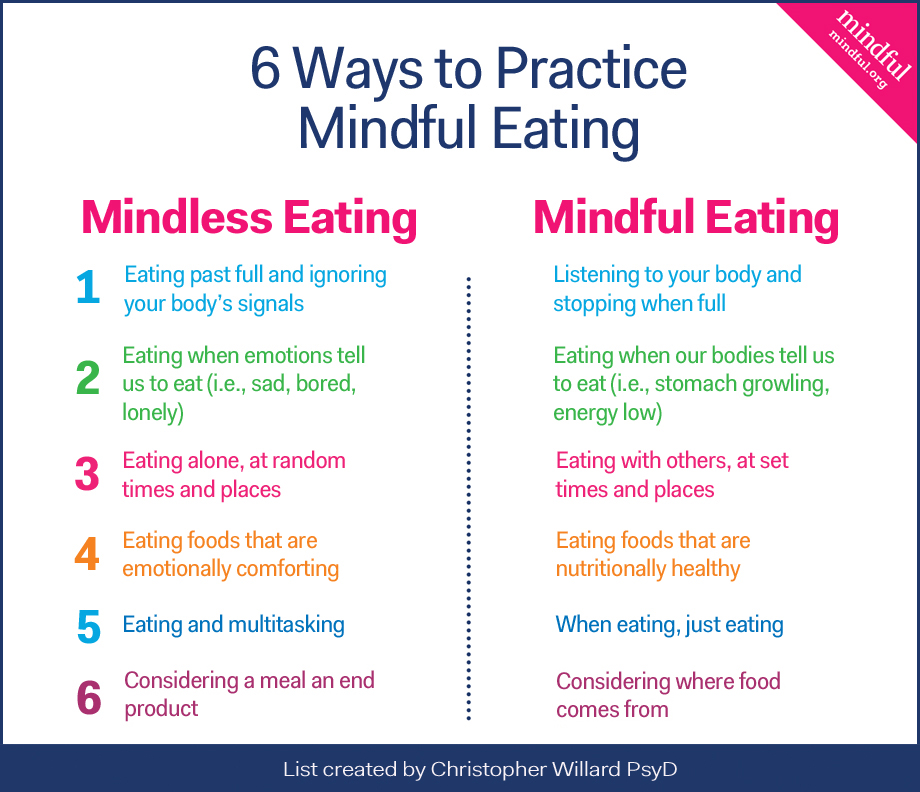

1. What Is Mindful Eating?
Mindful eating is the practice of bringing full attention to the eating experience.
Core principles
- Eating with awareness
- Noticing hunger and fullness cues
- Reducing distractions
- Eating without judgment
Instead of following strict food rules, mindful eating reconnects you with your body’s natural signals.
2. Why Mindful Eating Habits Support Weight Control
Weight gain often has less to do with food choice and more to do with mindless consumption.
Why mindful eating works
- Reduces overeating
- Improves portion awareness
- Decreases emotional eating
- Increases satisfaction from food
These effects make Mindful Eating Habits a powerful tool for sustainable weight control.
3. Mindful Eating vs Dieting
Traditional dieting focuses on restriction. Mindful eating focuses on regulation.
Key differences
- Diets rely on external rules
- Mindful eating relies on internal cues
- Diets often create guilt
- Mindful eating builds trust with food
This is why mindful eating tends to produce longer-lasting results.
4. Hunger Awareness: Eating When Your Body Needs Food
One of the first mindful eating skills is recognizing true hunger.
Signs of physical hunger
- Stomach sensations
- Low energy
- Difficulty concentrating
- Gradual urge to eat
Eating in response to physical hunger prevents extreme hunger and overeating later.
5. Fullness Awareness: Knowing When to Stop
Many people eat past fullness without realizing it.
Fullness cues include
- Slowing appetite
- Comfortable stomach sensation
- Reduced interest in food
- Feeling satisfied, not stuffed
Mindful eaters aim to stop at comfortable fullness, not extreme fullness.
6. Slowing Down: A Key Mindful Eating Habit
Speed matters more than most people realize.
Benefits of eating slowly
- Better digestion
- Improved fullness recognition
- Increased enjoyment
- Lower calorie intake naturally
Slowing down is one of the simplest Mindful Eating Habits to implement.
7. Reducing Emotional and Stress Eating
Stress often overrides hunger signals.
How mindful eating helps
- Creates a pause before eating
- Encourages emotional awareness
- Separates hunger from emotion
This reduces eating driven by boredom, anxiety, or fatigue.
8. Mindful Eating Habits for Portion Control
Portion control doesn’t require measuring cups.
Mindful portion strategies
- Serve food once
- Eat without distractions
- Check in halfway through meals
- Notice satisfaction levels
Awareness replaces external portion rules.
9. The Role of Satisfaction in Weight Control
Unsatisfying meals often lead to overeating later.
Why satisfaction matters
- Reduces cravings
- Prevents rebound eating
- Supports consistent intake
Mindful eating encourages meals that are both nourishing and enjoyable.
10. Eating Without Distractions
Distraction is one of the biggest drivers of overeating.
Common distractions
- Phones
- TV
- Work screens
- Multitasking
Removing distractions increases awareness and reduces excess intake.
11. Mindful Eating Habits in Real-Life Situations
Mindful eating is flexible—not rigid.
Practical applications
- Eating out
- Family meals
- Social events
- Busy workdays
The goal is progress, not perfection.
12. How Mindful Eating Affects Metabolism
Mindful eating supports metabolic health indirectly.
Metabolic benefits
- Improved insulin response
- Reduced stress hormones
- Better digestion
Chronic stress eating disrupts metabolism; mindful eating restores balance.
13. How Long It Takes to See Weight Changes
Mindful eating is gradual—but effective.
Typical timeline
- 1–2 weeks: improved awareness
- 3–4 weeks: reduced overeating
- 6–8 weeks: noticeable weight stabilization
Results build through consistency.
14. Common Mistakes With Mindful Eating
Avoid these misconceptions.
Mistakes to avoid
- Using mindful eating as another diet
- Expecting instant weight loss
- Ignoring nutrition quality
- Being overly strict
Mindful eating is a skill, not a rulebook.
15. Who Benefits Most From Mindful Eating Habits
Mindful eating is especially helpful for:
- Chronic dieters
- Emotional eaters
- People struggling with portion control
- Those wanting sustainable weight management
Its flexibility makes it widely accessible.
16. Final Verdict: Why Mindful Eating Is a Long-Term Solution
Weight control doesn’t require constant restriction. Mindful Eating Habits help you eat in alignment with your body, reduce overeating naturally, and create a healthier relationship with food.
Instead of fighting hunger, mindful eating teaches you to listen—and that’s what makes it sustainable.
Frequently Asked Questions (FAQ)
Q1. Can mindful eating really help with weight loss?
Yes. It reduces overeating and emotional eating, which supports weight control.
Q2. Do I need to eat “perfectly” mindfully?
No. Even small increases in awareness make a difference.
Q3. Is mindful eating the same as intuitive eating?
They are related, but mindful eating focuses more on present-moment awareness.
Q4. Can mindful eating work without counting calories?
Yes. Many people manage weight without tracking when practicing mindful eating.
Q5. How do I start mindful eating today?
Start by slowing down and removing distractions during one meal.
Conclusion
Lasting weight control isn’t about eating less—it’s about eating aware. Mindful Eating Habits offer a realistic, sustainable approach to managing weight without constant rules, guilt, or burnout.
When you learn to listen to your body instead of fighting it, balance becomes natural—and weight control follows.
More Related Topics:
VO2 Max Training for Long-Term Heart Health (Train Smarter, Live Longer)
Walking Meditation Benefits for Mental Clarity (A Simple Practice for a Busy Mind)
Posture Correction Exercises for Desk Workers (Fix Pain, Boost Energy, Work Better)