
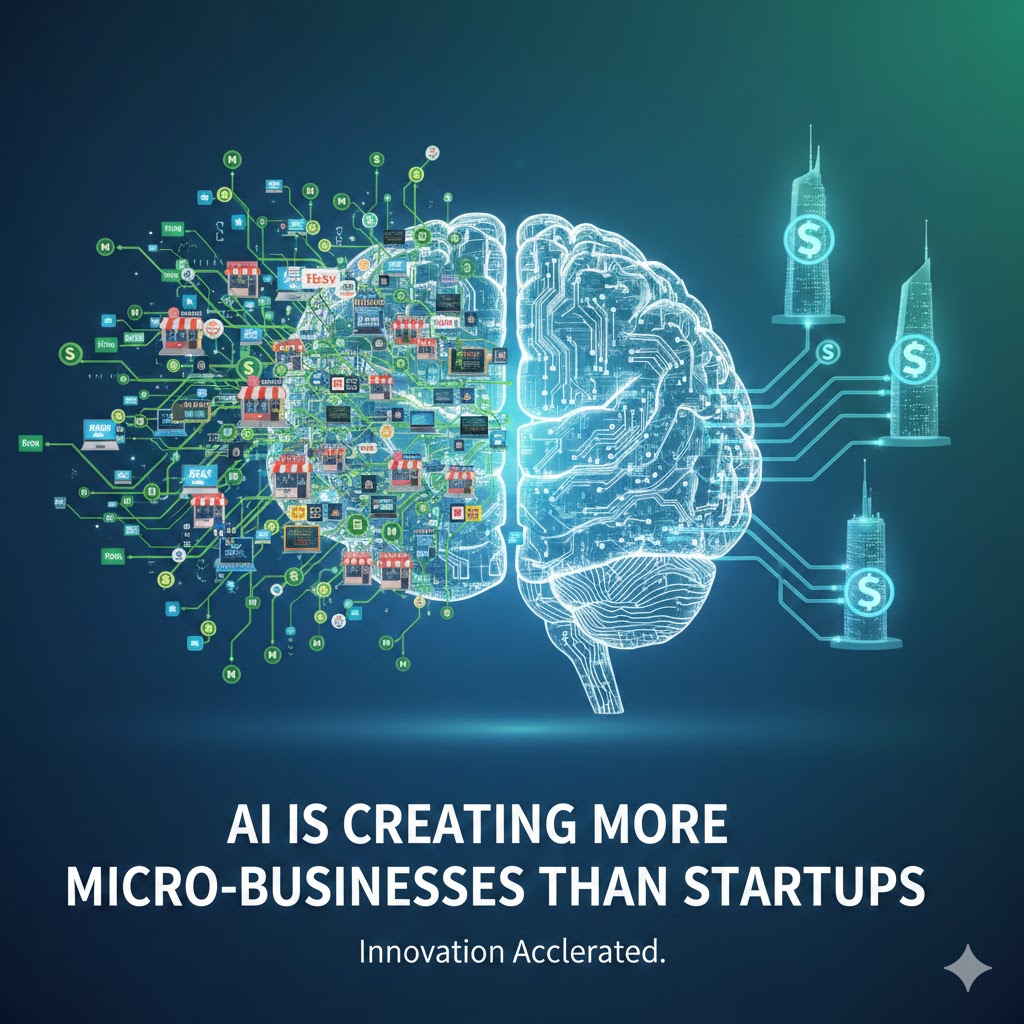
AI Is Creating More Micro-Businesses For decades, entrepreneurship was associated with startups—venture capital, large teams, rapid scaling, and high risk. But that definition is quietly changing. In today’s digital economy, AI is creating more micro-businesses than traditional startups, and it’s reshaping how people think about building income online.
Instead of chasing unicorn valuations, individuals are using AI to launch small, profitable businesses that require minimal overhead, fewer people, and far less risk. These micro-businesses are not about massive scale; they are about sustainability, speed, and control.
In this blog, we’ll explore why AI is creating more micro-businesses, how this shift is happening, and why it’s becoming the preferred path for modern entrepreneurs.
1. What Micro-Businesses Really Are
A micro-business is typically run by one person or a very small team. It focuses on a narrow niche, solves a specific problem, and generates consistent income without the need for aggressive scaling.
Unlike startups, micro-businesses do not depend on external funding, large infrastructures, or complex operations. AI has made this model more viable than ever by removing traditional barriers like time, skills, and cost.
2. Why Startups Are No Longer the Default Path
Startups come with high pressure. They require rapid growth, constant pitching, and large financial commitments. Many founders burn out before reaching profitability.
AI offers an alternative. Instead of building for investors, people can now build for customers directly. This shift is a major reason AI is creating more micro-businesses than startups.
Entrepreneurs are choosing freedom, flexibility, and profitability over scale-at-all-costs.
3. How AI Lowers the Barrier to Entry
Previously, starting a business required specialized skills—design, writing, marketing, development. AI now handles much of this work.
With AI, individuals can:
- Create content without writing expertise
- Design assets without graphic skills
- Automate customer support
- Run marketing systems with minimal effort
This accessibility explains why AI is creating more micro-businesses among beginners and solo creators.
4. Speed: The Biggest Advantage of AI-Driven Micro-Businesses
Startups often take months or years to launch properly. Micro-businesses powered by AI can be launched in days or weeks.
AI accelerates:
- Idea validation
- Content creation
- Product development
- Marketing execution
This speed allows entrepreneurs to test ideas quickly, pivot easily, and avoid long-term commitments to failing concepts.
5. Profitability Over Growth
Startups often prioritize growth over profit, hoping revenue will come later. Micro-businesses operate differently.
They focus on:
- Immediate monetization
- Low operating costs
- Direct customer relationships
AI reduces expenses so dramatically that profitability becomes achievable with smaller audiences. This is a key reason AI is creating more micro-businesses that succeed quietly without media attention.

6. Examples of AI-Powered Micro-Business Models
AI enables a wide range of micro-business ideas, including:
- Niche newsletters
- Faceless content channels
- Digital product stores
- Affiliate content sites
- Service automation businesses
These models don’t require large teams, offices, or funding—just smart systems.
7. Why Individuals Prefer Micro-Businesses Over Startups
Modern entrepreneurs value control more than prestige.
Micro-businesses offer:
- Full ownership
- Flexible working hours
- Lower stress
- Faster decision-making
As work culture changes, people are choosing autonomy over ambition. This mindset shift reinforces why AI is creating more micro-businesses globally.
8. Risk Reduction Through AI
Startups involve high financial and emotional risk. AI-powered micro-businesses reduce both.
With low startup costs and automated systems, failure becomes less expensive. Entrepreneurs can experiment without risking years of effort or large sums of money.
This safety net encourages more people to try entrepreneurship.
9. The Role of AI in Scaling Micro-Businesses
Micro-businesses don’t need to stay small forever. AI allows controlled scaling without losing simplicity.
Entrepreneurs can:
- Automate operations
- Expand content output
- Reach global audiences
- Increase revenue without increasing workload
This flexible scaling model is another reason AI is creating more micro-businesses instead of traditional startups.
10. Final Thoughts: Is This the Future of Entrepreneurship?
The rise of AI-powered micro-businesses signals a fundamental shift in entrepreneurship.
Instead of chasing startup hype, people are building sustainable, profitable systems that fit their lives. AI has made it possible to work smarter, not bigger.
As technology continues to evolve, AI is creating more micro-businesses—and for many, this model represents the future of work and income.
FAQs
Why is AI creating more micro-businesses than startups?
AI reduces costs, skills, and time requirements, making it easier for individuals to launch small, profitable businesses without external funding.
Are micro-businesses more profitable than startups?
Many micro-businesses reach profitability faster because they focus on low expenses and direct monetization rather than rapid scaling.
Do you need technical skills to start an AI-powered micro-business?
No, most AI tools are beginner-friendly and designed for non-technical users.
Can micro-businesses scale with AI?
Yes, AI allows micro-businesses to scale operations and revenue without significantly increasing workload or team size.
Is this model suitable for beginners?
Absolutely. AI-powered micro-businesses are ideal for beginners because of their low risk and simple setup.
Also read this:
Laziest Way to Make Money with AI in 2026 (For Beginners)