
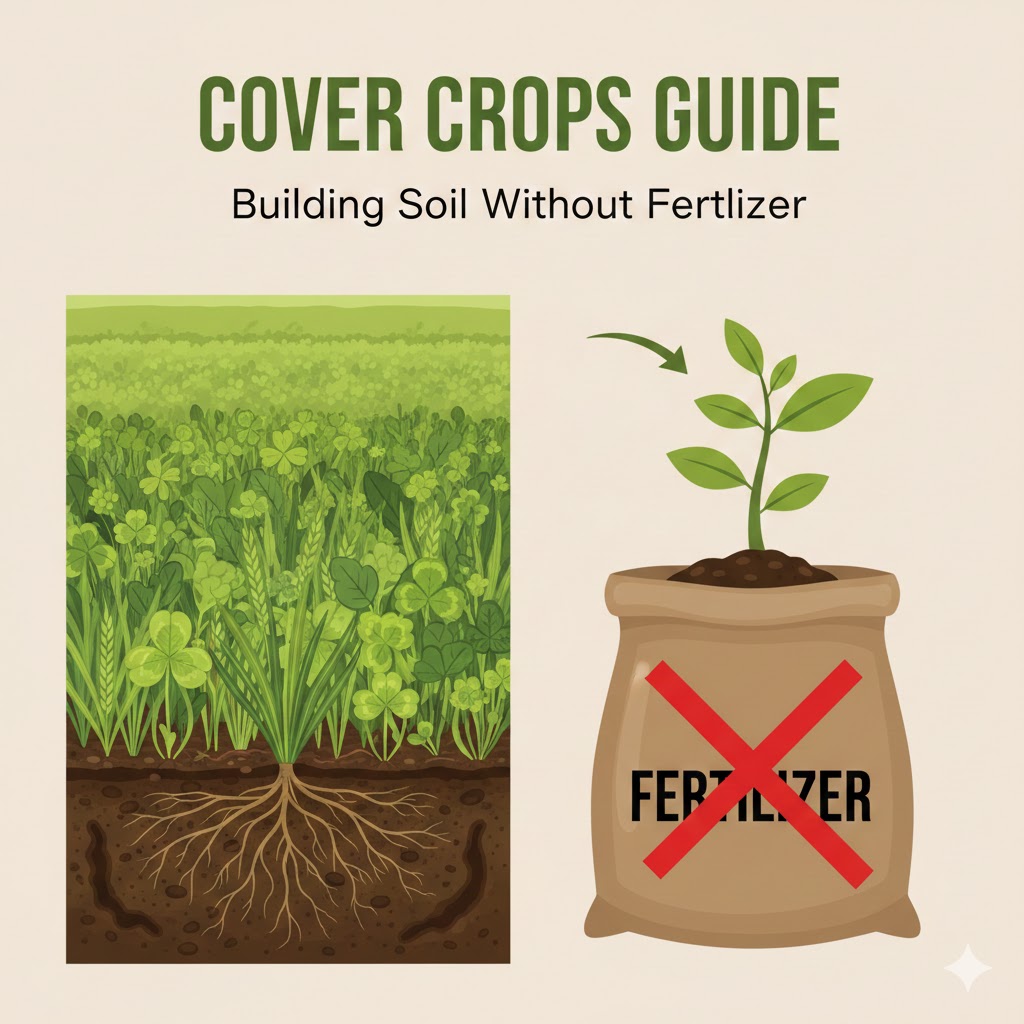
Modern agriculture has leaned heavily on synthetic fertilizers to push yields higher—but often at the cost of long-term soil health. As fertilizer prices rise and soils become more degraded, farmers and growers are rediscovering an older, smarter approach. This Cover Crops Guide explains how cover crops rebuild soil naturally, improve productivity, and reduce dependence on chemical inputs.
Cover crops aren’t just a sustainability trend. They are a biological tool that works with nature to restore soil function—without relying on fertilizer as a crutch.
1. What Are Cover Crops and Why They Matter
Cover crops are plants grown primarily to benefit the soil rather than to be harvested for sale. They are typically planted between cash crop cycles or alongside main crops.
In this Cover Crops Guide, the focus is on how these plants:
- Improve soil structure
- Increase organic matter
- Enhance nutrient cycling
- Protect soil from erosion
Healthy soil is a living system, and cover crops feed that system.
2. How Cover Crops Build Soil Without Fertilizer
Cover crops improve soil through biological processes, not chemical inputs.
They help by:
- Fixing atmospheric nitrogen
- Recycling nutrients from deeper soil layers
- Feeding beneficial microbes
- Increasing carbon content
Over time, soils managed with cover crops become more fertile, resilient, and productive—even with reduced fertilizer use.
3. Nitrogen Fixation: Nature’s Fertilizer Factory
Legume cover crops such as clover, vetch, and peas host bacteria that convert nitrogen from the air into plant-available forms.
This process:
- Supplies nitrogen naturally
- Reduces need for synthetic nitrogen fertilizers
- Improves nutrient availability for the next crop
In a practical Cover Crops Guide, nitrogen-fixing species are often the foundation of fertility-building systems.
4. Improving Soil Structure and Water Retention
Soil isn’t just dirt—it’s a complex structure.
Cover crop roots:
- Break up compacted layers
- Improve aggregation
- Increase pore space
- Enhance water infiltration
Better soil structure means less runoff, better drought resilience, and healthier root systems for future crops.
5. Feeding Soil Biology
Cover crops provide continuous food for soil organisms.
As roots grow and die, they:
- Release sugars that feed microbes
- Support fungi and bacteria
- Increase biological diversity underground
This biological activity drives nutrient cycling more effectively than synthetic fertilizers alone.
6. Weed Suppression Without Chemicals
A key benefit highlighted in this Cover Crops Guide is weed control.
Cover crops suppress weeds by:
- Shading soil
- Competing for space and nutrients
- Releasing natural allelopathic compounds
This reduces herbicide reliance while keeping fields productive.
7. Preventing Erosion and Nutrient Loss
Bare soil is vulnerable soil.
Cover crops:
- Protect the soil surface from wind and rain
- Reduce nutrient leaching
- Keep carbon and nitrogen in place
By holding soil together, they preserve long-term fertility instead of losing it to runoff.
8. Choosing the Right Cover Crops
Not all cover crops serve the same purpose.
Common categories include:
- Legumes for nitrogen
- Grasses for biomass and erosion control
- Brassicas for compaction and pest suppression
- Mixed species for balanced benefits
A good Cover Crops Guide emphasizes matching species to soil goals, climate, and crop rotation.
9. When and How to Terminate Cover Crops
Termination is part of the system.
Cover crops can be:
- Rolled or crimped
- Mowed
- Grazed
- Naturally winter-killed
The method affects nutrient release timing and soil protection. Planning termination properly ensures benefits carry over into the cash crop.
10. Transitioning Away From Fertilizer Gradually
One common mistake is cutting fertilizer too fast.
This Cover Crops Guide recommends:
- Gradual fertilizer reduction
- Soil testing over time
- Monitoring crop response
- Letting biology rebuild before expecting full results
Healthy soil systems take seasons, not weeks.
Why Cover Crops Are a Long-Term Investment
Cover crops don’t always show immediate yield gains—but they build something more valuable: resilience.
Benefits accumulate as:
- Soil organic matter increases
- Inputs decrease
- Yields stabilize under stress
In a world of rising costs and climate uncertainty, cover crops offer control and independence.
Frequently Asked Questions (FAQ)
Can cover crops really replace fertilizer?
They can significantly reduce fertilizer needs over time, especially nitrogen, but full replacement depends on crop type and soil conditions.
How long before I see results from cover crops?
Some benefits appear in the first season, but major soil improvements typically take 2–5 years.
Are cover crops expensive to implement?
Initial costs exist, but long-term savings from reduced fertilizer, herbicides, and erosion often outweigh them.
Do cover crops reduce yields?
When managed correctly, they maintain or improve yields. Poor timing or species choice can cause short-term issues.
Can cover crops work in small farms or gardens?
Yes. Cover crops are scalable and work in gardens, small farms, and large operations.
What’s the biggest mistake beginners make?
Planting cover crops without a clear goal or management plan.
Final Thoughts
This Cover Crops Guide highlights a simple truth: soil health isn’t bought—it’s built. Cover crops harness biological systems that fertilizers can’t replicate, turning soil from a passive growing medium into a living, self-renewing resource.
By investing in cover crops, growers aren’t just reducing inputs—they’re building soils that can feed crops naturally for generations to come.
More Related Topics:
Mouth Taping for Sleep: Does It Actually Work?
NAD+ Supplements: Anti-Aging Science or Snake Oil?
Only 3 Advanced Supplements You Really Need To Enhance Muscles