
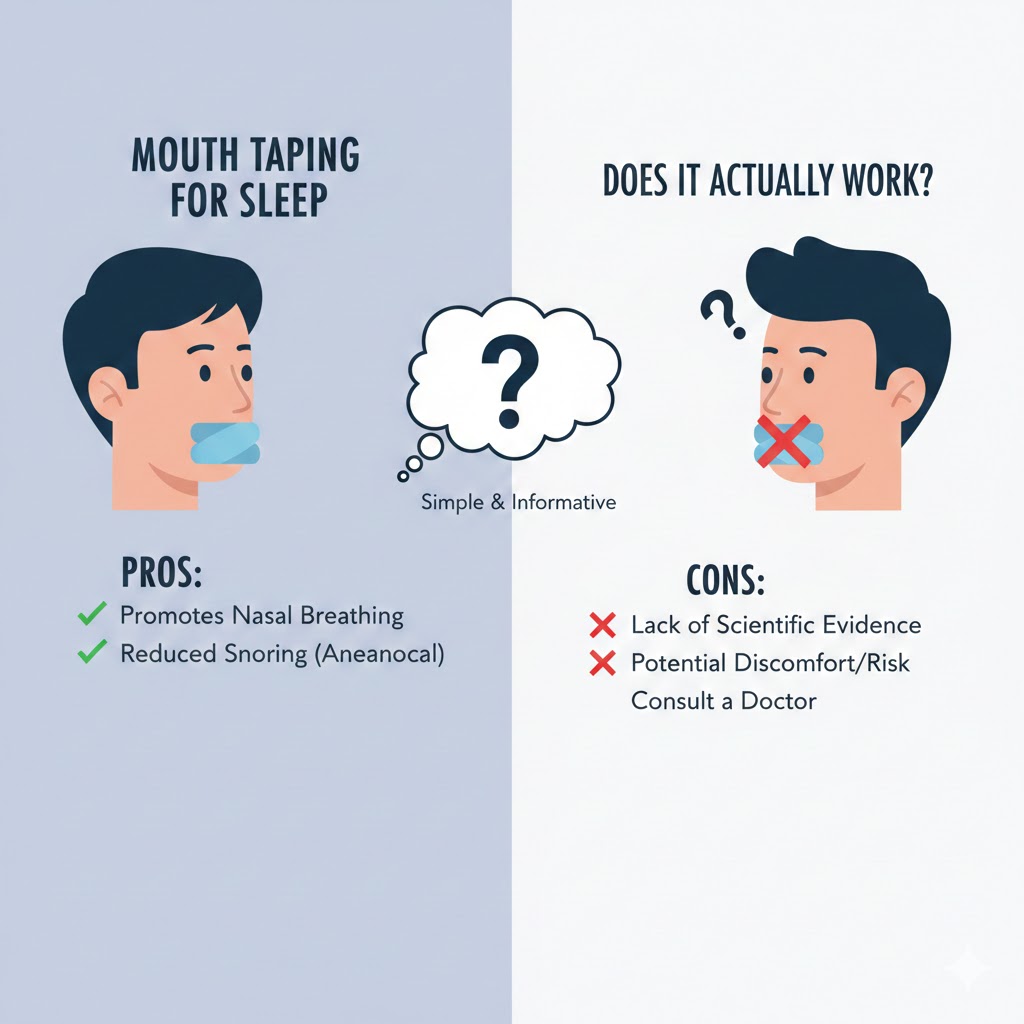
If you spend even a few minutes in sleep-health corners of the internet, you’ve probably seen it: people taping their mouths shut before bed and claiming deeper sleep, better focus, and more energy the next day. The practice is simple, inexpensive, and controversial. So what’s the truth—does Mouth Taping for Sleep actually work, or is it just another viral wellness trend?
Let’s look at the science, the benefits people report, the risks, and who should (and absolutely should not) try it.
1. What Is Mouth Taping for Sleep?
Mouth taping for sleep involves placing a small piece of tape over the lips before bed to encourage nasal breathing throughout the night.
The goal is not to force breathing but to:
- Reduce habitual mouth breathing
- Promote nasal airflow
- Improve breathing efficiency during sleep
Supporters of Mouth Taping for Sleep believe nasal breathing supports better oxygen delivery, calmer nervous system activity, and more stable sleep cycles.
2. Why Nasal Breathing Matters During Sleep
Breathing through the nose isn’t just a preference—it serves several physiological functions.
Nasal breathing:
- Filters and humidifies air
- Produces nitric oxide, which improves oxygen absorption
- Supports slower, more controlled breathing
- Reduces airway collapse
Mouth breathing, especially during sleep, is associated with dry mouth, snoring, fragmented sleep, and sometimes worsened breathing disorders.
This is the biological foundation behind Mouth Taping for Sleep.
3. What the Science Actually Says
Here’s where things get nuanced.
There is limited direct research on mouth taping itself. However, there is solid evidence supporting nasal breathing benefits.
Research shows:
- Nasal breathing improves oxygen efficiency
- Mouth breathing is linked to poorer sleep quality
- Snoring often decreases with nasal airflow optimization
Small studies and clinical observations suggest that Mouth Taping for Sleep may reduce snoring and improve perceived sleep quality in certain people—but it is not a universal solution.
4. Who Might Benefit from Mouth Taping for Sleep
Mouth taping tends to help people who:
- Breathe through their mouth out of habit
- Snore lightly (not severe sleep apnea)
- Wake up with dry mouth
- Have nasal passages that are clear at night
For these individuals, Mouth Taping for Sleep can act as a gentle reminder rather than a medical intervention.
5. What Mouth Taping Will NOT Fix
This is critical.
Mouth taping does not:
- Cure sleep apnea
- Replace CPAP therapy
- Fix structural airway issues
- Magically improve sleep in everyone
People with undiagnosed or moderate-to-severe sleep apnea should not rely on mouth taping without medical guidance.
6. Potential Benefits People Commonly Report
Anecdotal benefits include:
- Reduced snoring
- Less dry mouth in the morning
- Feeling more rested
- Improved focus during the day
- More stable breathing patterns
These benefits don’t come from tape itself—they come from nasal breathing consistency.
7. Real Risks and Safety Concerns
While often portrayed as harmless, Mouth Taping for Sleep is not risk-free.
Potential risks include:
- Breathing discomfort if nasal passages block
- Anxiety or panic in sensitive individuals
- Unsafe use in people with sleep apnea
- Skin irritation
If nasal breathing is compromised (due to congestion, allergies, or deviated septum), taping the mouth can cause distress rather than benefit.
8. How to Try Mouth Taping Safely (If You Do)
If someone chooses to experiment, safety matters.
Basic guidelines:
- Use breathable, skin-safe tape
- Tape vertically or with a small gap (not fully sealed)
- Ensure nasal passages are clear
- Stop immediately if discomfort occurs
- Never use if you have diagnosed sleep apnea unless approved by a doctor
Mouth Taping for Sleep should feel gentle—not forced.
9. Alternatives That Offer Similar Benefits
If mouth taping feels uncomfortable, other options include:
- Nasal strips or dilators
- Treating nasal congestion
- Breathing exercises before bed
- Sleep position adjustments
These approaches also encourage nasal breathing without physical restriction.
10. So… Does Mouth Taping for Sleep Actually Work?
The honest answer: sometimes.
Mouth taping works best as:
- A behavioral cue
- A short-term experiment
- A tool for mild mouth-breathers
It is not a medical treatment, not a cure-all, and not suitable for everyone.
Frequently Asked Questions (FAQ)
Is Mouth Taping for Sleep safe?
It can be safe for healthy individuals with clear nasal breathing, but it’s not recommended for everyone.
Can mouth taping cure snoring?
It may reduce mild snoring caused by mouth breathing, but it won’t fix structural airway issues.
Does mouth taping improve sleep quality?
Some people report better sleep, but scientific evidence is still limited.
Should people with sleep apnea try mouth taping?
No—unless advised by a healthcare professional.
What tape should be used?
Breathable, skin-safe medical tape designed for sensitive skin.
How long should someone try mouth taping?
Short trials of a few nights are reasonable to assess comfort and benefit.
Final Thoughts
Mouth Taping for Sleep sits in a gray zone between habit correction and wellness trend. It’s not nonsense—but it’s not a miracle either. For the right person, it can gently encourage healthier breathing patterns. For the wrong person, it can be uncomfortable or even unsafe.
The key isn’t the tape.
It’s understanding how you breathe—and whether changing that pattern actually helps you sleep better.
When it comes to sleep, curiosity is good. Caution is better.
More Related Topics:
NAD+ Supplements: Anti-Aging Science or Snake Oil?
Only 3 Advanced Supplements You Really Need To Enhance Muscles