
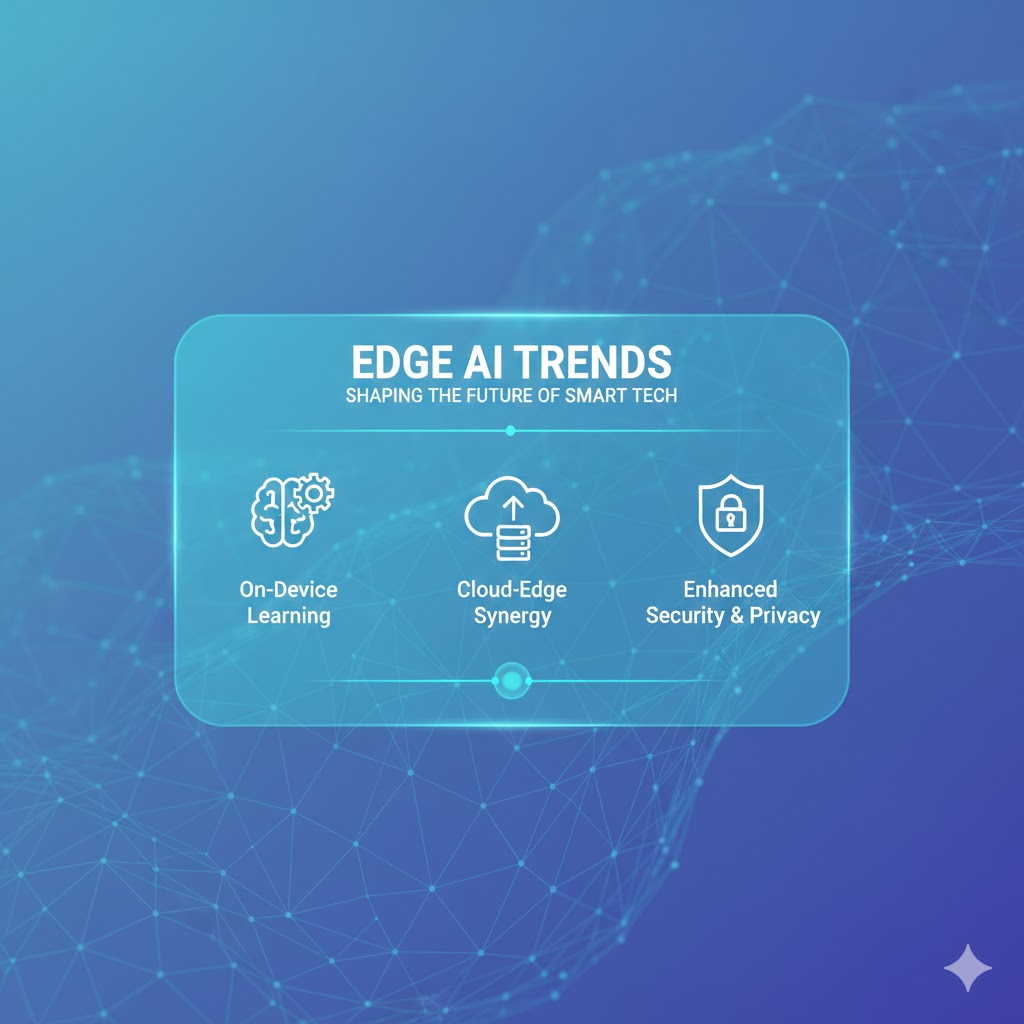
Edge AI Trends Shaping Artificial intelligence is no longer confined to massive cloud servers. In 2026 and beyond, intelligence is moving closer to where data is created—your phone, car, factory, home, and city streets. This shift is driven by Edge AI Trends Shaping the next generation of smart technology, where decisions happen instantly, privately, and efficiently.
Edge AI represents a fundamental change in how systems think, react, and learn. Instead of sending raw data to the cloud, devices process information locally—reducing latency, improving security, and enabling real-time intelligence.
Let’s explore the most important Edge AI Trends Shaping the future of smart tech and why they matter.
1. On-Device Intelligence Replacing Cloud Dependence
One of the most important Edge AI Trends Shaping modern technology is the move away from constant cloud reliance.
Edge AI allows devices to:
- Process data locally
- Make decisions in real time
- Function even without internet access
This is crucial for applications like autonomous vehicles, medical devices, and industrial robots where delays of even milliseconds matter.
Cloud AI isn’t disappearing—but edge AI is becoming the first line of intelligence.
2. Ultra-Low Latency for Real-Time Decisions
Latency is the silent bottleneck of smart systems. Edge AI eliminates the round-trip delay between device and server.
Key benefits include:
- Instant facial recognition
- Real-time language translation
- Immediate hazard detection in vehicles
- Faster response in smart manufacturing
These real-time capabilities are core Edge AI Trends Shaping how smart tech feels more responsive and human-like.
3. AI Chips Designed Specifically for the Edge
Traditional CPUs weren’t built for AI workloads. That’s changing fast.
A major Edge AI Trends Shaping the market is the rise of specialized hardware:
- Neural Processing Units (NPUs)
- AI-optimized system-on-chips
- Low-power inference accelerators
These chips allow complex models to run on small devices without draining battery or generating excess heat—unlocking AI everywhere.
4. Privacy-First AI Processing
As data privacy concerns grow, edge AI offers a powerful solution.
When data stays on the device:
- Sensitive information isn’t transmitted
- Surveillance risks are reduced
- Compliance becomes easier
- User trust increases
This makes edge AI especially valuable in healthcare, finance, and personal devices. Privacy-by-design is one of the most user-driven Edge AI Trends Shaping adoption.
5. Smarter IoT and Connected Devices
The Internet of Things is evolving into the Internet of Intelligence.
Edge AI enables IoT devices to:
- Filter meaningful data from noise
- Act without waiting for cloud commands
- Collaborate with nearby devices
- Scale without bandwidth overload
From smart homes to industrial sensors, this is one of the Edge AI Trends Shaping the next wave of connected ecosystems.
6. Edge AI in Autonomous Systems
Autonomy depends on immediate decision-making.
Self-driving cars, drones, and robots rely on edge AI for:
- Object detection
- Path planning
- Collision avoidance
- Environmental understanding
Cloud AI supports training and updates—but real autonomy lives at the edge. This distinction defines several Edge AI Trends Shaping transportation and robotics.
7. Energy Efficiency and Sustainability
Edge AI isn’t just faster—it’s greener.
Processing data locally:
- Reduces data transmission energy costs
- Lowers server infrastructure load
- Extends battery life in devices
As sustainability becomes a priority, energy-efficient AI is emerging as one of the most practical Edge AI Trends Shaping smart tech strategies.
8. Federated Learning at the Edge
Training AI models without centralizing data is another powerful shift.
Federated learning allows:
- Models to learn from many devices
- Raw data to remain local
- Global improvement without privacy compromise
This approach balances intelligence and security, reinforcing Edge AI Trends Shaping ethical and scalable AI deployment.
9. Edge AI in Smart Cities
Cities are becoming intelligent networks.
Edge AI supports:
- Traffic optimization
- Public safety monitoring
- Energy grid balancing
- Environmental sensing
By processing data locally at intersections, cameras, and sensors, cities gain speed and resilience—key examples of Edge AI Trends Shaping urban life.
10. Hybrid Edge-Cloud Architectures
The future isn’t edge or cloud—it’s both.
A defining Edge AI Trends Shaping modern systems is hybrid intelligence:
- Edge AI handles immediate decisions
- Cloud AI handles heavy analytics and training
- Continuous feedback improves both layers
This balance offers flexibility, scalability, and performance without compromise.
Why Edge AI Matters More Than Ever
Edge AI changes how technology feels:
- Faster responses
- Better privacy
- More autonomy
- Lower costs at scale
As devices become smarter and more independent, intelligence shifts from centralized control to distributed systems—reshaping entire industries.
Frequently Asked Questions (FAQ)
What is Edge AI?
Edge AI refers to running artificial intelligence algorithms directly on devices rather than in centralized cloud servers.
Why are Edge AI Trends Shaping smart technology now?
Because real-time performance, privacy, and energy efficiency are increasingly critical for modern applications.
Is Edge AI replacing cloud AI?
No. Edge AI complements cloud AI by handling local decisions while the cloud manages training and large-scale analytics.
Which industries benefit most from Edge AI?
Healthcare, automotive, manufacturing, smart cities, consumer electronics, and IoT sectors.
Is Edge AI more secure?
Yes, because data is processed locally, reducing exposure and transmission risks.
Will Edge AI increase device costs?
Initially, specialized hardware may raise costs, but long-term savings come from reduced bandwidth and infrastructure needs.
Final Thoughts
The future of smart technology isn’t just smarter—it’s closer. The Edge AI Trends Shaping today’s innovation are redefining speed, privacy, autonomy, and efficiency across industries.
As intelligence moves from distant servers to the devices in our hands and environments, smart tech becomes not just connected—but truly responsive. Edge AI isn’t a trend on the horizon. It’s already here, quietly powering the next era of intelligent living.
Also read this:
ChatGPT Consulting Business: Complete Startup Guide in 2026