
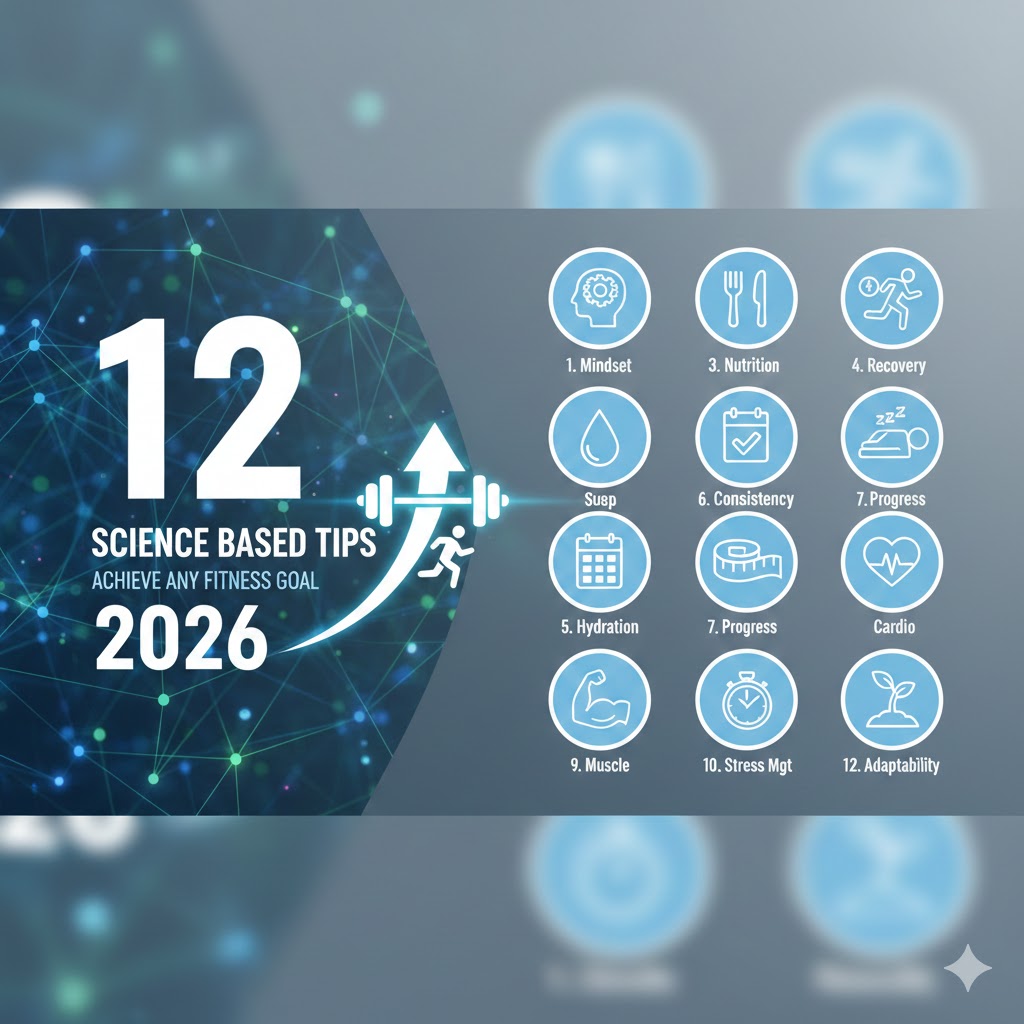
12 Science Based Tips Fitness advice is everywhere—but most of it is recycled, extreme, or disconnected from how the human body actually works. In 2026, achieving a fitness goal isn’t about grinding harder or following trends. It’s about alignment with biology, behavior science, and sustainability.
Whether your goal is fat loss, muscle gain, endurance, mobility, or overall health, these 12 Science Based Tips are built on research-backed principles that work across any fitness objective—without burnout or guesswork.
1. Define One Primary Goal at a Time
Science is clear: the body adapts best to specific demands. Trying to lose fat, gain muscle, train for endurance, and “get shredded” simultaneously leads to diluted results.
Choose one dominant goal for a training phase (8–16 weeks). Everything—training, nutrition, recovery—should support that single outcome. This focus is the foundation of all 12 Science Based Tips.
2. Train With Progressive Overload (Not Random Intensity)
Your body adapts only when it’s challenged slightly beyond its current capacity.
That means:
- Gradually increasing weight, reps, volume, or intensity
- Tracking workouts, not guessing
- Avoiding constant “random” workouts
Progressive overload applies to strength, endurance, and skill-based training. No overload = no adaptation.
3. Prioritize Consistency Over Motivation
Motivation is unreliable. Biology responds to repetition.
Studies consistently show that long-term fitness success depends more on:
- Habit formation
- Schedule stability
- Environmental design
Design workouts you can repeat even on low-energy days. Consistency beats intensity every time—one of the most underrated 12 Science Based Tips.
4. Eat Enough Protein—But Don’t Obsess
Protein supports muscle repair, fat loss, satiety, and recovery—but more isn’t always better.
Science supports:
- Adequate daily intake
- Even distribution across meals
- Context over timing perfection
Hitting your daily target matters far more than perfect shakes or timing windows.
5. Fuel Training, Don’t Starve It
Undereating is one of the fastest ways to stall progress.
Low energy availability leads to:
- Hormonal disruption
- Poor recovery
- Increased injury risk
- Plateaued results
Food is not the enemy. Strategic fueling supports every fitness goal, making this one of the most practical 12 Science Based Tips.
6. Sleep Is a Performance Enhancer, Not a Luxury
Sleep affects:
- Muscle growth
- Fat loss hormones
- Reaction time
- Injury risk
Less than 7 hours consistently impairs progress—no matter how perfect your workouts are.
If sleep isn’t prioritized, fitness goals become harder by default.
7. Manage Stress Like It’s Part of Training
Chronic stress interferes with:
- Muscle building
- Fat loss
- Recovery
- Motivation
High stress raises cortisol, which blocks adaptation. Walking, breathwork, downtime, and mental recovery are not optional extras—they’re biological necessities.
This is one of the most overlooked 12 Science Based Tips in modern fitness.
8. Use Strength Training for Almost Every Goal
Strength training isn’t just for muscle gain.
Research shows it improves:
- Fat loss efficiency
- Bone density
- Metabolic health
- Endurance performance
- Injury resilience
Regardless of your goal, some form of resistance training should be included.
9. Cardio Should Match Your Goal (Not Trends)
Cardio isn’t one-size-fits-all.
- Fat loss → moderate, sustainable cardio
- Endurance → structured aerobic base + intensity
- Health → regular low-to-moderate activity
Doing HIIT daily because it’s trendy often backfires. Match the tool to the goal—core logic behind these 12 Science Based Tips.
10. Track Progress Beyond the Scale
The scale is a blunt tool.
Better progress markers include:
- Strength improvements
- Measurements
- Energy levels
- Sleep quality
- Performance metrics
Science shows people stay consistent longer when progress is tracked in multiple ways—not just weight.
11. Adapt the Plan as Your Body Adapts
What worked at the start won’t work forever.
Plateaus are not failures—they’re signals.
Science-backed progress requires:
- Adjusting volume or intensity
- Changing stimulus
- Allowing deloads or recovery weeks
Rigid plans stall. Adaptive plans succeed.
12. Make Fitness Serve Your Life—Not Consume It
The best fitness plan is one that fits into real life.
Long-term studies show that sustainable routines outperform extreme ones—even if results come slower at first.
Fitness should enhance:
- Energy
- Confidence
- Health
- Longevity
If your plan makes life smaller, it won’t last. This final principle ties all 12 Science Based Tips together.
Frequently Asked Questions (FAQ)
Can these 12 Science Based Tips work for any fitness goal?
Yes. These principles apply to fat loss, muscle gain, endurance, health, and performance because they’re based on human physiology and behavior science.
Do I need supplements to reach my fitness goals?
No. Supplements can help in specific cases, but they are not required for success.
How long before I see results?
Most people notice measurable changes within 4–8 weeks when applying these tips consistently.
Is daily training necessary?
No. Recovery is part of progress. Many goals are achieved with 3–5 well-structured sessions per week.
What’s the biggest mistake people make in fitness?
Doing too much too soon, then quitting. Sustainability matters more than intensity.
Do these tips change with age or gender?
The principles stay the same, but recovery, volume, and nutrition should be individualized.
Final Thoughts
Fitness in 2026 isn’t about extremes—it’s about alignment with how the body actually adapts. These 12 Science Based Tips strip away noise and focus on what consistently works across goals, lifestyles, and fitness levels.
If you apply even half of them with patience and consistency, you won’t just reach your goal—you’ll build a system that keeps you there.
More Related Topics:
Chronic Stress Is Shrinking Your Brain: The Science Behind Workplace Burnout
Perimenopause at 35? Why It’s Happening Earlier Than You Think
Recovery Nutrition 2.0: Why Protein Timing Isn’t What We Thought