
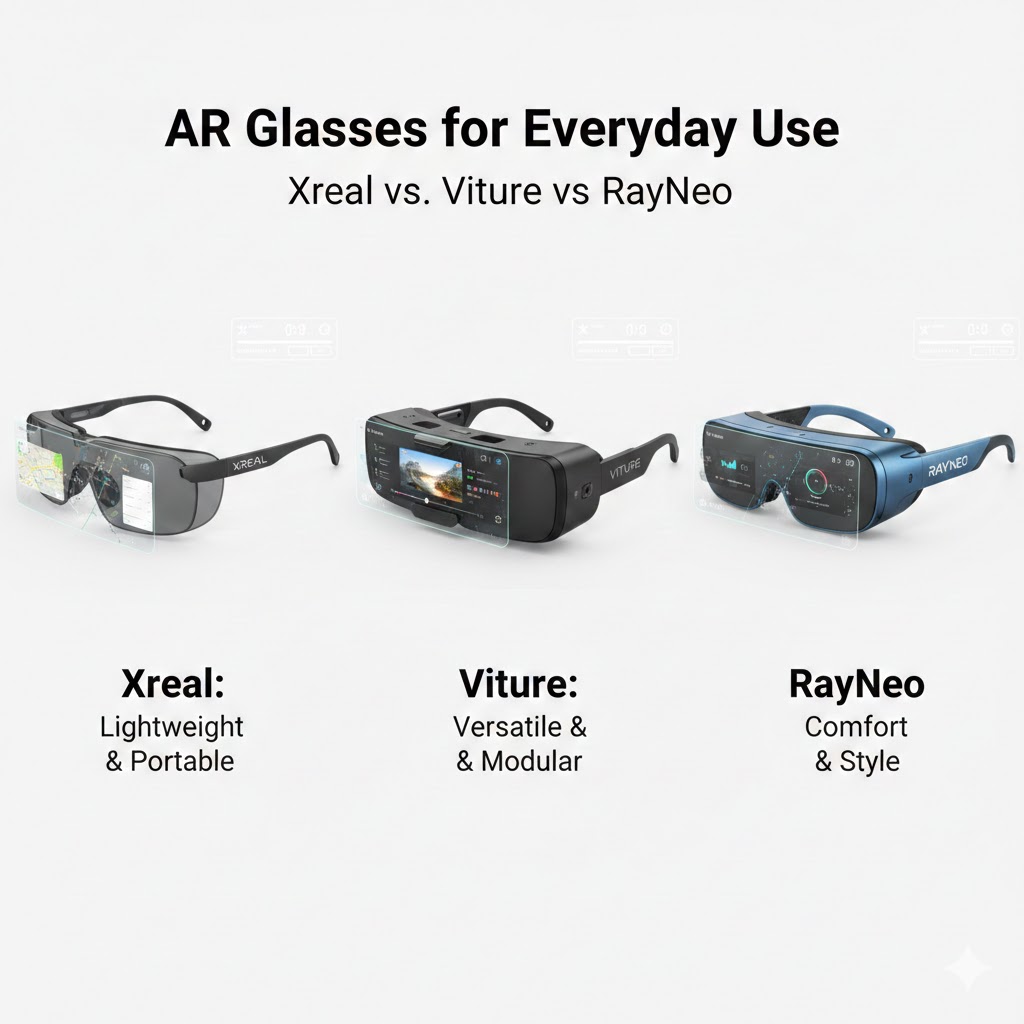
Imagine wearing technology that feels as natural as your favorite pair of sunglasses—but brings your digital world into view right in front of your eyes. That future is already here with AR Glasses for Everyday Use. These lightweight devices blend digital content with the real world, allowing you to watch media, navigate directions, take calls, and interact with apps without ever pulling out a phone.
As AR technology evolves, three brands are making waves for mainstream consumers: Xreal, Viture, and RayNeo. Each offers compelling features, style choices, and performance that could define how we use AR day-to-day. In this blog, we’ll explore the strengths and differences of these three options to help you understand which might fit your lifestyle best.
1. What Does AR Glasses for Everyday Use Mean?
When we talk about AR Glasses for Everyday Use, we’re talking about wearable devices you can comfortably use throughout your day for both work and entertainment. They aren’t bulky or limited to industrial settings like earlier AR iterations. Instead, they bridge real-world interactions with helpful digital overlays and immersive experiences.
Key expectations include:
- Comfortable all-day wear
- Clear visuals indoors and outdoors
- Easy connectivity with phones or computers
- Useful apps for productivity, navigation, and media
Now let’s see how Xreal, Viture, and RayNeo stack up.
2. Design and Comfort: Wearability Matters
One of the most important aspects of AR Glasses for Everyday Use is comfort.
Xreal glasses tend to be sleek and lightweight, designed for extended wear without strain. They look much like modern sunglasses, which makes them easy to use outdoors or in public without drawing attention.
Viture also focuses on a stylish, modern aesthetic. The frames are slightly more substantial but still wearable for long periods. Users often praise Viture for balancing tech and fashion.
RayNeo strives to deliver a minimal, tech-forward look. While slightly bulkier than traditional glasses, they distribute weight well and remain comfortable over many hours.
When it comes to design, think about how often you’ll wear your AR glasses and in what settings—style and comfort are key for daily use.
3. Display Quality: Seeing Digital Clearly
For AR to work well in everyday situations, the display has to be crisp, bright, and easy to read.
- Xreal displays are known for good clarity and vibrant colors, making them suitable for watching video content or reading notifications.
- Viture often focuses on a balance between resolution and brightness, which helps in both indoor and outdoor environments.
- RayNeo tends to emphasize sharp detail and wide viewing angles that enhance immersive experiences like watching movies or viewing maps.
Overall, the clarity of visuals is a cornerstone of enjoyable AR Glasses for Everyday Use—you want digital overlays that feel natural and unobtrusive.
4. Connectivity and Compatibility
Your AR glasses are only as powerful as the devices they connect to.
- Xreal glasses usually pair smoothly with Android devices and offer straightforward casting or screen mirroring. Some models extend compatibility to PCs as well.
- Viture focuses on seamless integration with smartphones and sometimes offers additional productivity tools for connected devices.
- RayNeo prides itself on broad compatibility, making it easy to pair with multiple device types whether you’re streaming content or interacting with apps.
Smooth connectivity ensures your AR glasses feel like a natural extension of your devices rather than a complicated accessory.
5. Everyday Use Cases: How You’ll Use AR Daily
Whether commuting, working, or relaxing, AR Glasses for Everyday Use become more valuable when they simplify routine tasks:
- Media and Entertainment – Watch videos on a large virtual screen
- Navigation – Get directions overlayed without looking at your phone
- Notifications – Glance at alerts without interrupting your workflow
- Fitness and Health Apps – Follow workout prompts in your field of view
- Work Productivity – View reference content or take calls while multitasking
Each brand adapts these use cases differently. Think about which daily habits you want to enhance—your choice may depend on that.
6. Battery Life and Performance
Battery life is a key factor for AR Glasses for Everyday Use because you want them to last through a typical day.
- Xreal tends to offer moderate battery life appropriate for media watching and productivity use.
- Viture aims for a balance between performance and endurance, letting you stay connected longer.
- RayNeo focuses on strong battery performance to support immersive experiences, but heavy use can drain power faster.
Always consider how long you’ll need your glasses to last between charges, especially if you plan to use them for work or travel.
7. Price and Value
Cost often reflects the balance between features and accessibility:
- Xreal models usually fall into a mainstream price range, making them attractive for first-time buyers.
- Viture may lean toward premium pricing with added style and features.
- RayNeo often delivers high performance that appeals to power users who want vivid visuals and strong connectivity.
When comparing prices, consider your priorities: style, performance, or everyday practicality.
8. Which AR Glasses for Everyday Use Should You Pick?
Here’s a quick way to think about your decision:
- Choose Xreal if you want a stylish, lightweight pair that’s easy to wear daily and balances performance with price.
- Choose Viture if you care about design and want a fashionable device with solid everyday functionality.
- Choose RayNeo if your priority is display quality and immersive use cases like media and multitasking.
All three brands are shaping the future of AR Glasses for Everyday Use, and each serves a slightly different audience depending on your lifestyle and priorities.
Frequently Asked Questions (FAQ)
What makes AR glasses suitable for everyday use?
AR glasses for everyday use are lightweight, comfortable, easy to connect with your phone or PC, and provide clear visual overlays that enhance daily activities like navigation, media, and notifications.
Can AR glasses replace smartphones?
Not entirely—but they can reduce your reliance on phones for quick tasks like viewing notifications, navigation, or media playback.
Are AR glasses safe to wear outdoors?
Yes, most AR glasses are designed for outdoor use, though brightness and visibility can vary depending on the model and lighting conditions.
Do I need a specific phone to use AR glasses?
Compatibility varies. Some focus on Android devices, others support broader connectivity with phones and PCs. Always check compatibility before buying.
How long can you use AR glasses on a single charge?
Battery life varies by model and usage patterns, but most AR glasses offer a few hours of continuous use before needing a recharge.
Is content available for AR glasses?
Yes—many apps and media platforms support casting or AR-specific features, and this ecosystem is growing as the technology becomes more mainstream.
Final Thoughts
AR Glasses for Everyday Use are ushering in a new way to interact with digital content—one that feels more natural and less intrusive than screens in your pocket. Whether you choose Xreal for all-day comfort, Viture for style, or RayNeo for immersive visuals, you’re stepping into the future of wearable tech. Each brand offers unique strengths, so your choice should reflect how you want to integrate AR into your daily routine.
Also read this:
AM5 vs LGA1851: Which Platform Should You Choose?
Sora AI Video Generator: Is It Better Than Runway
Workflow Automation Tools That Run Work on Autopilot in 2026