
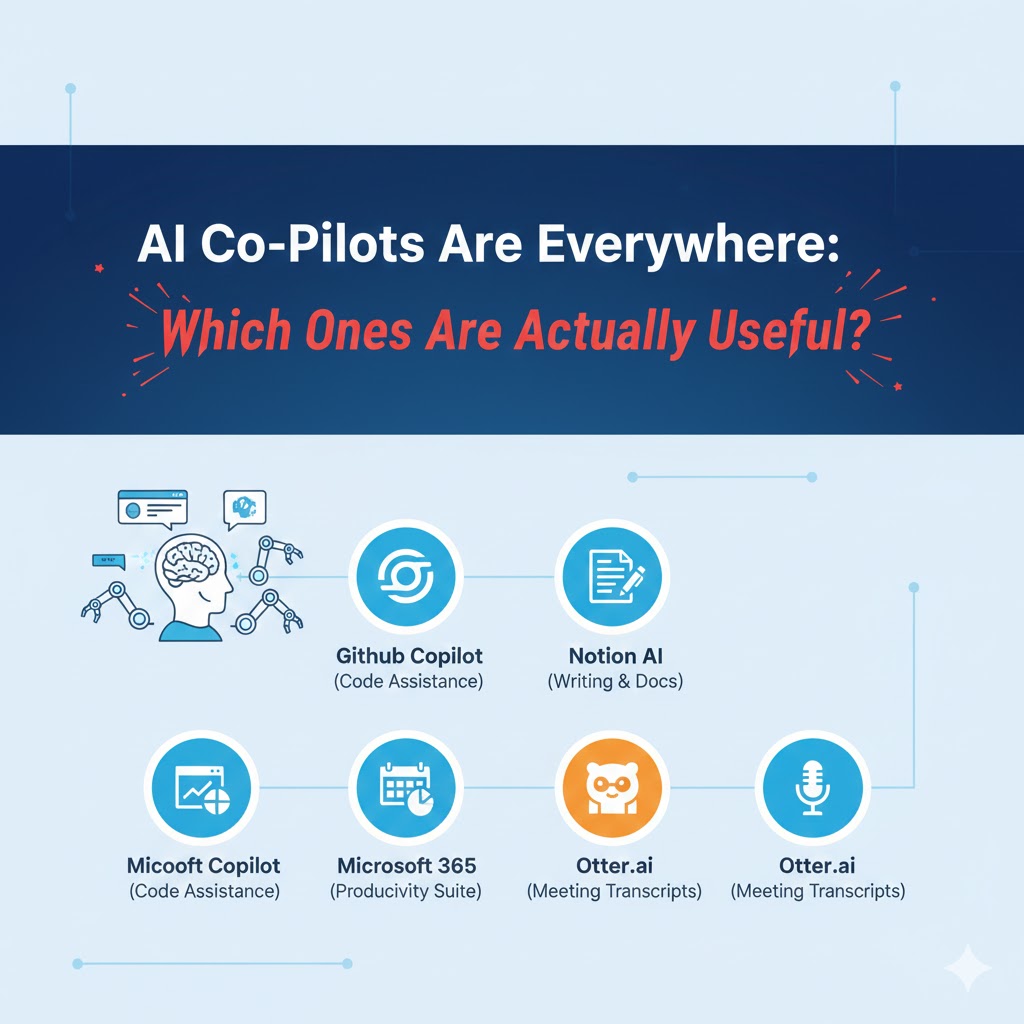
AI Co-Pilots Are Everywhere — in writing tools, coding platforms, business dashboards, design software, and even email inboxes. Almost every major tech product now claims to have an “AI co-pilot” that can think, assist, and work alongside you. But with so many options flooding the market, a critical question arises: which AI co-pilots genuinely improve productivity, and which ones are just marketing labels?
This article breaks down what AI co-pilots really are, where they provide real value, and how to identify the ones that are actually useful in everyday work.
What Is an AI Co-Pilot?
An AI co-pilot is a software assistant designed to work with a user rather than replace them. Instead of fully automating tasks, it supports decision-making, execution, and efficiency.
At a practical level, AI Co-Pilots Are Everywhere because they:
- Suggest actions instead of acting alone
- Assist with repetitive or cognitive-heavy tasks
- Learn from user behavior
- Integrate directly into existing tools
The key difference between a true co-pilot and basic automation is collaboration.
Why AI Co-Pilots Are Spreading So Fast
The rapid adoption of AI co-pilots is driven by demand for efficiency rather than novelty.
Major drivers include:
- Knowledge workers handling information overload
- Businesses aiming to reduce manual work
- AI models becoming more context-aware
- Seamless integration into existing workflows
Because of this, AI Co-Pilots Are Everywhere across industries rather than confined to tech alone.
AI Co-Pilots That Are Actually Useful
Not all co-pilots deliver the same value. The most effective ones fall into specific categories.
Productivity and Writing Co-Pilots
These co-pilots assist with drafting, editing, summarizing, and organizing information.
They are useful because they:
- Reduce blank-page friction
- Improve clarity and structure
- Summarize long documents quickly
- Adapt tone and format
They work best as collaborators, not replacements.
Coding and Technical Co-Pilots
Among the most effective AI co-pilots are those designed for developers.
They help with:
- Code suggestions and completion
- Debugging assistance
- Explaining unfamiliar code
- Speeding up routine development tasks
This is one area where AI Co-Pilots Are Everywhere and consistently deliver measurable productivity gains.
Business and Data Co-Pilots
These co-pilots assist with analysis and decision support rather than execution.
They typically provide:
- Data summaries
- Forecast suggestions
- Performance insights
- Natural-language queries for dashboards
Their value depends heavily on data quality and integration depth.
Customer Support and Operations Co-Pilots
AI co-pilots in support roles assist humans rather than fully replacing them.
They help by:
- Suggesting responses
- Summarizing tickets
- Highlighting urgent issues
- Reducing response time
When used properly, they enhance human judgment rather than override it.
AI Co-Pilots That Are Mostly Hype
Some co-pilots exist mainly to check a feature box.
Warning signs include:
- Generic responses with little context
- Poor integration with workflows
- Overpromising “autonomous” behavior
- Minimal learning from user input
When AI Co-Pilots Are Everywhere, it becomes easy to mistake presence for usefulness.
What Makes an AI Co-Pilot Truly Useful
A genuinely helpful AI co-pilot shares a few core traits.
Key qualities include:
- Deep integration into existing tools
- Context awareness
- Customization over time
- Clear boundaries and transparency
If a co-pilot saves time consistently, it’s useful. If it creates extra steps, it’s not.
Who Benefits Most from AI Co-Pilots
AI co-pilots are not equally valuable for everyone.
They provide the most benefit to:
- Knowledge workers
- Developers and analysts
- Marketers and writers
- Managers handling large information flows
People performing highly repetitive or cognitive-heavy tasks see the greatest gains.
Common Mistakes When Using AI Co-Pilots
Many users abandon co-pilots due to unrealistic expectations.
Common mistakes include:
- Expecting full automation
- Not providing enough context
- Using too many co-pilots at once
- Ignoring limitations
Understanding how to collaborate with AI is essential when AI Co-Pilots Are Everywhere.
The Future of AI Co-Pilots
AI co-pilots are evolving from assistants into decision-support partners.
Future developments are likely to include:
- Better memory and personalization
- Cross-tool coordination
- Proactive task suggestions
- Stronger privacy controls
The most valuable co-pilots will quietly enhance work rather than demand attention.
Frequently Asked Questions (FAQ)
Why are AI co-pilots suddenly everywhere?
Because AI models are now capable of contextual understanding and can integrate directly into tools people already use, making co-pilot features easier to deploy.
Are AI co-pilots replacing human workers?
No. Most AI co-pilots assist with execution and information processing, while humans remain responsible for judgment, creativity, and decisions.
Do AI co-pilots actually save time?
Yes, when properly integrated. The most effective co-pilots reduce repetitive work and decision fatigue rather than adding extra steps.
Are AI co-pilots safe to use with sensitive data?
It depends on the provider. Users should review data handling, storage, and privacy policies before using any co-pilot with confidential information.
Do I need technical skills to use AI co-pilots?
No. Most modern co-pilots are designed for non-technical users and rely on natural language interaction.
How do I know if an AI co-pilot is worth using?
If it saves time consistently, integrates smoothly, and improves output quality, it’s useful. If it feels distracting or redundant, it isn’t.
Will AI co-pilots keep improving?
Yes. As models gain better memory, reasoning, and personalization, co-pilots will become more effective and less intrusive.
Conclusion
AI Co-Pilots Are Everywhere, but usefulness varies widely. The best co-pilots act as quiet collaborators that reduce friction, enhance clarity, and support better decisions. The worst ones add noise without value. As AI continues to integrate into everyday software, the real winners will be tools that respect human judgment while making work noticeably easier.
Choosing the right co-pilot isn’t about hype — it’s about fit, context, and real productivity gains.
Also read this:
Top SaaS Tools Powered by AI That Are Exploding Right Now