
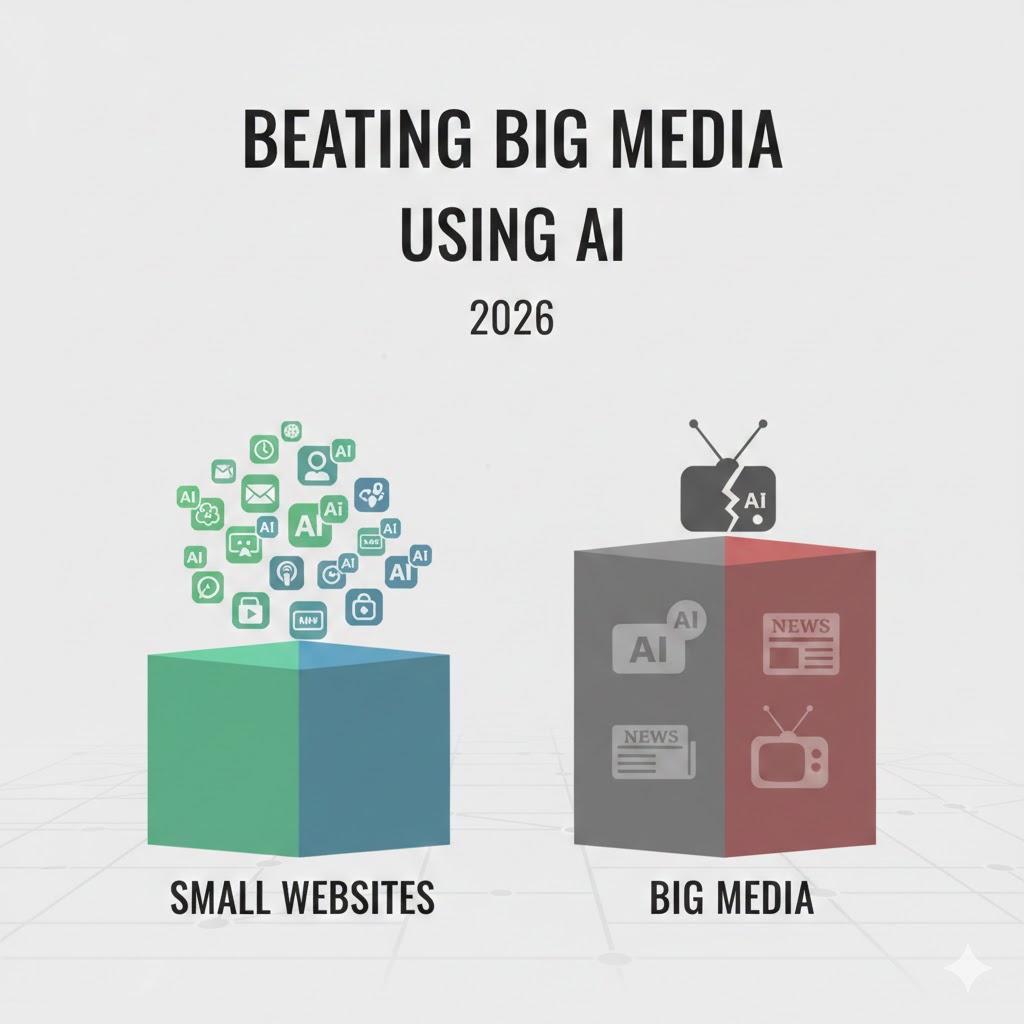
Small Websites Are Beating Big Media In 2026, the digital publishing landscape has shifted in a way few expected. Small, independent websites are now outperforming large media companies in traffic growth, search visibility, and monetization efficiency. This change is not driven by bigger budgets or larger teams, but by strategic use of artificial intelligence.
AI has leveled the playing field, allowing solo creators and small teams to compete with — and often outperform — traditional media giants that once dominated search results and online attention.
Why Big Media Is Losing Its Advantage
Small Websites Are Beating Big Media For years, large media organizations relied on scale: massive content teams, strong brand recognition, and high domain authority. However, these advantages have become less effective in the current search and content environment.
Structural weaknesses of big media
- Slow editorial workflows
- Generic, broad content designed for mass appeal
- Heavy reliance on ad revenue models
- Difficulty adapting quickly to algorithm changes
In contrast, search engines in 2026 prioritize relevance, depth, and user satisfaction over brand size. This has reduced the automatic advantage big publishers once had.
How AI Is Empowering Small Websites
Artificial intelligence tools now allow small websites to operate with the efficiency of large editorial teams.
Key AI-driven advantages
- Rapid content research and topic validation
- Faster publishing without sacrificing structure
- Content optimization for search intent
- Automated updates to keep content fresh
Instead of publishing hundreds of shallow articles, small websites are using AI to create highly focused, intent-driven content that directly answers user questions.
Search Engines Now Reward Precision Over Scale
Search algorithms in 2026 are heavily intent-focused. Rather than ranking pages based on brand authority alone, they evaluate how well content satisfies specific user needs.
Small websites excel here because they:
- Target narrow, high-intent queries
- Publish content for specific problems, not broad audiences
- Optimize for engagement rather than volume
AI helps identify low-competition queries that big media often ignores because they do not generate mass traffic at scale.
AI-Driven Content Is More Useful, Not Just Faster
Small Websites Are Beating Big Media A common misconception is that AI content is low quality. In reality, small websites using AI strategically produce more useful content than large publishers.
How AI improves content quality
- Summarizes complex information clearly
- Structures content for readability
- Identifies gaps in existing top-ranking pages
- Helps writers focus on clarity instead of filler
Big media often publishes surface-level content quickly to meet quotas, while AI-assisted small websites refine articles until they directly solve the reader’s problem.
Programmatic SEO Is Favoring Smaller Players
Programmatic SEO, once accessible only to large companies, is now widely used by small publishers through AI tools.
What small sites are doing differently
- Creating thousands of hyper-targeted pages
- Covering long-tail queries at scale
- Updating content dynamically based on trends
Big media struggles to implement this approach because of rigid editorial systems and brand guidelines. Small websites can test, iterate, and scale rapidly.
Monetization Is More Efficient on Small Sites
Small websites are not just getting traffic — they are converting it better.
Why monetization works better
- Traffic is highly targeted
- Content aligns closely with user intent
- Affiliate links feel contextual, not forced
- Less reliance on low-paying display ads
AI helps creators identify which content converts best and optimize internal linking, calls-to-action, and content placement accordingly.
AI Helps Small Sites Move Faster Than Algorithms
Search and social algorithms now change more frequently than ever. Big media reacts slowly due to internal approval layers, while small sites adapt immediately.
AI enables:
- Fast content refreshes
- Immediate optimization based on performance data
- Rapid testing of new formats and angles
Speed has become one of the most important competitive advantages in 2026 — and small websites win here consistently.
Authority Is Now Built Through Depth, Not Size
In 2026, authority is no longer about publishing everything. It is about owning a topic completely.
Small websites use AI to:
- Cover a niche end-to-end
- Build topical authority clusters
- Interlink content strategically
Big media sites often publish isolated articles across hundreds of topics, weakening topical relevance.
The Role of Human Judgment Still Matters
Small Websites Are Beating Big Media AI alone is not the reason small websites are winning. The real advantage comes from combining AI with human judgment.
Successful small publishers:
- Use AI for research, structure, and optimization
- Apply human insight for tone, experience, and accuracy
- Focus on solving real problems, not gaming algorithms
This hybrid approach produces content that feels both efficient and trustworthy.
What This Means for the Future of Publishing
The dominance of large media companies is no longer guaranteed. AI has removed many of the barriers that once prevented small websites from competing at scale.
In 2026:
- Niche expertise beats general authority
- Speed beats size
- Relevance beats brand recognition
Small websites that use AI intelligently are not just surviving — they are defining the next era of online publishing.
Conclusion
Small Websites Are Beating Big Media Small websites are beating big media in 2026 because AI has changed the rules. Content success is no longer about who has the biggest team or the most backlinks, but about who understands user intent, adapts fastest, and delivers the most value.
For creators willing to combine AI efficiency with focused strategy, this is the most powerful moment in the history of independent publishing.
Also read this:
How Early Trend Content Generates Long-Term Revenue in 2026