
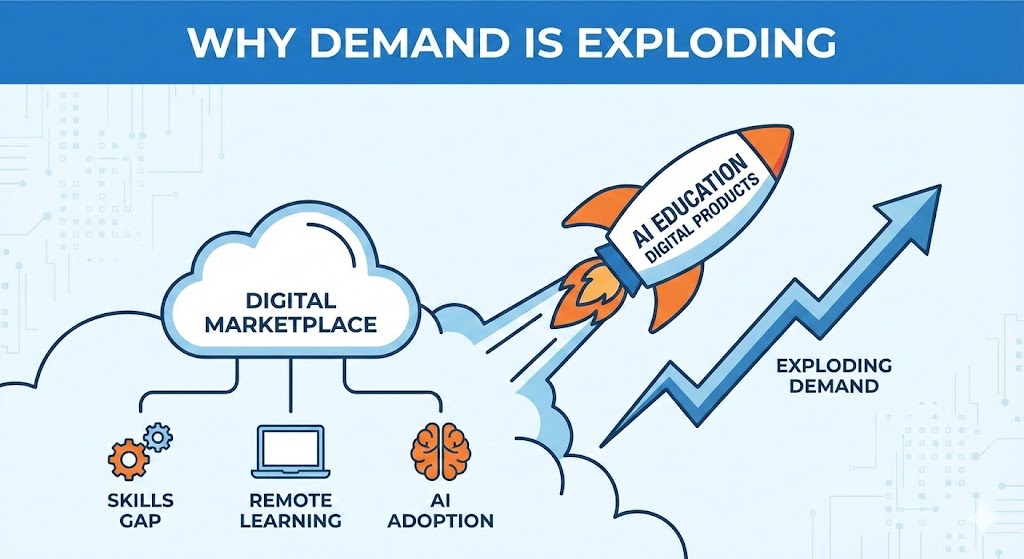
The artificial intelligence revolution has created an unprecedented demand for education that helps people understand, implement, and leverage these transformative technologies. This surge has positioned AI education as a digital product at the forefront of the online learning economy, with market projections suggesting exponential growth through the end of this decade. This comprehensive analysis explores why AI education demand is exploding, what makes it such a compelling digital product category, and how educators and entrepreneurs can successfully enter this lucrative market.
1. The Fundamental Drivers Behind AI Education Demand
Understanding why AI education as a digital product has become one of the fastest-growing segments in online learning requires examining the convergence of technological, economic, and societal factors creating this perfect storm of demand.
Rapid AI Technology Advancement
Artificial intelligence capabilities have progressed at breathtaking speed, with breakthrough developments occurring monthly rather than annually. Large language models, image generation systems, video synthesis tools, and autonomous agents have moved from research laboratories to everyday applications in remarkably short timeframes.
This rapid evolution creates continuous learning needs as professionals must constantly update their knowledge to remain current. Unlike more stable technology domains where skills retain relevance for years, AI developments create recurring demand for educational content that explains new capabilities, teaches emerging techniques, and helps users adapt to evolving best practices.
Workplace Integration Imperative
Organizations across every industry are integrating AI tools into core operations, creating urgent upskilling needs for existing workforces. Companies recognize that competitive advantage increasingly depends on how effectively their teams leverage AI capabilities, driving substantial investment in employee training and development.
This corporate demand extends beyond technical roles to include marketing professionals using AI writing tools, designers working with generative image systems, analysts employing AI-powered data platforms, and managers needing to understand AI implications for their departments. The breadth of workplace integration creates educational opportunities spanning skill levels and job functions.
Career Advancement and Job Security
Individual professionals recognize that AI literacy has become essential for career advancement and job security. Understanding how to work alongside AI systems, prompt them effectively, evaluate their outputs, and integrate them into workflows now represents a fundamental workplace competency comparable to computer literacy in previous decades.
This recognition drives millions of professionals to seek AI education independently, creating a massive consumer market beyond corporate training budgets. The fear of obsolescence combined with the opportunity to gain competitive advantages motivates substantial personal investment in AI skills development.
Entrepreneurial Opportunity Recognition
The AI revolution has spawned countless business opportunities for those who understand how to leverage these technologies effectively. Entrepreneurs recognizing opportunities in AI-powered products, services, consulting, and implementation are actively seeking education that helps them capitalize on emerging market needs.
This entrepreneurial demand favors practical, application-focused educational content over theoretical academic approaches, creating opportunities for educators who can bridge the gap between AI capabilities and business implementation.
2. The Digital Product Advantages of AI Education
AI education as a digital product offers unique advantages that make it particularly attractive for content creators, course developers, and educational entrepreneurs compared to other subject matter domains.
Scalability Without Diminishing Returns
Digital AI education products can serve unlimited students without significant marginal costs or quality degradation. A comprehensive course on prompt engineering or AI implementation strategies delivers the same value to the thousandth student as it did to the first, while production costs remain fixed.
This scalability enables creators to build substantial businesses from single products that continue generating revenue long after initial development. Unlike consulting or in-person training where income directly correlates with hours worked, digital products create leverage that allows income to exceed time investment dramatically.
Premium Pricing Justification
The immediate career and business value of AI skills justifies premium pricing that often exceeds rates for generic business or personal development courses. Students recognize that mastering AI tools can generate rapid returns through increased productivity, career advancement, or business opportunities, making them willing to invest significantly in high-quality education.
Specialized AI education products regularly command prices ranging from several hundred to several thousand dollars, with corporate licensing deals extending into five and six figures for comprehensive training programs. This pricing power creates exceptional revenue potential per customer compared to low-margin content categories.
Rapid Content Development Possibilities
Ironically, AI tools themselves accelerate the creation of AI education content. Educators can leverage large language models for research, content outlining, script drafting, and editing. They can use AI image generators for visual assets, video tools for production enhancement, and automation systems for course platform management.
This efficiency allows creators to produce comprehensive educational products in weeks rather than months, enabling quick market entry and rapid iteration based on student feedback and emerging AI developments.
Built-In Content Update Justification
The rapidly evolving nature of AI creates natural opportunities for updated versions, new editions, and supplementary content that extends product lifetime value. Students expect and accept that AI education requires regular updates to remain current, creating ongoing engagement and additional revenue opportunities through updated courses, membership communities, or subscription models.
3. Market Segments and Audience Targeting
The explosion of interest in AI education as a digital product spans diverse market segments, each with distinct needs, pain points, and willingness to pay for solutions.
Business Professionals Seeking Competitive Advantage
Marketing professionals need AI writing and content generation skills. Sales teams want to understand AI-powered prospecting and personalization. Project managers require knowledge of AI productivity tools. This segment values practical application over technical depth, preferring courses that demonstrate immediate workplace application.
Educational products targeting business professionals emphasize time savings, output quality improvements, and competitive positioning rather than technical fundamentals or programming concepts. Case studies showing real business results and templates for immediate implementation resonate strongly with this audience.
Technical Professionals Building AI Systems
Software developers, data scientists, and machine learning engineers represent a distinct segment seeking deeper technical knowledge about AI architectures, training methodologies, fine-tuning techniques, and system integration approaches. This audience values rigorous content covering mathematical foundations, coding implementations, and system design patterns.
Products for technical audiences command premium pricing when they provide genuine depth beyond freely available documentation, offering insights from practitioners with real-world implementation experience, advanced techniques not widely published, and comprehensive examples demonstrating production-ready approaches.
Entrepreneurs and Business Owners
Founders and business owners approach AI education seeking understanding of opportunities, threats, implementation strategies, and competitive positioning. They need education that bridges technical concepts and business strategy, helping them make informed decisions about AI investments and integrations.
This segment responds to content emphasizing business model implications, competitive dynamics, implementation frameworks, vendor evaluation criteria, and strategic positioning rather than hands-on technical skills or tool-specific training.
Career Transitioners and Students
Individuals seeking to enter AI-focused careers represent a substantial market for comprehensive foundational education. This segment needs structured learning paths covering fundamentals through advanced concepts, portfolio development guidance, and career positioning strategies.
Products serving career transitioners succeed through comprehensive curricula, practical project components that build portfolios, community support that maintains motivation, and career services that facilitate employment outcomes.
4. Content Formats and Delivery Models
Success in delivering AI education as a digital product requires selecting appropriate formats and models that match audience preferences, content complexity, and business objectives.
Self-Paced Video Courses
Pre-recorded video courses remain the dominant format for AI education, offering students flexibility while providing creators with scalable delivery. Effective video courses combine conceptual explanations, screen-captured demonstrations, practical examples, and visual aids that clarify complex topics.
The self-paced model suits both creators and students, allowing production on manageable timelines while enabling learners to progress according to their schedules and learning speeds. Platform choices like Teachable, Thinkific, or Kajabi provide infrastructure for course hosting, payment processing, and student management without technical complexity.
Interactive Coding Environments
For technical AI education, interactive environments where students write and execute code within the learning platform dramatically improve engagement and learning outcomes. Platforms like Jupyter notebooks, Google Colab, or specialized learning management systems with integrated development environments enable hands-on practice essential for technical skill development.
These interactive components transform passive content consumption into active learning experiences where students experiment with AI models, modify parameters, observe results, and develop intuition about how systems behave under different conditions.
Membership Communities and Cohorts
Subscription-based membership models create ongoing relationships with students rather than one-time transactions. Members receive regular content updates, community access, live sessions, and continuous learning opportunities that justify recurring payments.
Cohort-based models where groups progress through content together create accountability, peer learning, networking opportunities, and higher completion rates than purely self-paced approaches. The combination of structure and community often justifies premium pricing while delivering superior student outcomes.
Workshops and Bootcamps
Intensive short-format programs concentrating learning into days or weeks attract students seeking rapid skill acquisition without long-term commitments. AI workshops focusing on specific applications or tools provide immediate practical value while requiring less content development than comprehensive courses.
Bootcamp models combining instruction, projects, mentorship, and career services command premium pricing by delivering transformative outcomes in compressed timeframes. The intensive format creates urgency and commitment that drives higher completion rates and stronger results than extended programs.
5. Creating High-Value AI Education Products
Standing out in the expanding market requires creating AI education as a digital product that delivers exceptional value through careful design, comprehensive coverage, and genuine expertise.
Curriculum Development Frameworks
Effective AI education follows clear learning progressions from foundational concepts through advanced applications. Begin with essential context explaining what AI is, how it works conceptually, and why it matters. Progress to hands-on skill development with specific tools and techniques. Advance to complex applications, integration strategies, and sophisticated use cases.
Each learning module should include conceptual explanations, demonstrations, guided practice opportunities, independent exercises, and knowledge checks that ensure comprehension before progression. This structured approach prevents knowledge gaps while building confidence through incremental skill development.
Balancing Theory and Practice
Students need sufficient theoretical foundation to understand AI capabilities and limitations without becoming overwhelmed by technical complexity unnecessary for their applications. The optimal balance depends on audience sophistication, with business users requiring minimal technical depth while developers need rigorous coverage of underlying mechanisms.
Practical application should dominate content, with theory introduced only as necessary to support effective use. Demonstrations using real tools, examples from actual projects, and exercises that mirror authentic work scenarios create relevance that maintains engagement and facilitates knowledge transfer.
Production Quality Standards
While content substance matters most, production quality significantly impacts perceived value and learning effectiveness. Clear audio without background noise or inconsistencies, well-lit video that maintains visual interest, organized presentations that guide attention appropriately, and professional editing that removes errors and pacing issues all contribute to student satisfaction.
Investment in reasonable production equipment including quality microphones, lighting, screen recording software, and video editing tools pays dividends through enhanced student experience and reduced refund rates. However, obsessive pursuit of perfection shouldn’t delay product launches, as content value ultimately determines success more than production polish.
Community and Support Infrastructure
Student support infrastructure distinguishes premium offerings from basic content libraries. Discussion forums where students help each other, regular office hours where instructors address questions, feedback on student projects, and community networking opportunities all enhance perceived and actual value.
Building vibrant learning communities creates network effects where student interactions generate value beyond instructor-provided content. Active communities also provide social proof that attracts new students while increasing completion rates and satisfaction among existing participants.
6. Marketing and Positioning Strategies
Converting market demand into actual sales requires strategic marketing that positions AI education as a digital product effectively against expanding competition.
Content Marketing and Organic Authority
Publishing valuable free content establishes expertise, builds audience trust, and drives organic traffic that converts into course enrollments. Blog posts explaining AI concepts, YouTube tutorials demonstrating tools, podcasts interviewing AI practitioners, and social media content sharing insights all attract potential students while showcasing teaching ability.
Content marketing for AI education proves particularly effective because the topic naturally generates curiosity and shares well across social platforms. Thoughtful content that genuinely helps people understand or use AI builds audiences that become customers when ready for comprehensive paid education.
Strategic Partnerships and Affiliates
Collaborating with complementary creators, tools, and platforms expands reach while adding credibility. Guest appearances on established podcasts, co-marketing with AI tool providers, affiliate relationships with relevant newsletters or communities, and partnerships with corporate training providers all create distribution channels beyond your direct audience.
AI tool companies often welcome educational partnerships because quality training increases user success and retention. These relationships can provide affiliate income, co-marketing opportunities, early access to new features, and even joint product development that benefits both parties.
Social Proof and Case Studies
Demonstrating tangible student outcomes through testimonials, case studies, and success stories provides the evidence potential customers need to justify investment. Document how students applied learning to career advancement, business growth, productivity improvements, or skill development with specific metrics when possible.
Video testimonials where students describe their experience and results carry particular weight, as do detailed case studies showing before-and-after scenarios that illustrate transformative impact. Building systems for collecting and showcasing student wins should be integral to product development rather than marketing afterthoughts.
Launch Strategies and Urgency Creation
Well-orchestrated product launches generate concentrated sales momentum that boosts visibility and creates psychological triggers motivating purchases. Limited-time pricing, early-bird discounts, exclusive bonuses for launch participants, and cohort deadlines all create urgency that converts interested prospects into paying customers.
Launch strategies work particularly well for AI education because the rapid pace of development creates genuine time sensitivity. Students recognize that delaying AI skill development has real opportunity costs as competitors advance and market positions shift.
7. Monetization Models and Pricing Psychology
Optimizing revenue from AI education as a digital product requires thoughtful consideration of pricing strategies, payment structures, and value perception that maximizes both sales volume and customer lifetime value.
Premium Pricing Justification
AI education justifies premium pricing because students can clearly connect learning investments to financial returns. A course teaching AI implementation might cost fifteen hundred dollars but enable productivity improvements worth tens of thousands annually, making the value proposition compelling.
Position pricing relative to alternatives rather than arbitrary numbers. Compare course investment to traditional education costs, consulting fees, or the value of productivity gains to frame pricing as obviously worthwhile. Emphasize transformation and outcomes rather than content volume or production effort.
Tiered Product Offerings
Creating multiple product tiers serves different customer segments while maximizing revenue across varying willingness to pay. Basic tiers might offer core content, mid-tiers add community access and live sessions, and premium tiers include personalized support, project feedback, or implementation assistance.
Tiered structures also create natural upsell paths where customers enter at comfortable price points and upgrade as they recognize value. This approach captures customers across the price sensitivity spectrum rather than forcing single all-or-nothing purchase decisions.
Subscription and Membership Models
Recurring revenue models create business stability while aligning incentives toward continuous value delivery. Monthly or annual memberships for ongoing AI education, regular content updates, community access, and live learning sessions justify subscription costs while building predictable income streams.
The rapidly evolving AI landscape particularly suits subscription models because staying current requires continuous learning. Position memberships as essential for maintaining competitive AI knowledge rather than one-time educational events.
Corporate and Enterprise Licensing
Business-to-business sales targeting corporate training budgets offer substantially higher revenue per customer than individual consumer sales. Develop enterprise licensing options with features like multiple user seats, usage analytics, custom content integration, and dedicated support that justify premium pricing.
Corporate customers value different aspects than individual learners, prioritizing deployment ease, progress tracking, certification, and ROI measurement over community or individual attention. Tailoring offerings to corporate needs creates opportunities for five and six-figure deals from single customers.
8. Sustaining Success in an Evolving Market
Long-term success selling AI education as a digital product requires adapting to market evolution, technology advancement, and competitive dynamics while maintaining quality and relevance.
Continuous Content Evolution
The rapid pace of AI development demands regular content updates maintaining accuracy and relevance. Establish systematic processes for monitoring AI developments, evaluating which changes require content updates, and efficiently producing refreshed material without complete course overhauls.
Transparent communication about updates demonstrates commitment to student success while justifying ongoing product value. Frame updates as valuable bonuses rather than admissions of outdated original content, emphasizing that dynamic currency proves the field’s importance and your dedication to excellence.
Building Educational Platforms
Transitioning from individual products to comprehensive platforms creates defensible competitive advantages through brand recognition, network effects, and customer stickiness. A platform offering multiple courses, learning paths, certifications, community, and resources becomes increasingly valuable as it grows, creating moats against competition.
Platform development requires significant investment but generates compounding returns as content library, community size, and brand authority reinforce each other. Students choosing between similar individual courses select based on price and features, but platforms competing on ecosystem value follow different dynamics favoring established players.
Cultivating Expert Status
Positioning yourself as a recognized AI education authority extends beyond course quality to include thought leadership, media presence, speaking engagements, and community influence. Publishing insights, contributing to industry discussions, speaking at conferences, and building social media following all reinforce expert status that drives premium pricing and customer acquisition.
Expert positioning creates self-reinforcing cycles where visibility generates opportunities for more visibility, and perceived authority attracts students who specifically seek learning from recognized leaders. Investment in authority building pays dividends across all business aspects from pricing power to partnership opportunities.
Data-Driven Optimization
Systematic analysis of student behavior, learning outcomes, engagement patterns, and business metrics enables continuous improvement of both educational effectiveness and commercial performance. Track completion rates, knowledge retention, student satisfaction, and career outcomes to identify content strengths and weaknesses.
Business metrics including customer acquisition costs, lifetime value, refund rates, and conversion funnels reveal opportunities for marketing and sales optimization. Data-informed decisions about product development, pricing, marketing, and support allocation drive superior returns compared to intuition-based approaches.
Conclusion
The explosive demand for AI education as a digital product represents a transformative opportunity for educators, entrepreneurs, and content creators with expertise to share. The convergence of rapid technological advancement, workplace integration, career implications, and entrepreneurial possibilities has created a market that will likely sustain growth for years as artificial intelligence becomes increasingly central to professional and personal life.
Success in this space requires more than jumping on a trend. Creating valuable AI education demands genuine expertise, commitment to student outcomes, production quality, strategic marketing, and continuous evolution matching the pace of technological change. Those approaching AI education as a serious business rather than a quick money grab position themselves for sustainable success in an expanding market.
The competitive dynamics favor those who establish positions early, build authority systematically, create comprehensive offerings, and develop loyal student communities. While the market will inevitably mature and competition intensifies, the fundamental demand drivers suggest that AI education will remain a premium category where quality offerings command strong pricing and generate substantial revenue.
Whether you’re an AI practitioner considering education as a business, an educator exploring new subject matter, or an entrepreneur seeking opportunities in growing markets, AI education offers compelling prospects. The key lies in identifying your unique expertise, understanding specific audience needs, creating genuinely valuable learning experiences, and building sustainable businesses that grow alongside the AI revolution transforming every aspect of modern life.
Also read this:
Tech Courses Outperform Generic Online Courses: Why Specialized Training Wins Every Time