
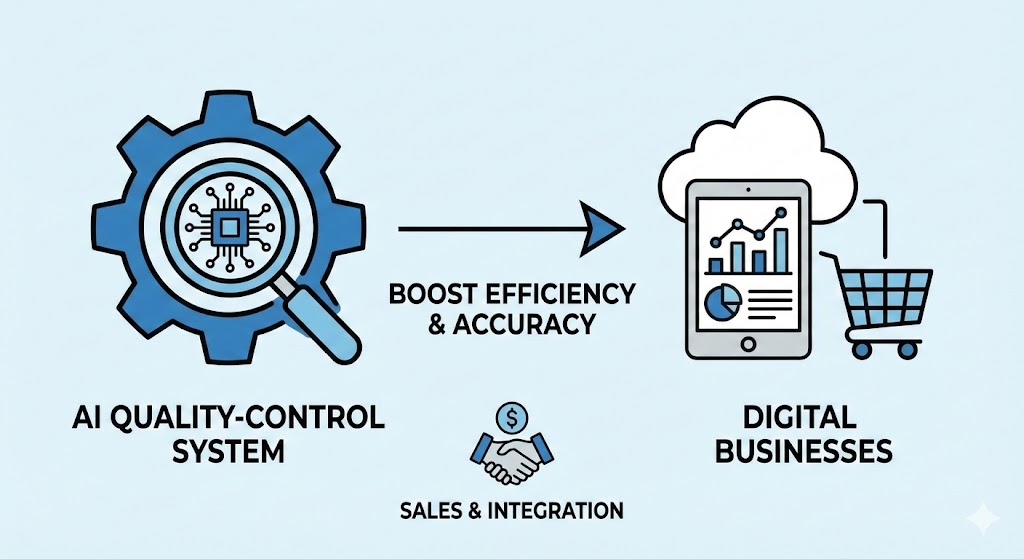
Selling AI Quality-Control Systems The digital business landscape has transformed dramatically over the past decade, creating unprecedented opportunities for companies that provide intelligent solutions. Among these opportunities, Selling AI Quality-Control Systems has emerged as one of the most lucrative and strategically important markets. Digital businesses operate at speeds and scales that make traditional quality control methods obsolete, creating a perfect environment for AI-powered solutions that can maintain standards while keeping pace with digital velocity.
Understanding how to effectively position, present, and sell these sophisticated systems requires deep insight into both the technology and the unique challenges digital businesses face. This comprehensive guide explores proven strategies for successfully selling AI quality-control solutions to digital enterprises across various sectors.
1. Understanding the Digital Business Quality Challenge
Before you can effectively sell AI quality-control systems, you must deeply understand the specific quality challenges that digital businesses encounter. These challenges differ significantly from traditional industries and require specialized approaches.
The Speed-Quality Paradox
Digital businesses operate in real-time environments where delays of even seconds can result in lost customers and revenue. They must deploy updates continuously, respond to customer inquiries instantly, and process transactions without hesitation. This speed imperative creates constant tension with quality requirements. Your sales approach should emphasize how AI systems resolve this paradox by providing instant quality verification that matches operational velocity.
Scale Beyond Human Capacity
A single digital business might process millions of transactions daily, serve content to global audiences simultaneously, and manage customer interactions across dozens of channels. Human quality control teams simply cannot review everything at this scale. When Selling AI Quality-Control Systems, emphasize how AI scales effortlessly from thousands to millions of quality checks without adding headcount or creating bottlenecks.
Complexity of Digital Ecosystems
Modern digital businesses comprise interconnected systems, third-party integrations, microservices architectures, and cloud infrastructures spanning multiple providers. Quality issues can emerge from countless interaction points. AI quality-control systems excel at monitoring these complex ecosystems, identifying problems that would be invisible to human observers reviewing individual components.
Cost of Digital Quality Failures
Quality failures in digital environments cascade rapidly and publicly. A website bug becomes visible to all users instantly. A payment processing error affects thousands of transactions. A content moderation failure creates viral social media backlash. Quantifying these costs helps digital businesses understand the value proposition of preventive quality control.
2. Identifying High-Value Digital Business Prospects
Not all digital businesses have equal need for AI quality-control systems. Successful sales strategies focus on prospects where quality control represents critical business challenges and where AI solutions deliver maximum value.
E-Commerce and Online Retail
E-commerce businesses face quality challenges across product listings, pricing accuracy, checkout processes, inventory management, and customer communications. They’re excellent prospects because quality issues directly impact conversion rates and revenue. When approaching these prospects, focus on how AI quality control prevents the specific errors that lose sales: incorrect product information, broken checkout flows, and pricing mistakes.
Software-as-a-Service Companies
SaaS businesses stake their reputations on reliability and user experience. They’re typically sophisticated technology buyers who understand AI value propositions. Selling AI Quality-Control Systems to SaaS companies requires demonstrating how your solution integrates with their development pipelines, monitors production environments, and maintains service quality at scale.
Digital Media and Content Platforms
Content platforms managing user-generated content, streaming services, and digital publishing operations need quality control for content moderation, metadata accuracy, recommendation systems, and platform performance. These prospects often have existing quality teams that are overwhelmed, making them receptive to AI augmentation.
Financial Technology Companies
Fintech businesses operate under strict regulatory requirements while serving customers who demand flawless digital experiences. Quality failures can trigger regulatory penalties, financial losses, and security breaches. These high-stakes environments make fintech companies willing to invest significantly in quality assurance, creating premium sales opportunities.
Digital Marketing and Advertising Platforms
Marketing technology companies manage campaigns across multiple channels, optimize creative assets, and ensure brand safety. They need quality control for ad placement, campaign performance, creative compliance, and brand alignment. These businesses understand ROI measurement, so sales approaches should emphasize measurable quality improvements and efficiency gains.
3. Building Compelling Value Propositions
The key to successfully Selling AI Quality-Control Systems lies in articulating value propositions that resonate with digital business priorities. Generic quality improvement messages don’t compel action; specific, quantifiable benefits do.
Revenue Protection and Enhancement
Digital businesses care intensely about revenue impact. Frame your quality-control system not as a cost center but as a revenue protection and enhancement tool. Calculate how preventing checkout errors increases conversion rates, how faster bug detection reduces customer churn, and how quality improvements enhance customer lifetime value. Use specific examples and case studies that show revenue impact.
Operational Efficiency and Cost Reduction
Quality control traditionally requires substantial human resources. AI systems dramatically reduce the headcount needed for quality assurance while improving consistency and coverage. Present detailed analyses showing how your system reduces manual testing time, eliminates repetitive quality checks, and allows quality teams to focus on strategic initiatives rather than routine verification.
Risk Mitigation and Compliance
For regulated digital businesses, quality failures create compliance risks with potentially severe penalties. Position your AI quality-control system as essential risk management infrastructure. Document how the system ensures regulatory compliance, creates audit trails, and prevents the quality failures that trigger regulatory scrutiny.
Competitive Advantage Through Superior Quality
In crowded digital markets, quality often differentiates leaders from followers. Help prospects understand how superior quality control enables better customer experiences, faster innovation cycles, and stronger market positions. Quality becomes a competitive weapon rather than merely a defensive necessity.
4. Demonstrating Technical Capability and Integration
Digital businesses evaluate quality-control solutions based on technical merit and implementation feasibility. Your sales process must address technical considerations comprehensively while remaining accessible to business stakeholders.
Seamless Integration Capabilities
Digital businesses won’t adopt solutions that require major infrastructure changes or create integration nightmares. Demonstrate how your AI quality-control system integrates with existing tools, supports standard APIs and protocols, and fits naturally into current workflows. Provide specific integration examples with popular platforms your prospects use.
Real-Time Processing and Responsiveness
Digital operations happen in real-time, so quality control must keep pace. Showcase your system’s processing speed, latency characteristics, and ability to provide instant feedback. Use live demonstrations showing quality checks completing in milliseconds rather than minutes, proving that quality control won’t slow operations.
Scalability and Performance Under Load
Prospects need confidence that your system will perform reliably as their business grows. Present architecture details demonstrating horizontal scalability, discuss how the system handles traffic spikes, and provide performance benchmarks at various scales. Include case studies from customers who’ve successfully scaled your solution.
Customization and Adaptability
Every digital business has unique quality requirements. While emphasizing that your system works effectively out-of-the-box, demonstrate customization capabilities that allow adaptation to specific needs. Show how businesses can define custom quality rules, adjust sensitivity thresholds, and train the AI on their specific quality standards.
5. Crafting Effective Sales Presentations
Presentations for Selling AI Quality-Control Systems must balance technical sophistication with business clarity. Your audience typically includes both technical evaluators and business decision-makers with different priorities and knowledge levels.
Lead with Business Impact
Begin presentations with business outcomes rather than technical features. Show how quality control improvements translate to revenue gains, cost savings, and risk reduction. Use compelling statistics, customer success stories, and industry benchmarks that resonate with business priorities.
Progressive Technical Disclosure
Structure technical content to progressively reveal complexity. Start with high-level capability overviews, then dive deeper based on audience interest and questions. This approach keeps business stakeholders engaged while satisfying technical evaluators who need implementation details.
Live Demonstrations Over Static Slides
Nothing sells AI quality-control systems more effectively than watching them work. Develop live demonstrations using realistic scenarios relevant to your prospect’s business. Show the system detecting quality issues in real-time, providing actionable insights, and adapting to new quality patterns. Interactive demonstrations create conviction that static presentations cannot match.
Addressing Common Objections Proactively
Digital businesses have predictable concerns about AI quality-control systems: accuracy concerns, integration complexity, change management challenges, and cost justification. Address these objections proactively in your presentation before prospects raise them. Providing reassurance early builds confidence and maintains momentum.
6. Leveraging Proof Points and Social Proof
Trust is essential when Selling AI Quality-Control Systems because prospects are betting their quality standards on your technology. Social proof and validated results accelerate trust-building and decision-making.
Customer Case Studies with Quantified Results
Develop detailed case studies showing how existing customers use your system and the measurable results they’ve achieved. Include specific metrics: percentage reduction in quality escapes, time savings in quality assurance processes, revenue impact from quality improvements, and ROI calculations. Quantified results are far more persuasive than general success claims.
Industry-Specific Success Stories
Digital businesses want evidence that your solution works for companies like theirs. Create case studies and references segmented by industry, company size, and use case. When selling to an e-commerce company, lead with e-commerce success stories. When approaching SaaS businesses, showcase SaaS implementations.
Third-Party Validation and Certifications
Independent validation increases credibility significantly. Pursue industry certifications, security audits, performance benchmarks from recognized testing organizations, and analyst recognition. These third-party endorsements provide objective credibility that supplements your sales claims.
Customer Reference Programs
Willing customer references who’ll speak with prospects about their experiences provide invaluable social proof. Develop a structured reference program with customers who’ve achieved strong results and are comfortable sharing their stories. Schedule reference calls strategically during the sales process when prospects need additional conviction.
7. Structuring Pricing and Commercial Terms
Pricing strategy significantly impacts success when Selling AI Quality-Control Systems. Digital businesses have particular pricing preferences and evaluation criteria that should inform your commercial approach.
Value-Based Pricing Models
Tie pricing to the value your system delivers rather than cost-plus formulas. If your quality-control system saves a prospect one million dollars annually in prevented quality failures, pricing at a fraction of that value becomes an easy decision. Develop pricing models that scale with customer value realization.
Flexible Subscription Options
Digital businesses prefer subscription pricing that aligns costs with usage and business growth. Offer tiered subscription plans based on transaction volumes, user counts, or feature access. Monthly subscriptions reduce initial commitment barriers, while annual contracts with discounts encourage long-term relationships.
Pilot Programs and Proof-of-Value Trials
Prospects often hesitate to commit fully without validating results in their environment. Structured pilot programs allow prospects to test your system with real data and workflows before full deployment. Design pilots with clear success criteria and defined timelines that naturally progress to full implementations.
ROI Guarantees and Performance Commitments
For significant deals, consider offering ROI guarantees or performance commitments that reduce perceived risk. Guaranteeing specific quality improvement metrics or efficiency gains demonstrates confidence in your solution and can accelerate decisions with risk-averse prospects.
8. Navigating Complex Sales Processes
Selling AI Quality-Control Systems to digital businesses typically involves multiple stakeholders, extended evaluation periods, and complex decision processes. Understanding and managing these dynamics increases win rates significantly.
Identifying All Decision Makers
Digital business purchases involve diverse stakeholders: engineering leaders evaluating technical capabilities, quality directors assessing functional fit, finance teams reviewing costs, security teams examining risks, and executives making final approvals. Map all stakeholders early and develop engagement strategies for each.
Building Internal Champions
Successful sales require internal champions who advocate for your solution within their organization. Identify potential champions early—typically quality leaders or engineering managers who understand the problem deeply and see value in your solution. Equip champions with materials, data, and arguments they need to sell internally.
Managing Procurement and Legal Reviews
Enterprise sales involve procurement processes, contract negotiations, and legal reviews that can extend timelines significantly. Anticipate these phases and prepare accordingly. Have standard contract templates, security documentation, and compliance certifications ready to expedite reviews.
Maintaining Momentum Through Long Cycles
Digital business sales cycles can extend months. Maintain engagement through regular touchpoints, progressive value demonstrations, and milestone-based progress. Create urgency by tying decisions to business events like product launches, compliance deadlines, or budget cycles.
9. Delivering Exceptional Implementation Experiences
The sale doesn’t end when contracts are signed. Implementation experiences significantly impact customer satisfaction, expansion opportunities, and reference potential. Excellence in implementation separates good vendors from great ones.
Structured Onboarding Programs
Develop comprehensive onboarding programs that guide customers from contract signature through production deployment. Clear phases, defined milestones, and dedicated resources demonstrate professionalism and increase implementation success rates. Document responsibilities clearly so customers know exactly what to expect.
Technical Enablement and Training
Digital businesses need their teams proficient with your AI quality-control system quickly. Provide thorough training programs covering system operation, configuration, interpretation of results, and troubleshooting. Multiple training formats—live sessions, recorded videos, documentation, and hands-on exercises—accommodate different learning preferences.
Proactive Success Management
Assign dedicated success managers who proactively engage with customers throughout implementation and beyond. Success managers should understand customer goals, monitor progress toward those goals, identify obstacles, and orchestrate resources to ensure success. Proactive management prevents issues from derailing implementations.
Rapid Time-to-Value Achievement
Digital businesses want to see value quickly. Design implementation approaches that achieve early wins demonstrating value within weeks rather than months. Quick wins build momentum, justify continued investment, and create internal enthusiasm for broader deployment.
10. Expanding Within Existing Accounts
Successfully Selling AI Quality-Control Systems extends beyond initial sales. Account expansion through additional use cases, departments, and capabilities often generates more revenue than new customer acquisition.
Identifying Expansion Opportunities
Once established with initial use cases, systematically identify additional opportunities within customer organizations. Quality challenges exist across multiple departments and functions in digital businesses. Map organizational structure, understand different teams’ quality challenges, and develop expansion strategies targeting high-value opportunities.
Demonstrating Expanding Value
Expansion sells best when you can demonstrate measurable value from initial deployments. Regularly review results with customers, quantify benefits achieved, and calculate ROI. Use these results to justify expanding to additional use cases, showing that proven results reduce risk for expanded investment.
Upselling Advanced Capabilities
Many AI quality-control systems offer advanced features beyond basic packages. As customers mature in their usage and see initial value, introduce advanced capabilities that address more sophisticated needs. Frame upsells as natural progressions that unlock additional value rather than as entirely new purchases.
Cross-Departmental Selling
Initial sales often focus on specific departments like engineering or quality assurance. However, quality challenges span organizations. Develop strategies to expand from initial departments to others that could benefit. Marketing teams, customer service departments, and operations groups all have quality-control needs your system might address.
11. Overcoming Common Sales Obstacles
Every sales process encounters obstacles. Anticipating and preparing for common objections and challenges when Selling AI Quality-Control Systems increases your success rate.
“We Already Have Quality Control Processes”
Prospects often believe existing processes adequately address quality needs. Counter by acknowledging their current efforts while illustrating limitations: manual processes don’t scale, human reviewers miss issues under time pressure, and traditional approaches can’t match AI speed and consistency. Position your solution as augmenting rather than replacing existing efforts.
“AI Accuracy Concerns”
Decision-makers sometimes doubt AI accuracy, fearing false positives that waste time or false negatives that miss real problems. Address these concerns with specific accuracy metrics from production deployments, explain how the system learns and improves, and describe human-in-the-loop capabilities that provide oversight for critical decisions.
“Too Expensive for Our Budget”
Price objections require understanding whether they reflect actual budget constraints or perceived value gaps. If prospects don’t see sufficient value, revisit value propositions and quantify benefits more specifically. If budget constraints are real, explore flexible payment terms, phased deployments, or narrower initial scopes that fit available budgets.
“Implementation Will Disrupt Operations”
Digital businesses fear implementations that disrupt operations or require extensive downtime. Address these concerns by describing your proven implementation methodology, explaining how the system integrates without operational disruption, and sharing case studies of smooth implementations. Offer phased rollouts that minimize risk.
12. Building Long-Term Customer Relationships
Sustainable success in Selling AI Quality-Control Systems comes from building lasting customer relationships that generate ongoing value for both parties.
Regular Business Reviews
Schedule quarterly business reviews with key customers to assess progress, review results, discuss challenges, and plan future initiatives. These reviews demonstrate commitment beyond the initial sale and create opportunities to identify expansion possibilities while strengthening relationships.
Continuous Product Evolution
Digital businesses operate in rapidly evolving environments where quality challenges constantly change. Keep your AI quality-control system evolving with new capabilities, integrations, and features that address emerging needs. Customers who see continuous improvement remain engaged and loyal.
Creating Customer Communities
Facilitate connections between customers through user groups, online communities, and customer conferences. These forums allow customers to share best practices, learn from each other, and provide product feedback. Strong communities increase customer engagement and reduce churn.
Transforming Customers Into Advocates
Your most successful customers can become powerful advocates who provide references, speak at events, participate in case studies, and refer other potential customers. Develop formal advocacy programs that recognize and reward customers who actively promote your solution.
Conclusion
Successfully Selling AI Quality-Control Systems to digital businesses requires understanding their unique challenges, articulating compelling value propositions, demonstrating technical excellence, and building relationships that extend far beyond initial transactions. The market opportunity is substantial and growing as digital businesses increasingly recognize that quality control represents competitive advantage rather than merely cost of doing business.
Digital businesses operate at speeds and scales where traditional quality approaches fail, creating perfect conditions for AI-powered solutions. However, success requires more than having superior technology. It demands sales approaches that resonate with how digital businesses think, decide, and operate.
The most successful vendors combine technical sophistication with business acumen, understanding both how their AI systems work and why digital businesses need them. They articulate value in business terms that executives understand while providing technical depth that satisfies engineering evaluators. They demonstrate results through proof points and social proof while designing commercial terms that align with customer preferences.
Perhaps most importantly, successful vendors view sales not as transactions but as the beginning of long-term partnerships. They invest in implementation excellence, customer success, and ongoing value delivery that transforms customers into references and advocates. This relationship-focused approach generates not just initial revenue but expanding accounts and referrals that fuel sustainable growth.
The digital business landscape continues evolving rapidly, creating ever-more-sophisticated quality challenges that demand AI solutions. Vendors who master the art and science of Selling AI Quality-Control Systems will find themselves well-positioned to capitalize on this expanding market opportunity while genuinely helping digital businesses deliver the quality their customers demand and their success requires.
Also read this:
Mistake-Prevention AI Systems Businesses Are Willing to Pay for Monthly
No-SaaS AI Business Models: How People Launch AI Services Without Building Software
Running Automated AI-Powered Operations for Online Stores: The Complete Recurring Revenue Guide