
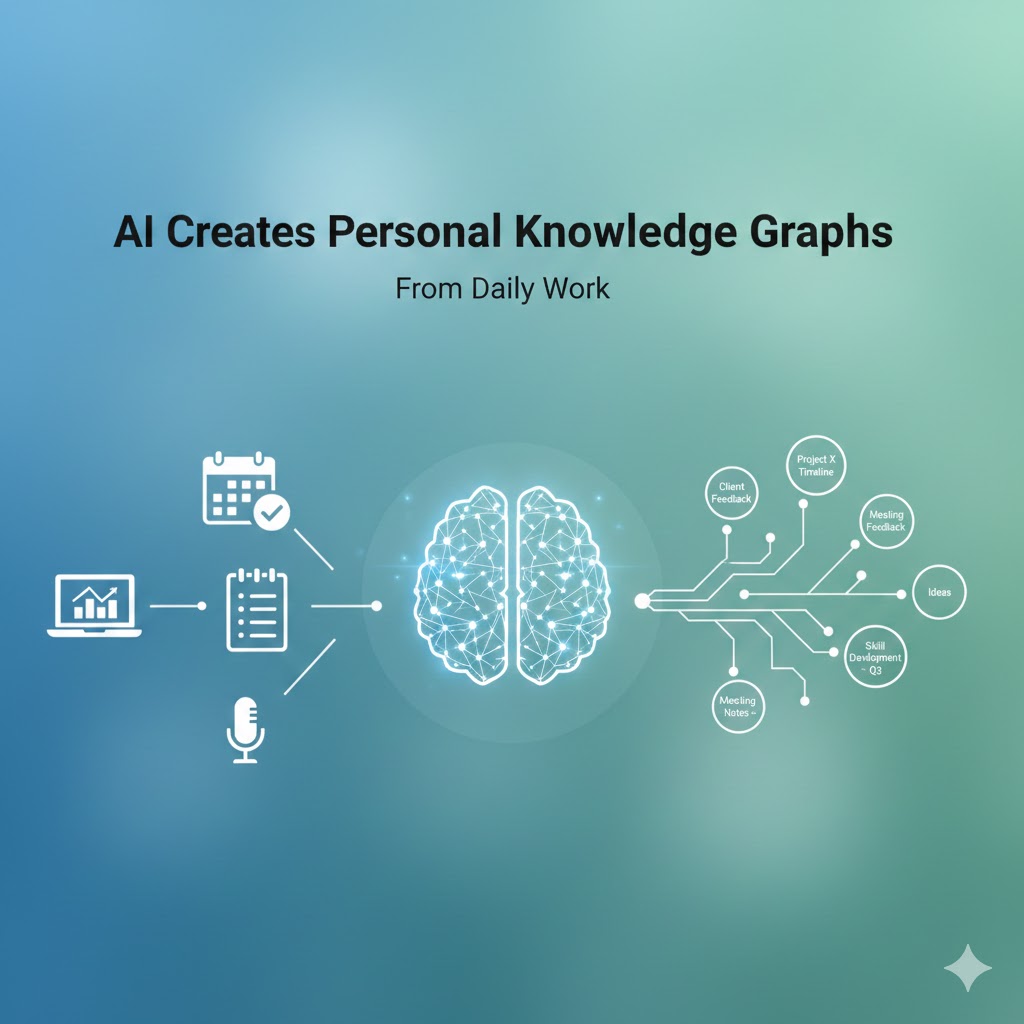
Information has become both the greatest asset and the most overwhelming challenge of modern professional life. Knowledge workers juggle dozens of projects simultaneously, consuming hundreds of documents, participating in countless meetings, exchanging thousands of messages, and generating enormous volumes of content. This relentless information flow creates a paradox: we have unprecedented access to knowledge yet struggle to recall, connect, and effectively use what we’ve learned.
Traditional organizational tools—folders, tags, bookmarks, notes—provide linear structures that fail to capture the rich, interconnected nature of human knowledge. Our brains don’t think in hierarchical folders; they operate through associations, connections, and networks of related concepts. The disconnect between how we naturally think and how we’re forced to organize digital information creates friction that diminishes productivity and insight generation.
This fundamental challenge has sparked a revolutionary approach: AI creates personal knowledge graphs that mirror how our minds actually work. These intelligent systems automatically analyze your daily work activities, extracting concepts, identifying relationships, and building dynamic networks that represent your unique knowledge landscape. Rather than manually organizing information into rigid structures, you simply work naturally while AI constructs a living map of everything you know and how it all connects.
1. Understanding Personal Knowledge Graphs
Before exploring how AI creates personal knowledge graphs, it’s essential to understand what these structures are and why they represent such a significant departure from conventional information management approaches.
What Are Knowledge Graphs
A knowledge graph is a network representation of information where nodes represent entities or concepts and edges represent relationships between them. Unlike traditional databases that store isolated records or file systems that organize documents hierarchically, knowledge graphs capture the web of connections that give information meaning and context.
In a personal knowledge graph, nodes might represent people you work with, projects you’re involved in, documents you’ve created or read, concepts you’ve learned, meetings you’ve attended, or tasks you need to complete. The edges connecting these nodes represent relationships such as “collaborated on,” “relates to,” “mentioned in,” “prerequisite for,” or “inspired by.”
This graph structure naturally accommodates the messy, interconnected reality of professional knowledge. A single document might relate to multiple projects, reference several colleagues, introduce new concepts, and connect to previous work in complex ways. Knowledge graphs capture this complexity without forcing artificial categorization.
Why Traditional Organization Systems Fall Short
Filing systems inherited from physical document management require placing each item in exactly one location within a rigid hierarchy. This forces impossible choices when information legitimately belongs in multiple categories. You might file a market research report under the client’s name, the project name, the date, or the topic—but whichever you choose, you’ll later forget and search in the wrong place.
Tagging systems improve on hierarchical folders by allowing multiple categories per item, but they still require manual effort and consistent application. Over time, tag systems become unwieldy as new tags proliferate, synonyms create confusion, and tag discipline degrades. The cognitive overhead of maintaining organized tags can exceed the benefit they provide.
Search-based approaches that rely entirely on full-text search skip organization entirely, but this creates different problems. Search works when you remember specific keywords but fails for conceptual queries like “what did we decide about the European expansion last quarter?” or “which projects involve similar technical challenges to this new opportunity?”
How Knowledge Graphs Solve These Problems
AI creates personal knowledge graphs that eliminate manual organization while providing richer connections than any filing system. Because the AI automatically extracts entities and relationships from your work, you’re never forced to choose where something goes or what tags to apply. The graph simultaneously represents multiple valid perspectives on the same information.
The graph structure enables sophisticated queries impossible with traditional systems. You can ask questions like “show me all discussions about pricing strategy that involved Sarah from the product team” or “what concepts from my research papers relate to this new project proposal?” The graph traverses relationships to answer questions that would require remembering specific file locations or search terms.
As you work, the graph grows organically, with new nodes and connections forming automatically. Patterns and clusters emerge that reveal insights you might never notice manually. You might discover that seemingly unrelated projects actually share common themes, or that particular colleagues consistently appear in your most successful initiatives.
The Difference Between Generic and Personal Knowledge Graphs
Large-scale knowledge graphs like those powering search engines represent universal knowledge about the world—facts like “Paris is the capital of France” or “Shakespeare wrote Hamlet.” These generic graphs are valuable but don’t capture your unique perspective, experiences, or work.
Personal knowledge graphs represent your individual knowledge landscape—the specific projects you’re working on, documents you’ve read, people you collaborate with, ideas you’re developing, and the unique connections you’ve made between concepts. This personalized perspective makes the graph far more valuable for your daily work than any generic knowledge base could be.
The personal nature means the graph understands context specific to your situation. When you search for “Q4 strategy,” it knows whether you mean sales strategy, product strategy, or marketing strategy based on your role and recent work. It understands that “the presentation” refers to a specific deck you’ve been working on this week.
2. How AI Creates Personal Knowledge Graphs
The technology that enables AI to create personal knowledge graphs combines multiple sophisticated artificial intelligence techniques, each contributing to different aspects of graph construction and maintenance.
Automated Entity Extraction
The foundation of knowledge graph creation is identifying entities—the nodes that will populate your graph. AI systems analyze your documents, emails, messages, meeting transcripts, and other work artifacts to extract meaningful entities automatically.
Named entity recognition identifies people, organizations, locations, dates, and specific projects mentioned in text. Advanced models trained on professional language understand that “Q3 roadmap” and “Sarah from marketing” are important entities worth capturing, while “next Tuesday” in an old email might not merit permanent representation.
Concept extraction goes beyond named entities to identify important ideas, themes, and topics discussed in your work. If you’re repeatedly discussing “customer churn” or “supply chain optimization,” the AI recognizes these as significant concepts in your knowledge domain and creates nodes for them.
Document and artifact recognition identifies important files, presentations, reports, and other artifacts that represent substantial knowledge. Rather than creating nodes for every file, AI distinguishes between significant documents worth tracking and ephemeral content that doesn’t merit representation.
The AI continuously refines its understanding of what matters in your specific context. Early in your graph’s development, it might cast a wide net, capturing many entities. Over time, it learns which types of entities you actually reference and use, focusing on what’s relevant to your work patterns.
Relationship Identification and Mapping
Once entities are extracted, the more complex task begins: identifying meaningful relationships between them. This is where AI creates personal knowledge graphs that go far beyond simple document collections.
Co-occurrence analysis identifies entities that frequently appear together in your work. If Sarah and the Q4 strategy are mentioned together across multiple documents and meetings, the AI creates a relationship indicating Sarah’s involvement with that initiative.
Semantic relationship extraction uses natural language processing to understand not just that entities co-occur but how they relate. The AI distinguishes between “Sarah leads the Q4 strategy,” “Sarah reviewed the Q4 strategy,” and “Sarah opposes the Q4 strategy,” creating different relationship types for different interactions.
Temporal relationship mapping captures how information evolves over time. The AI understands that the “initial proposal” preceded the “revised strategy,” which preceded the “final plan,” creating a timeline of how ideas developed.
Citation and reference tracking follows explicit connections you make, such as when one document references another, when meeting notes mention previous discussions, or when you link concepts together in your notes. These explicit connections augment the implicit relationships the AI infers.
Context and Metadata Integration
Beyond just entities and relationships, the AI captures rich context that makes the graph truly useful. AI creates personal knowledge graphs that understand not just what you know but when you learned it, who taught you, why it matters, and how it connects to your goals.
Temporal context records when information entered your knowledge base, allowing you to filter by recency or trace how your understanding evolved over time. Recent information might be weighted more heavily for current projects while older knowledge remains accessible for historical context.
Source provenance tracks where information came from—which documents, meetings, conversations, or external sources introduced particular concepts or facts. This enables evaluating reliability and returning to original sources when needed.
Project and goal association links knowledge elements to the projects and objectives they serve. The AI learns which information relates to which initiatives, allowing you to view your knowledge through the lens of specific projects or filter irrelevant content.
Confidence and certainty scoring reflects how sure the AI is about extracted entities and relationships. Information explicitly stated in formal documents receives high confidence, while relationships inferred from indirect evidence might be flagged as tentative.
Continuous Learning and Evolution
Unlike static databases, personal knowledge graphs created by AI are living structures that continuously evolve as your work progresses. The system doesn’t just add new nodes and edges but refines existing ones based on accumulating evidence.
Relationship strength evolution adjusts connection weights as you repeatedly interact with related concepts. A weak initial connection might strengthen into a central relationship as you work extensively with related topics.
Node importance calculation continuously recalculates which entities are most central to your knowledge landscape. An initially prominent project might fade in importance as it concludes and new initiatives take priority.
Pattern detection and clustering identifies emergent structures in your graph, recognizing themes, subtopics, and knowledge areas that weren’t explicitly defined but naturally emerge from your work.
Anomaly detection identifies unusual patterns that might indicate new interests, changing focus, or opportunities you’re not fully aware of yet. The AI might notice you’re increasingly working with concepts adjacent to a new field before you consciously realize your interests are shifting.
3. Tools and Platforms Building Personal Knowledge Graphs
The vision of AI creating personal knowledge graphs from daily work has inspired multiple companies and projects to build practical implementations, each with distinct approaches and strengths.
Notion AI and Notion Graph
Notion has evolved from a flexible document workspace into a platform that builds connections between your notes, documents, and databases. Notion AI enhances this by automatically suggesting relationships, summarizing connected information, and helping users discover relevant content they might have forgotten.
The platform’s bidirectional linking allows manually creating relationships between pages, while AI capabilities are increasingly automating connection discovery. Users can visualize their workspace as a graph, seeing how different projects, notes, and resources interconnect.
Notion particularly excels for teams, where the knowledge graph spans multiple people’s contributions, capturing not just individual knowledge but collective organizational understanding. The AI helps surface relevant institutional knowledge when someone begins working on a new project.
Obsidian with AI Plugins
Obsidian takes a local-first approach, storing all notes as plain markdown files on your device while providing powerful graph visualization and linking capabilities. Various AI plugins extend Obsidian to automatically suggest links, extract entities, and identify related content.
The platform’s graph view provides striking visualizations of your knowledge network, with clusters of related notes forming visual patterns that reveal structure you might not recognize linearly. Hovering over nodes shows connections and previews content, making exploration intuitive.
Obsidian’s strength lies in serving individuals who want complete control and privacy over their knowledge base. All AI processing can happen locally or through self-hosted models, ensuring your knowledge never leaves your devices.
Mem and Mem X
Mem positions itself as a self-organizing workspace where AI creates personal knowledge graphs automatically without requiring any manual linking or organization from users. You simply write notes naturally, and Mem’s AI extracts entities, identifies relationships, and builds a knowledge graph behind the scenes.
The platform’s AI-powered search understands context and relationships, answering questions about your knowledge rather than just matching keywords. You can ask natural language questions like “what did Alex say about the marketing campaign?” and Mem traverses the graph to find relevant information.
Mem X introduces an AI chat interface that converses with your entire knowledge base, answering questions by synthesizing information from across your notes and generating insights by connecting disparate pieces of knowledge you’ve captured.
Roam Research
Roam pioneered the “networked thought” approach to note-taking, emphasizing bidirectional links and graph-based navigation. While the platform initially required manual linking, recent AI integrations help automate relationship discovery and suggest connections.
Roam’s daily notes structure naturally captures temporal aspects of knowledge, while its block-based architecture allows fine-grained linking not just between documents but between specific ideas within documents. This granularity creates richer, more detailed knowledge graphs.
The platform particularly appeals to researchers, writers, and knowledge workers who think through writing and want to capture the evolution of ideas over time rather than just final conclusions.
Microsoft Graph and Microsoft 365 Copilot
Microsoft is building knowledge graph capabilities across its 365 suite, with Copilot serving as an AI layer that understands relationships between documents, emails, meetings, and people within the Microsoft ecosystem. This enterprise-focused approach builds organizational knowledge graphs that capture both individual and collective knowledge.
The system automatically identifies that when you email someone about a document discussed in a meeting related to a specific project, all these entities connect meaningfully. Graph-powered search and AI assistants can then answer questions that require traversing these relationships.
For enterprise users deeply embedded in Microsoft’s ecosystem, this represents a powerful approach where AI creates personal knowledge graphs from the full context of digital work without requiring any separate applications or data migration.
Capacities and Personal Database Approaches
Capacities and similar tools focus on creating structured personal databases that evolve into knowledge graphs organically. You create typed objects—people, projects, concepts, meetings—and the AI identifies relationships between them, suggesting connections and surfacing related information.
This approach combines structured database thinking with flexible graph relationships, allowing different types of entities to have specific properties while connecting freely across types. A “person” might have properties like contact information and role, while connecting to “projects” they’re involved in and “concepts” they’ve discussed.
The structured approach provides more explicit control than pure note-taking tools while remaining more flexible than traditional databases, striking a balance that works well for many users.
4. Practical Applications and Benefits
The ability of AI to create personal knowledge graphs from daily work delivers concrete benefits across multiple dimensions of knowledge work, transforming how people discover, connect, and apply information.
Enhanced Information Retrieval
Traditional search requires remembering specific words or phrases used in the content you’re looking for. Knowledge graph-based retrieval understands relationships and context, allowing more natural queries that describe what you’re looking for conceptually rather than verbally.
You can search for documents related to a person, project, or concept even if those terms don’t appear in the document text. The graph understands implicit connections, finding relevant content through relationship traversal rather than keyword matching.
Serendipitous discovery becomes possible when exploring the graph reveals unexpected connections. Browsing related nodes might surface a document you’d completely forgotten but that’s perfectly relevant to your current challenge.
Time-based filtering leverages temporal metadata to find information from specific periods, trace how understanding evolved, or focus only on recent developments. This temporal dimension often proves crucial for professional work where recency matters.
Accelerated Learning and Skill Development
As you learn new concepts and skills, AI creates personal knowledge graphs that map what you know and reveal gaps in understanding. Visualizing your knowledge landscape helps identify areas where you have deep expertise, subjects you understand superficially, and topics you haven’t explored yet.
The graph reveals learning pathways by showing how concepts build on each other. Understanding prerequisites and relationships helps structure learning more effectively than random exploration or generic tutorials that might not align with your existing knowledge.
Cross-pollination of ideas happens when the graph reveals connections between different domains. Insights from one field might apply to apparently unrelated challenges, but you’ll only recognize these opportunities if you can see the relationships.
Progressive elaboration allows starting with simple notes that become richer over time. Early in learning something, you might capture basic facts. Later, you add deeper understanding, examples, and connections to other knowledge. The graph grows more sophisticated as your understanding deepens.
Improved Decision Making and Strategy
Strategic decisions require synthesizing information from multiple sources, considering various perspectives, and understanding long-term implications. Knowledge graphs excel at supporting this type of complex thinking.
Multi-perspective analysis becomes easier when you can view a question through different lenses represented in your graph. You might examine a strategic decision by looking at what finance said, what customers indicated, what competitors are doing, and what technical constraints exist—all represented as different subgraphs that connect to the central question.
Historical context retrieval helps avoid repeating past mistakes by surfacing previous discussions, decisions, and outcomes related to current questions. The graph’s temporal dimension allows examining how similar situations were handled before and what results occurred.
Stakeholder mapping reveals who has relevant expertise, prior involvement, or vested interests in particular decisions. Before making choices, you can identify everyone who should be consulted by exploring the graph’s network of people and their connections to relevant topics.
Scenario exploration is enhanced when you can rapidly gather all relevant information about potential paths forward. The graph helps assemble complete pictures of options by connecting scattered pieces of information that bear on each possibility.
Better Collaboration and Knowledge Sharing
When teams adopt personal knowledge graph tools, individual graphs can connect to form organizational knowledge networks that capture collective understanding while preserving individual perspectives.
Expert identification becomes trivial when the graph reveals who has worked extensively with particular topics, who possesses specific expertise, or who might provide insights on new challenges. Rather than relying on self-reported expertise or formal credentials, the graph shows actual engagement with topics.
Context transfer helps new team members or collaborators quickly understand project history, decisions made, rationale behind choices, and current status. Rather than reading hundreds of documents sequentially, they can explore the knowledge graph to build understanding efficiently.
Reducing duplicate work happens when the graph surfaces that someone else already solved a similar problem, researched a topic, or created relevant resources. Organizations waste enormous effort recreating knowledge that exists but isn’t discoverable.
Intellectual continuity across time as people change roles or leave organizations becomes more manageable when their knowledge is captured in graph form. The connections they built, insights they developed, and context they accumulated don’t disappear but remain accessible to others.
5. Privacy, Security, and Control Considerations
As AI creates personal knowledge graphs from the entire breadth of your professional work, critical questions about privacy, security, and user control emerge that require careful consideration.
Data Privacy and Ownership
Personal knowledge graphs inherently contain sensitive information spanning your complete professional activities. Understanding where this data resides, who can access it, and what rights you maintain is essential.
Local versus cloud processing represents the fundamental architectural choice affecting privacy. Local-first tools like Obsidian keep your entire knowledge graph on your devices, ensuring complete privacy but limiting cross-device access and collaborative features. Cloud-based platforms provide seamless syncing and AI processing but require trusting providers with your data.
Encryption in transit and at rest should be standard for any tool handling professional knowledge. Verify that providers encrypt data during transmission and storage, preventing unauthorized access even if security is breached.
Data portability ensures you’re not locked into platforms. Tools that export your knowledge graph in open formats or standard structures allow migrating to alternatives if your needs change or providers discontinue services.
Deletion and right to forget policies determine whether you can truly remove information from systems. Some platforms retain data even after account deletion for backup or operational purposes, while others guarantee complete removal.
Access Control and Sharing
While personal knowledge graphs capture individual knowledge, professional contexts often require selective sharing or collaboration. Granular access control becomes essential.
Selective sharing should allow sharing specific subgraphs, particular projects, or individual nodes while keeping other information private. You might want to share everything related to a collaborative project while keeping strategic planning or personal notes confidential.
Permission hierarchies for teams need to accommodate different access levels—some people can view and edit, others only view, and some remain completely excluded from sensitive areas.
External link handling raises questions about shared resources. If your knowledge graph links to company documents, your graph’s privacy doesn’t protect those resources. Understanding how your tool handles external references is important.
Collaborative graph merging when working with teams requires protocols for combining individual perspectives while preserving attribution and handling conflicting information or divergent interpretations.
AI Model Transparency and Bias
The algorithms that construct your knowledge graph make consequential decisions about what to include, how to relate information, and what to surface. Understanding these systems’ operation matters.
Entity extraction biases might cause AI to systematically emphasize certain types of information while neglecting others. If the model was trained primarily on technical documents, it might struggle with creative or strategic content.
Relationship inference accuracy determines whether the connections in your graph reflect reality or artifacts of imperfect AI. Understanding confidence levels and reviewing suggested relationships helps maintain graph quality.
Algorithmic transparency regarding how the AI decides what matters, which relationships to create, and what to surface varies widely between tools. More transparent systems explain their reasoning, while opaque ones function as black boxes.
Personal data in training raises questions about whether your knowledge graph data might be used to train future AI models, potentially exposing your information or organizational knowledge in model outputs for other users.
6. Challenges and Limitations
Despite powerful capabilities, the technology that enables AI to create personal knowledge graphs faces meaningful challenges that constrain its current effectiveness and require ongoing development.
Quality and Accuracy Issues
Automated entity extraction and relationship identification aren’t perfect. The AI makes mistakes, missing important connections or creating spurious relationships based on superficial similarities.
False positives occur when the system creates relationships between unrelated items that happened to co-occur coincidentally. Your knowledge graph might incorrectly associate people or concepts that appeared in the same document by chance rather than meaningful connection.
False negatives happen when the AI fails to recognize important relationships, leaving your graph incomplete. Critical connections between ideas might go undetected if they’re expressed abstractly or through uncommon phrasings the model hasn’t learned.
Context misunderstanding leads to incorrect interpretations, particularly with nuanced language, sarcasm, or domain-specific meanings. A phrase might be interpreted literally when it was figurative, or a technical term might be confused with its common usage.
Entity disambiguation challenges arise with homonyms and context-dependent references. “Chase” might refer to Chase Bank, a person named Chase, or the act of pursuing something. The AI must determine correct meaning from context but sometimes fails.
Scalability and Performance Concerns
As personal knowledge graphs grow to thousands or tens of thousands of nodes with complex relationship networks, maintaining performance becomes challenging.
Query performance degradation can occur as graphs grow large. Finding paths between distant nodes, identifying clusters, or running complex graph algorithms may slow significantly with scale.
Storage requirements increase not just with node count but especially with relationship density. A graph with many highly interconnected nodes requires more storage and processing power than sparse collections.
Real-time processing limitations affect how quickly new information integrates into your graph. Some systems process content in batch operations rather than instantaneously, creating lag between when you work and when your graph reflects that work.
Visualization complexity makes large graphs difficult to comprehend visually. While clusters and high-level patterns remain discernible, detailed exploration of massive graphs can become overwhelming.
Integration and Workflow Friction
For AI to create personal knowledge graphs from daily work, it must access information across all your tools and platforms. This integration challenge remains partly unsolved.
Data silo problems occur when information lives in disconnected systems that knowledge graph tools cannot access. If critical discussions happen in messaging platforms, decisions are made in meetings not recorded, or important documents live in systems without API access, your graph remains incomplete.
Manual capture burden persists when automatic integration isn’t possible. Users must manually add information from offline meetings, phone conversations, or systems that don’t integrate, creating friction and incomplete graphs.
Platform switching costs arise because using a knowledge graph tool effectively often means changing how you work. If your organization standardizes on systems that don’t integrate well with your chosen knowledge graph platform, you face choosing between organizational compliance and personal productivity.
Learning curve and adoption friction prevent many potential users from benefiting. Understanding how to work effectively with knowledge graphs, trusting AI-generated relationships, and developing new workflows all require investment that many people find difficult to justify.
Cognitive and Organizational Challenges
Beyond technical issues, fundamental questions about how people think and work affect knowledge graph utility.
Graph thinking versus linear thinking represents a conceptual shift many find difficult. People trained in hierarchical organization struggle with graph-based systems where information exists in multiple contexts simultaneously without primary categories.
Over-reliance on AI risks developing where people stop actively thinking about how ideas connect, outsourcing relationship identification entirely to algorithms. This could diminish the cognitive benefits of actively organizing and synthesizing knowledge.
Information hoarding might increase as the ease of capturing everything in a knowledge graph removes incentive to deliberately decide what’s worth keeping. Graphs cluttered with trivial information become less useful than more selective collections.
Organizational resistance in corporate contexts can block adoption even when individuals see value. IT departments might prohibit tools that store company information externally, or organizational culture might resist new workflows.
7. Future Developments and Emerging Trends
The technology enabling AI to create personal knowledge graphs continues evolving rapidly, with emerging capabilities that will address current limitations and unlock new possibilities.
Multimodal Knowledge Integration
Current systems primarily process text, but future knowledge graphs will seamlessly incorporate images, audio, video, and other modalities into unified knowledge representations.
Visual knowledge extraction will analyze images, diagrams, charts, and infographics, extracting entities and relationships from visual content just as current systems process text. A photo from a whiteboard session will automatically contribute to your knowledge graph.
Audio processing will transcribe and analyze meetings, calls, and voice notes, identifying participants, topics, decisions, and action items that become graph nodes and relationships.
Video understanding will extract not just spoken content but visual information, screen shares, and demonstrations, creating rich multimodal knowledge representations.
Cross-modal relationships will connect information across formats, linking verbal discussions to related documents, connecting diagrams to textual explanations, and associating meeting decisions with email follow-ups.
Enhanced AI Reasoning and Inference
Future systems will move beyond extracting explicitly stated information to reasoning about implications, making inferences, and identifying gaps in knowledge.
Logical inference will derive new knowledge from existing graph relationships. If the graph knows “Project A requires Skill X” and “Person B has Skill X,” it can infer that Person B could contribute to Project A even if never explicitly stated.
Contradiction detection will identify inconsistent information in your knowledge base, flagging when different sources provide conflicting facts or when your understanding has evolved to contradict earlier beliefs.
Question answering will leverage graph structure to answer complex queries requiring multi-hop reasoning. Rather than just finding related information, the AI will synthesize answers by traversing relationships and combining information from multiple sources.
Predictive suggestions will anticipate what you need to know based on current work patterns, proactively surfacing relevant knowledge before you search for it.
Collective Intelligence and Shared Graphs
While personal knowledge graphs capture individual understanding, future systems will enable collective knowledge graphs that represent shared team or organizational understanding while preserving individual perspectives.
Perspective layering will allow viewing the same knowledge through different lenses—your personal interpretation, team consensus, organizational standard, or external expert opinion—all represented in connected but distinct graph layers.
Collaborative graph construction will enable multiple people contributing to shared knowledge structures with attribution, version control, and conflict resolution when people disagree about relationships or interpretations.
Organizational memory systems will capture institutional knowledge that persists beyond individual employees, ensuring critical understanding doesn’t disappear when people leave.
Cross-organizational knowledge exchange might eventually allow sharing anonymized graph structures or relationship patterns across organizational boundaries, enabling industry-wide learning while protecting sensitive information.
Ambient Knowledge Capture
Future systems will reduce manual effort by passively capturing knowledge from all work activities without requiring explicit note-taking or documentation.
Meeting intelligence will automatically analyze all meetings you attend, extracting relevant information and updating your knowledge graph without manual note-taking.
Communication mining will process emails, messages, and other communications to identify important information, decisions, and relationships that should be captured.
Activity tracking will observe what you read, research, and interact with, inferring learning and adding relevant knowledge to your graph even when you don’t explicitly save anything.
Contextual awareness will understand what you’re currently working on, automatically strengthening relevant parts of your knowledge graph while de-emphasizing unrelated information.
Conclusion
The emergence of technology that enables AI to create personal knowledge graphs from daily work represents a fundamental shift in how humans can manage and leverage knowledge in professional contexts. By moving beyond linear organization systems to network structures that mirror how we naturally think, these tools promise to amplify human cognitive capabilities in profound ways.
The systems available today—from Notion and Obsidian to Mem and enterprise solutions like Microsoft Graph—demonstrate real practical value, helping knowledge workers find information faster, make unexpected connections, and build more coherent understanding from fragmented inputs. As you work naturally, AI constructs a living map of your knowledge landscape that grows more valuable over time.
Yet significant challenges remain. Accuracy issues, integration difficulties, privacy concerns, and adoption friction prevent many potential users from benefiting. The technology works best for individuals and teams willing to invest in learning new workflows and who work primarily with digital information in accessible formats.
The future trajectory points toward increasingly sophisticated systems that process multimodal information, reason about implications, support collective intelligence, and capture knowledge with minimal manual effort. As these capabilities mature, the vision of AI creating personal knowledge graphs that serve as external cognitive extensions—amplifying memory, surfacing relevant context, suggesting novel connections, and supporting more effective thinking—moves closer to reality.
For knowledge workers drowning in information, these tools offer a path toward working with knowledge rather than being overwhelmed by it. The goal isn’t replacing human thinking but augmenting it, providing structures that help us remember more, connect ideas more creatively, and apply our knowledge more effectively. As the technology continues improving and adoption grows, personal knowledge graphs may become as fundamental to knowledge work as search engines are to information retrieval—invisible infrastructure that we wonder how we ever worked without.
The question facing individuals and organizations is no longer whether AI-powered knowledge graphs will transform knowledge work, but how quickly to adopt these tools and how to implement them effectively. Those who embrace this shift early, learning to work with knowledge graphs and training AI to understand their unique knowledge domains, will gain significant advantages in an increasingly information-intensive economy. The future belongs to those who can not just access information but truly understand and leverage the connections between everything they know.
Also read this:
AI Tools That Turn Handwritten Notes Into Digital Documents
AI Review Detection: How Shopping Websites Fight Fake Reviews
How AI Automatically Summarizes Long Documents Into Key Insights