
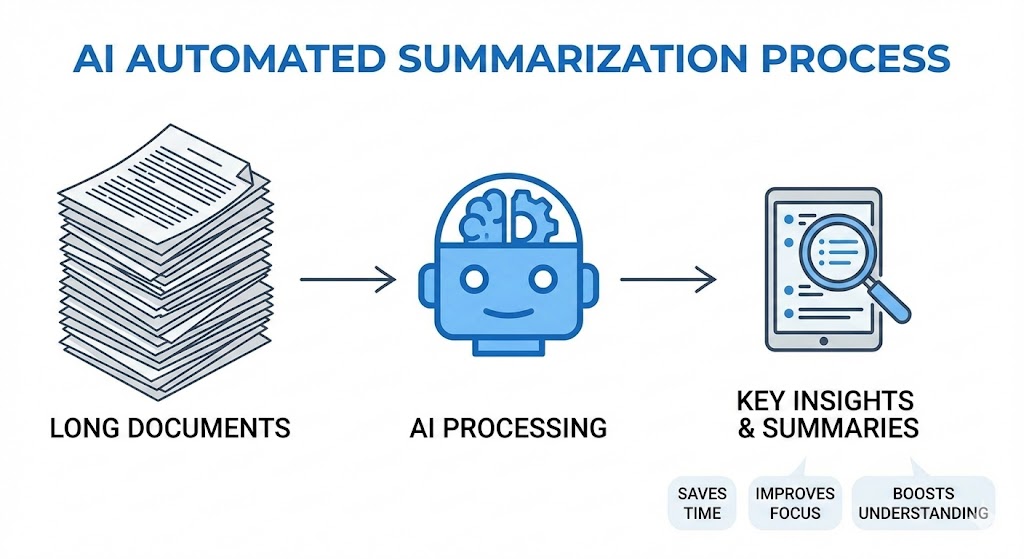
AI automatically summarizes long documents In today’s information-saturated world, professionals, researchers, and business leaders face an overwhelming challenge: processing massive volumes of text efficiently. Whether it’s legal contracts, research papers, business reports, or technical documentation, the sheer amount of content can be paralyzing. This is where artificial intelligence steps in as a game-changer. AI automatically summarizes long documents by leveraging sophisticated natural language processing algorithms that can distill hundreds of pages into actionable insights within seconds.
The transformation is remarkable. What once required hours of manual reading and note-taking can now be accomplished in minutes, with accuracy that rivals or exceeds human capabilities in many contexts. This technological advancement isn’t just about speed—it’s about fundamentally changing how we interact with information in the digital age.
1. Understanding How AI Automatically Summarizes Long Documents
The process by which AI automatically summarizes long documents is rooted in advanced machine learning techniques that have evolved dramatically over the past decade. At its core, document summarization involves analyzing text to identify the most important information while maintaining coherence and context.
The Technology Behind AI Summarization
Modern AI summarization systems employ neural networks, particularly transformer-based architectures, that have been trained on billions of words from diverse sources. These models learn patterns in language, understanding not just individual words but relationships between concepts, the structure of arguments, and the hierarchy of information importance.
The technology operates through several key mechanisms. First, the AI performs semantic analysis, understanding the meaning behind words rather than just their surface-level content. Second, it identifies key entities, concepts, and relationships within the text. Third, it evaluates the importance of different sections based on factors like frequency, position, and contextual relevance. Finally, it generates coherent summaries that capture the essence of the original document.
Types of AI Summarization
Extractive summarization works by selecting the most important sentences or phrases directly from the source document and combining them into a condensed version. This approach preserves the original wording and is particularly useful when precision and attribution are critical, such as in legal or scientific contexts.
Abstractive summarization takes a more sophisticated approach. The AI comprehends the document’s content and generates new sentences that convey the main ideas, much like a human would when explaining something in their own words. This method often produces more natural-sounding summaries and can better capture the overall meaning when dealing with complex or nuanced material.
Hybrid approaches combine both methods, using extractive techniques to identify key content and abstractive methods to refine and connect the information into coherent narratives.
The Role of Natural Language Processing
Natural Language Processing forms the foundation that enables AI to automatically summarize long documents effectively. NLP allows machines to parse grammatical structures, understand context, resolve ambiguities, and recognize the relationships between different parts of a text. Advanced NLP models can even grasp subtle elements like tone, intent, and implied meaning, which are crucial for creating accurate summaries that don’t distort the original message.
2. Key Applications Across Industries
The ability of AI to automatically summarize long documents has created transformative opportunities across virtually every sector of the economy. Different industries leverage this technology in unique ways, tailored to their specific needs and challenges.
Legal and Compliance
Law firms and corporate legal departments deal with massive volumes of contracts, case law, regulations, and discovery documents. AI summarization tools can review hundreds of pages of legal text, extracting key clauses, obligations, dates, and potential risks. This dramatically reduces the time lawyers spend on document review while improving consistency and reducing the risk of overlooking critical details.
In due diligence processes for mergers and acquisitions, AI can process thousands of documents to identify red flags, financial obligations, and contractual commitments that might impact deal valuations. Compliance teams use these tools to monitor regulatory changes across multiple jurisdictions, ensuring organizations remain current with evolving legal requirements.
Healthcare and Medical Research
Medical professionals are inundated with research papers, clinical trial results, patient records, and treatment guidelines. AI summarization helps doctors stay current with the latest medical literature without spending hours reading every study. The technology can extract key findings, methodologies, and conclusions from research papers, presenting them in digestible formats.
In clinical settings, AI can summarize lengthy patient histories, highlighting critical information like allergies, chronic conditions, previous treatments, and family medical history. This supports better decision-making at the point of care and reduces the risk of medical errors resulting from information overload.
Business Intelligence and Market Research
Corporations employ AI summarization to process competitor analyses, market reports, customer feedback, and industry publications. Marketing teams can quickly understand consumer sentiment from thousands of reviews or survey responses. Strategic planning departments can synthesize insights from multiple analyst reports to inform investment decisions.
Financial services firms use these tools to digest earnings reports, financial statements, and economic forecasts, enabling faster responses to market conditions. The technology proves particularly valuable during quarterly reporting seasons when analysts must review hundreds of corporate filings in compressed timeframes.
Academic Research and Education
Researchers across disciplines benefit from AI’s ability to summarize academic papers, helping them conduct literature reviews more efficiently. Instead of reading dozens of papers in full, researchers can review AI-generated summaries to determine which sources deserve deeper investigation.
Students use summarization tools to grasp complex textbook chapters or supplementary materials, though educators emphasize these should complement rather than replace thorough reading. Universities are exploring how AI summarization can support accessibility initiatives, making dense academic content more approachable for students with different learning needs.
Government and Public Policy
Government agencies manage enormous volumes of documents, from legislative proposals and policy briefings to public comments and agency reports. AI automatically summarizes long documents to help policymakers quickly understand constituent concerns, assess the potential impacts of proposed regulations, and track implementation of existing policies.
Intelligence and security agencies use summarization technology to process intelligence reports, open-source information, and communications data, helping analysts identify relevant information more quickly while maintaining appropriate security protocols.
3. The Benefits of AI-Powered Document Summarization
Organizations that implement AI summarization solutions realize substantial advantages that extend beyond simple time savings. These benefits compound across different functions and can fundamentally alter how knowledge work gets done.
Dramatic Time Savings
The most immediate benefit is speed. While a human might take several hours to thoroughly read and summarize a 100-page report, AI automatically summarizes long documents in minutes or even seconds. This time compression allows professionals to process far more information than would otherwise be possible, directly enhancing productivity.
For organizations dealing with hundreds or thousands of documents regularly, the cumulative time savings can be staggering. Law firms report reducing document review times by 60-80 percent. Research teams can survey literature across broader domains. Customer service departments can quickly understand complex issue histories before engaging with clients.
Enhanced Information Accessibility
AI democratizes access to specialized knowledge by making complex documents more approachable. Technical reports filled with jargon can be summarized in plain language. Lengthy policy documents can be condensed to their practical implications. This accessibility supports better cross-functional collaboration, as team members from different backgrounds can more easily understand each other’s domains.
The technology also supports better knowledge management within organizations. Instead of critical insights being buried in lengthy documents that few people read, AI-generated summaries can be systematically cataloged and searched, making organizational knowledge more accessible to those who need it.
Improved Decision Quality
When decision-makers can efficiently process more information, they make more informed choices. AI summarization allows executives to review a broader range of inputs before making strategic decisions. It helps reduce information asymmetry between different levels of an organization, ensuring that key insights reach the people who need them.
The technology also supports more consistent decision-making by ensuring that important details don’t get overlooked simply because they appeared deep within a lengthy document. This is particularly valuable in high-stakes environments like healthcare, where missing a critical piece of information can have serious consequences.
Cost Efficiency
While human expertise remains invaluable, there are significant cost savings when AI handles the initial processing of documents. Organizations can redirect skilled professionals from routine document processing to higher-value analytical and strategic work. This doesn’t eliminate jobs but rather shifts the nature of work toward more rewarding and impactful activities.
For smaller organizations or individual practitioners, AI summarization provides capabilities that might otherwise require hiring additional staff or outsourcing to expensive consulting firms. This levels the playing field, allowing smaller players to compete more effectively with larger, better-resourced competitors.
Consistency and Accuracy
Humans experience fatigue, distraction, and cognitive biases that can affect the quality of their work, especially when processing repetitive content. AI systems maintain consistent performance regardless of volume or timing. They don’t get tired during the last document of the day or skip important details because they seem routine.
Modern AI summarization tools, particularly those trained on domain-specific content, often match or exceed human accuracy in identifying key information. They’re less likely to let personal preferences or preconceptions influence which information they highlight as important.
4. How AI Automatically Summarizes Long Documents: The Technical Process
Understanding the technical mechanics behind how AI automatically summarizes long documents provides insight into both the capabilities and limitations of these systems. The process involves multiple sophisticated steps working in concert.
Document Preprocessing and Analysis
When a document enters an AI summarization system, the first step involves preprocessing. The AI extracts text from various formats (PDF, Word, scanned images via OCR), cleanses it of formatting artifacts, and structures it for analysis. This includes tokenization (breaking text into individual words or meaningful units), identifying sentence boundaries, and recognizing document structure like headings, lists, and sections.
The system then performs linguistic analysis, including part-of-speech tagging, named entity recognition (identifying people, organizations, locations, dates), and dependency parsing to understand how words relate to each other within sentences. This foundational analysis creates a rich representation of the document’s content that subsequent steps can leverage.
Content Evaluation and Importance Scoring
The AI assigns importance scores to different text segments using multiple algorithms. Statistical approaches consider factors like term frequency (how often specific words appear), document position (information at the beginning or end often carries more weight), and the presence of indicator phrases like “in conclusion” or “most importantly.”
More advanced neural approaches use attention mechanisms that learned during training which types of content humans typically consider important. These models can recognize that a sentence defining a key concept early in a technical document might be more important than a sentence with similar words appearing later in a less critical context.
Graph-based algorithms like TextRank create networks of sentence relationships based on content similarity, identifying sentences that are central to the document’s overall meaning. These approaches help ensure the summary captures the document’s core message rather than peripheral details.
Summary Generation
For extractive summaries, the AI selects the highest-scoring sentences or passages and arranges them in a logical order, ensuring the result reads coherently. It may adjust transitions between extracted segments to improve flow while preserving the original wording.
In abstractive summarization, the process is more complex. The AI uses sequence-to-sequence neural networks, often based on transformer architectures, that encode the entire document into an internal representation and then decode that representation into new sentences that capture the essential meaning. These models have learned patterns of how humans naturally summarize content and apply those patterns to new documents.
State-of-the-art systems use techniques like beam search to generate multiple candidate summaries and select the best one based on criteria like coherence, informativeness, and faithfulness to the source material. Some systems also employ reinforcement learning, where the model learns from feedback about summary quality.
Quality Control and Refinement
Advanced AI systems include quality control mechanisms. They check for factual consistency, ensuring the summary doesn’t introduce information not present in the original or contradict source content. They evaluate readability, adjusting vocabulary and sentence structure to match target audience needs.
Some systems allow customization, letting users specify summary length, level of detail, or focus areas. This flexibility enables AI to automatically summarize long documents in ways tailored to specific use cases, whether someone needs a brief executive overview or a more detailed technical synopsis.
5. Challenges and Limitations
Despite impressive capabilities, AI summarization technology faces meaningful challenges that users should understand. Awareness of these limitations helps organizations implement the technology effectively and maintain appropriate human oversight.
Context and Nuance Challenges
AI systems can struggle with highly nuanced content where understanding requires broad contextual knowledge or cultural familiarity. Sarcasm, irony, implied meanings, and subtle distinctions between similar concepts sometimes elude even sophisticated models. Documents that rely heavily on unstated assumptions or require significant background knowledge to interpret properly may be summarized less effectively.
Legal and regulatory documents often contain carefully constructed language where specific word choices carry significant implications. While AI has improved dramatically in these domains, there remains risk that summaries might miss critical nuances or fail to capture the full implications of particular phrasings.
Domain Specificity Requirements
General-purpose AI models trained on diverse internet text may not perform optimally on highly specialized content like advanced scientific research, technical engineering documents, or specialized medical literature. These domains use terminology and conceptual frameworks that require targeted training.
Organizations dealing with specialized content often need to invest in domain-adapted models or custom training, which requires technical expertise and substantial data. This can create barriers for smaller organizations or those working with unique, proprietary content that differs significantly from the AI’s training data.
Length and Complexity Constraints
While AI has become much better at processing long documents, there are still practical limits. Extremely lengthy documents (thousands of pages) may exceed processing capabilities of some systems. Complex documents with intricate cross-references, nested information structures, or heavily interconnected concepts can challenge AI’s ability to maintain coherence across the entire summary.
Some systems struggle with maintaining consistency when summarizing multiple related documents together, potentially missing contradictions or failing to synthesize information effectively across sources.
Bias and Fairness Concerns
AI models can inherit biases present in their training data, potentially affecting which information they emphasize or how they characterize certain topics, groups, or perspectives. A model trained primarily on Western sources might misunderstand or misrepresent concepts from other cultural contexts. Historical biases in published literature can be perpetuated in AI-generated summaries.
Organizations must be vigilant about evaluating AI outputs for potential bias, particularly when using summarization in sensitive contexts like hiring, lending, law enforcement, or policy development where biased summaries could lead to discriminatory outcomes.
Over-Reliance Risks
Perhaps the most significant risk is human over-reliance on AI-generated summaries. When AI automatically summarizes long documents, there’s a temptation to skip reading source material entirely. This can be problematic when the AI misses important details, misinterprets nuanced content, or when critical thinking about the original document is necessary.
In high-stakes situations, summaries should complement rather than replace human judgment. Critical decisions should still involve human review of relevant source material, with AI serving to enhance rather than replace human analysis.
6. Best Practices for Implementation
Successfully deploying AI summarization technology requires thoughtful implementation that addresses both technical and organizational considerations. These practices help maximize benefits while managing risks.
Start with Clear Use Cases
Identify specific scenarios where summarization will deliver the greatest value. Is the goal reducing time spent on routine document processing? Improving information accessibility across teams? Supporting faster decision-making in time-sensitive situations? Clear use cases help guide technology selection and measure success.
Prioritize use cases where the volume of documents is high, the time pressure is significant, and the content is relatively structured or within domains where AI has proven effective. Initial successes build momentum and organizational confidence in the technology.
Choose Appropriate Tools
The AI summarization landscape includes general-purpose solutions, industry-specific platforms, and custom-built systems. General tools work well for common document types like news articles, business reports, or standard research papers. Industry-specific solutions offer advantages for specialized content in legal, medical, financial, or technical domains.
Consider factors like integration capabilities with existing systems, security and privacy features (especially for sensitive content), customization options, accuracy on your specific content types, and total cost of ownership including licensing, implementation, and ongoing maintenance.
Implement Human-in-the-Loop Processes
Design workflows that combine AI efficiency with human judgment. Use AI to handle initial processing and identify documents or sections requiring detailed human review. Have subject matter experts verify AI-generated summaries, especially for high-stakes content.
Create feedback mechanisms where users can flag problematic summaries, helping improve system performance over time. This human oversight is essential for maintaining quality and catching cases where the AI struggles with particular content types or topics.
Establish Quality Metrics
Define concrete metrics for evaluating summarization quality. These might include accuracy (does the summary correctly represent source content?), completeness (are all key points captured?), coherence (does the summary read naturally?), and usefulness (does it meet user needs?).
Regularly audit AI outputs, particularly when deploying new models or applying the technology to new content types. Track metrics over time to identify improvement opportunities or detect quality degradation that might indicate the AI needs retraining or updating.
Train Users Effectively
Help users understand what AI summarization can and cannot do. Provide training on interpreting AI-generated summaries, recognizing when deeper review of source material is necessary, and using summarization tools effectively within their workflows.
Develop guidelines for appropriate use, emphasizing that summaries are starting points for understanding rather than complete substitutes for source documents in critical situations. Foster a culture where questioning AI outputs and verifying important information is encouraged rather than seen as distrust of the technology.
Address Data Privacy and Security
When dealing with confidential or sensitive documents, ensure the AI solution provides appropriate security controls. Understand where data is processed and stored, what retention policies apply, and whether your content might be used for training (which could inadvertently expose proprietary information).
For highly sensitive content, consider on-premises or private cloud deployments that provide greater control over data. Ensure compliance with relevant regulations like GDPR, HIPAA, or industry-specific requirements.
Plan for Continuous Improvement
AI technology evolves rapidly. Establish processes for staying current with new capabilities, regularly evaluating whether newer models or techniques could improve performance, and updating your implementation accordingly.
Build organizational knowledge about AI summarization through experimentation, documentation of lessons learned, and sharing of best practices across teams. This organizational learning compounds over time, increasing the value derived from the technology.
7. The Future of AI Document Summarization
The trajectory of AI summarization technology points toward increasingly sophisticated capabilities that will further transform how we interact with information. Understanding emerging trends helps organizations prepare for the next wave of innovation.
Multimodal Summarization
Future systems will seamlessly process documents containing text, images, charts, tables, and even video content, generating comprehensive summaries that synthesize information across all modalities. Instead of just summarizing text while ignoring visual elements, AI will automatically summarize long documents by understanding how graphics support or extend textual content.
This capability will be particularly valuable for technical documents, research papers with data visualizations, presentations, and multimedia reports where critical information appears in non-textual formats.
Personalized and Contextual Summarization
Next-generation systems will generate summaries tailored to individual users based on their role, expertise level, previous interactions, and current needs. A technical summary for an engineer might differ substantially from an executive summary for a CEO, even when both are derived from the same source document.
AI will understand the broader context of why someone is reading a document, what information they already know, and what decisions they’re trying to make, adjusting summaries accordingly. This contextual awareness will make summaries far more useful and actionable.
Interactive and Conversational Summarization
Rather than producing static summaries, future AI systems will support interactive exploration of documents. Users might ask follow-up questions, request deeper detail on specific sections, or have the AI compare information across multiple documents conversationally.
This conversational interface will make document understanding more intuitive, allowing users to efficiently extract exactly the information they need rather than accepting whatever the AI initially includes in a summary.
Real-Time Summarization and Synthesis
As AI processing becomes faster and more efficient, real-time summarization of live content will become practical. Imagine AI automatically summarizing meetings as they happen, generating summaries of live news events as they unfold, or synthesizing information from multiple data streams in real-time to support rapid decision-making.
This real-time capability will be transformative for fields like emergency response, financial trading, intelligence analysis, and any domain where timely access to information provides competitive advantage.
Enhanced Reliability and Verification
Future systems will incorporate better fact-checking and verification capabilities, automatically cross-referencing summarized content against trusted sources to ensure accuracy. They’ll be more transparent about uncertainty, explicitly flagging when information is ambiguous or when the AI’s confidence in particular summary elements is lower.
Advanced systems will maintain detailed attribution, allowing users to quickly jump to the specific source passages that support each summary point. This traceability will be essential for high-stakes applications where verification is critical.
Ethical AI and Bias Mitigation
As awareness of AI bias grows, future summarization systems will incorporate sophisticated bias detection and mitigation techniques. They’ll be designed to provide balanced representations of controversial topics, explicitly acknowledge multiple perspectives, and avoid perpetuating harmful stereotypes or historical biases.
Regulatory frameworks will likely emerge requiring transparency about how AI systems were trained, what biases they might contain, and how their outputs should appropriately be used. Organizations developing and deploying summarization technology will need to prioritize ethical considerations alongside technical performance.
Conclusion
The ability of AI to automatically summarize long documents represents a fundamental shift in how humans interact with information. What began as a technical curiosity has evolved into a practical tool that millions of professionals now rely on daily. The technology transforms time-consuming document review into efficient information extraction, making vast knowledge repositories accessible in ways previously impossible.
Yet this power comes with responsibility. Organizations must implement AI summarization thoughtfully, maintaining appropriate human oversight, addressing bias and accuracy concerns, and ensuring the technology enhances rather than replaces human judgment. The most successful deployments combine AI’s processing power with human expertise, creating hybrid workflows that leverage the strengths of both.
As AI capabilities continue advancing, the systems that automatically summarize long documents will become even more sophisticated, personalized, and integrated into our daily work. The future promises AI assistants that don’t just summarize what documents say but understand why we’re reading them and what we need to learn, providing exactly the right information at exactly the right time.
For organizations and individuals willing to embrace these tools while remaining mindful of their limitations, AI document summarization offers a pathway to working more efficiently, making better decisions, and ultimately using our most precious resource—human attention—more wisely in an increasingly information-dense world. The question is no longer whether to adopt AI summarization but how to do so in ways that amplify human capabilities while maintaining the critical thinking and nuanced judgment that only humans can provide.
Also read this:
Smart Grocery Lists Using AI: Shop Faster With Personalized Suggestions
AI App Integration: Automate Workflows Without Writing a Single Line of Code
AI Video Editing Workflows: Transform Raw Footage Automatically