
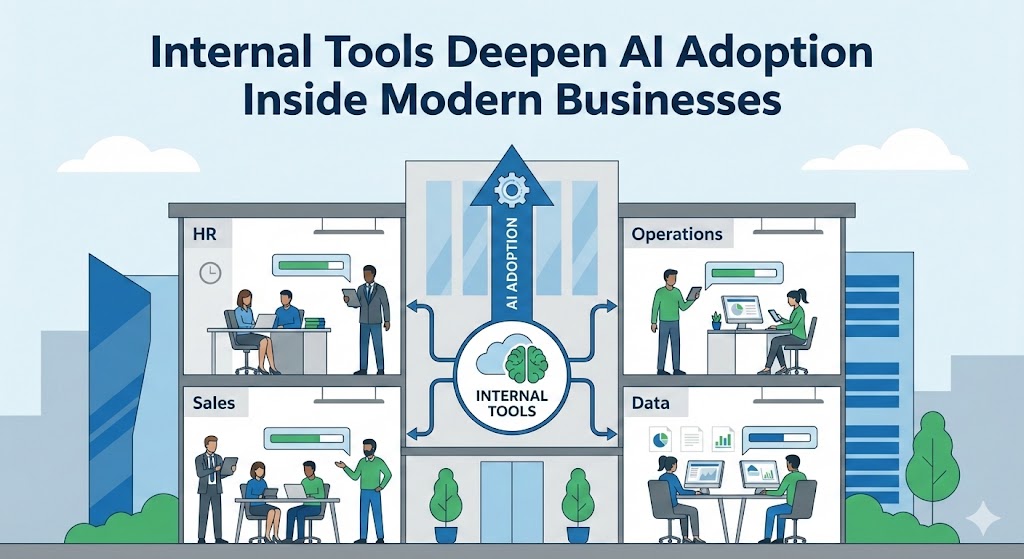
The artificial intelligence revolution has moved beyond consumer applications and experimental projects. Today’s forward-thinking organizations are discovering that Internal Tools Deepen AI integration in ways that fundamentally transform operations, decision-making, and competitive positioning. While external AI solutions capture headlines, the real transformation happens when businesses build and deploy AI-powered internal tools tailored to their unique workflows and challenges.
Modern enterprises face a critical choice: rely solely on off-the-shelf AI products or develop internal tools that embed intelligence directly into business processes. Evidence increasingly shows that Internal Tools Deepen AI adoption more effectively than external solutions alone. Custom internal tools address specific pain points, integrate with existing systems seamlessly, and evolve alongside organizational needs.
This comprehensive exploration examines how internal AI tools drive deeper adoption, the categories delivering maximum impact, implementation strategies that succeed, and the measurable outcomes organizations achieve. Understanding this landscape enables business leaders to make informed decisions about their AI investment strategies and accelerate their digital transformation journeys.
1. The Strategic Imperative for Internal AI Tools
Organizations that treat AI as merely another software subscription miss transformative opportunities. Internal Tools Deepen AI adoption by embedding intelligence where it matters most: within the daily workflows of employees across all departments and seniority levels.
Beyond Surface-Level AI Integration
External AI tools often provide generic capabilities that require significant adaptation to business-specific contexts. Internal tools eliminate this gap by incorporating proprietary data, organizational knowledge, and workflow requirements from inception. They understand industry terminology, company-specific processes, and the nuanced decision-making frameworks that define your organization.
When AI tools speak the language of your business and integrate with your data ecosystem, adoption accelerates naturally. Employees trust recommendations based on familiar data sources and appreciate interfaces designed for their actual tasks rather than generic use cases.
Competitive Differentiation Through Custom Intelligence
Market leaders increasingly recognize that AI competitive advantages come not from using the same tools as everyone else but from developing unique capabilities. Internal tools encode competitive intelligence, proprietary methodologies, and hard-won organizational knowledge into automated systems that competitors cannot replicate.
A financial services firm’s internal credit risk assessment tool incorporates decades of lending experience and portfolio performance data. A manufacturer’s predictive maintenance system understands the specific failure patterns of their unique equipment configurations. These advantages compound over time as internal tools learn from ongoing operations.
Cost Optimization and Resource Allocation
While developing internal tools requires upfront investment, the long-term economics often favor this approach. Organizations avoid recurring licensing fees for tools that serve limited use cases. They eliminate redundant capabilities across multiple vendor products. Custom tools optimize for actual usage patterns rather than feature bloat designed to appeal to broad markets.
Internal development teams can prioritize features delivering maximum business value rather than building comprehensive capabilities that remain largely unused. This focused approach accelerates time-to-value and improves return on investment.
Data Security and Compliance Advantages
Internal tools provide complete control over data handling, security implementations, and compliance measures. Sensitive information never leaves organizational boundaries, reducing breach risks and regulatory exposure. Custom security implementations address specific threats relevant to your industry and organization.
Compliance requirements integrate naturally into tool design rather than being retrofitted afterward. Internal tools can enforce data handling policies consistently across all users and use cases, simplifying audit processes and reducing compliance costs.
2. Knowledge Management and Information Retrieval
The explosion of organizational knowledge creates significant productivity challenges. Employees waste hours searching for information scattered across documents, databases, wikis, and human memory. Internal Tools Deepen AI impact by transforming how organizations capture, organize, and retrieve institutional knowledge.
Intelligent Document Search and Discovery
Modern internal search tools move beyond keyword matching to understand intent and context. They analyze document content semantically, identifying relevant information even when exact terminology differs. Natural language queries return precisely targeted results rather than overwhelming users with tangentially related documents.
These systems learn from user behavior, improving relevance rankings based on which documents prove useful for specific queries. They understand organizational hierarchies, automatically prioritizing authoritative sources and recent information over outdated materials.
Automated Knowledge Extraction and Summarization
Internal AI tools extract key information from lengthy documents automatically, generating concise summaries highlighting essential points. They identify action items, decisions, and important dates without manual reading. This capability proves invaluable for onboarding new employees, preparing for meetings, or quickly understanding project status.
Advanced systems connect related information across documents, building knowledge graphs that reveal relationships invisible to manual review. They identify contradictions or gaps in documentation, prompting updates that keep information accurate and complete.
Conversational Knowledge Interfaces
Internal chatbots provide instant access to organizational knowledge through natural conversation. Employees ask questions in plain language and receive accurate answers with source citations. These systems understand follow-up questions and maintain conversation context across multiple exchanges.
Unlike external chatbots, internal versions access complete organizational data including confidential information, internal processes, and proprietary methodologies. They authenticate users and enforce access controls, ensuring people only receive information they’re authorized to view.
Cross-Functional Knowledge Integration
Siloed knowledge hampers collaboration and duplicates effort. Internal AI tools break down these barriers by integrating information across departments and systems. Sales teams access engineering documentation, product managers retrieve customer support insights, and executives view real-time operational metrics without navigating multiple systems.
Unified knowledge platforms reduce time spent searching for information by 40-60%, according to enterprise implementations. They eliminate redundant work where different teams solve identical problems independently due to information silos.
3. Process Automation and Workflow Optimization
Repetitive tasks consume significant employee time while contributing minimal value. Internal Tools Deepen AI adoption by automating routine processes, freeing human workers for higher-value activities requiring creativity, judgment, and interpersonal skills.
Intelligent Task Routing and Assignment
Internal workflow systems analyze incoming requests, classify them accurately, and route to appropriate teams or individuals automatically. They consider workload balance, expertise areas, and priority levels when making assignments. This eliminates manual triage bottlenecks and ensures optimal resource utilization.
Machine learning models predict task completion times based on historical data, enabling accurate project planning and deadline commitments. They identify tasks at risk of missing deadlines early, allowing proactive intervention.
Document Processing and Data Entry Automation
AI-powered document processing extracts information from invoices, contracts, forms, and other business documents automatically. Optical character recognition combined with natural language processing handles diverse document formats with minimal manual configuration. Extracted data flows directly into business systems, eliminating manual entry and associated errors.
These tools learn document variations specific to your organization’s vendors, customers, and partners. They handle exceptions intelligently, flagging ambiguous cases for human review rather than making uncertain assumptions.
Approval Workflow Intelligence
Internal approval systems route requests through appropriate approval chains automatically based on amount, type, department, and policy requirements. They predict approval likelihood based on historical patterns, alerting requesters to potential issues before formal submission.
Smart escalation mechanisms ensure approvals don’t languish in bottlenecks. Systems identify absent approvers and suggest appropriate delegates. They detect unusual requests that merit additional scrutiny, reducing fraud risks while streamlining legitimate transactions.
End-to-End Process Orchestration
Advanced internal tools orchestrate complex processes spanning multiple systems and departments. They coordinate handoffs between teams, verify completion of prerequisite steps, and maintain process state across long-running workflows. Integration with existing enterprise systems happens through APIs and custom connectors built specifically for your technology stack.
Process mining capabilities analyze workflow execution data to identify bottlenecks, inefficiencies, and improvement opportunities. Organizations gain visibility into actual process execution versus designed procedures, revealing optimization opportunities.
4. Data Analysis and Business Intelligence
Data-driven decision-making requires accessible, timely insights. Internal Tools Deepen AI by democratizing data analysis, enabling employees at all skill levels to extract insights from organizational data without specialized technical knowledge.
Natural Language Query Interfaces
Internal business intelligence tools accept questions in plain English and generate appropriate SQL queries, run analyses, and present results in understandable formats. Non-technical users explore data independently without waiting for data team support. This self-service capability accelerates decision-making and reduces bottlenecks.
Systems understand business terminology and metric definitions specific to your organization. They know that “revenue” might mean different things in different contexts and apply correct calculations automatically. This contextual awareness prevents misinterpretation and ensures consistent metrics across analyses.
Automated Insight Generation
Proactive analytics systems monitor data continuously, identifying trends, anomalies, and patterns worthy of attention. They alert relevant stakeholders when metrics move outside expected ranges or when significant events occur. This eliminates the need for constant manual monitoring and ensures important signals aren’t missed.
Machine learning models predict future trends based on historical patterns, enabling proactive planning rather than reactive responses. They identify factors driving metric changes, supporting root cause analysis and informed intervention.
Custom Dashboard and Visualization Creation
Internal tools generate visualizations automatically based on data characteristics and analysis goals. They select appropriate chart types, apply effective formatting, and create interactive elements without manual configuration. Users focus on interpreting insights rather than wrestling with visualization tools.
Role-based dashboards present information relevant to specific job functions and responsibilities. Sales leaders see pipeline metrics, operations managers monitor production efficiency, and executives view high-level performance indicators. All dashboards update in real-time as underlying data changes.
Predictive and Prescriptive Analytics
Advanced internal analytics tools move beyond describing what happened to predicting what will happen and recommending actions. They forecast demand, predict customer churn, estimate project completion times, and identify likely equipment failures before they occur.
Prescriptive systems suggest optimal actions given current conditions and predicted outcomes. They weigh trade-offs between competing objectives and recommend strategies maximizing desired outcomes. This decision support enables better choices under uncertainty.
5. Customer Service and Support Enhancement
Customer experience increasingly differentiates competitive offerings. Internal Tools Deepen AI integration in customer-facing operations, enabling faster, more accurate, and more personalized service that drives satisfaction and loyalty.
Intelligent Ticket Classification and Routing
Internal support systems analyze incoming customer inquiries, classify issues accurately, and route to agents with appropriate expertise. They extract key information from unstructured text, populating ticket fields automatically. This reduces handling time and improves first-contact resolution rates.
Priority assignment considers factors like customer value, issue urgency, and potential business impact. High-value customers facing critical issues receive immediate attention while routine inquiries queue appropriately.
Agent Assistance and Knowledge Suggestions
Real-time agent assist tools analyze ongoing customer conversations and suggest relevant knowledge articles, previous similar cases, and recommended solutions. Agents access institutional knowledge instantly without searching or interrupting conversations to consult colleagues.
Systems draft response text based on conversation context, which agents review and edit before sending. This accelerates response times while maintaining quality and personal touch. Newer agents benefit from expert-level guidance, flattening the learning curve and reducing training time.
Sentiment Analysis and Escalation Management
Internal tools monitor conversation sentiment in real-time, detecting customer frustration or satisfaction. They alert supervisors when interactions turn negative, enabling timely intervention before situations escalate. Post-interaction analysis identifies patterns in negative experiences, informing process improvements.
Predictive models estimate satisfaction scores before customers complete surveys, allowing proactive outreach to potentially dissatisfied customers. This prevents negative reviews and retains at-risk accounts.
Self-Service Automation
Intelligent chatbots and virtual assistants handle routine inquiries completely autonomously, reserving human agents for complex issues requiring judgment and empathy. These systems access customer data, transaction history, and product information to provide personalized assistance.
Unlike generic chatbots, internal versions integrate with all relevant business systems. They can process returns, update account information, track orders, and execute transactions securely. Seamless handoff to human agents occurs when issues exceed automated capabilities, with full context transfer ensuring customers don’t repeat information.
6. Human Resources and Talent Management
People operations benefit enormously from AI-powered internal tools. Internal Tools Deepen AI adoption in HR functions, improving hiring, development, retention, and employee experience while reducing administrative burden.
Intelligent Recruitment and Candidate Screening
Internal recruitment tools parse resumes and applications automatically, extracting relevant information and scoring candidates against job requirements. They identify qualified candidates quickly, reducing time-to-fill for critical positions. Algorithms trained on historical hiring data predict candidate success likelihood based on experience, skills, and background.
Bias detection mechanisms flag potential discriminatory patterns in screening or evaluation processes. They ensure diverse candidate pools receive fair consideration and help organizations meet diversity goals while maintaining hiring quality.
Personalized Learning and Development
Internal learning platforms recommend training content based on role requirements, career goals, skill gaps, and learning preferences. They adapt difficulty levels based on demonstrated competency and pace learning appropriately. Employees receive relevant development opportunities without sifting through irrelevant catalog offerings.
Skills assessments identify proficiency levels and track improvement over time. Systems predict when employees might benefit from refresher training and proactively suggest relevant content. This ensures workforce capabilities remain current as business needs evolve.
Performance Management and Feedback
AI-enhanced performance management tools analyze multiple data sources including project outcomes, peer feedback, and behavioral indicators to provide comprehensive performance assessments. They identify high performers for advancement and struggling employees needing additional support.
Continuous feedback mechanisms surface recognition opportunities and coaching moments in real-time rather than waiting for annual reviews. Managers receive guidance on effective feedback delivery, improving communication quality and development impact.
Retention Risk Prediction
Internal analytics identify employees at risk of leaving before they submit resignations. Models analyze factors like engagement survey responses, performance trends, tenure, and market conditions to predict turnover probability. HR teams can intervene proactively with high-value employees showing flight risk signals.
Exit interview analysis reveals common departure reasons and suggests organizational changes addressing underlying issues. Retention initiatives target areas with greatest impact on employee satisfaction and longevity.
7. Software Development and IT Operations
Technology teams increasingly leverage AI to improve their own productivity and system reliability. Internal Tools Deepen AI penetration in technical operations, accelerating development cycles and enhancing system performance.
Code Generation and Review Assistance
Internal code generation tools understand organizational coding standards, architectural patterns, and common implementation approaches. They generate boilerplate code, suggest implementations for specific requirements, and identify potential bugs or security vulnerabilities during development.
Automated code review systems check for style compliance, identify performance issues, and verify adherence to security best practices. They learn from historical code review comments, incorporating organizational preferences and past lessons into automated checks.
Intelligent Testing and Quality Assurance
AI-powered testing tools generate test cases automatically based on code analysis and requirements documentation. They identify edge cases and error conditions developers might overlook. Automated test maintenance updates tests when application behavior changes intentionally, reducing maintenance burden.
Performance testing tools predict system behavior under various load conditions, identifying bottlenecks before production deployment. They recommend optimal infrastructure configurations based on expected usage patterns and performance requirements.
Incident Detection and Resolution
Internal monitoring systems detect anomalies in application behavior, infrastructure metrics, and user experience indicators. They distinguish genuine issues from normal variations, reducing false alerts that cause alarm fatigue. Root cause analysis capabilities identify underlying problems even when symptoms manifest far from the actual issue.
Automated remediation executes predefined responses to common problems, resolving incidents without human intervention. Systems restart failed services, scale resources to meet demand spikes, and route traffic around problematic components automatically.
Infrastructure Optimization
AI-driven resource management predicts capacity needs and adjusts infrastructure allocations dynamically. Systems scale resources up during peak periods and down during quiet times, optimizing costs while maintaining performance. They identify underutilized resources and recommend consolidation or decommissioning opportunities.
Security monitoring tools detect unusual access patterns, potential intrusions, and policy violations in real-time. They adapt to evolving threat landscapes and learn normal behavior patterns specific to your environment.
8. Financial Planning and Analysis
Finance functions generate significant value through AI-powered internal tools. Internal Tools Deepen AI capabilities in financial operations, improving accuracy, accelerating close processes, and enhancing strategic planning.
Automated Financial Reporting
Internal tools extract financial data from various systems, reconcile discrepancies, and generate reports automatically. They apply proper accounting treatments, ensure compliance with reporting standards, and flag unusual transactions for review. Month-end close cycles accelerate dramatically as manual consolidation and checking processes automate.
Variance analysis tools compare actual results against budgets and forecasts, explaining differences in natural language. They drill down into details automatically, identifying specific products, regions, or cost centers driving overall variances.
Forecasting and Scenario Planning
Predictive models generate financial forecasts incorporating historical trends, planned initiatives, and market conditions. They update continuously as new data becomes available, providing current projections rather than outdated monthly forecasts. Multiple scenario models evaluate potential outcomes under different assumptions, supporting strategic planning and risk management.
Machine learning algorithms identify forecast accuracy patterns and suggest model improvements. They adapt weighting of different factors based on which drivers prove most predictive in your specific business context.
Fraud Detection and Risk Management
Internal fraud detection systems analyze transaction patterns, identifying anomalies suggesting fraudulent activity. They learn normal business patterns and flag deviations worthy of investigation. Early detection prevents losses and enables timely law enforcement notification when appropriate.
Credit risk models assess customer payment likelihood based on historical behavior, financial health indicators, and market conditions. They recommend appropriate credit limits and payment terms balancing risk and revenue objectives.
Process Efficiency Analysis
Financial operations analytics identify bottlenecks in procure-to-pay, order-to-cash, and other financial processes. They measure processing times, error rates, and cost per transaction. Recommendations suggest automation opportunities and process improvements delivering measurable efficiency gains.
Vendor spend analysis tools identify consolidation opportunities, negotiate leverage, and duplicate payment risks. They ensure compliance with procurement policies and contract terms automatically.
9. Marketing and Sales Enablement
Revenue generation benefits substantially from AI-powered internal tools. Internal Tools Deepen AI utilization across marketing and sales functions, improving targeting, personalization, and conversion rates while optimizing resource allocation.
Lead Scoring and Prioritization
Internal lead scoring systems evaluate prospect quality based on demographic information, behavioral signals, and fit with ideal customer profiles. They predict conversion probability and potential customer lifetime value, enabling sales teams to focus effort on highest-potential opportunities.
Models incorporate data from marketing automation, CRM, website analytics, and external data sources. They update scores in real-time as prospect behavior changes, ensuring prioritization remains current.
Content Personalization and Recommendation
Marketing tools analyze customer interactions, preferences, and characteristics to recommend optimal content for each individual. They personalize website experiences, email campaigns, and product recommendations dynamically. This increases engagement rates and moves prospects through marketing funnels more effectively.
A/B testing automation identifies winning variations and allocates traffic automatically. Systems test continuously, compounding improvements over time as they learn audience preferences.
Sales Conversation Intelligence
Internal tools analyze sales calls and meetings, extracting key insights about customer needs, objections, and buying signals. They identify successful conversation patterns and suggest improvements to struggling sellers. Automated follow-up reminders ensure commitments don’t fall through cracks.
Competitive intelligence systems monitor mentions of competitors during sales conversations and suggest effective counter-positioning. They track win/loss factors and recommend strategy adjustments based on market feedback.
Campaign Performance Optimization
Marketing analytics platforms measure campaign effectiveness across channels, attributing revenue to specific marketing activities. They optimize budget allocation across channels and campaigns based on ROI. Real-time performance monitoring enables rapid adjustments when campaigns underperform.
Predictive models forecast campaign outcomes before full execution, enabling adjustments during planning phases. They recommend optimal timing, messaging, and audience targeting based on historical performance data.
10. Implementation Strategies for Successful AI Tool Adoption
Developing effective internal AI tools requires thoughtful approaches balancing ambition with pragmatism. Organizations that successfully deepen AI adoption follow proven patterns that mitigate risks while accelerating value realization.
Start with High-Impact Use Cases
Identify processes consuming significant time, creating frequent frustration, or directly impacting revenue or costs. Early wins build momentum and secure ongoing investment. Focus on problems with clear success metrics and strong business sponsor support.
Avoid attempting comprehensive transformations initially. Narrow, well-defined projects deliver faster and prove capabilities before expanding scope. Success breeds enthusiasm and reduces organizational resistance.
Build Cross-Functional Teams
Effective internal tools require collaboration between domain experts, data scientists, and software engineers. Domain experts ensure tools address real needs and integrate smoothly into workflows. Data scientists develop models delivering accurate, reliable predictions. Engineers build scalable, maintainable systems that operate reliably in production.
Include end users throughout development, gathering feedback early and often. Their insights prevent building tools that technically work but fail adoption due to usability issues or misaligned priorities.
Invest in Data Infrastructure
AI tools require quality data delivered reliably. Many organizations discover their data infrastructure inadequate when attempting AI implementation. Address data quality issues, establish clear governance policies, and build robust data pipelines before or alongside tool development.
Create centralized data platforms providing standardized access to organizational data. This accelerates future tool development and ensures consistency across different AI applications.
Prioritize User Experience
Internal tools compete with consumer applications for user attention. Poor interfaces or clunky interactions drive users back to manual processes despite superior underlying capabilities. Invest in professional design and intuitive interactions that minimize training requirements.
Integrate tools into existing workflows rather than requiring separate applications. Browser extensions, Slack integrations, and embedded capabilities reduce context switching and increase adoption.
Plan for Continuous Improvement
Initial tool versions rarely achieve full potential. Build feedback mechanisms capturing user experience, accuracy metrics, and usage patterns. Establish processes for regular model retraining and feature enhancement based on accumulated data and user requests.
Monitor tool performance continuously, detecting degradation before users notice problems. Automated alerts trigger investigation when accuracy declines or system performance degrades.
Conclusion
The transformation enabled by Internal Tools Deepen AI adoption cannot be overstated. Organizations investing in custom AI tools tailored to their specific needs achieve competitive advantages that generic solutions cannot provide. These tools embed intelligence directly into business processes, making AI benefits tangible in daily work rather than abstract possibilities.
Success requires strategic thinking about which problems to solve, thoughtful implementation balancing ambition with pragmatism, and ongoing investment in improvement and expansion. Organizations treating internal AI tools as strategic assets rather than IT projects position themselves for sustained competitive advantage.
The evidence is clear: Internal Tools Deepen AI integration more effectively than any alternative approach. They drive higher adoption rates, deliver better ROI, and create capabilities competitors cannot easily replicate. As AI technologies continue advancing, the gap between organizations leveraging internal tools strategically and those relying solely on generic solutions will widen dramatically.
Forward-thinking leaders recognize that Internal Tools Deepen AI capabilities in ways that fundamentally reshape their organizations. They’re investing now in the capabilities, infrastructure, and talent needed to build and maintain effective internal AI tools. The question is no longer whether to pursue this path but how quickly your organization can move to capture available advantages before competitors establish insurmountable leads.
The future belongs to organizations that embed intelligence throughout their operations through purpose-built internal tools. The transformation is underway, and the window for establishing leadership positions remains open. Organizations acting decisively today position themselves to thrive in an increasingly AI-driven business landscape where Internal Tools Deepen AI adoption separates market leaders from those struggling to keep pace.
Also read this:
Best AI Tools for Automating Python Data Analysis Pipelines in 2025
Best AI Tools to Convert Images Into Studio-Quality Edits
Latest AI Tools Transforming Content Creation and Software Development