
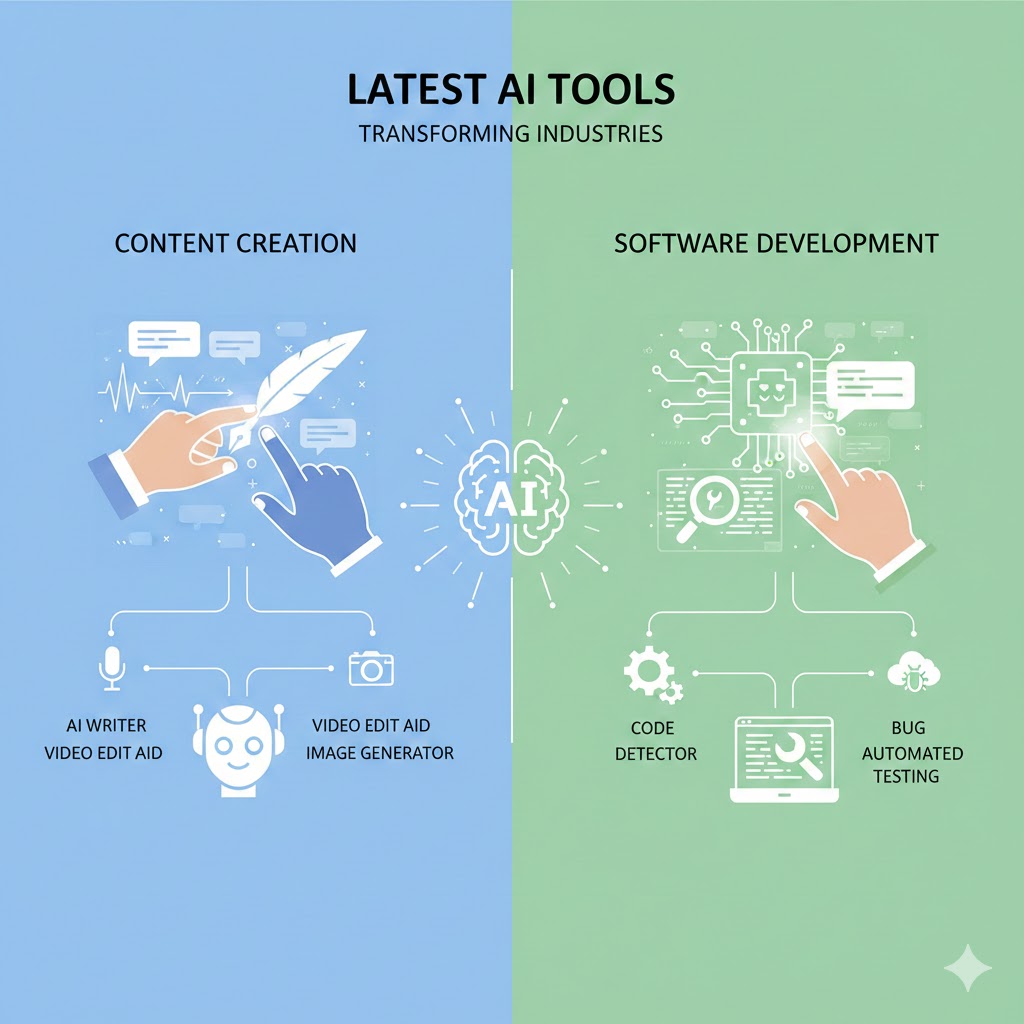
The technological landscape is witnessing an unprecedented revolution as artificial intelligence reshapes how we create content and develop software. The latest AI tools are not merely incremental improvements over previous solutions but represent quantum leaps in capability, efficiency, and accessibility. These innovations are democratizing creativity and technical development, enabling professionals and newcomers alike to produce exceptional work at speeds previously unimaginable.
From generating photorealistic images to writing production-ready code, latest AI tools are eliminating traditional barriers and redefining what’s possible in digital creation. This transformation is occurring across every creative and technical domain, fundamentally changing workflows, career paths, and business models.
1. Revolutionary AI Writing and Content Generation Tools
Advanced Language Models for Professional Writing
The latest AI tools for writing have evolved far beyond simple grammar checkers. Modern AI writing assistants understand context, tone, audience, and purpose with remarkable sophistication. These systems can generate everything from technical documentation to creative fiction, maintaining consistent voice and style throughout lengthy documents.
Context-Aware Content Creation
Today’s AI writing platforms don’t just generate text; they understand your objectives and adapt accordingly. Whether you’re crafting marketing copy that converts, academic papers requiring precise citations, or engaging blog posts that captivate readers, these tools adjust their output to match your specific requirements. The systems analyze successful content in your niche and incorporate proven engagement strategies while maintaining originality.
Multi-Language Content Generation
Breaking language barriers has become effortless with latest AI tools that generate native-quality content in dozens of languages. These platforms don’t simply translate but create culturally appropriate content that resonates with local audiences. Businesses can now maintain authentic communication across global markets without extensive translation teams.
Content Optimization and SEO Integration
Modern AI writing tools incorporate real-time SEO analysis, suggesting keywords, optimal content length, and structural improvements that enhance search visibility. These systems analyze top-ranking content for target keywords and provide data-driven recommendations for outperforming competitors while maintaining natural readability.
2. Next-Generation AI Code Generation Platforms
Intelligent Code Completion and Suggestion
Software development has been revolutionized by latest AI tools that understand programming contexts and generate accurate, efficient code. These systems analyze your existing codebase, understand your architectural patterns, and suggest implementations that align with your project’s conventions. The result is dramatically accelerated development without sacrificing code quality.
Full-Function Implementation from Natural Language
Developers can now describe desired functionality in plain English, and AI coding assistants generate complete implementations. Want a user authentication system with password reset functionality? Describe your requirements conversationally, and watch as the AI produces working code complete with error handling, security best practices, and documentation.
Bug Detection and Automated Code Review
Latest AI tools serve as tireless code reviewers, identifying potential bugs, security vulnerabilities, and performance bottlenecks before they reach production. These systems learn from millions of code repositories, recognizing patterns that lead to issues and suggesting preventive improvements. The AI can explain why specific code patterns are problematic and recommend alternative approaches.
Legacy Code Modernization
Organizations struggling with outdated codebases can leverage AI tools that analyze legacy systems and suggest modernization strategies. These platforms can even automatically refactor code, translating old languages to modern frameworks while preserving functionality and improving maintainability.
3. AI-Powered Visual Content Creation Tools
Photorealistic Image Generation
The latest AI tools for image creation have achieved stunning realism, generating photographs indistinguishable from camera-captured images. Marketing teams, designers, and content creators can produce custom visuals matching precise specifications without expensive photo shoots or stock image limitations. These systems understand lighting, composition, and artistic principles, creating images that aren’t just accurate but aesthetically compelling.
Style Transfer and Image Manipulation
Advanced AI tools enable sophisticated image editing that once required expert-level Photoshop skills. Remove backgrounds instantly, change lighting conditions, alter seasons, or apply artistic styles with simple text commands. The AI understands spatial relationships and maintains realistic coherence when making complex modifications.
Brand-Consistent Visual Assets
Organizations can train custom AI models on their brand guidelines, ensuring all generated visuals maintain consistent color schemes, styles, and aesthetic qualities. This consistency extends across all marketing materials, from social media graphics to presentation decks, without requiring detailed art direction for each asset.
Vector Graphics and Logo Design
Latest AI tools now extend beyond raster images to generate scalable vector graphics perfect for logos, icons, and illustrations. These systems understand design principles like balance, contrast, and harmony, producing professional-quality graphics suitable for both digital and print applications.
4. Video Production and Editing AI Solutions
Automated Video Creation from Scripts
Video production has been democratized by latest AI tools that transform text scripts into complete videos with narration, visuals, and music. These platforms select appropriate stock footage or generate custom visuals, synchronize audio, add transitions, and produce polished videos in minutes rather than days.
AI-Powered Video Editing
Professional-grade video editing is now accessible through AI assistants that handle time-consuming tasks automatically. These tools can remove silences, add captions, correct color grading, stabilize shaky footage, and even generate B-roll footage to complement primary content. The AI understands pacing and engagement, suggesting cuts and transitions that maintain viewer interest.
Deepfake Technology for Content Localization
While controversial, deepfake technology has legitimate applications in content creation. Latest AI tools enable video translation where speakers appear to speak different languages with perfectly synchronized lip movements. This technology allows global content distribution without expensive reshooting for each market.
Real-Time Video Enhancement
AI video tools can upscale resolution, interpolate frames for smoother motion, remove noise, and enhance audio quality in real-time. Older video content can be refreshed to modern quality standards, and low-quality recordings can be salvaged and made presentable.
5. Audio Generation and Music Production Tools
AI Voice Synthesis and Cloning
The latest AI tools generate remarkably natural-sounding speech in any voice, accent, or language. Content creators can produce audiobooks, podcasts, and voiceovers without recording studios or voice actors. Some platforms even allow voice cloning, enabling consistent narration across large content libraries using a single voice sample.
Automated Music Composition
AI music generation tools create original compositions matching specific moods, genres, and lengths. Need upbeat background music for a promotional video? Specify your requirements, and the AI composes unique, royalty-free music perfectly suited to your needs. These systems understand music theory, chord progressions, and instrumentation, producing professional-quality compositions.
Audio Enhancement and Noise Removal
Background noise, echo, and poor recording quality can ruin otherwise excellent audio content. Latest AI tools remove unwanted sounds while preserving voice clarity, making amateur recordings sound professionally produced. These systems can even separate individual audio sources from mixed recordings.
Podcast Production Automation
Podcast creators benefit from AI tools that handle editing, mixing, and enhancement automatically. These platforms can identify and remove filler words, adjust volume levels, add music and transitions, and generate show notes and transcripts, reducing production time by hours per episode.
6. AI-Driven Design and Prototyping Platforms
Automated UI/UX Design Generation
Latest AI tools transform wireframes or descriptions into complete user interface designs, selecting appropriate layouts, color schemes, typography, and component styles. These systems apply established design principles while allowing customization to match brand guidelines and specific requirements.
Responsive Design Optimization
AI design platforms automatically generate responsive versions of interfaces, ensuring optimal display across desktop, tablet, and mobile devices. The systems understand how interface elements should adapt to different screen sizes, maintaining usability and aesthetic quality across all formats.
Design System Management
Large organizations struggle to maintain consistent design systems across products and teams. Latest AI tools analyze existing interfaces, extract design patterns, and generate comprehensive design systems complete with components, guidelines, and documentation. These systems can even identify inconsistencies and suggest standardization opportunities.
A/B Testing and Conversion Optimization
AI design tools can generate multiple design variations automatically, predict their performance based on historical data, and run optimization experiments. These systems identify which design elements most significantly impact user behavior and recommend improvements that increase conversions.
7. Collaborative Development Environments
Real-Time Code Collaboration Tools
Modern software development is increasingly distributed, and latest AI tools facilitate seamless remote collaboration. These platforms provide intelligent conflict resolution when multiple developers modify the same code, suggest optimal code merge strategies, and maintain code quality across distributed teams.
Automated Documentation Generation
Technical documentation often lags behind code changes, creating maintenance headaches. AI documentation tools analyze code changes and automatically update relevant documentation, maintaining accuracy without manual intervention. These systems can even generate comprehensive API documentation from code annotations.
Project Management and Task Automation
Latest AI tools streamline development workflows by analyzing project requirements, estimating task complexity, suggesting optimal team assignments, and identifying potential bottlenecks. These platforms learn from past projects, continuously improving their predictions and recommendations.
Code Quality Metrics and Technical Debt Analysis
AI-powered code analysis tools provide comprehensive insights into codebase health, identifying areas of technical debt, suggesting refactoring priorities, and tracking quality metrics over time. These systems help teams make informed decisions about where to invest improvement efforts.
8. Natural Language Processing Applications
Advanced Chatbots and Virtual Assistants
The latest AI tools create conversational interfaces that understand context, remember previous interactions, and provide genuinely helpful responses. These systems can handle complex customer service scenarios, guide users through troubleshooting processes, and even complete transactions autonomously.
Sentiment Analysis and Text Classification
Understanding audience reactions and organizing large text datasets becomes manageable with AI tools that analyze sentiment, detect emotions, and categorize content automatically. These capabilities enable businesses to monitor brand perception, analyze customer feedback, and extract actionable insights from unstructured text.
Information Extraction and Summarization
AI summarization tools process lengthy documents, articles, or meeting transcripts and generate concise summaries capturing key points. Latest AI tools can even extract specific information types like dates, names, financial figures, or action items, organizing them into structured formats for easy analysis.
Translation and Localization Services
Modern AI translation surpasses simple word-for-word conversion, understanding idioms, cultural context, and technical terminology. These systems produce translations that read naturally in target languages while preserving the original message’s intent and tone.
9. Data Visualization and Analytics Tools
Automated Chart and Graph Generation
Latest AI tools transform raw data into compelling visualizations automatically, selecting appropriate chart types, color schemes, and layouts based on data characteristics and intended insights. These systems understand which visualization methods most effectively communicate different data relationships.
Predictive Analytics Integration
AI analytics platforms don’t just visualize past data but project future trends based on historical patterns. These tools identify correlations, detect anomalies, and generate forecasts that inform strategic decision-making across business functions.
Natural Language Data Queries
Instead of writing complex database queries, users can ask questions in plain English and receive accurate data responses with appropriate visualizations. This democratizes data access, enabling non-technical team members to extract insights independently.
Dashboard Customization and Optimization
Latest AI tools learn which metrics matter most to different users and automatically customize dashboards for maximum relevance. These systems can even suggest new metrics to track based on organizational goals and industry benchmarks.
10. Testing and Quality Assurance Automation
Intelligent Test Case Generation
Software testing becomes more comprehensive with latest AI tools that automatically generate test cases covering edge cases human testers might overlook. These systems analyze code to identify potential failure points and create targeted tests ensuring robust functionality.
Visual Regression Testing
AI-powered visual testing tools compare application interfaces across different versions, browsers, and devices, automatically identifying unintended visual changes. These systems understand which variations represent bugs versus acceptable differences, reducing false positives.
Performance Testing and Optimization
Load testing and performance analysis benefit from AI tools that simulate realistic user behaviors, identify bottlenecks, and recommend optimization strategies. These platforms can predict how systems will perform under various conditions, enabling proactive capacity planning.
Continuous Integration Enhancement
Latest AI tools integrate with CI/CD pipelines, intelligently prioritizing which tests to run based on code changes, predicting which builds might fail, and suggesting optimal deployment windows that minimize user impact.
11. Content Personalization and Recommendation Systems
Dynamic Content Adaptation
Modern websites and applications use latest AI tools to adapt content presentation based on individual user preferences, behavior patterns, and contextual factors. The same webpage can display different content, layouts, and calls-to-action depending on who’s viewing it and what they’re trying to accomplish.
Product and Content Recommendations
Recommendation engines analyze user behavior, preferences, and similar user patterns to suggest relevant content or products. These systems continuously learn from interactions, improving recommendation accuracy over time and increasing engagement and conversion rates.
Email Personalization at Scale
AI email tools go beyond inserting names in subject lines, generating truly personalized email content that reflects individual recipient interests, previous interactions, and predicted preferences. These systems can create thousands of unique email variations from a single campaign template.
Customer Journey Optimization
Latest AI tools map individual customer journeys, identifying optimal touchpoints and messaging for moving prospects toward conversion. These systems recognize patterns indicating purchase intent and trigger appropriate interventions at precisely the right moments.
12. Emerging AI Technologies Shaping the Future
Multimodal AI Systems
The frontier of AI development involves systems that seamlessly work across text, images, audio, and video simultaneously. These latest AI tools can analyze a video, generate descriptive text, create alternative visuals, and produce audio commentary all within a unified workflow. This convergence enables entirely new creative possibilities.
AI-Assisted 3D Modeling and Animation
Three-dimensional content creation is becoming accessible through AI tools that generate 3D models from text descriptions, photographs, or sketches. These systems understand spatial relationships, physics, and aesthetic principles, producing models suitable for gaming, architecture, product design, and animation.
Augmented Reality Content Creation
Latest AI tools simplify AR experience development, automatically generating 3D assets, spatial mappings, and interactive elements from simple descriptions. This democratization enables more creators to develop AR applications without specialized technical expertise.
Quantum-Inspired AI Algorithms
While true quantum computing remains in early stages, quantum-inspired algorithms are enhancing traditional AI capabilities. These approaches enable latest AI tools to solve optimization problems more efficiently, explore larger solution spaces, and generate more creative outputs.
Conclusion: Embracing the AI-Powered Future
The latest AI tools transforming content creation and software development represent more than technological advancement; they signify a fundamental shift in how we work, create, and innovate. These tools are not replacing human creativity and expertise but amplifying them, enabling individuals and teams to achieve results previously requiring much larger resources.
The democratization effect cannot be overstated. Solo entrepreneurs now access capabilities once exclusive to large corporations. Individual developers build complex applications that previously required entire teams. Content creators produce professional-quality work across multiple mediums without specialized training in each discipline.
However, success with these tools requires more than simply adopting them. The most effective implementations combine AI capabilities with human judgment, creativity, and strategic thinking. Latest AI tools excel at execution, optimization, and scale, but humans remain essential for setting direction, ensuring quality, and maintaining ethical standards.
As these technologies continue evolving at breathtaking pace, staying informed about emerging capabilities becomes crucial. The tools discussed here represent the current state of the art, but innovations arriving monthly expand possibilities further. Organizations and individuals who embrace these changes while developing skills to leverage them effectively will thrive in this new landscape.
The future is not about humans versus machines but humans empowered by machines. The latest AI tools are instruments of amplification, enabling us to focus on higher-level creative and strategic challenges while automating routine and repetitive tasks. Those who learn to orchestrate these capabilities will find themselves at the forefront of their industries, creating better products, engaging content, and innovative solutions faster than ever before.
The transformation is here, accelerating daily. The question is not whether to adopt these tools but how quickly and effectively you can integrate them into your workflows to maintain competitive advantage in an increasingly AI-enhanced world.
Also read this:
AI Tools for Marketing Automation That Increase Leads and Sales
Top AI Tools for Coding That Speed Up Development and Debugging
Top AI Tools list to Use in 2025 Across Marketing, Coding, and Automation