
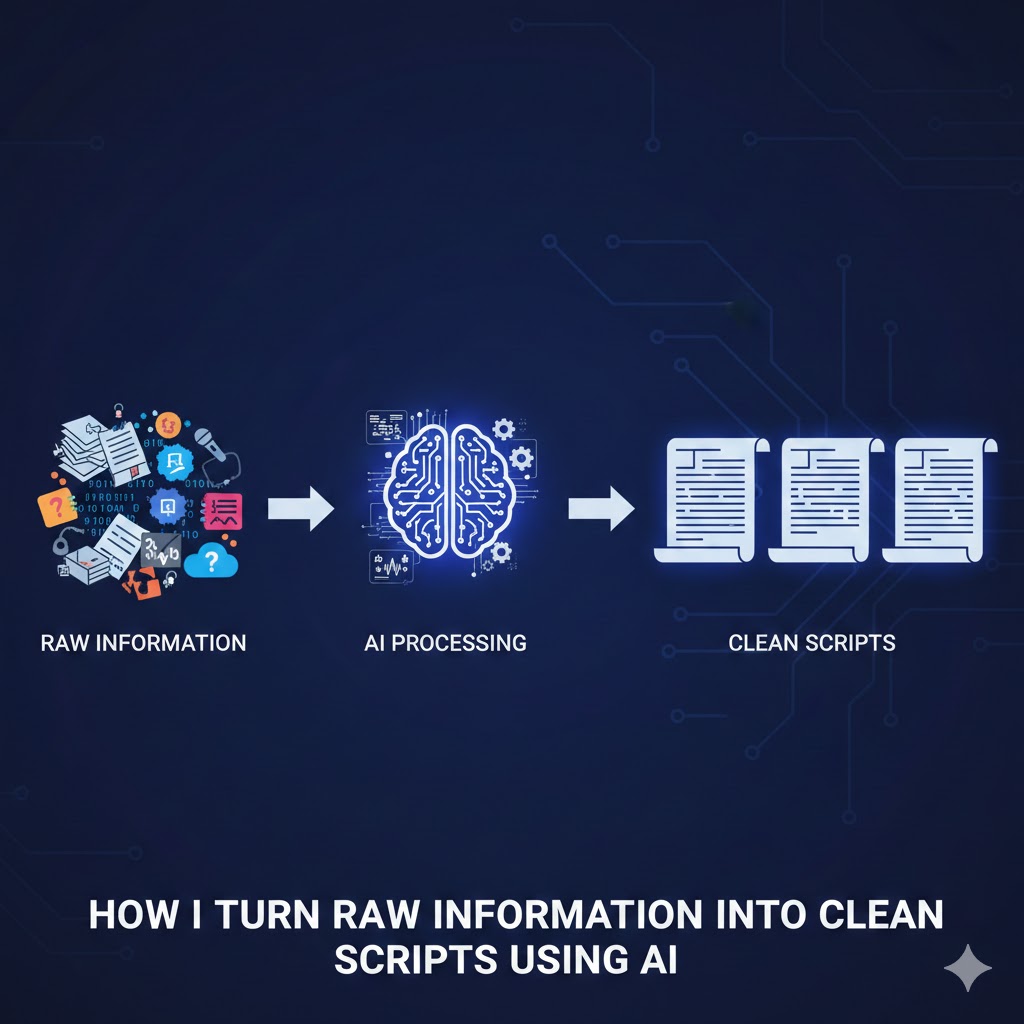
Content creation has evolved dramatically with artificial intelligence transforming how creators work. As someone who produces multiple video scripts weekly, I’ve discovered that the ability to transform Raw Information Into Clean Scripts Using AI has revolutionized my workflow, cutting production time by seventy percent while actually improving quality. This comprehensive guide shares the exact system I’ve developed to convert messy research notes, scattered ideas, and disorganized data into polished, engaging scripts ready for recording.
1. Why Converting Raw Information Into Scripts Matters
The challenge every content creator faces is the gap between having valuable information and presenting it effectively. Understanding why systematically turning Raw Information Into Clean Scripts Using AI matters helps prioritize this skill in your content production workflow.
The Cost of Disorganized Information
Raw information in its natural state creates significant production bottlenecks:
- Hours wasted trying to organize scattered notes and research
- Inconsistent quality when improvising from rough outlines
- Lost ideas buried in unstructured brainstorming documents
- Redundant research when information isn’t properly cataloged
- Missed opportunities to connect related concepts
- Audience confusion from poorly structured presentations
- Decreased credibility from rambling or unclear explanations
- Production delays when rewriting on the fly
The Power of Clean, Structured Scripts
Well-crafted scripts transform content production fundamentally:
- Consistent delivery maintaining professional quality standards
- Efficient recording with fewer retakes and less editing
- Clear messaging ensuring audience comprehension
- Strategic pacing keeping viewers engaged throughout
- Confident presentation eliminating uncertainty and hesitation
- Reusable frameworks accelerating future content creation
- Team collaboration simplified through clear documentation
- Scalable production allowing increased content volume
The AI Advantage in Script Writing
Artificial intelligence brings unique capabilities to script creation:
- Processing large volumes of information rapidly
- Identifying patterns and connections humans might miss
- Maintaining consistent tone and style across content
- Generating multiple variations for testing
- Adapting content for different audiences and platforms
- Organizing complex information into logical structures
- Eliminating writer’s block through intelligent suggestions
- Reducing production costs dramatically compared to hiring writers
Building Sustainable Content Systems
Systematizing the transformation of Raw Information Into Clean Scripts Using AI creates compounding benefits:
- Faster turnaround from idea to finished content
- Higher output volume without quality sacrifice
- Reduced mental fatigue from creative work
- Better work-life balance through efficient processes
- Increased revenue potential from more content
- Competitive advantage through consistent publishing
- Stronger audience relationships through regular delivery
- Professional growth through systematic improvement
2. Understanding the Script Creation Process
Breaking down how to effectively turn Raw Information Into Clean Scripts Using AI into distinct phases helps create reliable, repeatable workflows that consistently produce quality results.
Information Gathering and Research
The foundation of any great script starts with comprehensive information collection:
- Primary research through interviews and direct observation
- Secondary research from books, articles, and studies
- Competitor analysis revealing successful approaches
- Audience research understanding needs and preferences
- Expert consultation adding credibility and depth
- Case study collection providing concrete examples
- Statistical data supporting key claims
- Historical context establishing relevance
Initial Organization and Structuring
Raw information requires thoughtful organization before script writing:
- Categorizing information by topic and relevance
- Identifying main themes and supporting points
- Creating logical flow from introduction to conclusion
- Determining appropriate depth for each section
- Establishing narrative arc and story structure
- Noting areas requiring additional research
- Flagging particularly compelling quotes or data
- Outlining desired audience takeaways
AI-Assisted Content Generation
Modern AI tools excel at transforming organized information into scripts:
- Converting bullet points into flowing narrative prose
- Maintaining consistent voice and tone throughout
- Generating engaging introductions capturing attention
- Creating smooth transitions between topics
- Suggesting compelling examples and analogies
- Formatting content for optimal readability
- Identifying opportunities for emotional engagement
- Proposing calls-to-action aligned with goals
Human Refinement and Enhancement
AI provides excellent first drafts requiring strategic human input:
- Adding personal experiences and unique insights
- Injecting authentic personality and humor
- Ensuring technical accuracy and currency
- Optimizing pacing for intended delivery method
- Strengthening weak sections with additional content
- Removing redundancy and tightening prose
- Verifying alignment with brand voice
- Testing readability and comprehension
3. Essential AI Tools for Script Creation
Successfully implementing systems to transform Raw Information Into Clean Scripts Using AI requires selecting appropriate tools matching your specific needs and working style.
Advanced Language Models
Large language models provide powerful script generation capabilities:
- General-purpose AI assistants handling diverse content types
- Specialized writing tools optimized for scripts and screenplays
- Industry-specific AI trained on domain expertise
- Custom-trained models incorporating your unique voice
- Multi-lingual models for international content
- Context-aware systems remembering previous conversations
- Fine-tuned models for specific content formats
- API-accessible tools enabling workflow automation
Research and Information Management Tools
Efficient information organization supports quality script creation:
- Note-taking applications with AI organization features
- Research management platforms categorizing sources
- Web clipping tools capturing information for later use
- Knowledge management systems connecting related ideas
- Bookmarking services with AI tagging capabilities
- Document scanning and OCR for physical materials
- Voice recording transcription for interview capture
- Database tools for structured information storage
Script Formatting and Collaboration Platforms
Proper formatting ensures scripts are production-ready:
- Dedicated screenwriting software with industry-standard formatting
- Document editors with collaboration features
- Version control systems tracking changes over time
- Template libraries for common script types
- Style guide integration ensuring consistency
- Real-time collaboration for team-based production
- Export capabilities for various production tools
- Cloud storage providing access anywhere
Quality Enhancement and Editing Tools
Refinement tools polish AI-generated scripts to professional standards:
- Grammar and style checkers catching errors
- Readability analyzers ensuring appropriate complexity
- Plagiarism detectors verifying originality
- Tone analyzers matching desired emotional impact
- Fact-checking tools verifying claims and statistics
- Reading time estimators for video length planning
- SEO optimization tools for search-friendly titles
- A/B testing platforms for performance comparison
4. My Complete System for Turning Information Into Scripts
This proven framework for converting Raw Information Into Clean Scripts Using AI represents the exact process I use to produce multiple high-quality scripts weekly.
Step One: Information Collection and Brain Dump
Gather all relevant information without worrying about organization:
- Research your topic thoroughly across multiple sources
- Capture ideas as they come without filtering
- Record voice notes during inspiration moments
- Screenshot relevant social media discussions
- Save articles and videos for reference
- Interview experts and stakeholders
- Document personal experiences and observations
- Collect audience questions and feedback
Step Two: Preliminary Organization
Create initial structure from chaotic raw information:
- Review all collected materials in single session
- Identify three to five main themes or topics
- Group related information under each theme
- Note obvious gaps requiring additional research
- Highlight particularly strong quotes or statistics
- Create rough outline of logical progression
- Determine target script length and depth
- Establish primary goal and key takeaway
Step Three: AI-Powered Script Generation
Use artificial intelligence to transform organized information into draft scripts:
- Feed organized outline and research to AI tool
- Specify desired tone, style, and format
- Request specific script structure if needed
- Generate multiple variations if exploring options
- Review output for accuracy and relevance
- Identify sections requiring expansion or reduction
- Note areas where AI missed important points
- Extract particularly well-written sections
Step Four: Strategic Human Enhancement
Add irreplaceable human elements AI cannot provide:
- Inject personal stories and authentic experiences
- Add humor reflecting your unique personality
- Include industry insights from your expertise
- Strengthen weak arguments with additional reasoning
- Remove AI-generated generic phrases
- Verify all facts and update outdated information
- Ensure transitions feel natural and conversational
- Optimize hook and conclusion for maximum impact
Step Five: Format and Polish
Prepare script for actual production use:
- Apply proper script formatting conventions
- Add timing notes and pacing indicators
- Insert pronunciation guides for difficult terms
- Mark emphasis points and emotional beats
- Include visual cue suggestions
- Add B-roll or graphic placement notes
- Format for easy reading during recording
- Create backup sections for variable length
Step Six: Test and Refine
Validate script quality before final production:
- Read script aloud checking for awkward phrasing
- Time script delivery matching target duration
- Test with small audience for comprehension
- Adjust technical complexity for target viewers
- Verify logical flow from beginning to end
- Confirm calls-to-action are clear and compelling
- Check all references and citations
- Make final adjustments based on testing
5. Advanced Techniques for Superior Scripts
Elevating your ability to transform Raw Information Into Clean Scripts Using AI involves implementing sophisticated strategies that separate amateur from professional content.
Developing Your Unique Voice Framework
Train AI to write in your authentic style:
- Create detailed style guide documenting your voice
- Provide AI with examples of your best scripts
- Note specific phrases and expressions you use
- Document topics and angles you prefer
- Identify humor style and appropriate jokes
- Specify technical depth for your audience
- Define pacing preferences and sentence length
- Establish guidelines for personal story inclusion
Implementing Multi-Stage Refinement
Layer multiple AI passes for increasingly polished results:
- First pass generating comprehensive draft from outline
- Second pass strengthening hooks and transitions
- Third pass enhancing emotional engagement
- Fourth pass optimizing for specific platform requirements
- Fifth pass adding strategic pauses and emphasis
- Sixth pass ensuring perfect grammar and clarity
- Seventh pass checking consistency throughout
- Final human pass adding authentic personality
Creating Modular Script Components
Build reusable elements accelerating future production:
- Standard introduction templates for different topics
- Transition phrase libraries connecting sections
- Call-to-action variations for different goals
- Conclusion frameworks reinforcing key messages
- Story structure templates for common narratives
- Explanation patterns for complex concepts
- Engagement technique collections
- Brand element placement guidelines
Optimizing for Different Platforms
Adapt core information into platform-specific scripts:
- Long-form YouTube videos with detailed explanations
- Short-form social media with punchy delivery
- Podcast scripts emphasizing conversational tone
- Educational content with clear learning objectives
- Sales presentations balancing information and persuasion
- Webinar scripts incorporating audience interaction
- Interview scripts with strategic question placement
- Presentation scripts with visual complement notes
6. Common Challenges and How to Overcome Them
Even experienced creators face obstacles when turning Raw Information Into Clean Scripts Using AI, but these challenges have proven solutions.
Managing Information Overload
Too much research can paralyze script creation:
- Set research time limits preventing endless gathering
- Focus on information directly supporting main points
- Use AI to summarize lengthy sources
- Create tiered information hierarchy
- Save tangential information for future content
- Establish minimum viable research threshold
- Accept that scripts can evolve over time
- Trust that you know more than you think
Maintaining Authenticity with AI Assistance
AI-generated content can feel generic or artificial:
- Always add personal experiences and insights
- Edit AI suggestions rather than using verbatim
- Use AI for structure while writing key sections yourself
- Inject humor and personality AI cannot replicate
- Share opinions and perspectives uniquely yours
- Include conversational asides and tangents
- Reference current events and timely topics
- Let imperfections that humanize content remain
Balancing Depth and Accessibility
Technical topics require careful calibration:
- Define target audience clearly before writing
- Use analogy and metaphor for complex concepts
- Layer information from simple to complex
- Provide optional deep-dives for advanced viewers
- Test scripts with representative audience members
- Include definitions for necessary jargon
- Use concrete examples making abstract tangible
- Offer additional resources for deeper learning
Preventing AI Hallucinations and Errors
AI can generate confident-sounding incorrect information:
- Verify all factual claims against reliable sources
- Cross-reference statistics with original data
- Question surprisingly specific AI-generated details
- Maintain healthy skepticism of perfect-sounding explanations
- Use AI for structure rather than specialized facts
- Consult experts for technical accuracy verification
- Keep detailed source documentation
- Build fact-checking into your workflow
7. Measuring Script Quality and Performance
Evaluating your system for transforming Raw Information Into Clean Scripts Using AI requires tracking metrics indicating effectiveness and guiding continuous improvement.
Production Efficiency Metrics
Track how the system improves your workflow:
- Time from initial research to finished script
- Number of revision rounds required
- Recording efficiency and retake frequency
- Editing time required per finished video
- Scripts completed per week or month
- Cost per script compared to alternatives
- Team productivity if working with others
- Mental fatigue levels during production
Content Quality Indicators
Assess script quality through multiple lenses:
- Audience retention rates throughout video
- Engagement metrics like comments and shares
- Comprehension testing with sample viewers
- Feedback quality and depth from audience
- Re-watch rates indicating lasting value
- Citation and reference rates by others
- Authority signals like backlinks earned
- Personal satisfaction with finished content
Business Impact Measurements
Connect script quality to tangible outcomes:
- Conversion rates from viewers to customers
- Lead generation through calls-to-action
- Revenue directly attributed to content
- Subscriber growth rate over time
- Brand awareness and recognition metrics
- Speaking or collaboration opportunities
- Media coverage and press mentions
- Overall channel or business growth
Continuous Improvement Tracking
Monitor evolution of your script creation system:
- Comparison of early versus recent scripts
- Skill development in specific areas
- AI tool effectiveness over time
- Process refinement impact on efficiency
- Quality consistency across content types
- Scalability as production volume increases
- Team capability development
- Return on investment in tools and training
8. Building Sustainable Script Production Systems
Scaling your capacity to convert Raw Information Into Clean Scripts Using AI requires developing robust systems supporting consistent quality at increasing volume.
Creating Standard Operating Procedures
Document your process for reliable repetition:
- Detailed workflows for each production phase
- Decision trees for common situations
- Quality checklists ensuring nothing overlooked
- Template libraries for different content types
- Style guides maintaining brand consistency
- Tool usage guidelines and best practices
- Troubleshooting guides for common problems
- Training materials for team members
Implementing Workflow Automation
Use technology to eliminate repetitive manual tasks:
- Automated research compilation from saved sources
- Scheduled AI script generation from outlines
- Automatic formatting of completed drafts
- Integration between research and writing tools
- Version control and backup automation
- Collaboration notification systems
- Performance tracking and reporting
- Content calendar and deadline management
Building Content Asset Libraries
Develop repositories accelerating future production:
- Script template collection for various formats
- Research summary database by topic
- Expert quote and testimonial library
- Statistical data organized by subject
- Visual asset collections linked to topics
- Music and audio resource libraries
- Case study and example collections
- Call-to-action variation repository
Developing Team Capabilities
Scale beyond individual production capacity:
- Train team members on script creation system
- Establish clear roles and responsibilities
- Create review and approval workflows
- Develop feedback and coaching processes
- Build shared knowledge bases
- Foster collaboration and idea sharing
- Recognize and reward quality work
- Continuously refine team processes
9. Future of AI-Powered Script Creation
The technology enabling transformation of Raw Information Into Clean Scripts Using AI continues advancing rapidly, with emerging capabilities revolutionizing content creation.
Next-Generation AI Capabilities
Upcoming developments will offer:
- Real-time collaboration with AI during writing
- Multimodal AI understanding visual and audio context
- Emotional intelligence creating deeper engagement
- Personalization generating viewer-specific versions
- Predictive analytics forecasting content performance
- Automatic fact-checking and source citation
- Voice cloning matching your speaking style exactly
- Interactive scripts adapting to viewer choices
Enhanced Research Integration
AI will streamline information gathering:
- Autonomous research agents gathering information
- Real-time web monitoring for trending topics
- Expert network integration for specialized knowledge
- Academic database direct access and synthesis
- Competitive intelligence automatic tracking
- Audience sentiment analysis from comments
- Trend prediction identifying future topics
- Knowledge graph construction linking concepts
Advanced Production Integration
Script creation will connect seamlessly with production:
- Direct integration with video editing software
- Automatic B-roll and visual suggestion
- AI-generated production notes and shot lists
- Voiceover and narration automatic generation
- Real-time teleprompter with AI adjustment
- Multi-language script translation instantly
- Accessibility feature automatic creation
- Platform-specific formatting and optimization
Evolving Content Formats
New possibilities for script-based content:
- Interactive branching narratives
- Virtual and augmented reality experiences
- Conversational AI delivering your content
- Personalized educational pathways
- Immersive storytelling environments
- Gamified content experiences
- Social co-creation platforms
- Decentralized content networks
10. Getting Started with AI-Powered Script Creation
Implementing effective systems for turning Raw Information Into Clean Scripts Using AI requires methodical planning and phased execution.
Assessing Your Current Situation
Evaluate where you are and where you want to go:
- Document your existing script creation process
- Identify biggest time-consuming bottlenecks
- Assess current script quality honestly
- Determine production volume goals
- Calculate available budget for tools
- Evaluate team skills and capabilities
- Review competitor script quality
- Establish clear success metrics
Selecting Your Initial Tool Stack
Start with essential tools before expanding:
- Choose one primary AI writing assistant
- Select research organization platform
- Implement basic script formatting tool
- Set up cloud storage and backup
- Add grammar and style checker
- Choose analytics for performance tracking
- Start with free or low-cost options
- Plan upgrade path as needs grow
Running Initial Experiments
Test the approach before full commitment:
- Convert three to five existing topics to scripts
- Track time spent at each workflow stage
- Compare AI-assisted versus traditional results
- Gather feedback from audience on quality
- Calculate return on time investment
- Document lessons learned and challenges
- Refine process based on experience
- Build confidence before scaling
Developing Your Personal System
Create customized workflow matching your needs:
- Adapt general framework to your situation
- Incorporate tools that fit your budget
- Adjust complexity to your technical comfort
- Build on your existing strengths
- Address your specific weaknesses
- Maintain flexibility for experimentation
- Document your unique process
- Commit to continuous refinement
Scaling Production Systematically
Grow capacity methodically over time:
- Gradually increase script production volume
- Continuously refine and optimize processes
- Invest in better tools as justified by results
- Expand team if pursuing significant growth
- Maintain quality standards during scaling
- Build systematic improvement into workflow
- Share knowledge within your community
- Celebrate milestones and progress
Conclusion: Transforming Your Content Creation Forever
Mastering the art and science of turning Raw Information Into Clean Scripts Using AI represents one of the most valuable skills modern content creators can develop. This capability transforms the creative process from chaotic and exhausting to systematic and sustainable.
The artificial intelligence tools available today have reached a sophistication level where they genuinely augment human creativity rather than replacing it. They handle the heavy lifting of organization, structure, and initial drafting, freeing creators to focus on adding the irreplaceable human elements that make content truly engaging.
My personal journey with AI-powered script creation has completely transformed my content production. What once took days now takes hours. Content quality has improved through consistent structure and pacing. Production volume has tripled without increasing work hours. Most importantly, the creative process has become enjoyable again rather than draining.
The system I’ve shared in this guide represents the culmination of extensive experimentation, countless iterations, and lessons learned from hundreds of scripts. It works for video content, podcasts, presentations, courses, and any format requiring structured spoken or written material.
The question is not whether to incorporate AI into your script creation process, but how quickly you can develop effective systems that work for your unique situation. The tools exist, the techniques are proven, and the benefits are substantial. Start small, experiment freely, and refine continuously. Your future self will thank you for the time invested in building this critical capability.
Also read this:
From Podcast to Blog: How AI Automates Content Repurposing
How to Turn YouTube Videos Into SEO-Optimized Blog Posts Using AI
AI Subtitle Generation: Add Multiple Languages Automatically