
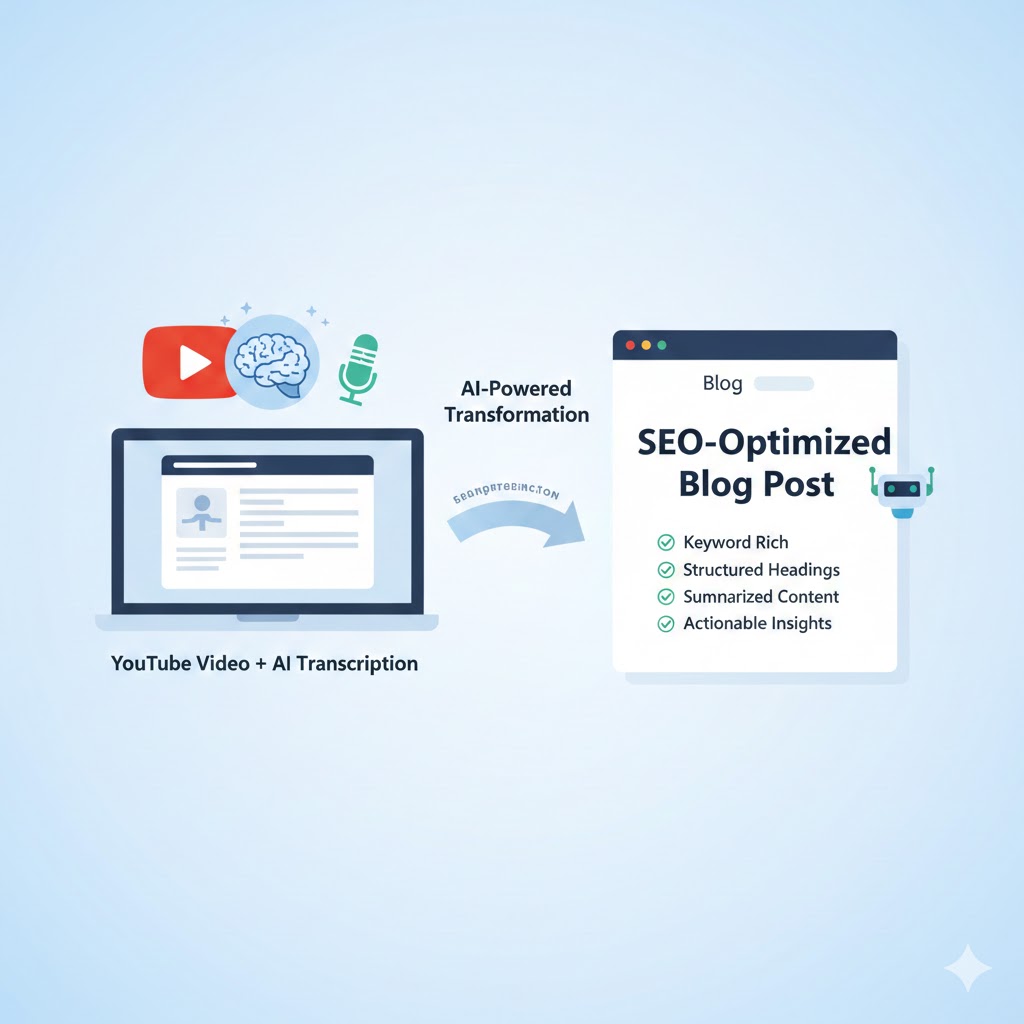
Content creators face an ongoing challenge: producing enough high-quality material to maintain audience engagement across multiple platforms. The solution lies in a powerful strategy that transforms YouTube Videos Into SEO-Optimized Blog Posts, maximizing the value of every piece of content you create. This approach leverages artificial intelligence to convert video content into written articles that rank well in search engines, dramatically expanding your content’s reach without multiplying your workload.
1. Why Converting YouTube Videos Into Blog Posts Matters
The strategic importance of turning YouTube Videos Into SEO-Optimized Blog Posts extends far beyond simple content repurposing. This approach creates a synergistic relationship between your video and written content that amplifies both formats.
Reaching Different Audience Segments
People consume content in vastly different ways based on their preferences, circumstances, and contexts:
- Visual learners prefer video content with demonstrations and presentations
- Reading-oriented individuals favor text they can scan and reference
- Mobile users in data-limited situations need text-based alternatives
- Workplace audiences often cannot watch videos with sound
- Quick researchers want scannable content for rapid information gathering
- Deep learners appreciate written content they can annotate and revisit
By maintaining both formats, you ensure no potential audience member is excluded based on their content consumption preferences.
Dominating Search Engine Results
Search engines display different types of results for various queries. Converting videos to blog posts allows you to:
- Appear in both video and traditional search results simultaneously
- Capture featured snippets with well-structured text content
- Rank for long-tail keywords easier to target in written form
- Build topical authority through comprehensive content coverage
- Earn backlinks from sources preferring to link to articles
- Improve dwell time with users consuming multiple content formats
- Create internal linking opportunities strengthening site architecture
Maximizing Content Investment Return
Creating quality video content requires substantial investment in equipment, filming time, editing, and production. Transforming that investment into multiple assets makes financial sense:
- Amortize production costs across multiple content pieces
- Generate additional traffic without additional filming
- Create evergreen written content from time-sensitive videos
- Build comprehensive resource libraries around key topics
- Develop lead magnets and downloadable guides from video series
- Establish thought leadership through diverse content formats
- Increase total content output without proportional time investment
2. Understanding the AI-Powered Conversion Process
The technology enabling efficient transformation of YouTube Videos Into SEO-Optimized Blog Posts involves sophisticated artificial intelligence systems working through multiple stages.
Automated Transcription Technology
Modern AI transcription services analyze video audio and convert speech to text with remarkable accuracy:
- Neural networks trained on millions of hours of speech data
- Contextual understanding that distinguishes homophones correctly
- Speaker identification for multi-person videos
- Punctuation prediction based on speech patterns
- Technical terminology recognition across various domains
- Accent and dialect adaptation for global content
- Real-time processing capabilities for rapid turnaround
- Timestamp generation for reference and verification
Natural Language Processing for Content Structuring
Once transcribed, AI language models reorganize raw transcript into coherent written content:
- Identifying main topics and subtopics within the video
- Creating logical section breaks and hierarchies
- Removing filler words and verbal redundancies
- Reformulating spoken language into written prose
- Generating compelling headlines and subheadings
- Extracting key quotes and important statements
- Summarizing lengthy explanations concisely
- Maintaining the creator’s voice and style
SEO Enhancement Algorithms
Advanced AI tools optimize the converted content for search engine performance:
- Keyword research based on video topic and target audience
- Strategic keyword placement throughout the article
- Meta description generation optimized for click-through rates
- Internal linking suggestions to related content
- Header tag optimization following SEO best practices
- FAQ section creation from common viewer questions
- Schema markup recommendations for rich results
- Readability optimization for target audience comprehension levels
Content Quality Refinement
AI writing assistants polish the transformed content to publication standards:
- Grammar and spelling corrections throughout
- Style consistency enforcement
- Tone adjustment for written medium
- Fact-checking against source video
- Plagiarism detection ensuring originality
- Readability scoring and improvement suggestions
- Mobile-friendliness optimization
- Accessibility compliance checking
3. Essential Tools for Converting Videos to Blog Posts
Successfully turning YouTube Videos Into SEO-Optimized Blog Posts requires selecting the right combination of AI-powered tools matching your workflow and quality standards.
Transcription Services
Accurate transcription forms the foundation of quality blog post conversion:
- Dedicated transcription platforms offering high accuracy rates
- Video hosting platforms with built-in transcription features
- AI writing assistants with transcription capabilities
- Browser extensions that extract video captions
- API-based solutions for automated workflows
- Multi-language transcription for international content
- Custom vocabulary training for specialized terminology
- Time-coded transcripts for easy reference
AI Writing and Editing Platforms
Transform raw transcripts into polished articles using:
- Large language models trained on vast text datasets
- Content optimization tools analyzing top-ranking pages
- Grammar and style checking systems
- Readability analyzers providing improvement suggestions
- Plagiarism detectors ensuring content uniqueness
- Tone adjustment tools matching brand voice
- Expansion and summarization capabilities
- Multi-format export options
SEO Research and Optimization Tools
Ensure your converted content ranks well through:
- Keyword research platforms identifying search opportunities
- Competitor analysis tools revealing content gaps
- On-page SEO analyzers checking optimization factors
- Content brief generators outlining ideal article structure
- SERP analysis tools showing ranking patterns
- Technical SEO checkers identifying issues
- Link building platforms for promotion strategies
- Analytics integration tracking performance
Content Management and Publishing Systems
Streamline the publication process with:
- Website content management systems with scheduling
- Workflow automation tools connecting multiple platforms
- Image generation and editing software
- Internal linking plugins suggesting relevant connections
- Schema markup generators for rich snippets
- Social sharing optimization tools
- Mobile preview systems ensuring responsive design
- Backup and version control systems
4. Step-by-Step Process to Transform YouTube Videos
Converting YouTube Videos Into SEO-Optimized Blog Posts follows a systematic process ensuring consistent quality and search engine performance.
Phase One: Video Selection and Analysis
Choose appropriate videos and gather essential information:
- Identify evergreen content with lasting search value
- Review video performance metrics for proven interest
- Analyze comments for audience questions and concerns
- Check search volume for video topic keywords
- Assess competition for target search terms
- Determine primary and secondary keyword targets
- Note visual elements requiring description or reproduction
- Identify quotable moments and key takeaways
Phase Two: Transcription and Initial Processing
Extract and prepare the raw content from your video:
- Upload video to transcription service or extract existing captions
- Review transcript for accuracy and make necessary corrections
- Remove timestamps unless needed for reference
- Eliminate repetitive phrases and filler words
- Correct homophone errors and misheard words
- Verify proper nouns, brand names, and technical terms
- Preserve important quotations exactly as spoken
- Note sections requiring expansion or clarification
Phase Three: Content Restructuring and Enhancement
Transform the transcript into engaging written content:
- Create compelling headline using target keywords naturally
- Develop introduction establishing article value and hooks
- Organize content into logical sections with clear headings
- Expand terse spoken explanations into complete written thoughts
- Add context that video viewers saw but readers need explained
- Include relevant data, statistics, and examples
- Create smooth transitions between major sections
- Develop strong conclusion with clear call-to-action
Phase Four: SEO Optimization Implementation
Ensure the article meets search engine best practices:
- Incorporate primary keyword in title, headers, and naturally throughout
- Add related keywords and semantic variations
- Optimize meta title and description for click-through rate
- Structure content with proper header hierarchy
- Create descriptive alt text for all images
- Add internal links to related content on your site
- Include external links to authoritative sources
- Implement schema markup for enhanced search results
Phase Five: Visual Enhancement and Formatting
Make the article visually appealing and easy to read:
- Extract key frames from video as featured images
- Create custom graphics illustrating major points
- Design infographics summarizing complex information
- Add screenshot examples where helpful
- Format text with appropriate spacing and line length
- Use bold and italics strategically for emphasis
- Include bullet points and numbered lists for scannability
- Embed the original video within the blog post
Phase Six: Quality Assurance and Publication
Final checks before making content live:
- Proofread entire article for errors and clarity
- Verify all links function correctly
- Test article display on mobile devices
- Confirm images load properly and display correctly
- Check page speed and optimize if necessary
- Preview social media sharing appearance
- Schedule publication at optimal time for audience
- Prepare social promotion posts announcing new content
5. Advanced Techniques for Superior Results
Elevating your approach to converting YouTube Videos Into SEO-Optimized Blog Posts involves implementing sophisticated strategies that differentiate your content from basic transcription conversions.
Creating Comprehensive Content Clusters
Build topical authority through strategic content organization:
- Develop pillar pages covering broad topics comprehensively
- Convert related videos into supporting cluster articles
- Implement strategic internal linking between related pieces
- Create content upgrade opportunities throughout articles
- Design logical reading pathways for deep topic exploration
- Update pillar content regularly with links to new posts
- Monitor cluster performance and identify gaps
- Expand successful clusters with additional video conversions
Enhancing Content with Original Research
Add unique value beyond video content:
- Conduct surveys related to video topics
- Compile and analyze industry data
- Interview subject matter experts for additional quotes
- Create original case studies demonstrating concepts
- Develop proprietary frameworks and methodologies
- Generate unique statistics and insights
- Build comparison charts and detailed analyses
- Commission custom research for flagship pieces
Optimizing for Featured Snippets
Structure content to capture position zero in search results:
- Identify questions your video answers directly
- Format answers in concise paragraphs of forty to sixty words
- Create definition snippets for key terminology
- Develop step-by-step lists for process explanations
- Build comparison tables when discussing alternatives
- Structure FAQ sections using schema markup
- Provide clear, direct answers before elaborating
- Use header tags that mirror search queries
Implementing Multimedia Integration
Combine multiple content formats for engagement:
- Embed original video prominently within article
- Add audio player offering podcast-style listening
- Include downloadable PDF versions for offline reading
- Create interactive elements like calculators or quizzes
- Design slide decks summarizing key points
- Develop video clips highlighting specific sections
- Add audio quotes from video at relevant points
- Build timeline visualizations for sequential content
6. Common Mistakes to Avoid When Converting Videos
Even when using AI to turn YouTube Videos Into SEO-Optimized Blog Posts, several pitfalls can undermine content quality and performance.
Publishing Unedited Transcripts
Raw transcripts rarely make good blog posts because:
- Spoken language differs fundamentally from written prose
- Repetition and filler words clutter the reading experience
- Important visual elements go undescribed
- Context that video provides visually is missing
- Casual speaking voice may seem unprofessional in text
- Transitions between topics feel abrupt without visual cues
- Technical accuracy may suffer from transcription errors
- Reader engagement suffers from unstructured content
Neglecting Original Written Content Value
Simply converting videos misses opportunities to add value:
- Readers expect depth that spoken content often lacks
- Additional research strengthens credibility and completeness
- Expanded examples help diverse learning styles
- Updated information keeps content current
- Unique perspectives differentiate from competitors
- Written medium allows more detailed explanations
- Additional resources provide extra reader value
- Original analysis demonstrates expertise
Ignoring SEO Fundamentals
Technical optimization separates successful content from overlooked posts:
- Missing target keywords in critical locations
- Poor header structure confusing search engines
- Absent or weak meta descriptions reducing clicks
- No internal links to related site content
- Missing image alt text eliminating accessibility
- Slow page load times frustrating users
- Mobile unfriendly formatting losing phone users
- Duplicate content issues from multiple video sources
Overlooking Audience Intent Differences
Video viewers and article readers have different needs:
- Video watchers may seek entertainment or demonstration
- Article readers often need quick answers or references
- Written content should be more scannable and structured
- Blog posts need different hooks than video introductions
- Reader questions may differ from viewer comments
- Search intent for written content skews more informational
- Article readers expect more depth and detail
- Written format requires different pacing and structure
7. Measuring Success and Optimizing Performance
Evaluating your efforts in transforming YouTube Videos Into SEO-Optimized Blog Posts requires tracking specific metrics that indicate content effectiveness.
Traffic and Visibility Metrics
Monitor how content performs in search and drives visitors:
- Organic search impressions and click-through rates
- Search engine ranking positions for target keywords
- Direct traffic indicating bookmark and return visits
- Referral traffic from backlinks and social shares
- Total page views and unique visitors
- Geographic distribution of audience
- New versus returning visitor ratios
- Traffic trends over time indicating growth patterns
Engagement Quality Indicators
Assess how readers interact with converted content:
- Average time on page compared to site average
- Scroll depth showing how far readers progress
- Bounce rate indicating content relevance
- Pages per session measuring site exploration
- Social shares across different platforms
- Comments and discussion participation
- Video embeds play rate within articles
- Newsletter signups from blog posts
Conversion and Business Impact
Evaluate content contribution to business objectives:
- Lead generation through content offers
- Email list growth from article subscriptions
- Product or service inquiries generated
- Affiliate link click-through and conversion
- Customer acquisition cost per channel
- Revenue attributed to organic content
- Customer lifetime value by acquisition source
- Return on investment for content production
Continuous Improvement Strategies
Use data to refine your conversion process:
- Identify top-performing topics and formats
- Analyze competitor content outranking yours
- Test different headline formulations
- Experiment with content length and depth
- Refine keyword targeting based on performance
- Update older posts with fresh information
- Improve internal linking to distribute authority
- Expand successful posts into comprehensive guides
8. Scaling Your Video-to-Blog Conversion System
As your content library grows, systematizing the process of turning YouTube Videos Into SEO-Optimized Blog Posts becomes essential for maintaining quality while increasing output.
Building Efficient Workflows
Create repeatable processes that ensure consistency:
- Document every step from video selection to publication
- Develop templates for common article structures
- Create checklists preventing overlooked tasks
- Establish quality standards for different content tiers
- Set realistic timelines for each workflow stage
- Assign clear responsibilities for team members
- Implement approval processes at critical points
- Build feedback loops for continuous improvement
Leveraging Automation Strategically
Use technology to eliminate repetitive manual tasks:
- Automate transcription upon video publication
- Set up content brief generation from transcripts
- Schedule keyword research for new topics
- Automate internal linking suggestions
- Implement automatic image optimization
- Configure social media posting upon publication
- Set up performance tracking dashboards
- Automate backup and version control
Managing Large Content Libraries
Maintain organization as your converted content grows:
- Implement comprehensive content inventory systems
- Tag content by topic, keyword, and performance
- Schedule regular content audits and updates
- Track video-to-blog conversion rates
- Monitor cannibalization between similar posts
- Prioritize updates for high-value older content
- Archive or consolidate underperforming pieces
- Plan content calendar balancing new and updated posts
Training Teams for Consistency
Ensure quality remains high as you scale:
- Develop comprehensive style guides
- Create training materials for new team members
- Establish editorial standards and review processes
- Conduct regular quality calibration sessions
- Share best practices and successful examples
- Provide constructive feedback systematically
- Recognize and reward quality work
- Foster collaboration and knowledge sharing
9. Future Trends in AI-Powered Content Conversion
The technology enabling transformation of YouTube Videos Into SEO-Optimized Blog Posts continues evolving rapidly, with emerging capabilities that will further streamline and enhance the process.
Advanced AI Writing Capabilities
Next-generation language models will offer:
- True understanding of video visual content, not just audio
- Automatic identification of key moments and highlights
- Generation of multiple article variations for A/B testing
- Personalized content versions for different audiences
- Real-time fact-checking against knowledge databases
- Automatic source citation and reference linking
- Voice and tone matching to creator’s existing content
- Predictive performance scoring before publication
Integrated Multimedia Creation
AI will generate complementary assets automatically:
- Custom images and graphics from video content
- Infographics summarizing key data and concepts
- Social media posts optimized for each platform
- Short video clips highlighting article sections
- Audio narration creating podcast versions
- Interactive elements engaging readers
- Presentation slides for speaking engagements
- Email newsletter versions for subscribers
Enhanced SEO Intelligence
Optimization tools will become more sophisticated:
- Predictive ranking analysis before publication
- Real-time search intent evolution tracking
- Automatic content updating as information changes
- Competitor monitoring with strategic recommendations
- Voice search optimization automation
- Visual search preparation and optimization
- Entity relationship mapping for topical authority
- Search engine algorithm adaptation suggestions
Seamless Platform Integration
Technology ecosystems will connect more smoothly:
- Direct video-to-blog conversion within hosting platforms
- Unified content management across all formats
- Automatic syndication to multiple channels
- Centralized performance tracking and analytics
- Cross-platform audience insights
- Integrated monetization across content types
- Simplified rights management for all assets
- Coordinated content scheduling across formats
10. Getting Started with Your Conversion Strategy
Launching your initiative to transform YouTube Videos Into SEO-Optimized Blog Posts requires careful planning and phased implementation for sustainable success.
Assessing Your Starting Point
Evaluate your current situation and resources:
- Inventory existing YouTube content by topic and performance
- Review current blog traffic and search visibility
- Identify content gaps in your written coverage
- Assess available budget for tools and services
- Determine team skills and training needs
- Analyze competitor video and blog strategies
- Set realistic goals for conversion output
- Establish success metrics and tracking methods
Selecting Your Technology Stack
Choose tools that match your needs and budget:
- Compare transcription service accuracy and cost
- Test AI writing assistants with sample content
- Evaluate SEO tools for your specific requirements
- Consider workflow automation platforms
- Assess content management system capabilities
- Review image editing and creation tools
- Determine analytics and tracking needs
- Plan for scalability as volume grows
Starting with a Pilot Program
Test your approach before full-scale implementation:
- Select three to five high-performing videos for conversion
- Document time required for each process step
- Track costs for tools and services used
- Monitor quality of converted content
- Measure traffic and engagement on published posts
- Gather feedback from team and readers
- Calculate return on investment
- Refine process based on learnings
Scaling to Full Production
Expand your program systematically:
- Develop standard operating procedures
- Train team members thoroughly
- Establish content calendar and production schedule
- Implement quality control checkpoints
- Monitor performance metrics consistently
- Optimize processes based on data
- Expand tool usage as volume justifies
- Build internal expertise and best practices
Maintaining Long-Term Success
Ensure sustainable growth and continuous improvement:
- Schedule regular content audits and updates
- Stay informed about AI tool advancements
- Adapt to search engine algorithm changes
- Refresh older converted posts periodically
- Expand into new content formats
- Build community around your content
- Develop thought leadership in your niche
- Measure and communicate ROI to stakeholders
Conclusion: Maximizing Content Value Through Strategic Conversion
The ability to efficiently turn YouTube Videos Into SEO-Optimized Blog Posts represents a significant competitive advantage in today’s content-saturated digital landscape. This strategy allows creators to maximize the return on their content investment while serving audiences across different platforms and consumption preferences.
Artificial intelligence has matured to the point where high-quality conversion is not only possible but practical for creators at any scale. The technology handles the heavy lifting of transcription, restructuring, and optimization, freeing creators to focus on adding unique value and maintaining their authentic voice.
Success in this approach requires more than simply running videos through AI tools. It demands strategic thinking about audience needs, search engine optimization, content quality standards, and systematic processes. Those who implement thoughtful conversion strategies build sustainable content engines that compound value over time.
The digital content ecosystem rewards creators who meet audiences where they are, in the formats they prefer. By maintaining both video and written content covering the same topics, you dominate search results, serve diverse learning styles, and build comprehensive topical authority that search engines reward.
The question is not whether to convert your video content into blog posts, but how quickly you can implement an effective system for doing so. The tools exist, the process is proven, and the benefits are substantial. Start with your best-performing videos, refine your process, and scale systematically. Your audience and your search rankings will thank you.
Also read this:
AI Subtitle Generation: Add Multiple Languages Automatically
AI Video Dubbing: Translate & Voice Videos Without Hiring Artists
Google Confirms AI Content Can Rank — If It Meets Quality Standards