
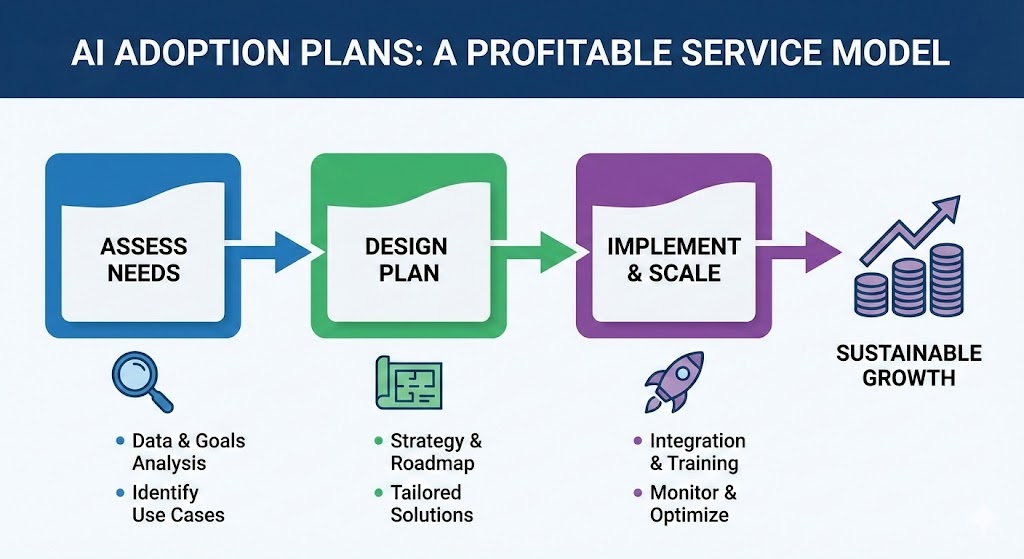
The artificial intelligence revolution is reshaping how businesses operate, compete, and deliver value to their customers. Yet, despite the overwhelming potential of AI technologies, many companies struggle to implement these solutions effectively. This gap between AI’s promise and practical implementation has created a lucrative opportunity for consultants and agencies who specialize in designing AI adoption plans that deliver measurable results.
As businesses across industries recognize the competitive advantage that AI can offer, the demand for expert guidance in navigating this complex landscape continues to surge. Designing AI adoption plans has emerged as one of the most profitable service models in the technology consulting space, offering substantial returns for those who can bridge the gap between cutting-edge AI capabilities and real-world business applications.
1. Understanding the AI Adoption Challenge
The Current State of AI Implementation
Organizations today face a paradox: while awareness of AI’s potential has never been higher, successful implementation rates remain surprisingly low. Research indicates that a significant percentage of AI projects fail to move beyond the pilot stage, with companies investing millions in technologies that never deliver their promised ROI.
This implementation gap exists for several reasons. Many businesses lack the internal expertise to evaluate AI solutions objectively, struggle to identify which processes would benefit most from automation or intelligence augmentation, and find it challenging to integrate new AI systems with legacy infrastructure. Additionally, organizations often underestimate the cultural and operational changes required for successful AI adoption.
Why Companies Need External Expertise
The complexity of designing AI adoption plans requires a unique combination of technical knowledge, business acumen, and change management expertise. Most companies, even large enterprises, don’t possess this combination internally. Their IT departments may understand technology but lack deep AI expertise, while their business leaders understand operations but may not grasp AI’s technical constraints and possibilities.
This knowledge gap creates tremendous value for consultants who can serve as trusted advisors, translating between technical capabilities and business objectives. Companies are willing to pay premium rates for experts who can help them avoid costly mistakes, accelerate their AI journey, and achieve faster time-to-value.
Market Opportunity Assessment
The market for AI consulting and implementation services is experiencing exponential growth. Industry analysts project this sector will reach hundreds of billions of dollars within the next five years, driven by increasing AI adoption across industries from healthcare and finance to manufacturing and retail.
Small and medium-sized enterprises represent a particularly underserved segment of this market. While large technology firms focus on enterprise clients with multi-million dollar budgets, SMBs desperately need affordable, practical guidance for AI adoption. This creates an excellent entry point for independent consultants and boutique agencies specializing in designing AI adoption plans for this market segment.
2. Core Components of Effective AI Adoption Plans
Business Needs Assessment and Discovery
Every successful AI adoption strategy begins with a comprehensive understanding of the client’s business. This discovery phase involves conducting stakeholder interviews across departments, analyzing current workflows and pain points, reviewing existing technology infrastructure, and understanding the company’s strategic objectives and competitive landscape.
The assessment should identify not just what the company thinks it needs, but what will actually drive measurable business value. This requires asking probing questions about current challenges, inefficiencies, and opportunities. Where are manual processes consuming excessive time? Which customer touchpoints could benefit from personalization? What data assets remain underutilized?
Effective designing AI adoption plans requires looking beyond surface-level requests. A client might ask for a chatbot, but deeper analysis might reveal that their real need is improving customer service response times or reducing support costs. Your value lies in uncovering these underlying needs and proposing solutions that address root causes rather than symptoms.
Technology Landscape Evaluation
Once you understand the business needs, the next step involves evaluating the available technology options. The AI landscape evolves rapidly, with new tools, platforms, and capabilities emerging constantly. Your expertise in navigating this landscape provides immense value to clients who lack the time or knowledge to evaluate options effectively.
This evaluation should consider multiple factors including technical capabilities and limitations, integration requirements with existing systems, scalability and performance characteristics, total cost of ownership including licensing and infrastructure, vendor stability and support quality, and security and compliance considerations.
For each potential solution, you should provide clear comparisons that help clients understand trade-offs. Sometimes the best recommendation isn’t the most advanced technology, but rather the solution that best fits the client’s current capabilities, budget, and strategic timeline.
Implementation Roadmap Development
Perhaps the most critical component of designing AI adoption plans is creating a practical, phased implementation roadmap. This roadmap transforms abstract AI possibilities into concrete, actionable steps that organizations can execute.
Effective roadmaps typically follow a crawl-walk-run approach, starting with quick wins that demonstrate value and build organizational confidence. The first phase might involve implementing relatively simple AI solutions that address clear pain points and deliver measurable ROI within three to six months. These early successes create momentum and justify further investment.
Subsequent phases can tackle more complex initiatives, building on the capabilities and learnings from earlier stages. Each phase should have clearly defined objectives, success metrics, resource requirements, and timelines. The roadmap should also identify dependencies and prerequisites, ensuring that foundational capabilities are in place before attempting more advanced implementations.
Change Management and Training Strategy
Technology implementation is rarely the primary challenge in AI adoption. The bigger obstacle is often organizational resistance and lack of preparedness. Your AI adoption plan must address the human side of transformation as thoroughly as the technical aspects.
This includes developing communication strategies to help employees understand how AI will augment rather than replace their roles, creating training programs tailored to different user groups and skill levels, establishing processes for gathering and addressing concerns, and identifying and empowering internal champions who can drive adoption.
Successful designing AI adoption plans recognizes that AI tools only create value when people actually use them effectively. Your plan should include specific tactics for driving user adoption, from hands-on training sessions to ongoing support mechanisms.
Governance and Ethics Framework
As AI systems become more integral to business operations, governance becomes increasingly important. Your adoption plan should include frameworks for ensuring responsible AI use, including guidelines for data privacy and security, processes for monitoring AI system performance and bias, clear accountability structures for AI-related decisions, and compliance procedures aligned with relevant regulations.
Companies increasingly recognize that poor AI governance can lead to reputational damage, legal liability, and loss of customer trust. By incorporating governance considerations into your AI adoption plans, you position yourself as a strategic partner concerned with long-term success rather than just a technology vendor focused on short-term implementation.
3. Building Your AI Adoption Planning Service
Defining Your Service Offerings
To build a profitable practice around designing AI adoption plans, you need clearly defined service packages that address different client needs and budget levels. Consider creating tiered offerings that serve various market segments.
A foundational assessment package might include a two to three week engagement focused on evaluating AI readiness and identifying high-priority opportunities. This could serve as an entry point for price-sensitive clients or as a precursor to more comprehensive engagements.
A comprehensive adoption plan package would include everything in the assessment plus detailed technology recommendations, a phased implementation roadmap, ROI projections, and a change management strategy. This typically involves four to eight weeks of work and commands premium pricing.
For ongoing client relationships, consider retainer-based advisory services where you provide continued guidance throughout implementation, helping clients navigate challenges, adjust strategies based on results, and identify new opportunities as their AI capabilities mature.
Pricing and Packaging Strategies
Pricing your AI adoption planning services requires balancing several considerations including the value you deliver to clients, your target market’s budget constraints, competitive positioning, and your own capacity and overhead costs.
For project-based work, value-based pricing often yields better results than hourly billing. If your AI adoption plan helps a company save five hundred thousand dollars annually or generate two million in new revenue, charging fifty thousand dollars for the planning engagement represents tremendous value despite being far more than hourly rates might suggest.
Consider creating package prices that include all deliverables rather than itemizing every activity. This simplifies the buying decision for clients and protects you from scope creep. Your pricing should reflect the outcomes you deliver, not just the hours you invest.
When designing AI adoption plans for different market segments, adjust your packaging accordingly. Enterprise clients might expect more comprehensive documentation and governance frameworks, while startups might prioritize speed and lean deliverables focused on rapid implementation.
Developing Proprietary Methodologies
Successful AI consulting practices often develop proprietary frameworks and methodologies that differentiate them from competitors. These methodologies serve multiple purposes including providing structure and efficiency for your delivery process, creating intellectual property that enhances your market value, establishing credibility and thought leadership, and justifying premium pricing.
Your methodology might include a proprietary assessment framework that evaluates AI readiness across multiple dimensions, a decision matrix for technology selection that considers factors unique to your target market, templates and tools that accelerate the planning process, or case studies demonstrating results achieved using your approach.
Document your methodology thoroughly and create marketing materials that explain your unique approach. This transforms you from a generalist consultant into a specialist with a proven system for delivering results.
4. Delivering Value Through AI Adoption Plans
Conducting Effective Discovery Sessions
The quality of your AI adoption plan depends heavily on the insights gathered during discovery. Effective discovery requires both structured frameworks and flexible inquiry that follows interesting threads wherever they lead.
Prepare for discovery sessions by researching the client’s industry, competitive landscape, and recent company news. Develop a core question set that ensures you cover all critical areas, but remain flexible enough to explore unexpected opportunities that emerge during conversations.
Interview diverse stakeholders across the organization, not just executives or IT leaders. Frontline employees often have the clearest understanding of operational inefficiencies and customer pain points. Data analysts can illuminate which information assets exist and their quality. Customer service representatives understand common complaints and requests.
During these sessions, practice active listening and ask follow-up questions that dig beneath surface-level responses. When someone mentions a challenge, explore the business impact in concrete terms. How much time does this problem consume? How does it affect customer satisfaction or revenue? What have been the consequences of not addressing it?
Creating Compelling Deliverables
Your AI adoption plan deliverable serves as both the culmination of your engagement and a marketing tool for future work. It should be comprehensive yet accessible, providing the detail needed for decision-making while remaining readable for busy executives.
Structure your deliverable logically, beginning with an executive summary that captures key findings and recommendations in two to three pages. Follow with detailed sections covering your assessment findings, technology recommendations with clear rationale, the phased implementation roadmap with timelines and resource requirements, financial projections including costs and expected returns, and risk assessment with mitigation strategies.
Use visual elements strategically to enhance comprehension. Diagrams showing current versus future-state workflows make transformation tangible. Charts depicting projected ROI over time help justify investment. Timeline graphics make complex roadmaps easier to grasp at a glance.
When designing AI adoption plans, remember that your deliverable will likely be shared with stakeholders who didn’t participate in your discovery process. It should stand alone as a complete narrative that builds the case for AI adoption and provides clear direction for next steps.
Presenting Findings and Recommendations
How you present your AI adoption plan can be as important as the plan’s content. A well-delivered presentation builds confidence in your recommendations and positions you for ongoing engagement.
Structure your presentation to tell a compelling story. Begin by validating the client’s current challenges and aspirations, demonstrating that you truly understand their situation. Present your findings in terms of opportunities rather than just problems. Frame recommendations as pathways to achieving the client’s strategic objectives.
Anticipate questions and objections, preparing thoughtful responses. Executives will likely ask about risk, timeline, and ROI. Technical leaders may question technology choices or integration approaches. Be ready to discuss alternatives you considered and why you recommend your chosen path.
Use the presentation as an opportunity to educate stakeholders about AI capabilities and limitations. Many decision-makers have unrealistic expectations shaped by marketing hype or science fiction. Your ability to provide grounded, realistic perspectives builds trust and credibility.
Facilitating Buy-In and Decision-Making
Even the most brilliant AI adoption plan creates no value if it sits on a shelf unimplemented. Part of your service involves facilitating the organizational buy-in needed to move forward.
This begins during the planning process by involving key stakeholders in shaping recommendations. When people contribute to the plan’s development, they’re more likely to support its execution. Use working sessions and interim reviews to gather input and build consensus progressively rather than unveiling a complete plan at the end.
Address concerns proactively in your plan and presentation. If budget is a major consideration, emphasize the phased approach that spreads costs over time and ties investment to demonstrated results. If technical complexity seems daunting, highlight how your roadmap builds capabilities incrementally.
Consider including a decision framework in your deliverable that helps leadership evaluate recommendations systematically. This might assess each initiative against criteria like strategic alignment, financial return, implementation difficulty, and risk level.
5. Marketing Your AI Adoption Planning Services
Positioning and Messaging
Success in designing AI adoption plans as a business depends not just on your capabilities but on your ability to communicate your value effectively to potential clients. Your positioning should clearly articulate who you serve, what problems you solve, and why clients should choose you over alternatives.
Consider specializing in a particular industry or company size segment. While generalist positioning seems appealing because it doesn’t exclude anyone, specialists often command higher rates and win clients more easily because they’re perceived as understanding unique industry challenges and requirements.
Your messaging should speak directly to the concerns keeping potential clients awake at night. Rather than leading with your methodology or credentials, lead with the outcomes you deliver. Do you help companies reduce operational costs through intelligent automation? Do you enable better customer experiences through personalization? Do you accelerate product development through AI-powered insights?
Develop clear differentiators that set you apart from competitors. Perhaps you focus exclusively on practical, implementable solutions rather than experimental technologies. Maybe you specialize in helping companies achieve quick wins that fund longer-term transformation. Your unique approach to designing AI adoption plans should be evident in every client conversation.
Content Marketing and Thought Leadership
Establishing yourself as an authority on AI adoption is one of the most effective ways to attract clients. Content marketing allows you to demonstrate expertise while educating your target market about challenges and solutions.
Create content that addresses specific questions and concerns your ideal clients face. Blog posts might explore topics like evaluating AI vendors, calculating ROI for AI initiatives, or overcoming common implementation obstacles. Case studies show how you’ve helped similar companies achieve results. Whitepapers dive deep into industry-specific AI applications.
Consider developing a content series that showcases your methodology for designing AI adoption plans. Share frameworks, templates, and tools that provide immediate value while demonstrating your systematic approach. This generosity builds trust and positions you as someone focused on helping clients succeed rather than just selling services.
LinkedIn has become an essential platform for B2B professional services marketing. Regular posting about AI trends, sharing insights from client work, and engaging in relevant discussions increases your visibility with decision-makers. Articles and posts that generate engagement expand your reach through LinkedIn’s algorithm.
Building Strategic Partnerships
Few consultants can deliver every aspect of AI adoption alone. Building partnerships with complementary service providers extends your capabilities while creating referral relationships.
Technology vendors often seek consulting partners who can help their clients implement solutions successfully. These relationships can provide lead flow, technical training, and sometimes financial incentives. However, maintain independence in your recommendations. Your value to clients depends on providing objective guidance rather than pushing particular products.
Consider partnerships with implementation firms, data infrastructure consultants, change management specialists, and industry-specific consultancies. These relationships allow you to focus on your core strength of designing AI adoption plans while ensuring clients have access to the full range of expertise needed for successful execution.
Former clients can become powerful referral sources if you maintain relationships after engagements conclude. Regular check-ins to see how implementation is progressing, sharing relevant insights or resources, and celebrating their successes keeps you top-of-mind when they encounter others facing similar challenges.
Lead Generation and Business Development
While content marketing and partnerships generate inbound interest, proactive business development remains important, especially when building your practice.
Identify target companies that fit your ideal client profile and research their AI readiness indicators. Are they hiring for AI-related roles? Have they announced digital transformation initiatives? Are they facing competitive pressure from AI-adopting rivals? These signals suggest receptiveness to conversations about AI adoption.
Cold outreach works better when you lead with insight rather than a sales pitch. Reference specific challenges you’ve noticed in their industry or company, and offer a perspective or resource that provides immediate value. The goal is beginning a conversation, not closing a deal on first contact.
Speaking engagements at industry conferences and events position you as an expert while connecting you with potential clients. Even local business groups and chamber of commerce events can generate opportunities. Offer to present on practical AI adoption topics that address real concerns rather than promoting your services explicitly.
6. Scaling Your AI Adoption Planning Practice
From Solo Consultant to Team
As demand for your services grows, you’ll face capacity constraints that limit revenue and create delivery risk. Scaling requires transitioning from doing everything yourself to building a team that can deliver consistently.
Start by documenting your processes thoroughly. Create playbooks that describe each phase of your engagement methodology, templates that standardize deliverables, and training materials that transfer your knowledge to others. This systematization is essential for maintaining quality as you grow.
Your first hires should complement your skills. If your strength is business strategy, consider adding someone with deep technical AI expertise. If you excel at technology, bring in someone strong in change management or business development. Look for people who not only have relevant skills but also align with your values and approach to client service.
As you build a team, establish quality control processes that ensure every engagement meets your standards. This might include peer reviews of deliverables, post-engagement retrospectives to identify improvement opportunities, and client feedback mechanisms that catch issues quickly.
Creating Recurring Revenue Streams
Project-based work provides good margins but creates revenue volatility. Building recurring revenue streams creates more predictable income and deepens client relationships.
Implementation oversight services allow you to continue supporting clients as they execute the AI adoption plans you’ve designed. This might involve monthly check-ins to review progress, quarterly strategy sessions to adjust approaches based on results, or on-demand consulting to help navigate unexpected challenges.
Some consultants offer fractional AI leadership, serving as a part-time Chief AI Officer for companies not ready to hire full-time executives. This provides strategic guidance on an ongoing basis while keeping you connected to organizational developments that might create additional project opportunities.
Training and enablement programs help organizations build internal AI capabilities. After designing AI adoption plans, you might deliver workshops for technical teams, develop custom training curriculum, or provide ongoing education as new AI capabilities emerge.
Leveraging Technology in Delivery
As an AI consultant, using AI tools in your own practice demonstrates credibility while improving efficiency. Consider how AI can enhance your delivery of adoption planning services.
AI-powered research tools can accelerate the discovery process, analyzing company data, industry reports, and competitive intelligence more quickly than manual methods. Natural language processing can help analyze interview transcripts and survey responses to identify patterns and themes.
Collaborative platforms equipped with AI features streamline project management and client communication. Automated reporting tools can generate progress updates and metrics dashboards, freeing your time for higher-value strategic work.
However, maintain the human element that clients value. AI should augment your expertise, not replace the judgment, creativity, and relationship-building that differentiate exceptional consultants from adequate ones.
Expanding Service Offerings
Once you’ve established a strong foundation in designing AI adoption plans, consider how adjacent services might serve clients and increase revenue per engagement.
Implementation services are a natural extension. Many clients prefer working with the consultant who designed their strategy rather than transferring knowledge to a new vendor. While implementation requires different skills and capacity, the margins can be attractive and the work often leads to additional strategic opportunities.
Post-implementation optimization helps clients maximize the value of AI investments. As systems go live, there are always opportunities to refine algorithms, improve user adoption, and extend functionality. Ongoing optimization retainers provide recurring revenue while keeping you connected to client results.
Some consultants develop productized services or software tools that codify their expertise. An AI readiness assessment tool, a vendor comparison framework, or a project management template specifically designed for AI initiatives can generate additional revenue streams with better scalability than pure consulting.
Conclusion
Designing AI adoption plans represents a compelling business opportunity at the intersection of technological innovation and practical business need. Companies across industries recognize that AI will be essential to their competitiveness, yet most lack the expertise to navigate this transformation successfully. This creates sustained demand for consultants who can bridge the gap between AI’s promise and pragmatic implementation.
Building a profitable practice around AI adoption planning requires more than technical knowledge. Success depends on understanding business strategy, communicating effectively with diverse stakeholders, managing organizational change, and maintaining the discipline to deliver consistent value across engagements.
The consultants and agencies that thrive in this space will be those who develop systematic approaches to designing AI adoption plans while remaining flexible enough to adapt to each client’s unique circumstances. They’ll balance strategic vision with practical execution, helping clients achieve quick wins while building toward transformational change.
As you develop your AI adoption planning service, remember that your ultimate product is not a document but a transformation. Your plans should create clarity where there was confusion, confidence where there was uncertainty, and a clear path forward where there was paralysis. When clients successfully implement AI and achieve meaningful business results, they become advocates who fuel your growth through referrals and reputation.
The AI revolution is still in its early stages, and the opportunity for consultants who specialize in designing AI adoption plans will only grow as adoption accelerates across industries and company sizes. By establishing your expertise now, developing proven methodologies, and building a track record of client success, you position yourself to capitalize on this massive market transformation for years to come.
Also read this:
AI Workflow Specialist: How to Earn Recurring Income by Automating Businesses
AI Earning Opportunities That Don’t Require Constant Client Outreach
AI Performance Monitoring Services: How to Earn Recurring Income From Businesses