
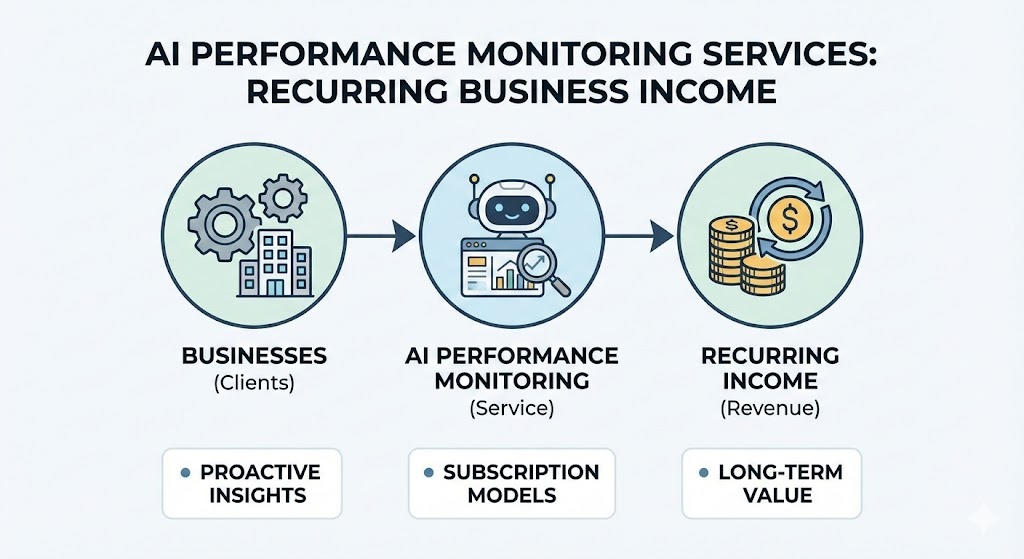
AI Performance Monitoring Services The artificial intelligence revolution has created an unexpected business opportunity that most entrepreneurs are overlooking. While everyone rushes to build AI tools and applications, a critical need remains largely unmet: monitoring and optimizing AI systems after deployment. AI Performance Monitoring Services represent one of the most lucrative recurring revenue opportunities in the technology sector today, combining technical expertise with business impact measurement.
Companies implementing AI solutions quickly discover that deployment is just the beginning. AI models degrade over time, data patterns shift, integration issues emerge, and business requirements evolve. Without continuous monitoring and optimization, expensive AI investments underperform or fail completely. This creates perfect conditions for AI Performance Monitoring Services that generate predictable monthly revenue while delivering measurable value.
The economics are compelling: businesses invest heavily in AI implementation but often lack the expertise or resources for ongoing performance management. They need external partners who can ensure their AI systems continue delivering ROI. This guide reveals how to build a thriving business providing these essential services.
1. Understanding the AI Performance Monitoring Market Opportunity
Why Businesses Need External Monitoring
Organizations implementing AI face a persistent challenge. Internal teams focus on building and deploying new capabilities, leaving little bandwidth for continuous performance monitoring. Even companies with skilled AI teams benefit from external oversight that provides objective assessment and specialized monitoring expertise.
The complexity of AI systems creates blind spots. Machine learning models interact with constantly changing data, integrate with multiple business systems, and impact numerous stakeholders. Without dedicated monitoring, performance degradation goes unnoticed until business impact becomes severe. Companies lose revenue, waste resources, or make poor decisions based on degraded AI outputs.
AI Performance Monitoring Services fill this gap by providing specialized expertise without requiring full-time hires. For most businesses, monthly monitoring services cost a fraction of employing specialized staff while delivering superior results through focused expertise and proven monitoring frameworks.
Market Size and Growth Trajectory
AI Performance Monitoring Services The AI monitoring market is expanding rapidly as AI adoption accelerates across industries. Research indicates that over seventy percent of organizations now use AI in at least one business function, and this percentage grows monthly. Each AI implementation creates ongoing monitoring needs, multiplying market opportunities.
Small and medium businesses represent particularly attractive clients. They implement AI to compete with larger rivals but lack enterprise resources for sophisticated monitoring. These companies recognize the need for oversight but cannot justify full-time positions, making them ideal customers for monitoring services delivered on monthly retainer models.
Enterprise clients offer different advantages. While they have internal resources, they value external monitoring for critical systems, objective performance assessment, and specialized expertise in specific AI domains. Enterprise contracts typically involve higher monthly fees and longer commitment periods, creating substantial recurring revenue.
The Recurring Revenue Advantage
Unlike project-based AI consulting, AI Performance Monitoring Services generate predictable monthly income. Once you establish monitoring for a client, revenue continues as long as their AI systems operate. Client retention rates exceed ninety percent when you deliver consistent value, creating compounding revenue growth as you add new clients.
The service model scales efficiently. Initial setup requires significant effort understanding client systems and establishing monitoring frameworks. However, ongoing monitoring largely automates, allowing you to serve multiple clients simultaneously. As your client base grows, profit margins expand while maintaining high service quality.
2. Core Components of AI Performance Monitoring Services
Model Accuracy and Performance Tracking
At the foundation of AI Performance Monitoring Services lies continuous assessment of model accuracy. Machine learning models trained on historical data gradually lose accuracy as real-world conditions change. This phenomenon, called model drift, affects virtually all production AI systems over time.
Your monitoring service tracks prediction accuracy against actual outcomes, identifying when performance drops below acceptable thresholds. For classification models, you monitor precision, recall, and F1 scores. For regression models, you track error metrics like mean absolute error and root mean squared error. When metrics deteriorate, you alert clients and recommend retraining or adjustment.
Beyond basic accuracy, you monitor model confidence levels. AI systems should indicate uncertainty in their predictions. When confidence drops across many predictions, it signals that the model encounters data patterns different from its training data. This early warning allows proactive intervention before accuracy degrades significantly.
Prediction Distribution Analysis
Production AI models should produce prediction distributions consistent with expectations. Dramatic shifts in prediction distributions often indicate data quality issues, integration problems, or fundamental changes in underlying patterns. Your monitoring service establishes baseline distributions during healthy operation and alerts when distributions deviate significantly.
Response Time and Latency Monitoring
AI systems must respond quickly enough for their business applications. A recommendation engine that takes five seconds to respond frustrates users and reduces conversion rates. Your service monitors response times continuously, identifying performance degradation before it impacts user experience. You track both average response times and tail latency, ensuring consistent performance even during peak loads.
Data Quality and Pipeline Health
AI systems are only as good as the data they receive. Data quality issues represent the most common cause of AI system failures in production. Your AI Performance Monitoring Services must include comprehensive data pipeline monitoring to catch problems before they corrupt model outputs.
Input Data Validation
Monitor incoming data against expected formats, value ranges, and business rules. Detect missing values, outliers, and anomalous patterns that suggest data collection problems. Establish automated alerts when data quality metrics fall below acceptable levels, allowing rapid response before bad data influences model predictions.
Feature Distribution Monitoring
Track the statistical distributions of input features over time. Significant shifts in feature distributions often indicate upstream data problems or fundamental changes in the business environment. By comparing current distributions to historical baselines, you identify data drift that requires model updates or recalibration.
Pipeline Reliability Tracking
Modern AI systems depend on complex data pipelines that extract, transform, and load data from multiple sources. Monitor each pipeline stage for failures, delays, and data loss. Track data freshness to ensure models receive timely information. Pipeline monitoring prevents scenarios where AI systems continue operating with stale or incomplete data.
Business Impact Measurement
Technical metrics matter only insofar as they relate to business outcomes. Sophisticated AI Performance Monitoring Services connect AI performance to business KPIs, demonstrating clear ROI and justifying continued investment in both the AI system and your monitoring service.
Revenue Impact Tracking
For AI systems designed to increase revenue, track their direct contribution. Recommendation engines should generate measurable lift in average order value or conversion rates. Pricing optimization AI should improve profit margins. Your monitoring service quantifies these impacts, providing executives with clear evidence of AI value.
Cost Reduction Measurement
Many AI implementations aim to reduce operational costs. Customer service chatbots decrease support ticket volume. Predictive maintenance AI reduces equipment downtime. Fraud detection systems prevent losses. Your monitoring service measures and reports these cost savings, often finding they exceed the cost of both the AI system and your monitoring service combined.
Operational Efficiency Metrics
Track how AI systems improve operational efficiency. Process automation AI should reduce processing time and error rates. Resource allocation AI should optimize utilization rates. Quality control AI should catch defects earlier in production processes. Monitoring these operational improvements demonstrates concrete business value beyond abstract technical metrics.
3. Setting Up Your AI Performance Monitoring Business
Defining Your Service Packages
Successful AI Performance Monitoring Services businesses offer tiered packages that address different client needs and budgets. This structure allows you to serve diverse clients while providing clear upgrade paths as client needs grow.
Essential Monitoring Package
The entry-level package covers fundamental monitoring needs for small businesses or single AI applications. Include basic accuracy tracking, data quality monitoring, and monthly performance reports. Price this package to be accessible for small businesses while covering your costs and generating reasonable profit. Typical pricing ranges from fifteen hundred to three thousand dollars monthly.
Professional Monitoring Package
Mid-tier packages serve growing businesses or those with multiple AI systems. Add real-time alerting, detailed root cause analysis, quarterly optimization recommendations, and priority support. Include business impact measurement to demonstrate ROI. Price professional packages between four thousand and eight thousand dollars monthly based on system complexity and monitoring scope.
Enterprise Monitoring Package
Premium packages serve large organizations with mission-critical AI systems. Provide dedicated monitoring dashboards, weekly status meetings, comprehensive business impact analysis, and proactive optimization services. Include on-call support for critical issues and annual strategic reviews. Enterprise packages typically start at ten thousand dollars monthly and can exceed thirty thousand for complex environments.
Essential Tools and Technology Stack
Building effective AI Performance Monitoring Services requires investing in the right technology infrastructure. Your tool stack should balance capability with cost-effectiveness, especially when starting.
Monitoring Platform Selection
Choose between building custom monitoring solutions or leveraging existing platforms. Custom solutions offer flexibility and can become proprietary advantages, but require significant development investment. Existing platforms like Prometheus, Grafana, or specialized AI monitoring tools provide faster time-to-market but less differentiation.
Many successful monitoring services use hybrid approaches. Start with established platforms for core monitoring infrastructure, then build custom dashboards and analysis tools that differentiate your service. This strategy minimizes initial investment while creating unique value propositions.
Data Storage and Analytics Infrastructure
AI monitoring generates substantial data volumes. You need scalable storage solutions and analytics capabilities to process this data efficiently. Cloud-based solutions like AWS, Google Cloud, or Azure provide cost-effective scaling and eliminate infrastructure management overhead.
Implement data retention policies that balance insight generation with storage costs. Detailed metric data might be retained for thirty days, while aggregated data and trend analysis remain available for years. This approach maintains analytical capability while controlling costs.
Alert Management Systems
Effective monitoring requires intelligent alerting that notifies appropriate stakeholders without overwhelming them. Implement alert prioritization that distinguishes critical issues requiring immediate attention from informational notifications. Integration with tools like PagerDuty, Slack, or email ensures alerts reach clients through their preferred channels.
Building Your Client Acquisition Strategy
Launching AI Performance Monitoring Services requires identifying and reaching target clients effectively. Your acquisition strategy should emphasize the recurring revenue model and focus on clients most likely to appreciate ongoing monitoring value.
Targeting AI Implementation Partners
Companies that build and implement AI solutions for clients often lack ongoing monitoring capabilities. Partner with AI consulting firms, development agencies, and system integrators to provide monitoring as a complementary service. These partnerships generate steady client referrals and position your service as essential to successful AI deployments.
Industry-Specific Positioning
Rather than offering generic monitoring services, consider specializing in specific industries where AI adoption is accelerating. Healthcare, financial services, retail, and manufacturing all have unique AI monitoring requirements and compliance considerations. Industry specialization allows premium pricing and reduces competition.
Content Marketing and Education
Many potential clients don’t yet recognize the importance of AI monitoring. Educational content that explains monitoring necessity and demonstrates its value generates qualified leads. Publish case studies showing how monitoring prevented failures or improved performance. Share insights about common AI system issues and how proactive monitoring addresses them.
4. Implementing Monitoring for Client AI Systems
Discovery and Assessment Phase
Successful AI Performance Monitoring Services begin with thorough understanding of client AI systems. The discovery phase establishes monitoring foundations and sets clear expectations for ongoing service delivery.
System Architecture Documentation
Map the complete AI system architecture including data sources, processing pipelines, model components, integration points, and output destinations. Understanding data flow and system dependencies allows you to identify potential failure points and establish comprehensive monitoring coverage.
Document technical details like model types, training frequencies, feature engineering processes, and deployment architectures. This information guides monitoring strategy and helps identify system-specific risks requiring specialized attention.
Performance Baseline Establishment
Before implementing ongoing monitoring, establish performance baselines representing normal system operation. Collect historical data on model accuracy, prediction distributions, response times, and business metrics. These baselines become reference points for detecting anomalies and performance degradation.
Work with clients to define acceptable performance ranges for critical metrics. Not every deviation from baseline constitutes a problem. Establish thresholds that trigger alerts only when performance issues impact business outcomes or risk system failures.
Stakeholder Requirement Gathering
Different stakeholders care about different aspects of AI performance. Technical teams focus on model accuracy and system reliability. Business leaders care about revenue impact and ROI. Compliance officers worry about regulatory adherence. Your monitoring service must address all stakeholder concerns.
Conduct interviews with key stakeholders to understand their priorities and concerns. Design reporting and alerting strategies that provide each stakeholder group with relevant information in formats they find useful. This multi-stakeholder approach increases perceived value and reduces client churn.
Monitoring Implementation Process
Deploying AI Performance Monitoring Services requires systematic implementation that minimizes disruption to client operations while establishing comprehensive oversight.
Non-Invasive Integration
Implement monitoring with minimal changes to existing AI systems. Use API monitoring, log analysis, and database queries rather than requiring code modifications. This approach reduces implementation time, minimizes risk, and makes your service easy to adopt.
When system modifications are necessary, implement them incrementally with thorough testing. Monitoring should never negatively impact system performance or reliability. Conduct performance testing to verify monitoring overhead remains negligible.
Dashboard and Reporting Setup
Create customized dashboards that present monitoring data clearly and actionably. Different dashboard views serve different audiences. Technical dashboards show detailed metrics and system health indicators. Executive dashboards highlight business impact and ROI. Design intuitive visualizations that communicate complex information at a glance.
Implement automated reporting that delivers regular performance summaries without requiring manual intervention. Weekly automated reports keep clients informed about system health. Monthly reports provide deeper analysis and trend identification. Quarterly business reviews assess overall AI value delivery and identify optimization opportunities.
Alert Configuration and Testing
Configure alerting systems to notify appropriate stakeholders when issues arise. Implement multiple alert severity levels: critical alerts for immediate attention, warnings for degrading performance, and informational notifications for trends requiring monitoring.
Test alerting thoroughly before going live. Verify that alerts trigger correctly, reach intended recipients, and provide sufficient information for effective response. False positives undermine alert credibility, so tune alert thresholds carefully to balance sensitivity with specificity.
5. Delivering Ongoing Value and Ensuring Client Retention
Proactive Problem Identification
The most valuable AI Performance Monitoring Services don’t just report problems after they occur. They identify potential issues before they impact business operations, providing clients with time to address root causes systematically.
Trend Analysis and Prediction
Analyze monitoring data to identify negative trends before they become critical. Gradual accuracy decline might not trigger immediate alerts but indicates eventual problems. Early identification allows scheduled retraining during planned maintenance windows rather than emergency interventions.
Use statistical analysis to project when metrics will cross critical thresholds based on current trends. This forward-looking approach transforms monitoring from reactive to proactive, substantially increasing service value.
Root Cause Analysis
When performance issues occur, provide comprehensive root cause analysis rather than simply reporting symptoms. Investigate whether problems stem from data quality issues, model drift, infrastructure limitations, or integration problems. Understanding root causes enables effective solutions and prevents recurring issues.
Document root cause analysis findings and share them with clients. This educational approach helps clients understand their AI systems better and positions you as a trusted advisor rather than just a monitoring vendor.
Optimization Recommendations
Regular monitoring reveals optimization opportunities beyond issue resolution. Identify underutilized features that could improve accuracy, suggest architectural changes that would enhance reliability, or recommend additional training data sources that might boost performance.
Provide quarterly optimization reports that summarize improvement opportunities with projected business impact. Prioritize recommendations by implementation difficulty and expected benefit, helping clients make informed decisions about AI system investments.
Communication and Reporting Excellence
Exceptional communication differentiates successful AI Performance Monitoring Services from commodity providers. How you present information often matters as much as the information itself.
Customized Reporting Formats
Adapt reporting style to client preferences. Some clients prefer detailed technical reports while others want concise executive summaries. Some appreciate frequent updates while others prefer consolidated monthly reviews. Flexible reporting demonstrates client-centricity and increases satisfaction.
Incorporate client branding and terminology into reports when appropriate. Use metrics and KPIs that align with client business objectives. This customization shows that you understand their business, not just their technology.
Clear, Actionable Insights
Every report should contain clear insights and specific recommendations. Avoid overwhelming clients with data without interpretation. Highlight the most important findings, explain their significance, and suggest concrete actions.
Use visual data presentation to communicate complex information efficiently. Well-designed charts and graphs convey trends and comparisons more effectively than tables of numbers. Annotate visualizations to direct attention to key points.
Regular Check-In Meetings
Schedule recurring meetings with clients to discuss monitoring results, address questions, and maintain relationships. Monthly or quarterly business reviews provide forums for strategic discussions about AI system evolution and future requirements.
These meetings serve multiple purposes beyond information sharing. They maintain personal connections that increase client loyalty, identify upsell opportunities for expanded services, and gather feedback that improves service delivery.
6. Scaling Your AI Performance Monitoring Business
Automation and Efficiency Optimization
As your AI Performance Monitoring Services business grows, automation becomes essential for maintaining quality while serving more clients. Strategic automation increases profitability without sacrificing service excellence.
Monitoring Template Development
Create standardized monitoring templates for common AI system types. Templates for recommendation engines, classification models, regression models, and natural language processing systems accelerate client onboarding. Customize templates for each client while leveraging proven monitoring patterns.
Build libraries of pre-configured alerts, dashboard layouts, and reporting templates. These assets reduce setup time from weeks to days, allowing you to serve more clients with the same resources. Templates also ensure consistent service quality across your client portfolio.
Automated Analysis and Reporting
Invest in automated analysis tools that identify anomalies, generate insights, and draft report sections. While human review remains essential, automation handles routine analysis and focuses your attention on complex issues requiring expertise.
Develop natural language generation capabilities that transform monitoring data into report narratives automatically. These systems create first drafts that you refine and customize, dramatically reducing report preparation time while maintaining high quality and personalization.
Client Portal Development
Build self-service portals where clients access real-time monitoring data, historical reports, and system documentation. Portals reduce support overhead by empowering clients to find information independently. Include features like customizable dashboards, metric exports, and alert configuration.
Well-designed portals increase perceived service value while reducing your workload. Clients appreciate instant access to their data without waiting for scheduled reports or requesting custom analyses.
Team Building and Specialization
Scaling beyond what you can manage personally requires building a team with complementary skills. Strategic hiring enables business growth while maintaining service quality.
Technical Monitoring Specialists
Hire specialists with expertise in specific AI domains or industries. Deep technical knowledge enables superior monitoring, faster problem resolution, and more valuable insights. Specialists can serve multiple clients in their domain, creating efficient resource utilization.
Balance generalists and specialists on your team. Generalists handle standard monitoring tasks across clients while specialists address complex issues and provide deep expertise when needed.
Client Success Managers
Dedicated client success managers maintain relationships, ensure satisfaction, and identify growth opportunities. These non-technical team members handle regular check-ins, report distribution, and satisfaction surveys. They also identify clients at risk of cancellation and coordinate retention efforts.
Client success managers free technical staff to focus on monitoring and analysis rather than account management. This specialization improves both service delivery and client satisfaction.
Data Analysts and Report Writers
Skilled data analysts transform monitoring data into actionable insights. They identify patterns, conduct deep-dive investigations, and develop recommendations. Strong analytical skills combined with business acumen create reports that drive client decision-making.
Report writers with excellent communication skills present technical information clearly to non-technical audiences. They craft executive summaries, visualize data effectively, and ensure reports address stakeholder priorities.
7. Pricing Strategies for Maximum Profitability
Value-Based Pricing Models
The most profitable AI Performance Monitoring Services implement value-based pricing that aligns fees with client benefits rather than cost-plus models that limit revenue potential.
Business Impact Pricing
For AI systems with measurable business impact, consider pricing as a percentage of value delivered. If your monitoring helps maintain a recommendation engine generating one million dollars annually in incremental revenue, charging five thousand monthly represents just six percent of annual value while generating sixty thousand in annual recurring revenue.
This approach aligns incentives and makes pricing discussions about value rather than cost. Clients readily accept fees when they clearly see how monitoring protects and enhances AI business value.
Risk Mitigation Pricing
Position monitoring as insurance against AI system failures. Calculate potential costs of system failures including lost revenue, wasted resources, and reputational damage. Price your service as a fraction of potential failure costs, making it obviously worthwhile.
This framing works especially well for mission-critical AI systems where failures create severe consequences. Financial services, healthcare, and manufacturing clients particularly appreciate risk mitigation positioning.
System Complexity Pricing
Base pricing on AI system complexity including number of models, data sources, integrations, and monitoring requirements. Complex systems require more sophisticated monitoring and generate greater value, justifying premium pricing.
Develop clear complexity tiers with associated pricing. This transparent approach helps clients understand costs while providing straightforward upgrade paths as their AI implementations grow.
Additional Revenue Streams
Beyond core monitoring subscriptions, AI Performance Monitoring Services businesses can generate additional revenue through complementary services.
Implementation and Onboarding Fees
Charge one-time fees for initial monitoring setup that covers discovery, baseline establishment, dashboard configuration, and integration. Implementation fees typically range from five thousand to twenty thousand dollars depending on system complexity.
These upfront fees improve cash flow and offset the substantial effort required for client onboarding. They also create psychological commitment, reducing early cancellation risk.
Optimization Consulting
Offer hourly or project-based consulting for AI system optimization beyond routine monitoring. When your analysis identifies improvement opportunities requiring significant changes, clients often engage you for implementation support.
Optimization consulting generates high-margin revenue while leveraging deep system knowledge gained through monitoring. Typical hourly rates range from two hundred to five hundred dollars depending on expertise level and client size.
Training and Education
Provide training services that help client teams understand AI monitoring, interpret results, and respond to alerts effectively. Training creates additional revenue while improving client sophistication and reducing support demands.
Offer both one-time training sessions during onboarding and ongoing educational programs that keep client teams current with best practices. Training also positions you as an industry expert and thought leader.
8. Handling Common Challenges and Client Objections
Demonstrating ROI and Value
Some prospective clients question whether AI Performance Monitoring Services justify their cost. Effective value demonstration overcomes this objection and accelerates sales cycles.
Quantifying Risk Reduction
Calculate potential costs of unmonitored AI failures. Include direct revenue losses, remediation costs, reputational damage, and wasted resources. Compare these risks to monitoring costs, showing that even preventing one major failure justifies years of monitoring investment.
Share case studies and statistics about AI system failure rates without monitoring. Industry research shows that unmonitored AI systems commonly experience significant performance degradation within six to twelve months of deployment.
Showcasing Quick Wins
Offer trial periods or pilot programs that demonstrate value before requiring long-term commitment. During trials, focus on identifying and resolving one significant issue that creates measurable business impact. This tangible demonstration of value converts skeptical prospects into committed clients.
Document trial results meticulously, showing exactly what you discovered, how it impacted business performance, and what would have happened without monitoring. These detailed success stories become powerful sales tools for future prospects.
Comparing Alternatives
Help prospects understand their alternatives to professional monitoring services. Building internal monitoring capabilities requires hiring specialized staff, developing monitoring infrastructure, and maintaining systems over time. These costs typically far exceed external monitoring service fees while delivering inferior results due to divided attention and less specialized expertise.
Even for organizations with internal AI teams, external monitoring provides objective oversight and specialized expertise that internal teams cannot replicate while focusing on development and deployment priorities.
Managing Scope Creep and Expectations
Without careful management, monitoring engagements can expand beyond contracted scope, eroding profitability. Clear boundaries and communication prevent scope creep while maintaining client satisfaction.
Detailed Service Definition
Document exactly what monitoring services include and exclude. Specify which systems are monitored, what metrics are tracked, how frequently reports are delivered, and what level of support is provided. Clear documentation prevents misunderstandings and provides reference points when scope questions arise.
Include appendices showing examples of standard reports, dashboards, and alerts. Visual examples create shared understanding about deliverables and reduce ambiguity.
Change Order Processes
Establish clear processes for handling scope changes. When clients request additional monitoring, extra reports, or expanded services, provide change orders documenting new requirements and associated costs. This professional approach maintains profitability while accommodating legitimate client needs.
Explain that scope management protects both parties. It ensures you can deliver promised services at agreed quality levels while giving clients predictable costs and clear understanding of what they receive.
Setting Response Time Expectations
Clarify response time commitments for different issue severities. Critical alerts might warrant immediate response while informational notifications receive attention during business hours. Clear SLAs prevent misunderstandings about availability and response speed.
Document these commitments in service agreements and remind clients during onboarding. Consistent adherence to stated SLAs builds trust and credibility.
Conclusion: Building Your AI Performance Monitoring Business
The AI Performance Monitoring Services opportunity represents one of the most attractive recurring revenue business models available today. Companies worldwide need sophisticated monitoring for their AI investments, creating massive market potential. The subscription nature of monitoring services generates predictable revenue that compounds as you acquire clients.
Success requires balancing technical expertise with business acumen. You must understand AI systems deeply enough to monitor them effectively while communicating value in business terms that justify continued investment. The most successful providers become trusted advisors who help clients maximize AI value rather than merely vendors delivering monitoring data.
Start by defining your target market and service packages clearly. Consider specializing in specific industries or AI system types to differentiate your offering and command premium pricing. Build standardized monitoring frameworks that allow efficient scaling while maintaining quality.
Invest in automation and tools that let you serve multiple clients simultaneously without proportional increases in labor. Develop team capabilities strategically, hiring specialists who enhance service quality and enable business growth. Implement value-based pricing that aligns your success with client success.
Also read this:
10 Profitable AI Service Niches Built on Client Retention, Not Lead Generation
AI Agency Services That Automate Manual Operations for Businesses
How to Build a Reliable AI Service Business From Scratch (Beginner to Pro)