
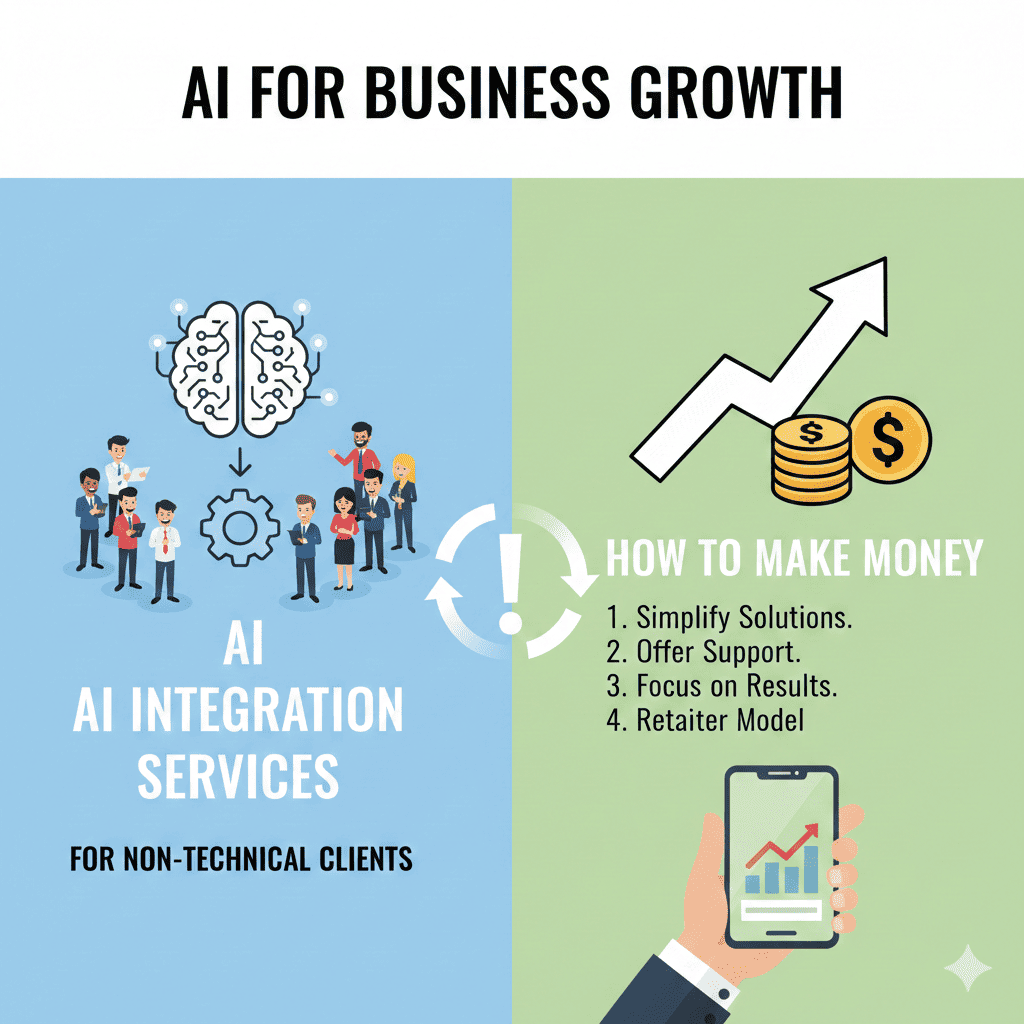
The artificial intelligence revolution has created a massive disconnect in the business world. Thousands of companies recognize AI’s transformative potential but lack the technical expertise to implement it effectively. This gap represents an extraordinary opportunity for entrepreneurs who can bridge the divide between complex AI technology and practical business applications. Learning how to Make Money Offering AI Integration Services positions you at the intersection of high demand and limited supply.
Non-technical clients—small business owners, medical practices, law firms, retailers, consultants, and countless others—desperately need AI solutions but feel overwhelmed by technical complexity. They require someone who speaks their language, understands their challenges, and can implement AI tools without requiring them to become data scientists. This comprehensive guide reveals exactly how to build a profitable business helping these clients harness AI’s power.
Understanding the AI Integration Market Opportunity
Before diving into implementation strategies, understanding why Money Offering AI Integration Services represents such a lucrative opportunity is essential. The market dynamics create nearly perfect conditions for service providers.
Supply and demand imbalance – Thousands of businesses need AI integration, but relatively few professionals offer accessible implementation services tailored to non-technical clients. This scarcity allows premium pricing and client selectivity.
High perceived value – Business owners recognize that AI can automate tasks, reduce costs, increase revenue, and provide competitive advantages. They’re willing to invest substantially in solutions that deliver these outcomes.
Recurring revenue potential – AI integration isn’t a one-time transaction. Systems require ongoing optimization, updates, training, and support. This creates stable monthly recurring revenue streams.
Low technical barriers to entry – Modern no-code and low-code AI platforms enable service delivery without advanced programming skills. Understanding business processes and client communication matters more than coding expertise.
Expanding market size – As AI tools become more powerful and accessible, more businesses recognize implementation necessity. Early movers establish themselves as trusted experts before market saturation occurs.
1. Identifying Your Ideal Non-Technical Client Profile
Successfully Make Money Offering AI Integration Services begins with precisely defining which non-technical clients you serve best. Attempting to serve everyone dilutes your marketing message and prevents deep expertise development.
Small to Medium Business Characteristics
Focus on businesses with 5 to 100 employees facing operational challenges that AI can address. These organizations possess budgets for solutions but lack dedicated IT departments. They experience enough pain from inefficient processes to justify investment yet remain small enough for personal service.
Industry-Specific Targeting
Select one or two industries for initial focus. Medical practices struggle with patient scheduling and documentation. Law firms drown in document review and research. Real estate agencies need lead qualification and follow-up automation. Retailers want inventory optimization and customer insights. Deep industry knowledge allows you to speak client language and understand unique challenges.
Problem-Centric Approach
Identify specific, expensive problems that AI solves effectively. Businesses don’t buy AI integration—they buy solutions to problems keeping them awake at night. Position yourself as solving customer service overload, administrative burden, lead qualification inefficiency, or data analysis paralysis rather than generically offering AI services.
Decision-Maker Accessibility
Target businesses where you can directly reach decision-makers. Small business owners, practice managers, and department heads can approve projects without navigating complex corporate approval processes. Quick decision cycles mean faster revenue generation.
2. Developing Your Service Offerings
The most profitable way to Make Money Offering AI Integration Services involves packaging specific solutions rather than offering generic consulting. Non-technical clients want clear deliverables with predictable outcomes.
Chatbot Implementation Packages
Offer turnkey chatbot solutions for customer service, lead qualification, or appointment scheduling. Include discovery consultation, bot personality design, training on client’s specific information, platform integration, testing, deployment, and staff training. Package pricing ranging from two thousand to ten thousand dollars depending on complexity creates clear expectations.
Email Automation Systems
Implement AI-powered email management that categorizes messages, drafts responses, schedules follow-ups, and extracts action items. Non-technical clients immediately understand this value proposition and can quickly assess ROI through time savings.
Document Processing Automation
Create systems that automatically extract information from invoices, contracts, forms, or receipts, then route data to appropriate systems. Accounting firms, legal practices, and logistics companies particularly value these solutions.
Customer Data Analysis and Insights
Offer to analyze existing customer data to identify high-value segments, predict churn risks, optimize marketing spend, and recommend retention strategies. Present findings through clear visualizations and actionable recommendations rather than technical reports.
Voice Assistant Integration
Implement voice-activated systems for hands-free operations in medical offices, warehouses, or customer service centers. These tangible solutions demonstrate immediate practical value to non-technical audiences.
3. Building Technical Skills Without Becoming a Developer
Successfully Make Money Offering AI Integration Services doesn’t require computer science degrees or programming expertise. Modern platforms enable sophisticated implementations through visual interfaces and pre-built components.
Master No-Code Automation Platforms
Learn tools like Zapier, Make (formerly Integromat), or n8n that connect applications and automate workflows through visual interfaces. These platforms handle technical complexity while you focus on designing solutions matching client needs.
Understand AI Platform Capabilities
Familiarize yourself with major AI platforms including ChatGPT, Claude, Google’s AI services, and Microsoft’s Azure AI. Understand what each excels at, their limitations, and typical use cases. You don’t need to build AI models—just know which tools solve which problems.
Learn Integration Basics
Understand how different business applications connect through APIs, webhooks, and integrations. This knowledge allows you to design systems that work seamlessly with clients’ existing software without requiring extensive custom development.
Develop Prompt Engineering Skills
Master the art of crafting effective prompts that generate consistent, high-quality AI outputs. This skill proves crucial for implementing chatbots, content generation systems, and automation workflows that reliably deliver desired results.
4. Conducting Discovery and Needs Assessment
Non-technical clients often struggle articulating their needs in technical terms. Your discovery process must translate business challenges into AI solutions while building trust and demonstrating expertise.
Initial Consultation Framework
Conduct structured conversations exploring current processes, pain points, manual tasks consuming excessive time, bottlenecks limiting growth, and desired outcomes. Ask specific questions about daily operations rather than abstract technology preferences.
Process Documentation
Map existing workflows visually, showing current steps, time requirements, error rates, and handoffs. This documentation helps clients see inefficiencies clearly and understand where AI creates value. Visual process maps communicate more effectively than technical specifications.
ROI Calculation
Calculate potential return on investment in client-friendly terms. Translate time savings into salary costs recovered. Quantify revenue increases from improved lead conversion. Express customer satisfaction improvements in retention percentage gains. Non-technical clients need concrete numbers justifying investment.
Proof of Concept Development
Offer small-scale demonstrations showing how AI would work with their specific data or scenarios. These tangible examples reduce perceived risk and help clients visualize the solution’s impact on their daily operations.
5. Pricing Strategies for Maximum Profitability
How you structure pricing significantly impacts your ability to Make Money Offering AI Integration Services. Value-based pricing generates substantially more revenue than hourly billing.
Project-Based Pricing
Charge fixed fees for complete implementations. Calculate what the problem costs clients currently, then price your solution as a fraction of that cost while delivering superior results. A chatbot replacing half of a customer service representative’s workload might cost 25 percent of that annual salary while providing 24/7 availability.
Tiered Service Packages
Create bronze, silver, and gold packages with increasing features, support levels, or implementation speed. This structure accommodates different budget levels while anchoring higher prices through contrast. Most clients select mid-tier offerings when presented with three options.
Retainer Arrangements
After initial implementation, offer monthly retainer packages covering ongoing optimization, troubleshooting, updates, and performance monitoring. Retainers create predictable recurring revenue and maintain client relationships for upselling additional services.
Performance-Based Components
Include success fees tied to measurable outcomes for appropriate projects. Charge base implementation fees plus bonuses for exceeding conversion rate targets, cost reduction goals, or efficiency improvements. This approach aligns your success with client results and can dramatically increase total compensation.
6. Simplifying Technical Concepts for Non-Technical Clients
Your ability to Make Money Offering AI Integration Services depends heavily on communication skills. Non-technical clients need to understand what you’re doing and why it matters without drowning in jargon.
Use Business Language
Replace technical terminology with business outcomes. Instead of discussing “natural language processing models,” talk about “understanding customer questions automatically.” Swap “API integration” for “connecting your existing systems.” Focus on what technology accomplishes rather than how it works.
Leverage Analogies and Metaphors
Explain AI concepts through familiar comparisons. Describe chatbots as “digital employees who never sleep, never forget training, and handle multiple conversations simultaneously.” Compare automation to “assembly line efficiency for information work.”
Visual Communication
Create diagrams, flowcharts, and screenshots showing how systems work. Before-and-after process maps dramatically illustrate improvements. Dashboard mockups help clients visualize reporting capabilities. Visual communication transcends technical knowledge gaps.
Demonstrate Rather Than Explain
Show working prototypes instead of describing theoretical capabilities. Let clients interact with sample chatbots, see automated workflows in action, or explore sample dashboards. Hands-on experience builds understanding and confidence faster than lengthy explanations.
7. Implementation Process for Non-Technical Clients
Successful Money Offering AI Integration Services businesses follow structured implementation processes that make clients feel supported throughout the journey.
Project Kickoff and Expectation Setting
Begin with formal kickoff meetings establishing clear timelines, deliverables, communication protocols, and success criteria. Non-technical clients need structure and regular updates to feel confident. Establish weekly check-ins and milestone reviews.
Staged Rollout Approach
Implement solutions in phases rather than attempting complete transformations overnight. Start with pilot programs in limited areas, gather feedback, make adjustments, then expand gradually. This approach reduces risk and allows clients to adapt to new workflows comfortably.
Comprehensive Training Programs
Create custom training materials including video tutorials, written guides, and hands-on practice sessions. Non-technical users need more extensive training than technical audiences. Build confidence through repeated practice with your support readily available.
Documentation and Resources
Provide clear documentation covering system operation, troubleshooting common issues, and contact information for support. Non-technical clients require reference materials written in accessible language without assuming technical knowledge.
8. Overcoming Common Client Objections
When you Make Money Offering AI Integration Services, non-technical clients frequently raise predictable concerns. Addressing these objections effectively accelerates sales and builds trust.
“AI Will Replace Our Employees”
Reframe AI as augmentation rather than replacement. Explain how AI handles repetitive tasks, allowing human employees to focus on complex problem-solving, relationship building, and creative work. Emphasize that successful businesses use AI to make existing teams more effective, not smaller.
“It’s Too Complex for Our Business”
Counter complexity concerns by showing simple interfaces and straightforward workflows. Demonstrate that while underlying technology may be sophisticated, using the system is intuitive. Compare it to smartphones—complex technology with simple user experiences.
“We Can’t Afford This Right Now”
Address cost concerns by clearly articulating the cost of NOT implementing solutions. Calculate how much current inefficiency costs in salary, lost opportunities, and competitive disadvantage. Position your services as investments generating returns rather than expenses.
“What If It Doesn’t Work?”
Reduce perceived risk through staged implementations, pilot programs, and performance guarantees. Offer money-back guarantees for initial phases if solutions don’t meet agreed-upon criteria. Share case studies and testimonials from similar clients.
9. Building Your Service Delivery Infrastructure
Scaling your ability to Make Money Offering AI Integration Services requires systematic approaches to service delivery that maintain quality while serving multiple clients simultaneously.
Standard Operating Procedures
Document every step of your implementation process from initial consultation through post-launch support. Create checklists, templates, and workflows ensuring consistent delivery regardless of which team member executes tasks.
Tool Stack Optimization
Establish your core technology stack including project management software, documentation platforms, communication tools, and AI platforms. Master these tools thoroughly rather than constantly switching between alternatives.
Quality Assurance Processes
Implement testing protocols verifying that AI systems perform as expected before client handoff. Create acceptance criteria for each deliverable and systematically validate functionality. Quality problems damage reputation and create expensive remediation work.
Client Onboarding Systems
Develop streamlined onboarding processes collecting necessary information, setting expectations, and preparing clients for successful implementations. Automated onboarding sequences save time while ensuring nothing falls through cracks.
10. Marketing Your AI Integration Services
Attracting the right non-technical clients requires marketing that speaks their language and addresses their specific concerns about Money Offering AI Integration Services.
Educational Content Marketing
Create blog posts, videos, and guides explaining how AI solves specific business problems in accessible language. Address common questions and concerns. Educational content positions you as a trusted expert while attracting inbound leads.
Case Studies and Success Stories
Document client results quantitatively through detailed case studies. Show before-and-after metrics, implementation timelines, and client testimonials. Non-technical prospects need social proof that similar businesses achieved success.
Industry-Specific Positioning
Market yourself as an AI integration specialist for your chosen industries rather than a generalist. “AI Solutions for Medical Practices” resonates more powerfully with practice managers than “AI Integration Services.”
Strategic Partnerships
Collaborate with complementary service providers serving your target clients. Web designers, marketing agencies, IT support companies, and business consultants can refer clients needing AI integration while you reciprocate with referrals.
11. Providing Ongoing Support and Maintenance
The most profitable way to Make Money Offering AI Integration Services involves building long-term client relationships through exceptional ongoing support.
Proactive Performance Monitoring
Regularly review AI system performance metrics, identifying optimization opportunities before clients notice problems. Proactive outreach demonstrating continuous improvement justifies ongoing fees and strengthens relationships.
Regular Optimization Sessions
Schedule quarterly reviews assessing system performance against goals, discussing new capabilities, and identifying additional automation opportunities. These sessions naturally lead to scope expansion and additional revenue.
Priority Support Access
Offer retainer clients priority response times and dedicated support channels. Non-technical clients particularly value knowing they can quickly reach someone who understands their systems when issues arise.
Continuous Education
Provide ongoing training on new features, best practices, and advanced capabilities as clients become comfortable with basic functionality. This education increases system utilization and value realization.
12. Scaling to Six Figures and Beyond
Systematically growing your business around Money Offering AI Integration Services requires strategic approaches beyond simply working harder.
Productize Your Services
Transform custom implementations into standardized packages serving specific industries or use cases. Productization reduces delivery time, simplifies pricing, and enables easier delegation to team members.
Build a Team
Hire specialists handling specific implementation aspects while you focus on client relationships and strategic work. Start with contractors for overflow work, then bring key roles in-house as revenue justifies.
Create Passive Revenue Streams
Develop training courses, templates, or software tools that generate income without direct service delivery. These products leverage your expertise across broader audiences while establishing additional authority.
Expand Service Offerings
Once established in one area, systematically add complementary services. Chatbot clients might need email automation. Data analysis clients could benefit from workflow automation. Strategic expansion increases lifetime customer value.
Avoiding Critical Mistakes
Success in Money Offering AI Integration Services requires avoiding common pitfalls that derail promising businesses.
Over-Promising Results
Set realistic expectations about what AI can accomplish and implementation timelines required. Disappointed clients create reputation damage outweighing short-term sales gains. Under-promise and over-deliver consistently.
Neglecting Change Management
Technology implementation succeeds or fails based on user adoption. Dedicate significant effort to change management, training, and ongoing support. The best technical solution fails if users resist adoption.
Skipping Contracts and Agreements
Always use clear written agreements defining scope, deliverables, timelines, payment terms, and intellectual property ownership. Handshake deals with non-technical clients create disputes when expectations misalign.
Ignoring Data Security
Non-technical clients may not understand security implications, but you must. Implement proper data handling, access controls, and security measures. A security breach destroys business reputation instantly.
Real-World Client Acquisition Strategy
Building a profitable business around Money Offering AI Integration Services requires systematic lead generation beyond waiting for referrals.
Direct Outreach Campaigns
Identify businesses matching your ideal client profile and conduct personalized outreach. Reference specific challenges they likely face and how your solutions address these problems. Direct outreach generates predictable lead flow.
Networking and Speaking
Attend industry conferences, join trade associations, and pursue speaking opportunities where target clients gather. Position yourself as the AI integration expert within your chosen industries.
Free Value Demonstrations
Offer complimentary audits identifying AI opportunities within prospect businesses. These no-obligation assessments demonstrate expertise, build relationships, and frequently convert to paid engagements.
LinkedIn Authority Building
Consistently share insights, case studies, and educational content on LinkedIn where business decision-makers actively engage. Strategic LinkedIn presence generates steady inbound inquiries from qualified prospects.
Conclusion
The opportunity to Make Money Offering AI Integration Services to non-technical clients represents one of the most lucrative and accessible business models emerging from the AI revolution. This market offers premium pricing, recurring revenue, and massive demand from businesses recognizing AI’s transformative potential but lacking implementation expertise.
Success doesn’t require advanced technical degrees or programming skills—just willingness to learn accessible tools, ability to understand business problems, and talent for explaining solutions in client-friendly language. The barrier isn’t technical complexity but rather the communication gap between AI capabilities and business needs.
Start by selecting one specific industry and problem to solve. Learn the relevant tools, develop a clear service package, and acquire your first client. Document your process, refine your approach, and systematically build from there. Within months, you can establish a thriving business serving non-technical clients who desperately need exactly what you offer.
The businesses that will dominate their industries over the next decade are already implementing AI solutions today. By positioning yourself as the bridge between complex technology and practical business applications, you capture enormous value while genuinely helping businesses compete and thrive. Your journey to Make Money Offering AI Integration Services begins with the decision to start today rather than waiting until the opportunity becomes crowded. Take the first step now and position yourself among the early movers reaping the substantial rewards of this transformative shift.
Also read this:
Best AI Opportunities for Freelancers in 2026 to Increase Monthly Income Fast
Profitable AI Side Hustles Based on Services (Not Content Creation)
How to Sell AI Automation Packages to Small Businesses Without Technical Skills: A Complete Guide