
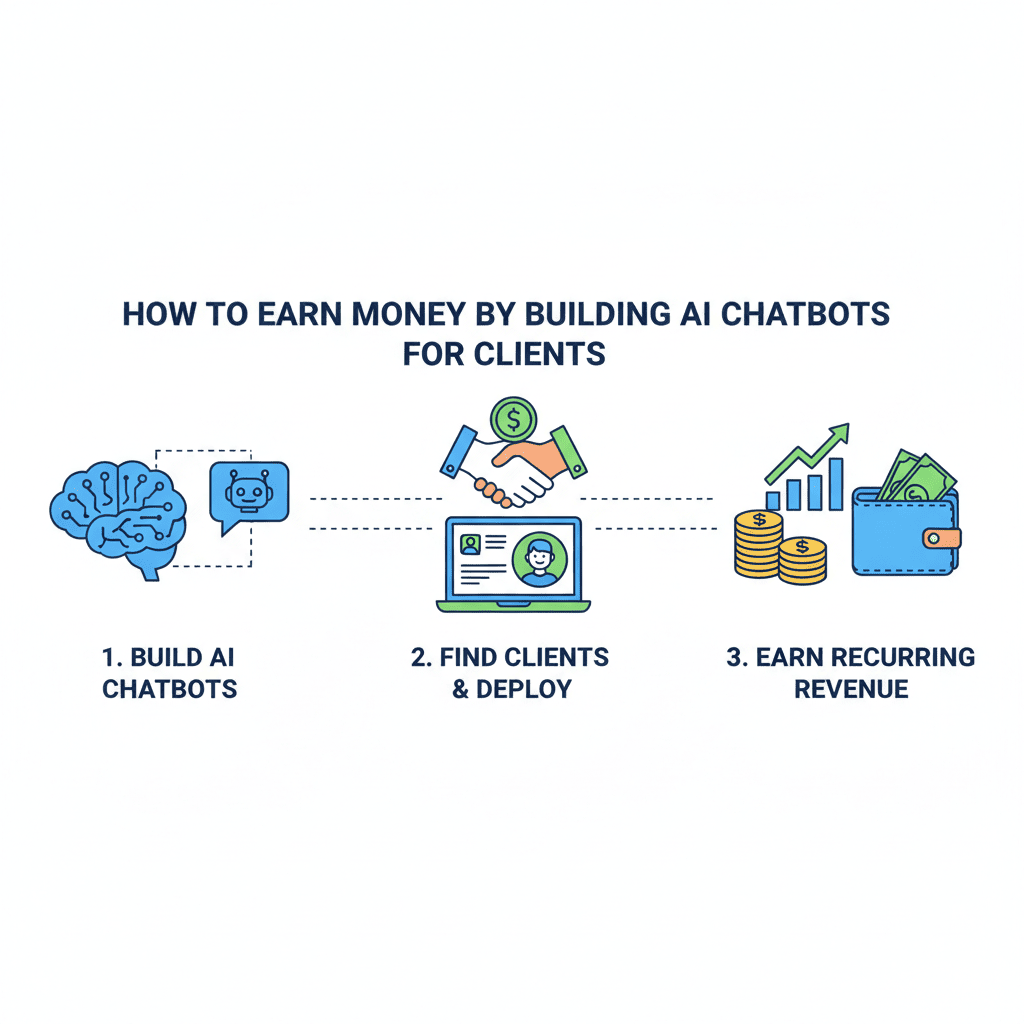
The artificial intelligence revolution has created unprecedented opportunities for entrepreneurs and developers to build profitable businesses. Among the most accessible and lucrative opportunities is building AI chatbots for clients who need intelligent automation to improve customer service, streamline operations, and scale their businesses. The demand for AI chatbot solutions has exploded as companies recognize the competitive advantage of 24/7 automated customer engagement powered by advanced language models.
This comprehensive guide reveals how to transform chatbot development skills into a thriving business generating substantial income. Whether you’re a developer looking to monetize your technical skills, an entrepreneur seeking a service business with low startup costs, or a consultant wanting to expand your offerings, chatbot development provides a viable path to financial success in the AI economy.
The beauty of this business model lies in its scalability and recurring revenue potential. Unlike one-time development projects, chatbot solutions often require ongoing maintenance, updates, and optimization, creating steady monthly income from each client. As businesses across every industry rush to implement AI solutions, the timing has never been better to establish yourself as a chatbot specialist and capitalize on this market opportunity.
1. Understanding the AI Chatbot Market Opportunity
Success begins with comprehending the market landscape, identifying where demand exists, and recognizing which industries offer the most lucrative opportunities.
Market Size and Growth Trajectory
The global chatbot market has experienced explosive growth, expanding from a niche technology to a mainstream business solution. Market research indicates the chatbot industry will reach over fifteen billion dollars by 2027, with compound annual growth rates exceeding 23 percent. This rapid expansion creates abundant opportunities for service providers who can deliver effective solutions.
Small and medium businesses represent particularly strong opportunities because they need AI capabilities but lack resources for full-time AI teams. These companies willingly pay for chatbot services that would cost significantly more to develop in-house or hire dedicated staff to manage.
Enterprise clients offer higher project values and longer-term contracts, though competition intensifies at this level. The sweet spot for most chatbot developers lies in serving growing businesses with annual revenues between one and fifty million dollars. These companies have budgets for technology investments while remaining accessible to independent developers and small agencies.
Industries with Highest Demand
Healthcare organizations need chatbots for appointment scheduling, symptom checking, and patient communication. Regulatory compliance requirements make this sector complex, but healthcare providers pay premium rates for compliant solutions that improve patient experience while reducing administrative burden.
E-commerce businesses require chatbots that handle product inquiries, order tracking, and customer support. The 24/7 nature of online retail makes automated assistance essential, and successful implementations directly impact revenue through improved conversion rates and reduced cart abandonment.
Real estate agencies use chatbots for lead qualification, property inquiries, and appointment scheduling. The industry’s transaction-based compensation structure means agents eagerly invest in tools that increase lead conversion and free their time for high-value activities.
Professional services including law firms, accounting practices, and consulting agencies need chatbots for client intake, appointment booking, and answering common questions. These firms value their billable time highly, making automation that reduces administrative work particularly attractive.
Financial services institutions deploy chatbots for account inquiries, transaction support, and financial education. Strict regulatory requirements in this sector create barriers to entry but also justify higher pricing for developers who understand compliance requirements.
Client Pain Points You Solve
When you’re building AI chatbots for clients, you’re fundamentally solving business problems rather than just implementing technology. Customer service teams drowning in repetitive inquiries need relief that chatbots provide by handling routine questions automatically, freeing human agents for complex situations requiring empathy and judgment.
Sales teams losing leads due to slow response times benefit from instant automated qualification and engagement. Research shows that responding to leads within five minutes increases conversion dramatically, yet most businesses struggle to achieve this consistently without automation.
Operations managers seeking efficiency gains find value in chatbots that automate workflows, gather information, and route requests appropriately. The cumulative time savings across an organization quickly justify chatbot investments through measurable productivity improvements.
Marketing departments wanting better engagement metrics implement chatbots that initiate conversations, qualify leads, and guide prospects through the customer journey. These interactive experiences generate more data and insights than passive websites while improving conversion rates.
2. Building Your Technical Foundation
Technical competence forms the bedrock of a successful chatbot business, though you don’t need to be an AI researcher to deliver valuable solutions.
Essential Skills and Knowledge
Natural language processing fundamentals help you understand how chatbots interpret and respond to user input. You don’t need deep theoretical knowledge, but grasping concepts like intent recognition, entity extraction, and context management enables better solution design and troubleshooting.
API integration skills are crucial because effective chatbots connect to existing business systems. You’ll frequently integrate with CRM platforms, scheduling systems, payment processors, and databases. Comfort working with REST APIs, webhooks, and authentication protocols is essential.
Conversation design represents a often-overlooked skill that separates excellent chatbots from mediocre ones. Understanding how to structure dialogues, handle errors gracefully, and guide users toward successful outcomes requires studying human conversation patterns and user experience principles.
Basic programming knowledge in languages like Python or JavaScript enables customization beyond platform limitations. While no-code tools handle many requirements, the ability to write custom code for unique business logic significantly expands your capabilities and client value.
Choosing Your Development Approach
No-code chatbot platforms like ManyChat, Chatfuel, and Landbot enable rapid development without programming expertise. These tools work excellently for straightforward use cases and allow you to start serving clients immediately. The tradeoff is limited customization and potential platform lock-in.
Low-code platforms such as Dialogflow, Microsoft Bot Framework, and Rasa balance ease of use with flexibility. They provide visual interfaces for common tasks while allowing custom code when needed. This hybrid approach suits most business requirements while keeping development efficient.
Custom development using frameworks and APIs provides maximum flexibility but requires significant technical expertise. This approach makes sense for complex enterprise requirements or when building AI chatbots for clients who need tight integration with proprietary systems.
Your choice should align with your current skills, target market, and growth strategy. Many successful chatbot businesses start with no-code platforms to validate the business model, then gradually add technical capabilities as client requirements become more sophisticated.
Leveraging AI Language Models
OpenAI’s GPT models revolutionized chatbot capabilities by enabling natural, contextual conversations that were previously impossible. Integrating these models allows your chatbots to handle unexpected questions, provide detailed explanations, and adapt to conversational nuances.
Claude from Anthropic offers another powerful option with strong reasoning capabilities and helpful, harmless interaction patterns. Different AI models have different strengths, so understanding when to use each maximizes solution quality.
Prompt engineering becomes critical when working with large language models. Crafting effective system prompts that define chatbot personality, knowledge boundaries, and response patterns determines whether AI-powered chatbots delight or frustrate users.
Cost management for AI API usage requires attention because token consumption directly impacts profitability. Implementing caching strategies, optimizing prompts, and setting usage limits prevents unexpectedly high costs that could eliminate project margins.
Understanding Platform Ecosystems
Facebook Messenger remains one of the largest chatbot platforms with billions of users and robust business tools. Businesses already communicating with customers through Facebook Pages can deploy chatbots without requiring users to download new apps.
WhatsApp Business API enables chatbots on the world’s most popular messaging app, particularly valuable for international clients and markets where WhatsApp dominates. The platform’s end-to-end encryption and high engagement rates make it extremely effective for customer communication.
Website chat widgets provide universal accessibility regardless of platform preferences. Every business has a website, making this integration opportunity universally relevant. Modern widgets offer rich interactive experiences beyond simple text conversations.
SMS chatbots reach customers on the most ubiquitous communication channel. While more expensive per message than internet-based options, SMS ensures delivery to any mobile phone without requiring app installations or internet connectivity.
Voice assistants including Alexa, Google Assistant, and Siri create opportunities for voice-based chatbots. While technically more complex, voice interfaces serve specific use cases like hands-free operation or accessibility requirements.
3. Identifying and Attracting Ideal Clients
Technical skills alone don’t create a business. Finding and winning clients requires marketing, sales, and relationship-building capabilities.
Defining Your Ideal Client Profile
Client selection significantly impacts business success and satisfaction. Ideal clients have clear pain points that chatbots solve effectively. They possess adequate budgets to pay professional rates rather than seeking the cheapest possible option. They understand technology’s value and make decisions based on return on investment rather than pure cost minimization.
Company size influences buying processes and expectations. Smaller businesses typically involve simpler decision-making with owners directly involved, while larger organizations require navigating multiple stakeholders and longer sales cycles. Choose the size range matching your sales capabilities and preferences.
Industry specialization accelerates growth by building deep domain expertise and reusable solutions. Focusing on healthcare, real estate, or e-commerce allows you to understand industry-specific challenges, speak clients’ language, and develop templates that reduce development time while increasing quality.
Geographic considerations affect whether you serve local clients requiring in-person meetings or operate entirely remotely serving global markets. Remote operation offers unlimited market size but increases competition, while local focus creates relationship advantages and community reputation benefits.
Building Your Online Presence
A professional website establishes credibility and educates prospects about your services. Your site should clearly explain what problems you solve, showcase successful projects, and make contacting you effortless. Including educational content demonstrates expertise while improving search engine visibility.
Case studies and portfolio pieces provide social proof that you deliver results. Document successful projects with specific metrics like reduced response times, increased conversion rates, or cost savings. Quantified results prove value far more effectively than generic capability claims.
Content marketing through blogging, videos, or podcasts positions you as an authority while attracting organic traffic. Creating helpful content about chatbot best practices, industry-specific use cases, or AI trends builds audience trust and generates qualified leads who already understand your value before contacting you.
Social media presence on platforms where your target clients spend time increases visibility and engagement opportunities. LinkedIn works exceptionally well for B2B services like building AI chatbots for clients, while Instagram or TikTok might reach business owners in creative industries.
Outreach and Lead Generation Strategies
Cold outreach through email or LinkedIn can be effective when highly targeted and personalized. Research prospects thoroughly, identify specific problems they likely face, and propose concrete solutions rather than generic service offerings. Low response rates are normal, but quality targeting generates sufficient interest to build a pipeline.
Networking at business events, conferences, and local meetups creates relationship opportunities that email alone cannot achieve. Face-to-face interactions build trust more rapidly and often lead to referrals even when the person you meet doesn’t directly need your services.
Partnerships with complementary service providers multiply your reach without direct marketing costs. Web developers, digital marketing agencies, and business consultants all serve clients who might need chatbots. Offering partner referral commissions or reciprocal referral arrangements creates win-win relationships.
Online marketplaces like Upwork, Fiverr, and Toptal provide access to clients actively seeking chatbot services. While competition is intense and fees reduce margins, these platforms help build initial portfolios and client testimonials that establish credibility for attracting direct clients later.
Crafting Compelling Service Offerings
Package your services clearly rather than offering completely custom projects. Defined packages like “Basic Customer Service Chatbot,” “Advanced Lead Qualification System,” and “Enterprise Integration Solution” help clients understand options and simplify decision-making compared to nebulous custom quotes.
Pricing strategy balances competitiveness with profitability. Underpricing to win clients sounds attractive but creates unsustainable businesses and attracts problematic clients focused solely on cost. Research market rates, calculate your costs including time investment, and price to generate healthy margins that support business growth.
Value-based pricing focuses on the economic value delivered rather than hours invested. A chatbot saving a client fifty thousand dollars annually through reduced staffing costs justifies premium pricing even if development takes modest time. Communicate value clearly and price accordingly.
Recurring revenue models through monthly maintenance retainers create predictable income and improve client relationships. Monthly fees covering hosting, updates, optimization, and support provide clients peace of mind while giving you stable cash flow and ongoing client touchpoints.
4. The Client Discovery and Sales Process
Converting interested prospects into paying clients requires structured sales processes that uncover needs, demonstrate value, and close agreements.
Initial Consultation Strategy
Discovery calls aim to understand client situations, identify problems, and determine if you’re a good fit. Prepare questions about current customer service processes, pain points, technology stack, and business goals. Listen more than you talk, taking detailed notes that inform your proposal.
Qualifying prospects early prevents wasting time on poor-fit opportunities. Red flags include unrealistic budgets, unclear decision-making authority, resistance to providing necessary information, or expectations misaligned with what chatbots realistically achieve. Politely declining bad-fit projects allows focusing energy on promising opportunities.
Demonstrating expertise during discovery builds confidence in your capabilities. Share relevant case studies, explain how similar businesses benefited from chatbots, and ask insightful questions that prove you understand their industry and challenges. Consultative selling positions you as a trusted advisor rather than vendor.
Setting clear next steps before ending calls maintains momentum. Whether it’s providing additional information, scheduling a product demonstration, or receiving a proposal, both parties should know exactly what happens next and when to expect it.
Creating Winning Proposals
Proposals should tell a compelling story rather than merely listing features and prices. Start by restating the prospect’s situation and challenges as you understand them, demonstrating that you listened and comprehend their needs. This confirmation ensures alignment and proves you’re proposing relevant solutions.
Solution description explains specifically how your chatbot addresses their problems. Include sample conversation flows, screenshots of similar implementations, and clear explanations of functionality in business terms rather than technical jargon. Help clients visualize the solution and understand exactly what they’re getting.
Implementation timeline sets realistic expectations about the development process, required client involvement, and launch schedule. Breaking projects into phases with specific milestones creates checkpoints for progress review and payment, reducing risk for both parties.
Pricing and payment terms should be clear and unambiguous. Specify exactly what’s included in quoted prices, what costs extra, and how payment scheduling works. Requiring deposits or milestone payments protects you from non-payment risk while demonstrating client commitment.
Terms and conditions covering important legal and business issues like intellectual property ownership, confidentiality, liability limitations, and cancellation policies protect both parties. While comprehensive contracts from lawyers are ideal, clear terms in proposals provide basic protection for smaller projects.
Handling Objections and Closing Deals
Price objections commonly arise even with fair pricing. Address these by reframing discussions around value and return on investment rather than absolute cost. Calculate specific savings or revenue increases the chatbot enables, showing that it pays for itself many times over.
Technology concerns from clients unfamiliar with AI require patient education. Share case studies of similar businesses successfully implementing chatbots, offer trial periods or pilot projects that reduce risk, and explain your ongoing support that ensures success.
Timing objections where clients claim they’re not ready often mask budget constraints or competing priorities. Probe gently to understand real concerns, then address those specific issues. Sometimes, proposing phased implementation allows clients to start with smaller investments and expand as they see results.
Competition from other providers or internal development requires differentiation. Emphasize your unique strengths whether that’s industry expertise, superior support, proven results, or technological advantages. Avoid disparaging competitors; instead, focus on concrete reasons why you’re the best choice.
5. Building and Delivering Exceptional Chatbots
Project execution determines whether clients become delighted advocates or disappointed detractors. Excellence in delivery builds reputations and referrals that fuel business growth.
Project Planning and Scoping
Detailed requirements gathering prevents misunderstandings and scope creep. Document every functionality expectation, integration requirement, and success metric. Review this documentation with clients for confirmation before beginning development.
Conversation flow mapping visualizes the user experience before building anything. Create flowcharts showing how different user inputs lead through conversation paths to successful outcomes. This planning identifies edge cases and ensures logical, user-friendly experiences.
Technical architecture decisions about platforms, integrations, and infrastructure should consider not just immediate project needs but also future scalability and maintenance requirements. Choosing flexible, well-supported technologies prevents costly rebuilds when clients need expanded functionality.
Risk identification and mitigation planning acknowledges that projects encounter obstacles. Anticipate potential issues like integration challenges, data access limitations, or changing requirements. Having contingency plans prevents these issues from derailing projects.
Development Best Practices
Version control using Git or similar systems tracks changes, enables collaboration, and provides rollback capabilities if issues arise. This professional practice prevents lost work and makes managing complex projects significantly easier.
Testing throughout development rather than only at the end catches issues early when they’re easier and cheaper to fix. Test individual conversation paths, integration points, and error handling systematically rather than assuming everything works until clients discover problems.
Documentation of code, conversation logic, and system architecture pays dividends during maintenance and future enhancements. Well-documented systems can be maintained years later when memories fade, and they facilitate transferring projects to other developers if needed.
Security considerations protect client data and comply with regulations. Implement proper authentication for admin interfaces, encrypt sensitive data, follow platform security best practices, and stay current on security updates for any libraries or frameworks used.
Client Communication During Development
Regular progress updates keep clients informed and engaged without requiring their constant attention. Weekly summaries of completed work, upcoming tasks, and any decisions needed maintain momentum and trust.
Demonstrating work-in-progress allows clients to provide feedback before significant effort goes into wrong directions. Short videos showing conversation flows or screenshots of functionality enable course corrections early rather than major revisions after completion.
Managing scope creep requires diplomatic firmness. When clients request additional features beyond original scope, acknowledge their needs while explaining how these items extend beyond agreed deliverables. Offer to add them as phase two work or adjust timeline and budget accordingly.
Problem communication should be prompt and solution-focused. When encountering obstacles, inform clients quickly while presenting options for moving forward rather than simply reporting problems without paths to resolution.
6. Launching and Optimizing Chatbots
Successful deployment ensures chatbots perform well in production and deliver promised value. Post-launch optimization continually improves performance and client satisfaction.
Pre-Launch Preparation
Comprehensive testing in production-like environments catches issues that might not appear during development. Test all conversation paths, error scenarios, edge cases, and integration points. Involve team members unfamiliar with the project to get fresh perspectives that identify confusion points.
User acceptance testing with actual client team members ensures the chatbot meets their needs and expectations. Have client representatives use the chatbot as real users would, providing feedback on conversation quality, functionality gaps, and improvements they’d like to see.
Training client staff who will monitor, maintain, or promote the chatbot ensures successful adoption. Create documentation, provide hands-on walkthroughs, and make yourself available for questions during the transition to client ownership.
Launch planning includes deciding on gradual rollout versus full deployment, preparing monitoring tools, establishing escalation procedures for issues, and communicating the launch to end users appropriately.
Post-Launch Monitoring
Performance metrics tracking measures whether chatbots achieve intended goals. Monitor conversation completion rates, user satisfaction scores, containment rates for customer service bots, or conversion rates for sales bots. These metrics quantify success and identify optimization opportunities.
Conversation analysis reveals where users struggle, get frustrated, or abandon interactions. Reviewing actual conversation logs highlights misunderstood intents, missing functionalities, or unclear bot responses that need improvement.
Technical monitoring ensures systems remain operational and performant. Track response times, error rates, API usage, and infrastructure health. Automated alerts notify you of problems before clients discover them, protecting your reputation.
User feedback collection through post-conversation surveys or feedback mechanisms provides qualitative insights complementing quantitative metrics. Direct user input often reveals improvement opportunities that pure data analysis misses.
Continuous Improvement
A/B testing different conversation approaches, prompts, or flows reveals what works best. Test variations of greeting messages, different ways of asking for information, or alternative response styles. Data-driven optimization continually improves performance.
Regular content updates keep chatbot knowledge current and accurate. Business information changes, new products launch, and policies update. Maintaining fresh, accurate content prevents chatbots from providing outdated information that frustrates users.
Feature enhancements based on usage patterns and user requests expand chatbot capabilities over time. Successful building AI chatbots for clients includes treating them as evolving systems rather than static products. This ongoing improvement increases value and justifies continued monthly fees.
Performance reporting to clients demonstrates ongoing value and return on investment. Monthly reports showing key metrics, improvements made, and value delivered keep clients engaged and appreciative of your work, reducing churn and enabling upselling opportunities.
7. Scaling Your Chatbot Business
Growing from individual projects to a sustainable, scalable business requires systems, processes, and potentially team expansion.
Developing Repeatable Processes
Standard operating procedures for common tasks like client onboarding, requirements gathering, testing, and deployment increase efficiency and consistency. Document your processes so they can be followed by others or refined over time.
Template-based development where you reuse conversation structures, integrations, and functionality patterns across similar projects dramatically reduces development time. Industry-specific templates for restaurants, dental offices, or real estate agencies allow rapid customization rather than building from scratch.
Tools and automation for repetitive tasks like testing, deployment, or reporting free time for higher-value activities. Invest in or build tools that accelerate your work without compromising quality.
Quality checklists ensure every project meets your standards regardless of time pressures or team members involved. Checklists covering requirements documentation, testing procedures, and launch criteria prevent costly oversights.
Building a Team
Hiring timing should balance workload demands with financial sustainability. Growing too quickly strains cash flow while being understaffed leads to burnout and quality issues. Track your utilization rates and hire before reaching unsustainable workload levels.
Role specialization allows team members to develop deep expertise in conversation design, technical development, or client management rather than everyone doing everything. Specialists typically produce higher quality work more efficiently than generalists.
Contractor versus employee decisions involve tradeoffs between flexibility and commitment. Contractors provide flexibility for variable workloads without long-term obligations but may lack deep investment in your business. Employees typically offer more commitment and cultural alignment at higher fixed costs.
Training and development investments in your team improve capabilities and retention. Encourage continued learning about AI advances, new platforms, and industry trends. Knowledge sharing within the team multiplies individual learning across the organization.
Productizing Your Services
Creating packaged offerings transforms custom services into scalable products. Develop “chatbot in a box” solutions for specific use cases that require minimal customization, allowing you to serve more clients with less time investment per client.
White-label solutions for agencies enable other companies to resell your chatbot development under their brand. This B2B2C model scales your reach without direct marketing to end clients while leveraging partners’ existing client relationships.
SaaS products that clients can configure themselves represent the ultimate scalability because they eliminate custom development time entirely. While requiring significant upfront investment, successful SaaS products generate revenue with minimal ongoing effort per customer.
Licensing chatbot templates to other developers or agencies creates additional revenue streams from intellectual property you’ve already created. Other developers pay for proven templates that accelerate their work.
Managing Growth Challenges
Cash flow management becomes more complex as you grow. Larger projects with longer payment terms or significant upfront expenses before client payments require careful financial planning. Maintain adequate reserves to cover operating expenses during revenue gaps.
Client portfolio diversification reduces risk from over-dependence on single clients. If one major client represents most of your revenue, losing them could be catastrophic. Deliberately building a diversified client base improves stability.
Quality maintenance under growth pressure requires vigilance because rapid scaling often degrades quality if processes don’t scale accordingly. Prioritize systematic quality assurance over faster but sloppier delivery that damages reputation.
Work-life balance considerations prevent burnout that destroys both personal wellbeing and business performance. Success means creating a sustainable business that supports your life rather than consuming it entirely.
8. Maximizing Revenue and Profitability
Growing revenue while maintaining healthy profit margins requires strategic pricing, service design, and operational efficiency.
Pricing Optimization
Value-based pricing rather than hourly rates captures more of the economic value you create. A chatbot reducing client costs by one hundred thousand dollars annually justifies significantly higher pricing than cost-plus calculations based on your time investment might suggest.
Tiered service packages accommodate different client budgets while encouraging upsells. Basic, professional, and enterprise tiers let clients start at comfortable levels then upgrade as they experience value and their needs grow.
Monthly recurring revenue through maintenance agreements, hosting fees, or subscription-based services provides income predictability and improves business valuation compared to purely project-based revenue.
Performance-based pricing where compensation ties partly to results aligns your interests with clients’ and can justify premium rates. Shared success models where you receive bonuses for exceeding metrics like conversion rates or cost savings strengthen client relationships.
Upselling and Cross-Selling
Expansion opportunities exist within current clients who’ve experienced your value. After successful initial chatbot deployment, propose additional chatbots for other functions, enhanced features, or integration with additional systems.
Related services like AI strategy consulting, customer experience optimization, or general digital transformation broaden your value proposition beyond pure chatbot development. These adjacent services leverage your expertise while increasing wallet share with existing clients.
Referral programs incentivizing satisfied clients to introduce you to peers efficiently acquire new business at low cost. Offering referral bonuses or service discounts motivates clients to actively recommend you rather than passively mentioning your services when asked.
Long-term retainer agreements that lock in monthly revenue for ongoing optimization, support, and improvements provide both financial stability and deeper client relationships that lead to additional project opportunities.
Operational Efficiency
Automation of your own business processes including proposal generation, contract management, invoicing, and reporting reduces administrative overhead. Every hour saved on administration is an hour available for billable client work or business development.
Outsourcing non-core functions like accounting, legal work, or administrative tasks allows focus on high-value activities like client relationships and chatbot development. Attempting to personally handle everything limits growth and often does those tasks less effectively than specialists would.
Technology investments in project management tools, development platforms, or business systems pay for themselves through time savings and quality improvements. Cheap tools that waste time or create errors cost more than their purchase price savings.
Continuous process improvement through regular review of how you work identifies inefficiencies and optimization opportunities. Small improvements compound over time into significant productivity gains that directly improve profitability.
9. Staying Competitive in Evolving Markets
The AI field advances rapidly, requiring ongoing learning and adaptation to maintain competitive advantages and service relevance.
Keeping Technical Skills Current
Following AI research and product announcements helps you understand emerging capabilities that could enhance your offerings. Subscribe to relevant newsletters, follow key researchers and companies on social media, and participate in online communities discussing AI developments.
Experimenting with new AI models, platforms, and techniques before clients need them positions you as an innovator rather than follower. Allocate time for learning and experimentation even when client work is busy, treating skill development as essential business investment.
Attending conferences, workshops, and training programs accelerates learning while providing networking opportunities. The connections made at industry events often prove as valuable as the formal content through knowledge sharing and potential partnerships.
Obtaining certifications from major platforms like Google, Amazon, or Microsoft demonstrates expertise to prospective clients who use certifications as vendor evaluation criteria. While certificates don’t prove practical ability, they provide credible signals in competitive situations.
Monitoring Industry Trends
Customer expectation evolution means chatbots that impressed users last year may seem basic today. Understanding rising expectations for natural conversation, multimodal interaction, and proactive assistance ensures your solutions remain competitive.
Regulatory changes particularly around AI, data privacy, and accessibility affect chatbot requirements. Staying informed about evolving regulations prevents delivering solutions that create compliance risks for clients.
Competitive analysis of what other chatbot developers and agencies offer reveals market positioning opportunities and pricing benchmarks. Understanding your competition helps you differentiate effectively and identify underserved market segments.
Technology consolidation and partnership shifts in the platform ecosystem affect tool availability and strategy. Major acquisitions, deprecated features, or new platform alliances require adapting your technology choices and development approaches.
Differentiation Strategies
Specialization in specific industries, use cases, or technologies creates competitive moats. Being known as the healthcare chatbot expert or the WhatsApp Business specialist makes you the obvious choice for those specific needs rather than competing on general capabilities.
Exceptional service quality including responsiveness, proactive communication, and going beyond contractual obligations builds reputation and referrals that are more valuable than any marketing campaign. Outstanding service differentiates more effectively than technical features clients may not understand.
Innovative approaches to common problems give clients better results than competitors’ standard solutions. When you’re building AI chatbots for clients using novel techniques or unique combinations of technologies, you deliver superior outcomes that justify premium pricing.
Thought leadership through content creation, speaking engagements, or community contributions establishes authority that attracts clients who prefer working with recognized experts. Publishing case studies, methodologies, or insights positions you as an innovator rather than commodity service provider.
10. Building Long-Term Business Success
Sustainable success requires looking beyond immediate projects to build a business that thrives long-term through reputation, relationships, and strategic positioning.
Client Relationship Management
Exceeding expectations on every project creates delighted clients who provide referrals, testimonials, and repeat business. The difference between adequate and exceptional service often involves relatively small extra efforts that generate disproportionate appreciation.
Regular check-ins with clients beyond project work maintain relationships and identify new opportunities. Quarterly business reviews, informal coffee meetings, or simply staying in touch demonstrates that you care about their success beyond collecting project fees.
Handling problems professionally when issues inevitably arise protects relationships and reputation. Taking responsibility, communicating transparently, and prioritizing resolution over blame maintains client trust even when problems occur.
Client appreciation through thoughtful gestures acknowledges the relationship’s value. Holiday gifts, congratulations on business milestones, or simply expressing gratitude for their partnership strengthens bonds that transcend transactional interactions.
Building Business Assets
Proprietary methodologies that codify your approach to chatbot development create defensible intellectual property and marketing differentiators. Document your processes, frameworks, and techniques as formal methodologies that can be taught, licensed, or protected.
Content assets including blog posts, videos, case studies, and tools provide enduring value. Quality content attracts prospects continuously through search engines and social sharing, functioning as always-on marketing that requires no ongoing effort.
Technology assets like reusable components, templates, or custom tools reduce future project costs while improving quality and consistency. Building a library of proven solutions accelerates delivery and differentiates your capabilities.
Brand equity through consistent quality, distinctive positioning, and community recognition makes your business itself valuable beyond individual projects or team members. Strong brands command premium pricing and attract better opportunities.
Planning for Business Evolution
Market evolution requires periodically reassessing your positioning, services, and strategy. The chatbot market five years from now will differ significantly from today. Flexibility and willingness to evolve prevent obsolescence as markets mature.
Exit strategy planning acknowledges that you may eventually want to sell, merge, or transition the business. Building systems, documenting processes, and creating transferable assets makes the business valuable to potential acquirers rather than dependent entirely on your personal involvement.
Passive income opportunities through products, partnerships, or licensing reduce dependence on active project delivery. Transitioning some revenue to passive or semi-passive models improves lifestyle flexibility and business resilience.
Legacy and impact considerations about what you want your business to represent and accomplish provide motivation beyond financial returns. Building something meaningful that helps businesses succeed and improves their customer experiences creates satisfaction that pure profit cannot match.
Conclusion
The opportunity to build a profitable business building AI chatbots for clients has never been stronger. Businesses across every industry recognize the necessity of AI automation for remaining competitive, creating sustained demand for developers who can implement effective solutions. The combination of accessible technology, proven business models, and expanding markets makes chatbot development one of the most viable paths to entrepreneurial success in the AI economy.
Success requires balancing technical capabilities with business skills. The best chatbot developer who cannot attract clients or deliver projects profitably will struggle, just as an excellent salesperson lacking technical skills to deliver quality solutions eventually loses credibility. Developing both dimensions creates sustainable competitive advantages.
Starting small with initial clients while continuously improving your skills, processes, and offerings allows organic growth without unsustainable risk. Each successful project builds momentum through referrals, portfolio pieces, and expanding capabilities. Patience and persistence through initial challenges separate those who build lasting businesses from those who abandon promising opportunities too early.
The recurring revenue potential from maintenance agreements and ongoing client relationships creates business stability and predictable income that pure project work cannot match. Structuring your services to emphasize ongoing value delivery rather than transactional projects improves both client retention and business economics.
For those willing to invest the effort learning technical skills, understanding business needs, and delivering exceptional service, building AI chatbots for clients provides a realistic path to substantial income and professional independence. The market will continue growing as AI becomes increasingly central to business operations, ensuring opportunities for skilled practitioners who stay current and deliver measurable value.
The question isn’t whether chatbot services represent a viable business opportunity, but whether you’re prepared to seize it. The tools, markets, and knowledge are available. Success belongs to those who combine them effectively through dedicated effort, continuous learning, and unwavering focus on solving real business problems through intelligent automation. The future of business communication is conversational AI, and you can profit by helping companies navigate this transformation successfully.
Also read this:
I Built an AI-Controlled Smart Room That Responds to Voice Commands
How I Built an AI-Controlled Smart Desk That Works on Voice Commands
Building a ChatGPT-Powered Smart Speaker From Scratch (Full Demo)