
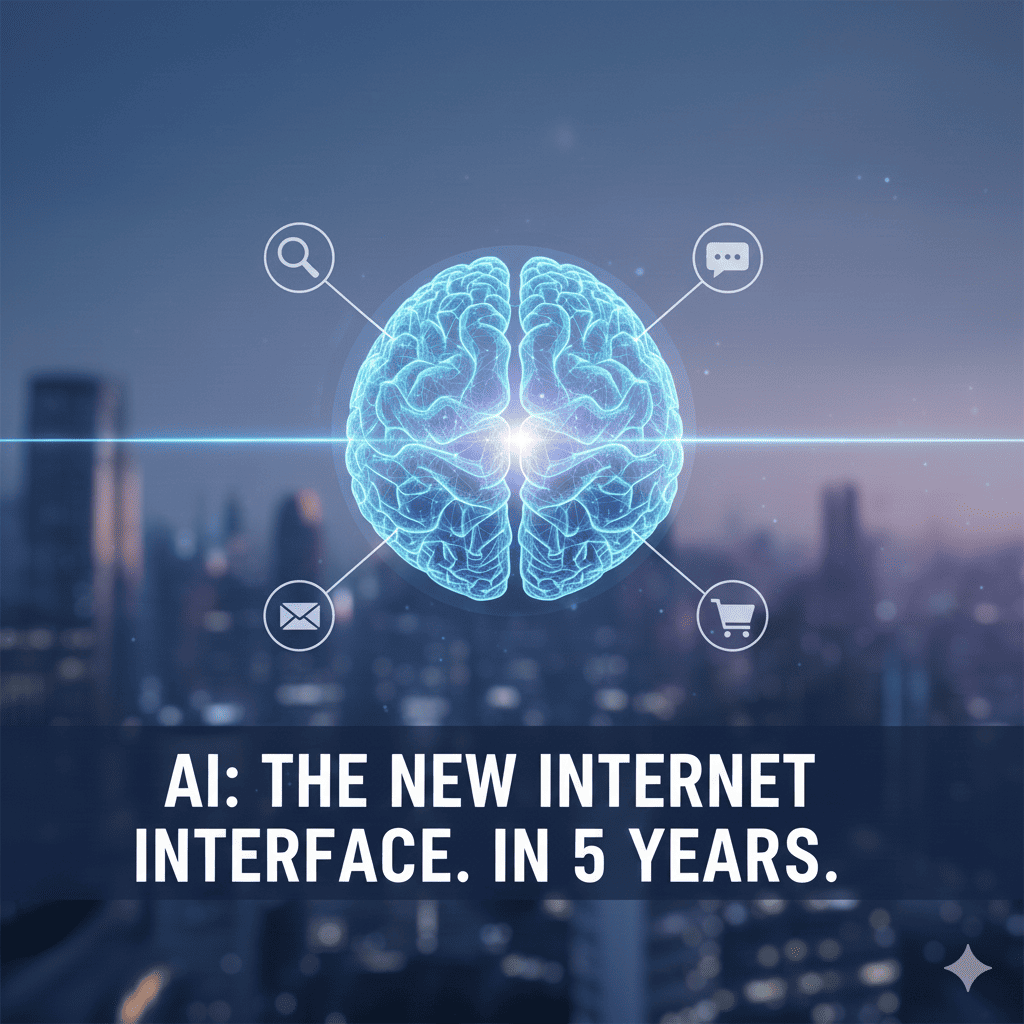
The internet as we know it is on the brink of a fundamental transformation. For decades, we’ve navigated the digital world through browsers, search bars, and endless clicking through websites. But a seismic shift is underway. Within the next five years, AI will become the default interface for how billions of people access, interact with, and experience the internet. This isn’t speculation—it’s an inevitable evolution driven by technological advancement, user demand, and the limitations of current systems.
The transition from traditional interfaces to AI-powered ones represents the most significant change in human-computer interaction since the graphical user interface replaced command lines in the 1980s. Just as smartphones replaced desktop computers as the primary internet access point for most users, AI will become the default interface that mediates our digital experiences. Understanding why this shift is happening and what it means for users, businesses, and society is crucial for anyone looking to stay ahead in our rapidly evolving digital landscape.
1. The Current Internet Interface Is Fundamentally Broken
The Search Engine Limitation
Today’s primary method of internet interaction—typing keywords into search engines—is increasingly inadequate for modern needs. Users must sift through pages of results, evaluate sources, click multiple links, and piece together information from disparate sources. This process is time-consuming, inefficient, and often frustrating.
Traditional search engines return links, not answers. They require users to do the cognitive heavy lifting of synthesizing information, determining credibility, and extracting actionable insights. For simple queries, this might involve visiting three to five websites. For complex research, it can mean dozens of tabs and hours of work. This model made sense when the internet was smaller and information was scarce, but today’s information abundance demands a more intelligent intermediary.
Information Overload and Decision Fatigue
The average person is exposed to thousands of digital choices daily. Which article to read? Which product to buy? Which service to subscribe to? This constant decision-making leads to cognitive exhaustion and suboptimal choices. Users increasingly crave simplification—not more options, but better guidance through the options that exist.
The paradox of choice has never been more evident. Studies show that when presented with too many options, people either make worse decisions or avoid deciding altogether. The current internet interface exacerbates this problem by dumping information without context, personalization, or intelligent filtering. AI will become the default interface because it solves this fundamental problem by serving as an intelligent filter and advisor.
The Mobile-First Reality
More than 60% of internet traffic now comes from mobile devices, yet most websites and applications are still designed with desktop experiences in mind. Scrolling through lengthy articles, navigating complex menus, and filling out forms on small screens is cumbersome. Mobile users need faster, more intuitive ways to accomplish tasks—ways that don’t require extensive tapping, typing, and navigation.
Voice-based and conversational interfaces naturally suit mobile contexts where typing is inconvenient. Whether driving, cooking, or walking, users want hands-free access to information and services. Traditional interfaces fail in these scenarios, while AI-powered conversational systems excel.
2. Natural Language Processing Has Reached Critical Mass
The Breakthrough Moment
Recent advances in large language models have crossed a critical threshold: AI can now understand and respond to human language with near-human comprehension. Models can grasp context, nuance, ambiguity, and even humor. They can engage in multi-turn conversations, remember previous interactions, and adapt their responses based on user preferences.
This isn’t incremental improvement—it’s a paradigm shift. For the first time in computing history, humans don’t need to learn computer language; computers can understand human language. This removes the most significant barrier between people and technology. When AI will become the default interface, it will democratize technology access for billions who find current interfaces intimidating or inaccessible.
Multimodal Understanding
Modern AI systems don’t just process text—they understand images, audio, video, and can generate responses across multiple formats. A user can show their phone a photo of a dish and ask for the recipe, or describe a product verbally and receive visual search results. This multimodal capability makes interactions more natural and powerful than traditional keyword-based systems.
The integration of different input and output modalities creates seamless experiences impossible with conventional interfaces. Users can start a task on one device via voice, continue on another via text, and complete it on a third via visual interface—all within a continuous, AI-mediated conversation.
Personalization at Scale
AI interfaces learn from every interaction, building sophisticated models of individual user preferences, habits, and needs. Unlike static websites that present the same content to everyone, AI interfaces can tailor responses, recommendations, and information delivery to each user’s unique context, knowledge level, and goals.
This personalization extends beyond simple preference matching. AI can understand a user’s expertise level and adjust explanation complexity accordingly. It can remember past conversations and build on previous interactions. It can anticipate needs based on patterns and proactively offer assistance. This level of intelligent personalization is impossible with traditional interfaces.
3. Economic Incentives Are Driving Rapid Adoption
Cost Reduction for Businesses
Deploying AI interfaces is increasingly cost-effective compared to maintaining traditional web properties and customer service operations. A single AI system can handle millions of simultaneous conversations, providing 24/7 service without the scaling costs of human support teams. For businesses, the ROI is compelling and often measurable within months.
Companies that implement AI interfaces report significant reductions in customer service costs, often 30-50% or more. Beyond direct cost savings, AI interfaces improve customer satisfaction by providing instant responses and personalized assistance. In competitive markets, these advantages translate directly to customer retention and revenue growth.
Revenue Opportunities
AI interfaces create new monetization possibilities. They can facilitate transactions conversationally, recommend products contextually, and guide users through complex purchasing decisions. The conversion rates for AI-assisted sales often exceed traditional e-commerce by substantial margins because the AI can address objections, answer questions, and personalize offers in real-time.
Subscription services, micropayments, and premium features delivered through AI interfaces represent growing revenue streams. Users increasingly pay for superior AI experiences that save time, provide expert guidance, or unlock advanced capabilities. This willingness to pay for AI-mediated services validates the business model and encourages further investment.
Competitive Pressure
As early adopters demonstrate the advantages of AI interfaces, competitive pressure forces others to follow. Companies that fail to implement AI risk appearing outdated and losing market share to more innovative competitors. This creates a self-reinforcing cycle where adoption accelerates as more players recognize AI will become the default interface not as a future possibility but as a present necessity.
Industry leaders across sectors—from banking to healthcare to retail—are investing billions in AI interface development. This investment isn’t experimental; it’s strategic positioning for a market where AI-mediated interactions become the norm. Companies understand that controlling the interface means controlling the customer relationship.
4. User Behavior Is Shifting Toward Conversational Interaction
Voice Assistant Proliferation
Smart speakers, voice assistants, and voice-enabled devices have trained hundreds of millions of users to interact with technology conversationally. While early voice assistants were limited, they established user comfort with speaking to machines. As AI capabilities improve, these conversational behaviors are expanding from simple commands to complex interactions.
Voice commerce, voice search, and voice-based content consumption are growing exponentially. Users who initially used voice assistants for weather and music now use them for shopping, research, and productivity. This behavioral shift creates demand for more sophisticated conversational interfaces across all digital touchpoints.
Chat-Based Expectations
Messaging apps are now the primary communication channel for billions of people. Users are accustomed to achieving goals through chat—whether messaging friends, contacting customer service, or conducting business. This chat-first mentality naturally extends to expectations for how they should interact with all digital services.
The success of AI chatbots in customer service has normalized conversational interfaces for problem-solving and transactions. Users no longer question whether they’re talking to a human or AI; they care only about getting effective assistance. This acceptance lowers barriers to AI interface adoption across domains.
Generational Preferences
Younger users, who grew up with smartphones and conversational apps, strongly prefer interactive, personalized experiences over static web pages. They expect technology to understand context, anticipate needs, and adapt to their communication style. Traditional interfaces feel archaic to these digital natives who have never known a world without intelligent, responsive technology.
As this generation gains purchasing power and becomes the dominant user demographic, their interface preferences will reshape digital experiences. Companies targeting these users must offer AI-powered interactions or risk irrelevance. The generational shift alone ensures AI will become the default interface as older interaction paradigms lose their user base.
5. Technical Infrastructure Is Maturity
Cloud Computing and Edge Processing
The computational demands of AI were once prohibitive, but advances in cloud infrastructure and edge computing make real-time AI interactions feasible at scale. Distributed processing allows AI to run efficiently on smartphones, smart devices, and even embedded systems, bringing intelligence to every connected device.
Edge AI—processing that happens on-device rather than in the cloud—enables fast, private, and reliable AI interactions even without constant internet connectivity. This technical capability removes a major barrier to ubiquitous AI interfaces and enables new use cases in environments with limited connectivity.
API Ecosystems and Integration
Modern AI systems can connect to vast ecosystems of services through APIs, enabling them to take actions on behalf of users. An AI interface can book appointments, make purchases, control smart home devices, or interact with thousands of services—all through conversational commands. This integration capability makes AI interfaces genuinely useful rather than merely conversational.
The standardization of API protocols and the growth of AI-friendly service architectures create a virtuous cycle. As more services become AI-accessible, AI interfaces become more valuable. As AI interfaces become more valuable, more services prioritize AI compatibility. This ecosystem effect accelerates the transition toward AI will become the default interface across the digital landscape.
Continuous Learning Systems
Unlike static websites that require manual updates, AI interfaces improve continuously through machine learning. Every interaction makes the system smarter, better at understanding user intent, and more capable of providing relevant assistance. This self-improving quality means AI interfaces get better over time while traditional interfaces stagnate or require costly redesigns.
Continuous learning also enables rapid adaptation to changing user needs, emerging trends, and new information. An AI interface can incorporate the latest news, update recommendations based on new data, and adjust to shifting user preferences—all without developer intervention. This dynamic quality is fundamentally superior to static interfaces.
6. Accessibility and Inclusion Benefits
Breaking Down Barriers
Traditional internet interfaces create barriers for people with disabilities, those with limited technical literacy, or those who speak languages underserved by current technology. AI interfaces, particularly voice and conversational ones, dramatically reduce these barriers. Someone who cannot type can speak. Someone who struggles with complex navigation can simply ask for what they need.
The ability to interact with technology in natural language, at one’s own pace, with explanations and guidance readily available, makes the internet accessible to billions who currently struggle with conventional interfaces. When AI will become the default interface, it will represent the most significant accessibility improvement in digital history.
Language Diversity
AI translation and multilingual capabilities enable truly global interfaces. Users can interact in their native language, even if the underlying service operates in a different language. This linguistic flexibility opens digital services to markets and populations previously excluded by language barriers.
Real-time translation within AI interfaces enables cross-language communication and collaboration. A Spanish speaker and a Hindi speaker can each interact in their own language while the AI mediates the conversation. This capability transforms global commerce, education, and cultural exchange.
Educational Leveling
AI interfaces can adapt to users’ knowledge levels, providing detailed explanations to novices and concise responses to experts. This adaptive teaching capability makes complex topics accessible to learners at any stage. The internet becomes not just an information repository but an intelligent tutor available to anyone.
The democratization of expertise through AI interfaces reduces knowledge gaps and educational inequalities. Someone without formal education can receive expert-level guidance on health, finance, law, or any domain. This educational empowerment has profound social and economic implications.
7. Privacy and Control Considerations
Data Sovereignty
As AI interfaces mediate more of our digital lives, questions of data ownership, privacy, and control become critical. Users increasingly demand transparency about how AI systems use their data and want control over their information. The next generation of AI interfaces will need to address these concerns through privacy-preserving architectures and user-controlled data policies.
Decentralized AI models that run locally on user devices, federated learning approaches that keep data distributed, and zero-knowledge systems that provide intelligence without exposing personal information represent technical solutions to privacy challenges. The success of AI as the default interface depends partly on solving these privacy puzzles in user-friendly ways.
Algorithmic Transparency
Users need to understand how AI interfaces make decisions, particularly when those decisions affect important outcomes. Explainable AI—systems that can articulate their reasoning—builds trust and enables users to correct mistakes or challenge inappropriate outputs. Transparency isn’t just ethical; it’s essential for user adoption and regulatory compliance.
The ability to audit AI decisions, understand the factors influencing recommendations, and contest automated determinations will be fundamental features of trustworthy AI interfaces. Companies that prioritize explainability will gain competitive advantages through enhanced user trust.
8. The Infrastructure Shift Is Already Underway
Major Platform Investments
Technology giants are investing tens of billions of dollars in AI interface development. These investments signal confidence that AI will become the default interface and determination to control this interface layer. The companies that dominate AI interfaces will likely dominate the next era of the internet, much as search engines and social media platforms dominated the previous era.
Every major technology company has either launched or announced AI interface products. These aren’t experimental side projects but core strategic initiatives receiving massive resources and executive attention. The scale and speed of investment indicate industry consensus about the inevitability of this transition.
Developer Ecosystem Growth
Millions of developers are now building applications, integrations, and services designed for AI interfaces rather than traditional web or mobile platforms. This growing ecosystem of AI-native applications creates network effects that accelerate adoption. As more tools become available, AI interfaces become more capable, attracting more users and more developers in a self-reinforcing cycle.
Development frameworks, pre-trained models, and AI-building platforms have made creating AI-powered interfaces accessible to developers without specialized machine learning expertise. This democratization of AI development ensures a diverse, innovative ecosystem of AI applications and interfaces.
Regulatory Frameworks Emerging
Governments and regulatory bodies worldwide are developing frameworks for AI governance. While regulations create compliance requirements, they also provide clarity and legitimacy that encourage mainstream adoption. As legal frameworks mature, enterprises gain confidence to deploy AI interfaces in regulated industries like healthcare, finance, and legal services.
The establishment of standards, certification processes, and best practices for AI interfaces removes uncertainty and enables large-scale deployments. Regulated adoption in sensitive domains validates AI reliability and safety, building public trust that extends to broader applications.
9. The Timeline to Ubiquity
Years 1-2: Early Majority Adoption
We’re currently in the early majority phase where AI interfaces move from early adopters to mainstream users. Major websites and applications are adding AI interface options alongside traditional interfaces. Users begin experiencing AI-mediated interactions regularly in customer service, search, and productivity tools.
During this phase, AI interfaces handle increasingly complex tasks, from scheduling appointments to conducting research to making purchases. User familiarity and comfort with AI interactions grow, and behavioral expectations shift toward conversational engagement as the default rather than an alternative.
Years 3-4: Tipping Point
By years three and four, AI interfaces will handle the majority of digital interactions for a significant portion of users. Traditional websites become secondary to AI-mediated experiences. Younger users, in particular, will primarily access internet services through AI interfaces, rarely visiting conventional websites except for specific purposes.
During this tipping point phase, businesses that haven’t implemented robust AI interfaces face competitive disadvantages. User acquisition and retention increasingly depend on AI interface quality. Investment flows predominantly to AI-first platforms and services.
Year 5: The New Normal
Within five years, AI will become the default interface for most internet users in developed markets and rapidly advancing developing markets. Traditional web browsing won’t disappear but will become a specialized activity rather than the primary mode of internet interaction. New users coming online will learn AI interfaces first, just as today’s users learn mobile before desktop.
The transition will feel natural rather than disruptive for most users because AI interfaces are simply easier and more intuitive than alternatives. Like the shift from desktop to mobile, the transition to AI interfaces will be driven by superior user experience rather than technological novelty.
Conclusion: Preparing for the AI Interface Era
The evidence is overwhelming: AI will become the default interface for the internet within the next five years. This isn’t about technology replacing humans but about technology finally adapting to humans instead of the other way around. For decades, we’ve learned computer languages, memorized commands, and adapted our thinking to machine logic. AI interfaces reverse this relationship, making computers adapt to human communication and thinking patterns.
For individuals, this transition means developing comfort with conversational interactions, understanding AI capabilities and limitations, and learning to communicate effectively with AI systems. For businesses, it means investing in AI interface development, reimagining customer experiences, and preparing for a world where the website is no longer the primary digital touchpoint.
The shift to AI as the default interface represents the most significant change in how humans access and interact with information since the invention of the printing press. Those who understand this transition and position themselves accordingly will thrive. Those who cling to outdated interface paradigms will find themselves increasingly irrelevant in a world where intelligence mediates every digital interaction.
The future isn’t about visiting websites, clicking through menus, or filling out forms. It’s about conversing with intelligent systems that understand our needs, anticipate our questions, and help us accomplish our goals efficiently and naturally. That future is arriving faster than most people realize, and it will fundamentally reshape not just the internet but society itself. The question isn’t whether AI will become the default interface—it’s how quickly we’ll adapt to this inevitable transformation.
Also read this:
AI Feature Improves Typing Speed: The Revolutionary Technology That’s Changing How We Type