
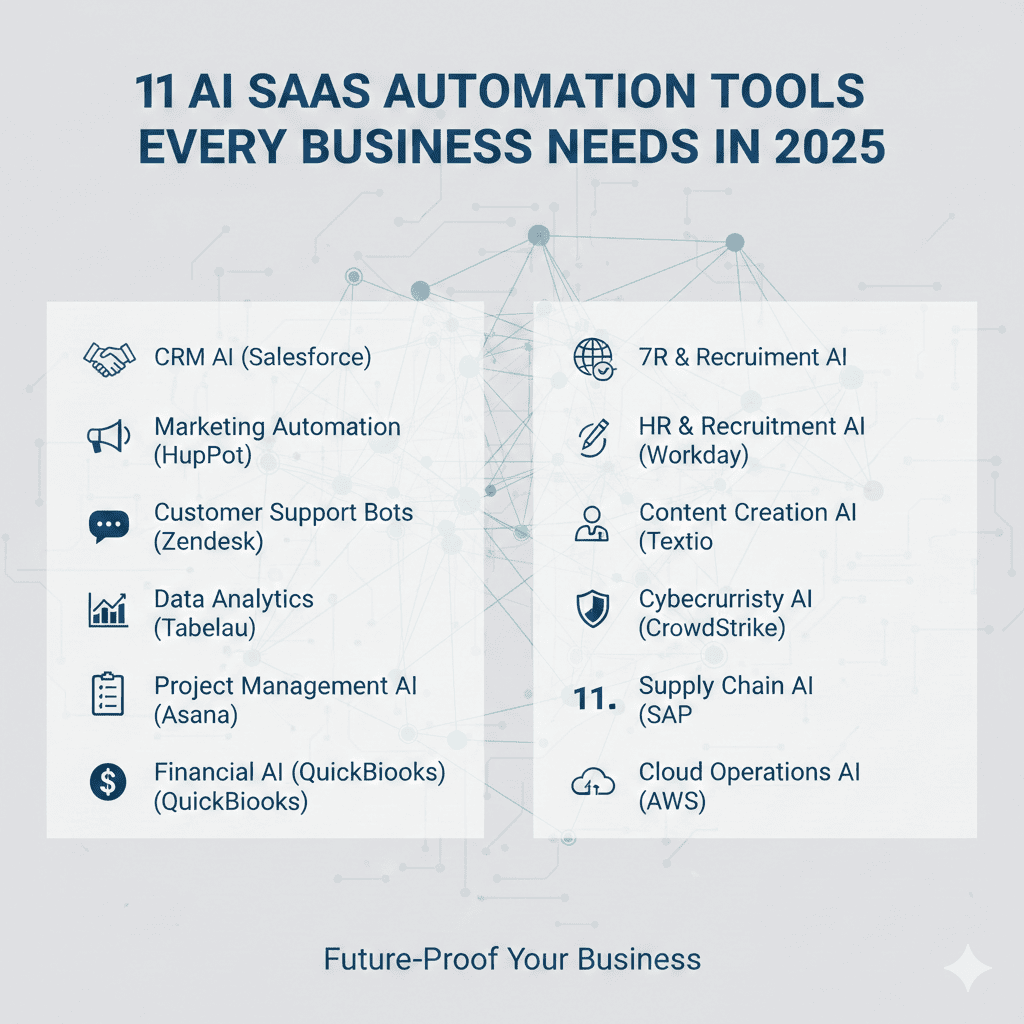
The business landscape has fundamentally shifted. Companies that once relied on manual processes and traditional software solutions are now being outpaced by competitors leveraging intelligent automation. AI SaaS Automation Tools have evolved from experimental technologies to mission-critical systems that determine whether businesses thrive or merely survive in today’s hyper-competitive environment.
The statistics are compelling. Organizations implementing AI-powered automation are seeing productivity gains of up to forty percent, cost reductions averaging thirty percent, and customer satisfaction improvements exceeding twenty-five percent. These aren’t marginal improvements; they represent transformational changes that directly impact bottom-line results and competitive positioning.
What makes AI SaaS Automation Tools particularly powerful is their accessibility. Unlike the complex, expensive enterprise systems of the past, modern cloud-based AI tools are available to businesses of all sizes with predictable subscription pricing and minimal implementation barriers. Small teams can now access capabilities that were previously exclusive to Fortune 500 companies with massive IT budgets.
This comprehensive guide examines eleven essential AI SaaS automation tools that every forward-thinking business should implement in 2025. These solutions span critical business functions from customer communication and content creation to data analysis and workflow automation. Each tool has been selected based on proven impact, ease of implementation, and ability to deliver measurable ROI quickly.
1. Conversational AI Platforms for Customer Engagement
The first impression your business makes increasingly happens through automated conversations. Modern conversational AI has transcended simple chatbots to become sophisticated engagement platforms that handle complex customer interactions with remarkable naturalness and effectiveness.
Why Conversational AI Matters Now
Customer expectations have fundamentally changed. People expect immediate responses regardless of time zones or business hours. They want their questions answered instantly without waiting in phone queues or email response cycles. Traditional customer service models simply cannot scale to meet these expectations without prohibitive costs.
Conversational AI platforms solve this challenge by providing intelligent, context-aware interactions that feel natural while handling unlimited concurrent conversations. These systems learn from every interaction, continuously improving their ability to understand intent, provide accurate information, and route complex issues appropriately.
Core Capabilities to Expect
Modern conversational AI platforms offer multi-channel support, engaging customers consistently across website chat, social media messages, WhatsApp, SMS, and other channels. They understand natural language processing that interprets customer intent even when questions are phrased in varied or imperfect ways. Intent recognition allows the system to understand what customers actually need rather than just matching keywords.
These platforms integrate seamlessly with your existing systems, pulling information from CRM databases, knowledge bases, order management systems, and other sources to provide informed, accurate responses. They also feature intelligent escalation that recognizes when conversations require human intervention and routes them to appropriate team members with full context.
Business Impact and ROI
Companies implementing conversational AI typically see response times drop from hours to seconds, customer satisfaction scores increase by fifteen to thirty percent, and support costs decrease by twenty-five to forty percent as routine inquiries are handled automatically. Perhaps most importantly, human support agents are freed to focus on complex, high-value interactions where empathy and creative problem-solving create real competitive advantage.
The best AI SaaS Automation Tools in this category learn and improve over time. Each conversation trains the system to become more effective, creating compounding returns on your investment.
2. Intelligent Document Processing Solutions
Every business drowns in documents. Invoices, contracts, forms, receipts, applications, and countless other paper-based or PDF workflows consume enormous amounts of time and create opportunities for costly errors. Intelligent document processing transforms this pain point into a strategic advantage.
Beyond Simple OCR
Traditional optical character recognition can extract text from documents but lacks understanding of context, structure, or meaning. Intelligent document processing powered by AI goes dramatically further by understanding document types and structures, extracting specific data fields accurately regardless of format variations, validating information against business rules and external data sources, and routing documents through appropriate workflows based on content.
These systems handle structured documents like standard forms, semi-structured documents like invoices that follow general patterns but vary in specifics, and even unstructured documents like contracts or correspondence where relevant information might appear anywhere.
Practical Applications Across Departments
Accounts payable teams use these tools to automatically process incoming invoices, extracting vendor information, line items, amounts, and payment terms before routing for approval and payment. Human resources departments automate candidate screening by extracting information from resumes and applications, comparing qualifications against job requirements, and flagging top candidates for human review.
Legal departments process contracts by extracting key terms, dates, obligations, and risk factors while flagging unusual clauses for attorney review. Operations teams handle shipping documents, work orders, and compliance paperwork without manual data entry.
Measurable Efficiency Gains
Organizations implementing intelligent document processing typically reduce processing time by seventy to ninety percent, decrease error rates by over eighty percent, and redeploy staff from repetitive data entry to value-added activities. The technology pays for itself quickly, often within months, through direct cost savings and indirect benefits from faster processing and improved accuracy.
3. AI-Powered Content Generation and Optimization
Content remains king in digital business, but creating high-quality content at scale has always been expensive and time-consuming. AI-powered content tools are revolutionizing how businesses create, optimize, and personalize content across all channels.
Understanding Modern Content AI
Today’s AI SaaS Automation Tools for content go far beyond simple text generation. They understand brand voice and style guidelines, research topics by analyzing top-performing content, optimize for search engines while maintaining readability, and personalize content for different audiences and channels.
These platforms can generate blog posts, product descriptions, email campaigns, social media content, ad copy, and more while maintaining consistency with your brand identity. More importantly, they handle the research and optimization work that typically consumes hours of human time.
Strategic Content Workflows
The most effective implementations use AI for drafting and optimization while keeping humans in the loop for strategy and final review. You might use AI to generate initial drafts of product descriptions based on specifications, then have team members refine and approve them. Or create multiple versions of email campaigns optimized for different audience segments, with marketers selecting the best variations.
Content AI tools also excel at repurposing existing content. Transform a comprehensive blog post into social media snippets, email newsletter sections, and video scripts. Turn webinar transcripts into blog posts, infographics, and case studies. This multiplier effect dramatically increases the value extracted from every piece of original content.
SEO and Performance Optimization
Advanced content AI platforms analyze search trends and competitor content to identify opportunities. They suggest topics with high search volume and manageable competition, recommend keywords to target naturally throughout your content, and predict content performance based on factors like readability, structure, and semantic relevance.
Some platforms even test different headlines, introductions, and calls-to-action to determine which variations drive better engagement and conversions.
4. Predictive Analytics and Business Intelligence Platforms
Data has always been valuable, but most businesses struggle to extract actionable insights from the massive amounts of information they collect. Predictive analytics platforms powered by AI transform raw data into forward-looking intelligence that drives better decisions.
From Descriptive to Predictive
Traditional business intelligence tells you what happened in the past. AI-powered predictive analytics tells you what’s likely to happen next and why. These systems identify patterns invisible to human analysis, forecast future trends with quantifiable confidence levels, detect anomalies that signal opportunities or risks, and recommend specific actions based on predicted outcomes.
This shift from reactive reporting to proactive intelligence fundamentally changes how businesses operate. Instead of discovering problems after they occur, you can prevent them. Rather than missing opportunities, you can pursue them early when competitive advantage is greatest.
Practical Prediction Scenarios
Sales teams use predictive analytics to identify which leads are most likely to convert, which existing customers are at risk of churning, and which accounts have expansion potential. This allows them to prioritize efforts where they’ll generate the greatest return.
Marketing departments predict campaign performance before spending budget, identify customer segments most responsive to specific messages, and optimize channel mix based on predicted ROI. Operations teams forecast demand to optimize inventory levels, predict equipment failures before they cause downtime, and identify process bottlenecks before they impact delivery.
Implementation Without Data Science Teams
Modern AI SaaS Automation Tools for predictive analytics are designed for business users rather than data scientists. They feature intuitive interfaces with natural language queries, automated model building that selects appropriate algorithms, and clear explanations of predictions and contributing factors.
You don’t need a PhD in statistics to implement these tools effectively. The AI handles the complex mathematics while presenting insights in business-friendly formats that drive immediate action.
5. Workflow Automation and Integration Platforms
Most businesses run on dozens of disconnected software tools. Data lives in silos, processes require manual handoffs between systems, and employees waste hours on repetitive tasks that could be automated. Workflow automation platforms solve these friction points by connecting your technology stack into cohesive, intelligent workflows.
The Power of Connected Systems
Modern integration and automation platforms allow you to create sophisticated workflows without coding. When a new lead fills out a form, the system automatically creates a CRM record, sends a welcome email, notifies the sales team, schedules a follow-up task, and updates your analytics dashboard. When a customer makes a purchase, the workflow triggers order fulfillment, sends confirmation, updates inventory, logs the transaction in your accounting system, and adds the customer to appropriate marketing segments.
These platforms support thousands of pre-built integrations with popular business tools while also offering custom connections through APIs and webhooks. The AI components learn from your workflows, suggesting optimizations and identifying bottlenecks.
Beyond Simple If-Then Logic
Advanced automation platforms incorporate AI decision-making that goes beyond simple conditional logic. They can route tasks to appropriate team members based on workload, skills, and availability; prioritize work items based on predicted business impact; detect patterns that indicate process improvements; and adapt workflows based on outcomes and feedback.
This intelligence transforms automation from rigid, brittle processes into flexible, learning systems that improve over time.
Cross-Functional Impact
Every department benefits from workflow automation. Marketing teams nurture leads through personalized journeys without manual intervention. Sales teams maintain consistent follow-up without remembering every task. Customer service teams route inquiries to specialists based on complexity and topic. Finance teams process approvals and payments on schedule without chasing stakeholders.
The cumulative impact of eliminating hundreds of manual tasks and handoffs is substantial. Organizations typically recover fifteen to twenty-five hours per employee per month after implementing comprehensive workflow automation.
6. AI-Enhanced Customer Data Platforms
Understanding your customers has never been more critical or more challenging. Customer interactions span multiple touchpoints, devices, and channels, creating fragmented data that’s difficult to unify and analyze. AI-enhanced customer data platforms solve this challenge by creating comprehensive, actionable customer profiles.
Unified Customer Views
These platforms aggregate data from every customer touchpoint including website behavior, email engagement, purchase history, support interactions, social media activity, and offline interactions. AI algorithms identify and merge duplicate records, resolve identity across devices and channels, and fill gaps in customer profiles through predictive modeling.
The result is a single, comprehensive view of each customer that updates in real-time as new interactions occur. This unified profile becomes the foundation for personalized experiences, targeted marketing, and informed business decisions.
Predictive Customer Intelligence
Beyond organizing existing data, AI-enhanced CDPs generate predictive insights about each customer. They calculate propensity scores indicating likelihood to purchase, churn, or engage with specific offerings. They identify next-best actions that maximize customer lifetime value. They segment customers not just by demographics or past behavior but by predicted future value and needs.
This forward-looking intelligence allows you to invest resources where they’ll generate the greatest return and personalize experiences based on what customers need next, not just what they’ve done before.
Privacy-First Approach
The best AI SaaS Automation Tools in this category prioritize data privacy and compliance. They feature built-in consent management, support data subject access and deletion requests, maintain detailed audit trails, and enable fine-grained permission controls. This ensures you can leverage customer data effectively while respecting privacy and maintaining regulatory compliance.
7. Intelligent Email Marketing and Automation Platforms
Email remains one of the highest-ROI marketing channels, but creating effective email campaigns traditionally requires significant time and expertise. AI-powered email platforms automate and optimize every aspect of email marketing while dramatically improving results.
Beyond Batch-and-Blast
Modern email AI goes far beyond scheduling messages to large lists. These platforms personalize subject lines, content, images, and calls-to-action for each recipient based on their behavior, preferences, and predicted interests. They determine optimal send times for each individual rather than one-size-fits-all scheduling. They predict which recipients are most likely to engage and adjust targeting accordingly.
The system tests variations automatically, learning which messages perform best for different segments and continuously improving campaign effectiveness without manual A/B testing.
Behavioral Trigger Automation
AI email platforms monitor customer behavior across channels and trigger relevant messages at the right moments. When someone browses specific products but doesn’t purchase, they receive personalized recommendations. When engagement drops, re-engagement campaigns activate automatically. When someone reaches a milestone or anniversary, celebratory messages arrive on time.
These behavioral workflows run continuously, nurturing relationships without constant manual intervention. The AI learns which sequences drive the best outcomes and adjusts timing, content, and calls-to-action accordingly.
Deliverability Optimization
Getting messages into inboxes is increasingly challenging as spam filters become more sophisticated. AI email platforms optimize deliverability by monitoring sender reputation, adjusting sending patterns to maintain positive relationships with email providers, cleaning lists by identifying and removing problematic addresses, and analyzing content for spam triggers before sending.
This automated deliverability management ensures your messages reach intended recipients rather than spam folders.
8. AI-Powered Project Management and Resource Allocation
Traditional project management relies heavily on human judgment to estimate timelines, allocate resources, and identify risks. AI-enhanced project management tools augment human expertise with data-driven insights that improve planning accuracy and execution effectiveness.
Intelligent Planning and Forecasting
These platforms analyze historical project data to generate realistic timelines and resource requirements. They identify dependencies and potential bottlenecks, predict which tasks are most likely to encounter delays, and recommend optimal resource allocation across multiple concurrent projects.
When projects deviate from plan, AI systems flag issues early and suggest corrective actions before small problems become major crises. This proactive approach to project management reduces failed projects and budget overruns significantly.
Resource Optimization Across Projects
One of the most challenging aspects of project management is balancing resources across multiple initiatives. AI platforms optimize this balance by tracking resource availability, skills, and workload in real-time, matching project needs with resource capabilities, predicting capacity constraints before they impact deadlines, and recommending resource reallocation when priorities shift.
This optimization ensures teams are neither overloaded nor underutilized while maximizing the likelihood of on-time, on-budget project completion.
Collaboration Enhancement
Modern AI SaaS Automation Tools for project management also facilitate team collaboration through intelligent features like automatically summarizing discussions and decisions, suggesting relevant documentation and past decisions, identifying subject matter experts for specific questions, and routing approvals to appropriate stakeholders.
These collaboration features reduce the overhead of project coordination while improving information sharing and decision quality.
9. Automated Financial Management and Accounting Systems
Financial operations involve numerous repetitive, rules-based tasks that are perfect candidates for AI automation. Automated accounting platforms handle routine financial processes while providing real-time visibility and intelligent insights that improve financial decision-making.
Core Accounting Automation
These systems automatically categorize transactions based on learned patterns, reconcile accounts by matching transactions across systems, generate invoices and follow up on payments, process expense reports and flag policy violations, and prepare financial statements and reports on schedule.
By automating these routine tasks, finance teams can focus on analysis, planning, and strategic initiatives rather than data entry and reconciliation.
Cash Flow Prediction and Management
AI-powered financial platforms forecast cash flow with impressive accuracy by analyzing historical patterns, outstanding receivables, upcoming payables, and business trends. They alert you to potential shortfalls before they occur and suggest specific actions to improve cash position.
This predictive capability is especially valuable for growing businesses where cash flow management can determine success or failure.
Fraud Detection and Compliance
AI excels at identifying anomalies that might indicate fraud or compliance issues. Automated financial systems continuously monitor transactions for unusual patterns, flag suspicious activities for review, ensure compliance with accounting standards, and maintain audit trails automatically.
This protective layer reduces financial risk while demonstrating strong controls to auditors, investors, and regulators.
10. AI-Driven Recruitment and HR Automation
Finding, evaluating, and onboarding talent consumes enormous resources while directly impacting organizational success. AI-powered HR platforms automate time-consuming recruitment tasks while improving hiring quality and employee experience.
Intelligent Candidate Sourcing and Screening
Modern recruitment AI automatically sources candidates from multiple channels including job boards, social media, professional networks, and internal referrals. The system screens applications against job requirements using natural language processing to understand skills and experience, ranks candidates based on predicted fit and success probability, and schedules interviews automatically.
This automation dramatically reduces time-to-hire while ensuring qualified candidates aren’t overlooked due to resume formatting or keyword matching quirks.
Bias Reduction and Diversity Improvement
One of the most valuable benefits of AI recruitment tools is their potential to reduce unconscious bias. When properly configured, these systems evaluate candidates based on qualifications and predicted job performance rather than demographics or subjective factors. They can anonymize applications during initial screening and identify diverse candidate pools proactively.
This helps organizations build more diverse, equitable teams while maintaining high hiring standards.
Employee Onboarding and Engagement
Beyond recruitment, AI HR platforms automate onboarding workflows, personalize training paths based on role and background, monitor engagement through surveys and interaction patterns, and identify employees at risk of leaving before they resign.
This comprehensive approach to talent management improves retention while creating better employee experiences from day one.
11. Intelligent Customer Success and Retention Platforms
Acquiring customers is expensive. Retaining and expanding them is far more profitable. AI-powered customer success platforms help businesses maximize customer lifetime value by identifying risks and opportunities proactively.
Proactive Churn Prevention
These AI SaaS Automation Tools analyze customer behavior patterns to identify churn signals before customers cancel. They track product usage, engagement trends, support interaction sentiment, and payment patterns to calculate churn risk scores for each account.
When risk increases, the platform triggers appropriate interventions such as personalized outreach from customer success teams, targeted retention offers, or additional training and support. This proactive approach reduces churn by fifteen to thirty percent compared to reactive retention efforts.
Expansion and Upsell Identification
The same behavioral analysis that predicts churn also identifies expansion opportunities. AI platforms recognize customers who are getting maximum value from current solutions and are ready for additional products or upgraded plans. They identify usage patterns that indicate unmet needs your other offerings could address.
Customer success teams receive prioritized lists of expansion-ready accounts along with specific recommendations for what to propose and when. This intelligence-driven approach to account growth consistently outperforms intuition-based strategies.
Automated Health Scoring and Reporting
Customer success platforms automatically calculate health scores for every account based on multiple factors including product adoption, engagement frequency, support ticket patterns, and business outcome achievement. These scores update continuously, providing real-time visibility into portfolio health.
Automated reporting keeps stakeholders informed about customer base health, at-risk revenue, expansion pipeline, and team performance without manual report creation.
Maximizing Your Investment in AI SaaS Automation Tools
Implementing AI SaaS Automation Tools isn’t just about selecting products and signing up for subscriptions. Success requires strategic planning, thoughtful implementation, and ongoing optimization.
Start with Clear Objectives
Before evaluating any tools, identify specific business challenges you’re trying to solve and outcomes you want to achieve. Are you trying to reduce customer service costs? Improve lead conversion rates? Accelerate time-to-market for new products? Clear objectives guide tool selection and provide benchmarks for measuring success.
Prioritize use cases based on potential impact and implementation complexity. Quick wins build momentum and justify investment in more ambitious automation initiatives.
Focus on Integration and Data Quality
The most powerful AI SaaS Automation Tools derive their intelligence from quality data. Before implementing AI solutions, audit your data quality and address obvious issues. Ensure systems can integrate properly so AI platforms have access to the information they need.
Plan your automation architecture to avoid creating new data silos. Look for platforms with strong integration capabilities and consider workflow automation tools as the connective tissue between specialized AI applications.
Invest in Change Management
Technology implementation fails more often due to people issues than technical problems. Invest in change management by communicating clearly about why automation is being implemented and how it benefits employees, providing comprehensive training that goes beyond basic feature tutorials, celebrating early wins to build enthusiasm, and gathering feedback to address concerns and improve implementation.
Remember that AI augments human capabilities rather than replacing people. Frame automation as a tool that eliminates tedious work so employees can focus on more engaging, valuable activities.
Monitor, Measure, and Optimize
AI systems improve over time, but only if you monitor performance and optimize actively. Establish clear metrics for each automated process, review performance regularly, provide feedback to train AI models, and expand automation gradually as confidence builds.
The businesses that derive the most value from AI SaaS Automation Tools treat implementation as an ongoing journey rather than a one-time project.
Conclusion: The Imperative of AI Automation in 2025
The question is no longer whether to implement AI SaaS Automation Tools, but how quickly you can do so effectively. Businesses that embrace intelligent automation are realizing substantial competitive advantages in efficiency, customer experience, and decision quality. Those that delay are falling further behind with each passing month.
The eleven categories of AI automation tools covered in this guide address the most critical business functions across operations, customer engagement, marketing, sales, finance, and human resources. Each category offers proven solutions that deliver measurable ROI quickly while building foundations for long-term competitive advantage.
The accessibility of modern AI SaaS solutions means that businesses of all sizes can implement these capabilities. You don’t need massive budgets or specialized data science teams. The tools are designed for business users with intuitive interfaces and pre-built AI models that work effectively out of the box.
Start by selecting one or two high-impact areas where automation can deliver immediate value. Implement those solutions thoroughly, learn from the experience, and expand systematically to additional use cases. This measured approach builds expertise and confidence while delivering continuous improvement.
The businesses that will thrive in 2025 and beyond are those that view AI automation not as a technological novelty but as a fundamental business capability as essential as accounting systems or customer databases. The tools are here, proven, and accessible. The only question remaining is how quickly you’ll implement them to transform your business operations and competitive position.
Also read this:
AI CRM Consulting for Beginners: Step-by-Step Guide to Attract High-Ticket Clients
Top AI CRM Tools for Lead Generation & Sales Automation in 2025