
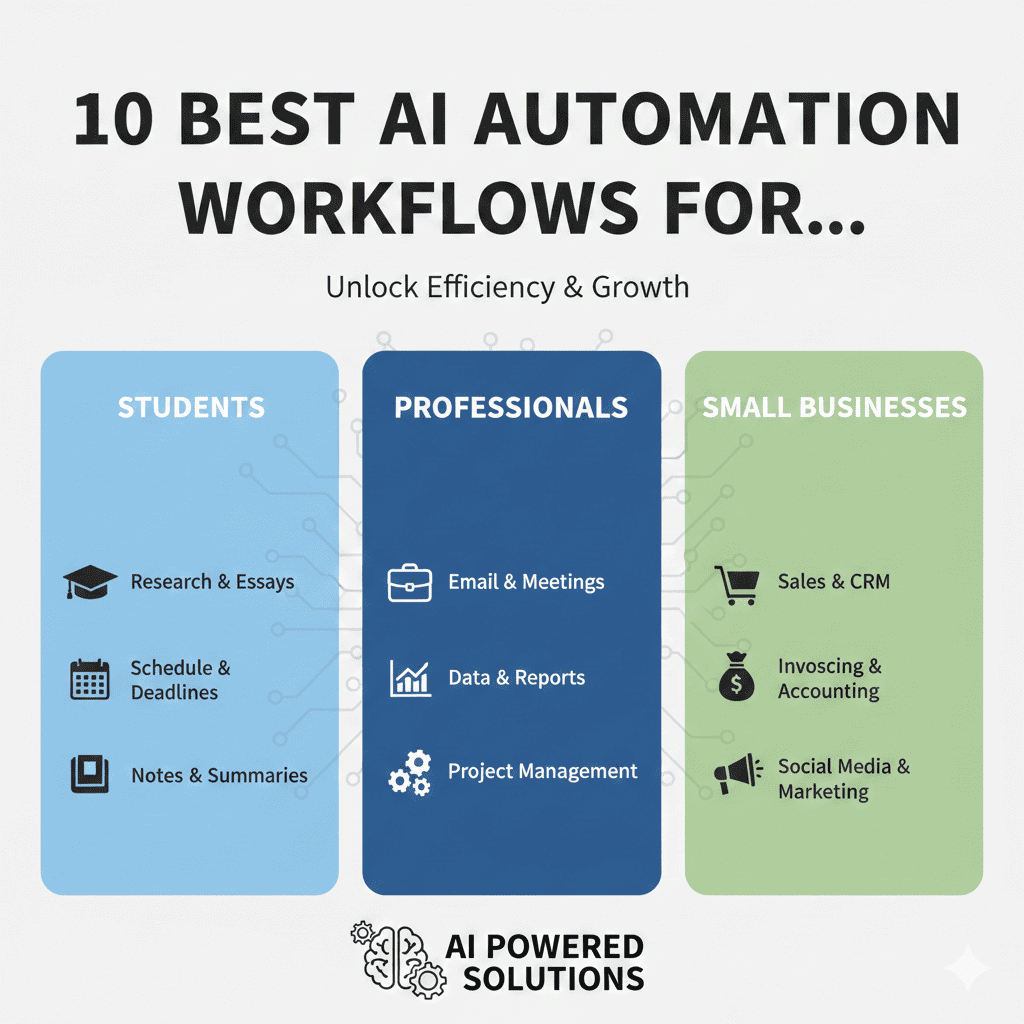
The digital revolution has transformed how we work, study, and manage businesses. At the heart of this transformation lies AI automation workflows—intelligent systems that handle repetitive tasks, streamline processes, and free up valuable time for strategic thinking and creativity. Whether you’re a student juggling multiple assignments, a professional managing complex projects, or a small business owner wearing countless hats, implementing the right AI automation workflows can dramatically boost your productivity and efficiency.
This comprehensive guide explores ten powerful AI automation workflows that can revolutionize your daily operations, reduce manual workload, and help you focus on what truly matters. From content creation to customer service, these automation strategies leverage artificial intelligence to deliver results that were once impossible without significant human intervention.
1. Intelligent Email Management and Response System
Email remains one of the most time-consuming aspects of modern work life. An intelligent email management workflow powered by AI can transform how you handle your inbox, saving hours each week while maintaining professional communication standards.
How This AI Automation Workflow Functions:
The system uses natural language processing to categorize incoming emails based on priority, sender importance, and content urgency. AI algorithms can automatically draft responses to common queries, schedule emails for optimal send times, and flag messages requiring immediate attention. Integration with calendar systems allows automatic meeting scheduling based on email requests, while smart filters ensure important messages never get lost in the clutter.
Implementation Strategy:
Connect your email platform with AI-powered tools that offer smart categorization features. Set up rules for automatic responses to frequently asked questions, create templates for common scenarios, and configure priority scoring based on your specific needs. The system learns from your behavior patterns, continuously improving its accuracy in identifying what matters most to you.
Benefits for Different Users:
Students can automatically organize emails from professors, group project members, and administrative offices while setting up auto-responses for common inquiries. Professionals benefit from automated follow-up reminders and intelligent meeting scheduling that eliminates the back-and-forth of finding suitable times. Small businesses can handle customer inquiries more efficiently, ensuring no potential lead goes unanswered while maintaining personalized communication.
Time Savings Potential:
Most users report saving between 5-10 hours weekly once this AI automation workflow is properly configured and trained to their communication patterns.
2. Content Creation and Optimization Pipeline
Creating high-quality content consistently is challenging for anyone, regardless of their role. An AI-driven content creation workflow streamlines everything from ideation to final publication, maintaining quality while dramatically reducing production time.
Workflow Components:
This comprehensive system begins with AI-powered topic research and trend analysis, identifying relevant subjects based on your audience interests and search patterns. The workflow then moves to outline generation, where AI suggests structure and key points based on top-performing content in your niche. Content drafting leverages language models to produce initial versions, followed by AI-assisted editing for grammar, readability, and SEO optimization.
Customization Options:
Configure the workflow to match your brand voice by training it on existing content samples. Set parameters for tone, complexity level, and target audience specifications. Integrate plagiarism detection and fact-checking tools to ensure originality and accuracy. Connect with publishing platforms for seamless content distribution across multiple channels.
Application Across Disciplines:
Students can generate research paper outlines, create study guides, and develop presentation content more efficiently. Professionals use this workflow for report writing, proposal development, and internal communication materials. Small businesses leverage it for blog posts, social media content, email newsletters, and marketing collateral that drives engagement and conversions.
Quality Considerations:
While AI generates the foundation, human oversight remains crucial for maintaining authenticity and ensuring content aligns with strategic objectives. The workflow should enhance human creativity, not replace it entirely.
3. Smart Document Processing and Data Extraction
Organizations and individuals handle massive volumes of documents daily. An AI automation workflow for document processing eliminates manual data entry, extracts key information automatically, and organizes everything systematically.
Technical Capabilities:
Optical character recognition combined with natural language understanding allows the system to read various document formats—PDFs, scanned images, handwritten notes, and digital files. AI identifies and extracts specific data points such as names, dates, amounts, addresses, and custom fields relevant to your needs. The extracted information populates databases, spreadsheets, or other systems automatically, with validation checks ensuring accuracy.
Workflow Integration:
Connect the system with your existing document management platforms, cloud storage solutions, and business applications. Set up automated routing where processed documents move to appropriate folders or trigger specific actions based on their content. Configure notification systems to alert relevant team members when certain document types arrive or when extracted data meets specific criteria.
Practical Applications:
Students can digitize and organize research materials, automatically extracting citations and key quotes for reference. Professionals streamline invoice processing, contract management, and report analysis without manual data entry. Small businesses automate receipt tracking, customer onboarding documentation, and compliance record-keeping, reducing administrative burden significantly.
Accuracy and Reliability:
Modern AI document processing achieves accuracy rates exceeding 95% for structured documents and 85-90% for complex or handwritten materials, with continuous improvement through machine learning.
4. Automated Social Media Management System
Maintaining consistent social media presence across multiple platforms demands significant time and creative energy. This AI automation workflow handles scheduling, content adaptation, engagement monitoring, and performance analysis comprehensively.
System Architecture:
The workflow begins with content creation or curation, where AI suggests posts based on trending topics, audience interests, and your content calendar. Automated scheduling ensures optimal posting times for each platform based on when your audience is most active. The system adapts content format and length to match platform-specific requirements—what works on LinkedIn differs from Instagram or Twitter specifications.
Engagement Automation:
AI monitors comments, messages, and mentions across all platforms, categorizing them by sentiment and urgency. Automated responses handle simple inquiries while flagging complex issues for human attention. The system identifies engagement opportunities such as relevant conversations where your input adds value, helping you build authentic connections efficiently.
Analytics and Optimization:
Comprehensive performance tracking measures engagement rates, reach, conversions, and other key metrics. AI analyzes patterns to identify what content resonates best with your audience, suggesting improvements for future posts. A/B testing capabilities allow systematic refinement of messaging, visuals, and posting strategies.
User-Specific Benefits:
Students building personal brands can maintain consistent presence without sacrificing study time. Professionals establish thought leadership through regular, high-quality sharing without constant platform monitoring. Small businesses reach broader audiences, nurture customer relationships, and drive traffic to their offerings while focusing on core business operations.
5. Intelligent Customer Support and Chatbot System
Providing excellent customer support while managing costs presents ongoing challenges. An AI-powered customer support workflow delivers instant assistance, resolves common issues automatically, and ensures complex queries reach the right human experts efficiently.
Core Functionality:
Advanced chatbots powered by conversational AI understand customer questions in natural language, providing accurate responses based on your knowledge base, product information, and historical interactions. The system handles multiple conversations simultaneously across various channels—website chat, messaging apps, social media, and email. When issues exceed the chatbot’s capabilities, intelligent routing connects customers with appropriate human agents along with full conversation context.
Knowledge Management:
The system continuously learns from interactions, expanding its ability to handle diverse queries. Regular analysis identifies knowledge gaps, suggesting new content for your support documentation. Integration with your product or service database ensures customers receive current, accurate information about availability, pricing, features, and specifications.
Multilingual Capabilities:
Modern AI support systems communicate effectively in multiple languages, automatically detecting customer language preferences and responding appropriately. This expands your reach without requiring multilingual support staff.
Implementation Benefits:
Students developing online projects or small ventures can provide professional-level support without dedicated staff. Professionals in service industries automate appointment scheduling, inquiry handling, and basic troubleshooting. Small businesses dramatically reduce support costs while improving response times and customer satisfaction, with 24/7 availability that manual support teams cannot match economically.
Performance Metrics:
Well-implemented systems resolve 60-80% of customer inquiries without human intervention, reducing support costs while maintaining or improving satisfaction scores.
6. Automated Research and Information Synthesis
Research consumes enormous time whether you’re writing academic papers, preparing business presentations, or making informed decisions. This AI automation workflow gathers information from multiple sources, synthesizes key insights, and presents findings in digestible formats.
Research Process Automation:
The workflow starts with query formulation, where AI helps refine research questions for optimal results. Automated web scraping and database searches gather information from academic journals, news sources, industry reports, and other credible repositories. Natural language processing analyzes collected materials, identifying relevant passages, extracting key statistics, and noting important findings.
Synthesis and Organization:
AI categorizes information by theme, creates summaries of lengthy documents, and identifies connections between different sources. The system generates annotated bibliographies with proper citations, fact-checks claims against multiple sources, and highlights contradictions or controversies in the literature. Visual representations like mind maps or concept diagrams help you understand complex relationships between ideas.
Collaborative Features:
Shared research workflows allow teams to contribute findings, with AI preventing duplication and highlighting complementary information. Version control tracks how research evolves over time, making it easy to revisit earlier findings or understand how conclusions developed.
Domain-Specific Applications:
Students conducting literature reviews can process hundreds of papers efficiently, identifying research gaps and building comprehensive understanding of their topics. Professionals making strategic decisions access synthesized market research, competitive intelligence, and industry trend analysis. Small businesses monitor customer feedback, competitor activities, and market conditions without dedicated research staff.
Quality Assurance:
The system includes credibility scoring for sources, helping you prioritize information from authoritative references while flagging potentially unreliable content.
7. Financial Management and Expense Tracking Automation
Financial oversight requires attention to detail and consistency. An automated financial management workflow captures expenses, categorizes transactions, generates reports, and provides insights that improve financial decision-making.
Transaction Processing:
The system connects with bank accounts, credit cards, and payment platforms, automatically importing transaction data. AI categorizes expenses based on merchant information, transaction descriptions, and learned patterns from your historical categorization. Receipt scanning via mobile apps captures details from paper receipts, matching them with digital transactions for complete record-keeping.
Budgeting and Forecasting:
Automated budget tracking compares actual spending against planned allocations, sending alerts when categories approach or exceed limits. Predictive analytics forecast future expenses based on historical patterns, seasonal variations, and upcoming commitments. Cash flow projections help businesses anticipate tight periods and plan accordingly.
Reporting and Compliance:
The workflow generates financial reports on demand or scheduled intervals, presenting data through customizable dashboards with visual analytics. Tax preparation becomes simpler with organized, categorized transactions and automatic identification of deductible expenses. Integration with accounting software ensures seamless data transfer for professional financial management.
User Applications:
Students track spending against budgets, identify savings opportunities, and build healthy financial habits through automated insights. Professionals manage business expenses, streamline reimbursement processes, and maintain accurate records for tax purposes. Small businesses achieve professional-grade financial management without full-time accounting staff, with real-time visibility into financial health.
Compliance and Security:
Bank-level encryption protects sensitive financial data while automated backup ensures information remains secure and accessible.
8. Project Management and Task Automation System
Managing projects involves coordinating multiple tasks, team members, deadlines, and resources. This comprehensive AI automation workflow streamlines project execution from initiation through completion, ensuring nothing falls through the cracks.
Planning and Scheduling:
AI assists in project planning by suggesting task breakdowns based on project type and historical data. Intelligent scheduling considers dependencies, resource availability, and team member workloads, creating realistic timelines automatically. The system identifies potential bottlenecks before they impact deadlines, recommending adjustments to keep projects on track.
Task Assignment and Tracking:
Automated task distribution assigns work based on team member skills, current workload, and availability. Progress tracking monitors completion rates, automatically updating project status and alerting stakeholders to delays or risks. Recurring tasks receive automatic generation and assignment, eliminating manual setup for routine activities.
Collaboration Enhancement:
Integrated communication tools ensure team members stay informed about relevant updates without notification overload. The system automatically documents decisions, maintains meeting notes, and tracks action items with assigned owners and deadlines. File version control prevents confusion about which document version is current.
Adaptive Management:
AI learns from project outcomes, improving estimates and recommendations over time. When projects deviate from plans, the system suggests corrective actions based on successful strategies from similar past situations.
Practical Implementations:
Students managing group projects benefit from clear task division, deadline tracking, and equitable workload distribution. Professionals juggling multiple initiatives maintain visibility across all projects, preventing important tasks from being overlooked. Small businesses execute marketing campaigns, product launches, and operational improvements with coordination efficiency typically found only in larger organizations.
9. Personal Learning and Skill Development Automation
Continuous learning is essential for career advancement and personal growth. An AI-driven learning workflow creates personalized education paths, delivers content at optimal times, tracks progress, and adapts to your evolving needs and learning style.
Personalized Curriculum Design:
The system assesses your current knowledge level, identifies skill gaps relevant to your goals, and creates customized learning paths. AI curates content from various sources—online courses, articles, videos, podcasts, and interactive exercises—selecting materials matched to your learning preferences and comprehension level. Progressive difficulty adjustment ensures you’re consistently challenged without becoming overwhelmed.
Spaced Repetition and Retention:
Automated review scheduling presents information at scientifically optimized intervals for long-term retention. The system identifies concepts you struggle with, providing additional practice and alternative explanations. Quizzes and assessments gauge understanding, adjusting future content based on demonstrated mastery.
Learning Analytics:
Comprehensive tracking shows time invested, topics covered, assessments completed, and skills acquired. Progress visualization keeps you motivated by illustrating improvement over time. Predictive analytics estimate when you’ll achieve specific learning goals based on current pace and consistency.
Integration with Professional Development:
The workflow aligns learning activities with career objectives, recommending skills that increase employability or advancement opportunities in your field. Certificate tracking organizes credentials earned through various platforms, creating a comprehensive portfolio of professional development achievements.
Accessibility Across User Types:
Students supplement formal education with targeted skill development, preparing for careers while managing academic workloads. Professionals stay current with industry developments through efficient, focused learning without extended time away from work responsibilities. Small business owners develop entrepreneurial skills in marketing, finance, operations, and leadership through structured, self-paced learning.
10. Comprehensive Meeting Management and Documentation
Meetings consume significant work time, yet important insights and decisions often get lost without proper documentation. This AI automation workflow handles scheduling, agenda preparation, note-taking, action item tracking, and follow-up, maximizing meeting productivity.
Scheduling Intelligence:
The system analyzes participant calendars, identifies optimal meeting times considering time zones and preferences, and sends invitations automatically. Recurring meetings receive intelligent scheduling that avoids conflicts while maintaining consistent timing. Pre-meeting preparation reminders ensure participants arrive ready to contribute effectively.
Agenda and Material Distribution:
AI generates agenda templates based on meeting type, suggests discussion topics based on ongoing projects and outstanding issues, and automatically distributes relevant documents to participants. Previous meeting notes and action item status appear in agendas, providing continuity across sessions.
Real-Time Documentation:
Automated transcription captures meeting discussions accurately, with speaker identification distinguishing who said what. AI summarizes key points, extracts decisions made, identifies action items with assigned owners and deadlines, and flags questions requiring follow-up. The system distinguishes between casual conversation and important content, focusing documentation on substantive matters.
Post-Meeting Workflows:
Automated distribution sends meeting notes to participants immediately after conclusion. Action items flow into project management systems with appropriate assignments and due dates. Calendar integration schedules follow-up meetings when needed. Progress tracking monitors action item completion, sending reminders as deadlines approach.
Efficiency Gains:
Students collaborating on group projects maintain clear records of responsibilities, decisions, and progress. Professionals reduce meeting time through focused agendas and clear documentation that prevents redundant discussions. Small businesses ensure accountability, track strategic initiatives, and maintain institutional knowledge even as team members change.
Cultural Impact:
Organizations implementing comprehensive meeting automation often discover they need fewer meetings overall, as documentation and asynchronous communication handle many items previously requiring synchronous discussion.
Implementing AI Automation Workflows Successfully
While the benefits of AI automation workflows are substantial, successful implementation requires thoughtful planning and execution. Simply adopting technology without strategy often leads to disappointment and wasted resources.
Assessment and Prioritization:
Begin by analyzing your current workflows, identifying the most time-consuming, repetitive, or error-prone processes. Calculate the actual time spent on various activities to establish baseline metrics. Prioritize automation opportunities based on potential time savings, error reduction, and strategic importance. Start with one or two workflows rather than attempting comprehensive automation simultaneously.
Tool Selection Criteria:
Evaluate automation platforms based on ease of use, integration capabilities with existing systems, scalability as needs grow, security and privacy protections, and total cost of ownership including subscription fees and implementation time. Many powerful automation tools offer free tiers suitable for individual users and small teams, allowing exploration before financial commitment.
Change Management:
Successful automation requires adjusting established habits and workflows. Invest time in learning new systems thoroughly rather than superficial adoption. Document your automated workflows, creating references for troubleshooting and refinement. Build gradually, allowing time to adapt before adding complexity. Remain flexible, modifying automated workflows when they don’t serve intended purposes.
Monitoring and Optimization:
Regularly review automation performance against initial objectives. Track time savings, error rates, and satisfaction levels. Gather feedback from everyone affected by automation, addressing concerns and incorporating suggestions. Update workflows as your needs evolve and as automation technology improves.
Balancing Automation and Human Judgment:
Remember that AI automation workflows excel at handling routine, predictable tasks but lack human creativity, emotional intelligence, and contextual understanding. Maintain human oversight for strategic decisions, sensitive communications, and situations requiring empathy or nuanced judgment. The goal is augmenting human capabilities, not replacing human involvement entirely.
The Future of AI Automation
The AI automation workflows described here represent current capabilities, but the field evolves rapidly. Emerging developments promise even greater productivity enhancements across all user categories.
Advancing Capabilities:
Natural language interfaces make automation accessible without technical expertise, allowing anyone to create custom workflows through simple conversation. Improved contextual understanding enables AI to handle increasingly complex, nuanced tasks currently requiring human judgment. Enhanced learning algorithms mean automated systems adapt more quickly to individual preferences and changing circumstances.
Cross-Platform Integration:
Future automation will seamlessly connect disparate systems and applications, eliminating current integration challenges. Universal automation platforms will manage workflows spanning multiple tools and services, providing unified control and visibility.
Ethical Considerations:
As automation becomes more powerful, important questions emerge about data privacy, algorithmic bias, employment impacts, and appropriate human oversight. Responsible implementation considers these factors, ensuring technology serves human flourishing rather than creating new problems.
Accessibility and Democratization:
Declining costs and improving usability make sophisticated AI automation workflows accessible to individuals and small organizations previously unable to afford enterprise-level solutions. This democratization levels the playing field, allowing anyone to compete with larger, better-resourced entities.
Conclusion
The ten AI automation workflows explored in this guide represent transformative opportunities for students, professionals, and small businesses seeking to enhance productivity, reduce manual workload, and focus energy on high-value activities requiring human creativity and judgment.
From intelligent email management that tames overflowing inboxes to comprehensive meeting automation that ensures productive collaboration, these workflows address real challenges faced daily by people across different roles and industries. Content creation becomes less daunting, financial management more accurate, customer support more responsive, and project execution more reliable through thoughtful automation implementation.
Success with AI automation workflows doesn’t require technical expertise or significant financial investment. It requires willingness to examine current processes critically, openness to new approaches, and commitment to learning new tools and techniques. Start small, focusing on one workflow that addresses your most pressing pain point. Build gradually as you gain confidence and experience tangible benefits.
The future belongs to individuals and organizations that harness technology effectively while maintaining the human elements that drive innovation, build relationships, and create meaning. AI automation workflows provide the foundation for this balance, handling routine tasks efficiently while freeing human potential for the work that truly matters. Whether you’re studying for exams, managing professional responsibilities, or building a business, the right automation strategy can transform your productivity and effectiveness, creating time for what you value most.
Also read this:
How to Automate Your Entire Workday Using AI Tools (Beginner Guide, No Coding Needed)