
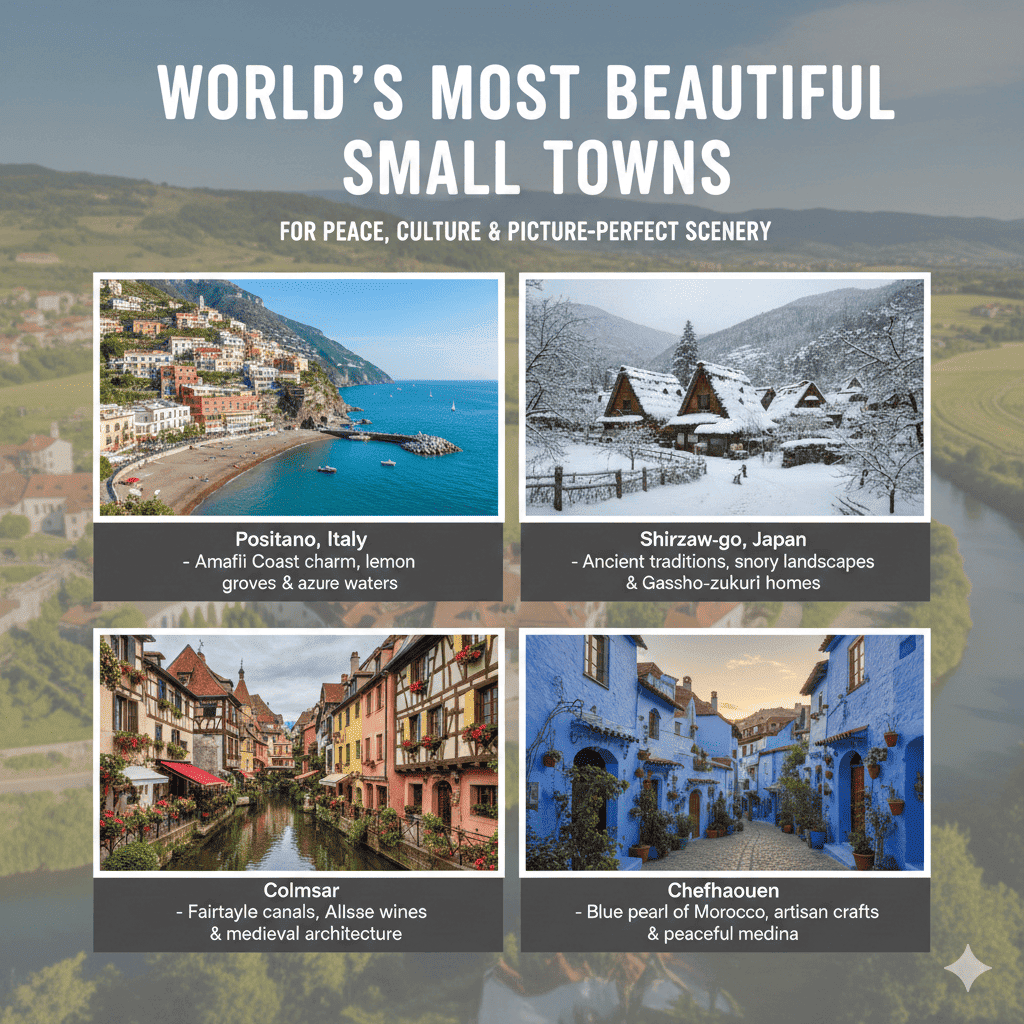
Beautiful Small Towns In an era dominated by bustling megacities and overcrowded tourist hotspots, a growing number of travelers seek refuge in the world’s most enchanting small towns where time moves slower, traditions remain vibrant, and natural beauty frames everyday life. These hidden gems and lesser-known destinations offer something increasingly rare in modern travel: authentic experiences unmarred by mass tourism, opportunities for genuine cultural immersion, and landscapes so stunning they seem painted rather than real. Whether nestled in dramatic mountain valleys, perched on coastal cliffs, or tucked away in countryside settings, the world’s beautiful small towns provide sanctuaries where peace, culture, and breathtaking scenery converge to create unforgettable experiences. This comprehensive guide explores exceptional small towns across continents, revealing destinations that reward travelers with tranquility, architectural charm, rich heritage, and photographic opportunities that capture the essence of timeless beauty.
1. European Alpine Villages: Mountain Magic and Timeless Traditions
The European Alps harbor some of the continent’s most picturesque settlements, where centuries-old traditions persist against backdrops of soaring peaks, pristine lakes, and meadows that burst with wildflowers each spring. These beautiful small towns embody the romantic ideal of mountain life.
Hallstatt, Austria
Hallstatt occupies a narrow strip of land between the Hallstätter See and the towering Dachstein mountains, creating one of Europe’s most photographed settings. This UNESCO World Heritage village features pastel-colored houses with flower-laden balconies climbing hillsides, narrow cobblestone streets winding past baroque architecture, and a church spire reflected perfectly in mirror-calm lake waters.
The town’s history spans over 7,000 years, with salt mining forming the foundation of its prosperity since prehistoric times. Visitors can tour the ancient salt mines carved deep into surrounding mountains, experiencing underground lakes and learning about mining techniques used for millennia. The Hallstatt Skywalk platform provides panoramic views across the entire Salzkammergut region, revealing why this landscape inspired countless artists and writers.
Despite its fame bringing significant tourist numbers, Hallstatt maintains authentic charm, particularly during early mornings or late afternoons when day-trippers depart. The market square, surrounded by traditional Alpine houses, hosts cafes where locals still gather, maintaining community rhythms unchanged by tourism. Winter transforms the village into a snow-dusted wonderland, with far fewer visitors experiencing the peaceful majesty of the season.
Grindelwald, Switzerland
Grindelwald sits in a glacier-carved valley beneath the iconic north face of the Eiger, surrounded by some of Switzerland’s most dramatic Alpine scenery. Traditional wooden chalets with carved details and geranium-filled window boxes line streets where the sound of cowbells echoes from nearby pastures during summer months.
The village serves as a gateway to the Jungfrau region’s hiking trails, cable cars, and mountain railways, yet maintains a peaceful atmosphere despite its accessibility. The First Cliff Walk suspension bridge and viewing platform provides heart-stopping perspectives over valleys thousands of feet below, while gentler trails wind through Alpine meadows offering close encounters with grazing cattle and mountain wildflowers.
Grindelwald’s combination of accessibility and authentic mountain culture makes it exceptional among Alpine destinations. The village hasn’t sacrificed character for tourism, with local families still operating farms, traditional restaurants serving regional specialties, and festivals celebrating centuries-old customs. The surrounding mountains provide endless photographic subjects, from dawn alpenglow painting peaks pink to evening light creating long shadows across valleys.
Zermatt, Switzerland
Zermatt’s car-free streets maintain an atmosphere of tranquility unusual for a renowned mountain resort. Electric taxis and horse-drawn carriages provide transportation through the village, where traditional Valais architecture mingles with modern Alpine design. The Matterhorn’s distinctive pyramid dominates every view, its reflection appearing in the Riffelsee lake during calm conditions, creating one of Switzerland’s most iconic images.
Beyond its famous peak, Zermatt offers remarkable cultural depth. The village church dating to 1913 features stunning stained glass, while the mountaineers’ cemetery honors those who died attempting surrounding peaks. The Alpine Museum documents climbing history and traditional Valais life, preserving stories of the communities that thrived in these mountains for centuries.
Summer transforms surrounding slopes into hiking paradises, with trails ranging from gentle valley walks to challenging high routes offering extraordinary mountain panoramas. Winter brings world-class skiing, though the village never feels overwhelmed, maintaining its essential character as a mountain community rather than merely a resort.
2. Mediterranean Coastal Gems: Where Sea Meets History
Mediterranean coastlines host numerous beautiful small towns where azure waters lap against ancient harbors, centuries-old architecture cascades down hillsides, and daily life follows rhythms established generations ago. These destinations combine natural beauty with deep cultural heritage.
Positano, Italy
Beautiful Small Towns Positano appears to tumble down steep cliffs toward the Tyrrhenian Sea, its pastel houses, domed churches, and cascading bougainvillea creating a vertical village of extraordinary beauty. Narrow staircases connect levels of the town, each turn revealing new perspectives across the coastline or down to the small beach where colorful fishing boats rest on pebbles.
The town’s layout means most exploring happens on foot, climbing and descending stairs that wind between houses, boutiques, and restaurants. This vertical geography preserves Positano’s intimate scale and prevents the kind of development that has altered many coastal destinations. The main beach, Spiaggia Grande, provides the town’s social center, where visitors relax at beach clubs or swim in clear waters while admiring the dramatic coastal setting.
Despite international fame, Positano maintains authentic character, with local families operating businesses passed through generations. Traditional ceramics featuring bright lemons and Mediterranean motifs fill shops, restaurants serve regional specialties like scialatielli ai frutti di mare, and evening passegiata sees locals promenading along the waterfront. The town’s beauty changes dramatically with light, from morning sun illuminating facades to golden hour casting warm glows across the entire scene.
Rovinj, Croatia
Rovinj’s old town occupies a peninsula jutting into the Adriatic, its tightly packed houses painted vibrant shades of yellow, orange, and red rising toward the hilltop church of St. Euphemia. Narrow cobblestone streets barely wide enough for two people wind through the historic center, opening occasionally to small squares where cafes spill onto ancient stones.
The town’s Venetian heritage appears in architectural details, dialect influences, and cultural traditions. The harbor, lined with fishing boats and backed by colorful facades reflected in calm waters, provides endless photographic opportunities. Artists have long been drawn to Rovinj, establishing studios and galleries throughout the old town, adding contemporary creativity to historical charm.
Beyond the postcard-perfect center, Rovinj offers natural beauty through the nearby Zlatni Rt forest park and the archipelago of small islands visible from the waterfront. The town maintains working fishing traditions, with markets selling fresh catches each morning. Evening brings locals and visitors to waterfront restaurants where seafood is prepared simply, allowing quality and freshness to shine through.
Oia, Santorini, Greece
Oia clings to volcanic cliffs on Santorini’s northern tip, its whitewashed buildings with blue-domed churches creating the iconic Greek island aesthetic. The town’s architecture evolved from necessity, with houses carved into volcanic rock providing natural insulation, their distinctive barrel-vaulted ceilings and minimal windows reflecting adaptation to the harsh island environment.
Sunset in Oia attracts crowds who gather along the castle ruins and clifftop pathways to watch the sun sink into the Aegean, casting golden light across white facades and blue domes. Despite this daily spectacle drawing significant visitors, Oia maintains quieter moments during mornings and afternoons when exploring narrow lanes reveals hidden corners, tiny churches, and viewpoints offering stunning caldera vistas without crowds.
The town’s artistic community contributes to its cultural richness, with galleries showcasing local artists inspired by the dramatic landscape and luminous Mediterranean light. Traditional cave houses have been transformed into boutique hotels, allowing visitors to experience the unique architecture while enjoying modern comfort. The combination of natural drama, architectural beauty, and cultural authenticity makes Oia enduringly captivating despite its fame.
3. Asian Mountain Retreats: Spirituality and Scenic Splendor
Asia’s mountainous regions harbor beautiful small towns where spiritual traditions, dramatic landscapes, and unique cultures create experiences markedly different from Western destinations. These locations offer profound peace alongside visual magnificence.
Luang Prabang, Laos
Luang Prabang sits at the confluence of the Mekong and Nam Khan rivers, surrounded by mountains draped in tropical vegetation. This UNESCO World Heritage town preserves traditional Lao architecture, Buddhist temples with gilded details and intricate carvings, and French colonial buildings reflecting its complex history. The town’s compact size allows exploration on foot or bicycle, with tree-lined streets connecting temples, markets, and riverfront areas.
Each morning, monks in saffron robes walk through streets collecting alms from residents and visitors in a centuries-old ritual that provides profound cultural insight. Over thirty Buddhist temples occupy the small town, each featuring unique architectural details and religious art. Wat Xieng Thong, the most famous temple, displays the classic Lao temple style with its sweeping multi-tiered roof nearly touching the ground.
Beyond spiritual sites, Luang Prabang offers natural beauty through nearby waterfalls, caves, and river landscapes. The night market transforms the main street into a showcase of local craftsmanship, with textiles, paintings, and handicrafts reflecting traditional skills. The town maintains a peaceful atmosphere despite tourist presence, with preservation efforts ensuring development respects historical character and cultural traditions.
Shirakawa-go, Japan
Shirakawa-go’s traditional gassho-zukuri farmhouses, with their distinctive steep thatched roofs designed to withstand heavy snowfall, create a landscape seemingly unchanged for centuries. This UNESCO World Heritage village occupies a mountain valley where rice paddies surround clustered farmhouses, and forested mountains rise on all sides. The architectural style, with its triangular roofs resembling hands in prayer, developed in isolation, creating structures unique to this region.
Visiting Shirakawa-go feels like stepping into historical Japan. Many farmhouses remain occupied by descendants of original families, while others have been converted to museums, restaurants, or guesthouses allowing overnight stays. The village illumination events during winter evenings, when snow blankets roofs and lights glow from windows, create magical scenes that attract photographers worldwide.
The surrounding mountains provide hiking trails through pristine forests to viewpoints overlooking the entire valley. The Ogimachi Castle Observatory offers the classic elevated perspective that appears in countless photographs, revealing the village’s layout and its harmonious relationship with the landscape. Visiting during different seasons provides completely different experiences, from spring’s cherry blossoms to autumn’s brilliant foliage.
Namche Bazaar, Nepal
Beautiful Small Towns Namche Bazaar, perched at 3,440 meters in the Himalayas, serves as the gateway to Everest region trekking while maintaining its character as a Sherpa cultural center. The town amphitheater-shaped settlement occupies a natural bowl surrounded by towering peaks, with traditional stone houses climbing terraced hillsides and prayer flags fluttering in thin mountain air.
Despite its remote location requiring several days of trekking to reach, Namche functions as a vibrant community with markets, monasteries, museums, and lodges operated by Sherpa families. The Saturday market attracts villagers from surrounding areas, trading goods and maintaining social connections as they have for generations. The town’s altitude and surrounding peaks create constantly changing light conditions that transform the landscape throughout the day.
The Sherpa culture, deeply influenced by Tibetan Buddhism, permeates daily life. Monasteries feature colorful prayer wheels, intricate murals, and statues of Buddhist deities. The Museum of Sherpa Culture documents traditional lifestyles, mountaineering history, and the region’s unique adaptation to extreme altitude living. Namche offers not just scenic beauty but immersion in a mountain culture that has thrived in one of Earth’s most challenging environments.
4. Colonial Heritage Towns: Architecture and Historical Charm
Former colonial settlements worldwide preserve architectural styles and cultural blends that create distinctive atmospheres. These beautiful small towns showcase how different cultures merged, creating unique heritage expressed through buildings, traditions, and daily life.
San Miguel de Allende, Mexico
San Miguel de Allende’s colonial architecture, dominated by the neo-Gothic pink limestone Parroquia de San Miguel Arcángel, creates a skyline of unusual beauty. Cobblestone streets wind past 18th-century mansions painted vibrant colors, their thick walls hiding interior courtyards filled with fountains and gardens. The town’s designation as a UNESCO World Heritage site recognizes both its architectural preservation and its role in Mexican independence history.
The artistic community has flourished here since the mid-20th century, attracting painters, writers, sculptors, and crafts people who contribute to vibrant cultural scenes. Galleries occupy colonial buildings, public art appears throughout the town, and numerous festivals celebrate everything from music to literature to local traditions. The Instituto Allende and other art schools maintain the town’s creative reputation.
Despite significant expatriate presence, San Miguel retains Mexican character through markets selling regional produce and crafts, traditional celebrations like Dia de los Muertos and Semana Santa, and family-run restaurants serving regional specialties. The surrounding countryside features hot springs, hiking trails, and other colonial towns, allowing exploration of the Bajío region’s broader heritage.
Hoi An, Vietnam
Hoi An’s Ancient Town preserves an exceptionally complete example of a Southeast Asian trading port dating from the 15th to 19th centuries. Wooden merchant houses with Chinese, Japanese, and Vietnamese architectural influences line narrow streets where traditional lanterns hang from every building, creating magical scenes when illuminated at night. The iconic Japanese Covered Bridge, built in 1593, symbolizes the town’s historical international connections.
Walking through Hoi An reveals layers of cultural exchange, with Chinese assembly halls, Vietnamese tube houses, French colonial buildings, and evidence of Japanese merchant communities all within blocks of each other. The preservation of traditional architecture and the absence of modern high-rises maintain a scale and atmosphere increasingly rare in developing Vietnam.
Tailoring remains a major industry, with dozens of shops creating custom clothing within days at reasonable prices. Traditional crafts including lantern making, pottery, and carpentry continue, with artisans often welcoming visitors to observe their work. The riverside location provides beautiful settings for walks or boat trips, while nearby beaches offer alternatives to cultural exploration. Monthly full moon sees the town transform for the Lantern Festival, when electric lights are extinguished and traditional lanterns illuminate everything.
Cartagena de Indias, Colombia
While larger than many towns discussed here, Cartagena’s historic walled city maintains an intimate feel with its completely preserved colonial architecture. Colorful facades in shades of yellow, blue, orange, and pink feature large wooden doors, ornate balconies overflowing with flowers, and shuttered windows. Narrow streets paved with rounded stones wind past churches, plazas, and converted colonial mansions now serving as boutique hotels and restaurants.
The city’s fortifications, including the massive Castillo San Felipe de Barajas, represent the most extensive military architecture in South America, reflecting Cartagena’s strategic importance during the colonial period. Walking the walls provides perspectives over the old town’s terracotta roofs and the Caribbean Sea beyond. The Getsemaní neighborhood, once working-class, has evolved into a vibrant arts district while maintaining authentic character and more affordable options.
Cartagena combines colonial heritage with Caribbean culture, expressed through music, dance, cuisine, and the relaxed atmosphere that pervades despite tourist popularity. Street vendors sell fresh fruit, musicians perform on plazas, and evening brings outdoor dining throughout the historic center. The contrast between preserved colonial grandeur and contemporary Colombian vibrancy creates a dynamic cultural experience.
5. Countryside Villages: Rural Beauty and Agricultural Traditions
Agricultural regions worldwide contain beautiful small towns where rural life continues much as it has for generations. These destinations offer peaceful alternatives to urban tourism while showcasing landscapes shaped by farming traditions.
Bibury, England
The Cotswolds village of Bibury earned William Morris’s declaration as “the most beautiful village in England.” Honey-colored limestone cottages with steep gabled roofs line streets shaded by mature trees, with the River Coln flowing clear and cold through water meadows grazed by sheep. Arlington Row, a collection of 17th-century weavers’ cottages, creates one of Britain’s most photographed scenes, its ancient stone walls and moss-covered roofs appearing almost organically grown from the landscape.
The village church, St. Mary’s, dates to Saxon times, with Norman additions creating architectural layers spanning nearly a millennium. The Swan Hotel, a 17th-century coaching inn, maintains period character while offering modern hospitality. Bibury represents the quintessential English village, where traditional pubs serve local ales, gardens burst with cottage flowers, and the pace of life seems unchanged by modern rush.
The surrounding Cotswolds landscape features gentle hills, ancient woodlands, and traditional farms maintaining sheep breeds that have grazed these pastures for centuries. Walking paths connect Bibury to neighboring villages, passing through countryside that inspired generations of artists and writers. The area’s distinctive limestone, used for building since Roman times, creates visual harmony as every structure shares the same warm golden tone.
Rothenburg ob der Tauber, Germany
Rothenburg’s completely preserved medieval walls, half-timbered houses, and Gothic and Renaissance architecture create an experience of traveling back to the Middle Ages. The town’s towers, gates, and fortifications remain intact, allowing visitors to walk the entire wall circuit while viewing over terracotta rooftops to the Tauber valley beyond. The market square, surrounded by colorful facades and the Town Hall with its distinctive tower, forms the heart of the historic center.
The town’s remarkable preservation stems partly from relative poverty during industrialization, which prevented replacement of historic buildings with modern structures. Today, this accident of history provides an invaluable window into medieval German town planning and architecture. Museums including the Medieval Crime Museum and the Christmas Museum offer cultural depth beyond architectural appreciation.
Despite tourist popularity, particularly during summer and the famous Christmas market season, Rothenburg maintains authentic character. Local families still occupy many historic houses, traditional craft shops operate alongside tourist stores, and evening after day-trippers depart reveals quieter sides of town life. The surrounding Franconian countryside offers wine regions, walking trails, and additional medieval towns that receive far fewer visitors.
Giethoorn, Netherlands
Beautiful Small Towns Giethoorn earned its nickname “the Venice of the North” through its network of canals, numerous bridges, and lack of roads in the old village center. Traditional thatched-roof farmhouses dating to the 18th and 19th centuries sit on small islands connected by wooden footbridges, with boats serving as the primary transportation method. The peaceful waterways, lined with reeds and surrounded by nature reserves, create serene beauty contrasting sharply with Netherlands’ more urban areas.
The village developed in peat marshland, with early inhabitants digging peat and inadvertently creating the canal system that defines modern Giethoorn. The traditional farmhouses, built from materials available locally, feature distinctive construction methods adapted to the wet environment. Many have been converted to restaurants, cafes, or rental properties while maintaining their historic exteriors and thatched roofs.
Exploring Giethoorn by rental boat or canoe provides unique perspectives on the village and surrounding wetlands. The quiet created by the absence of cars allows natural sounds to dominate, with bird calls and water lapping against canal banks replacing urban noise. The surrounding Weerribben-Wieden National Park protects wetland ecosystems and provides additional opportunities for nature observation and outdoor activities.
6. Desert and Arid Region Oases: Beauty in Harsh Landscapes
Settlements in arid regions demonstrate human adaptation to challenging environments while creating unexpected beauty. These beautiful small towns prove that stunning scenery exists even in the world’s driest places.
Chefchaouen, Morocco
Chefchaouen’s buildings painted in every shade of blue create one of the world’s most visually distinctive towns. The tradition of blue-washing buildings, possibly introduced by Jewish refugees in the 1930s, has been maintained and expanded, with residents regularly refreshing the blue pigment. The result transforms the entire medina into a surreal blue-tinted maze where narrow alleys, staircases, and doorways provide endless photographic compositions.
The town occupies a valley in the Rif Mountains, with dramatic peaks rising behind blue buildings to create striking contrasts. Traditional Moroccan architecture featuring ornate doorways, tiled fountains, and small squares appears throughout the medina, while cats sleep on blue staircases and locals sell handicrafts including distinctive woven blankets and leather goods.
Despite tourist popularity, Chefchaouen maintains an authentically Moroccan atmosphere. The main square, Place Outa el Hammam, serves as a community gathering place where locals outnumber visitors during morning and evening hours. Traditional cafes serve mint tea and Moroccan pastries, while restaurants offer tagines and other regional specialties. The surrounding mountains provide hiking opportunities with views over the blue town and surrounding valleys.
Sidi Bou Said, Tunisia
Sidi Bou Said overlooks the Mediterranean from cliffs northeast of Tunis, its white buildings with distinctive blue doors and window grilles creating a cohesive aesthetic maintained through strict architectural regulations. The town developed around the tomb of a Muslim holy man, growing into a settlement that later attracted artists, intellectuals, and musicians drawn by its beauty and peaceful atmosphere.
Beautiful Small Towns The narrow streets climb hillsides, with staircases and arched passages providing shaded routes between levels. Bougainvillea cascades over white walls, its pink and purple flowers contrasting vividly against blue and white color schemes. Numerous cafes and restaurants occupy buildings with terraces providing views across the gulf of Tunis, where traditional sailing boats dot blue waters.
The town’s artistic heritage includes notable residents like Paul Klee and August Macke, whose works were influenced by North African light and color. Contemporary galleries and music venues maintain cultural vibrancy. The Ennejma Ezzahra palace, now a museum of Arab and Mediterranean music, preserves traditional Tunisian architecture and musical traditions. Sidi Bou Said demonstrates how architectural unity and attention to aesthetic detail can create extraordinary beauty from simple elements.
Petra’s Treasury Area, Jordan
While Petra encompasses a vast archaeological site, the area around the Treasury and nearby structures creates a concentrated zone of extraordinary beauty where natural geology and human craftsmanship combine spectacularly. The rose-red sandstone facades carved by the Nabataeans 2,000 years ago glow in changing light throughout the day, revealing intricate details and subtle color variations in the rock.
The Siq, the narrow gorge leading to the Treasury, creates dramatic anticipation as walls soar hundreds of feet overhead while barely allowing sunlight to penetrate. The first glimpse of the Treasury through the Siq’s end opening provides one of travel’s most stunning moments. Beyond the Treasury, the site expands to reveal tombs, temples, a Roman-style theater, and the Monastery, each demonstrating the Nabataeans’ remarkable stone-carving abilities.
The surrounding landscape of desert mountains, deep gorges, and endless stone formations provides natural beauty complementing the archaeological wonders. Sunrise and sunset transform the stones’ colors, creating optimal conditions for photography and contemplation. While crowds gather at the Treasury, hiking to less-visited tombs and high places reveals quieter aspects of this ancient city.
7. Island Hideaways: Tropical and Remote Beauty
Small island communities offer isolation, distinct cultures, and often spectacular natural settings. These beautiful small towns provide escapes where island rhythms slow time and natural beauty surrounds everything.
Vernazza, Italy (Cinque Terre)
Vernazza occupies perhaps the most dramatic position among the five Cinque Terre villages, its colorful houses clustering around a small harbor protected by medieval fortifications. The main street, really a covered stream, runs through the village center to the piazza opening onto the harbor, where fishing boats rest on pebbles and locals gather at waterfront cafes.
The church of Santa Margherita di Antiochia, with its distinctive tower, rises above the harbor, providing an iconic focal point for photographs. Narrow lanes wind uphill from the harbor, climbing past houses painted traditional colors toward terraced vineyards that produce the local white wine. The lack of cars and the compact size mean everything is accessible on foot, contributing to the village’s peaceful atmosphere.
Despite severe flood damage in 2011, Vernazza recovered through community effort and maintains its character as a working fishing village rather than merely a tourist attraction. Restaurants serve fresh seafood and regional specialties including pesto and focaccia. The castle ruins above the village provide panoramic views along the coast, while hiking trails connect Vernazza to neighboring villages through terraced vineyards and Mediterranean vegetation.
Nusa Penida Villages, Indonesia
While Nusa Penida island has grown more popular recently, small traditional villages maintain Balinese character away from the main coastal attractions. These settlements feature temples with distinctive architecture, traditional compounds surrounded by stone walls, and community structures that have defined Balinese village life for centuries.
The island’s dramatic coastline, with towering cliffs dropping into turquoise waters, provides some of Bali’s most spectacular scenery. Kelingking Beach viewpoint reveals a cliff formation resembling a T-Rex, Crystal Bay offers excellent snorkeling, and Angel’s Billabong creates natural infinity pools in coastal rock formations. The villages provide bases for exploring these natural wonders while experiencing authentic Balinese culture.
Traditional ceremonies, temple festivals, and daily offerings maintain spiritual practices less commercialized than those in Bali proper. The slower pace, less developed infrastructure, and preservation of traditional architecture create experiences of Bali as it existed before mass tourism transformed much of the main island.
Bled, Slovenia
Beautiful Small Towns While Lake Bled’s island church creates the iconic image, the lakeside town of Bled provides the base for experiencing this Alpine jewel. Medieval Bled Castle perches on a cliff above the lake, with the island and its church occupying the lake’s center, all surrounded by mountains including the Julian Alps rising dramatically in the distance.
The town itself features a pleasant center with parks, cafes, and the famous cream cake called kremšnita for which Bled is renowned. Walking or cycling around the lake provides constantly changing perspectives on the castle, island, and mountain backdrop. Traditional pletna boats, rowed by licensed boatmen, ferry visitors to the island where the church contains a wishing bell tradition dating back centuries.
Beyond the lake itself, Bled serves as a gateway to Triglav National Park and its hiking trails, the Vintgar Gorge with its wooden walkways following a rushing river, and nearby Lake Bohinj offering a quieter alternative. The combination of lake beauty, mountain drama, and cultural heritage makes Bled one of Europe’s most complete small town experiences.
Conclusion
The world’s beautiful small towns offer treasures increasingly valuable in our fast-paced, urban-dominated era. These destinations provide more than just picturesque settings for photographs, though their visual beauty certainly justifies travel. They offer opportunities to experience human settlement patterns that evolved over centuries in harmony with natural landscapes, to engage with cultures maintaining traditions that give meaning and continuity to communities, and to find the peace that comes from places where modern rush hasn’t yet overwhelmed timeless rhythms.
Each town discussed represents countless others deserving discovery. The specific destinations matter less than the approach to travel they represent: choosing depth over breadth, seeking authentic experiences over tourist spectacles, and appreciating how human creativity and natural beauty combine to create places of extraordinary character. Whether exploring medieval European villages, colonial Asian towns, remote mountain settlements, or coastal gems, these beautiful small towns remind us that some of Earth’s most magnificent places exist on intimate scales.
As you plan future travels, consider dedicating time to these smaller destinations rather than rushing between major cities. The memories created in peaceful town squares, along quiet streets lined with centuries-old buildings, or in landscapes barely changed by time often prove more lasting and meaningful than those from crowded tourist sites. The world’s beautiful small towns wait to share their stories, cultures, and scenic splendor with travelers willing to slow down and truly see them.
Also read this:
Avoid Tourist Scams While Traveling Abroad: Essential Safety Rules Every Traveler Must Know
Plan a Perfect Honeymoon Trip Abroad: The Complete Guide to Romance on a Budget