
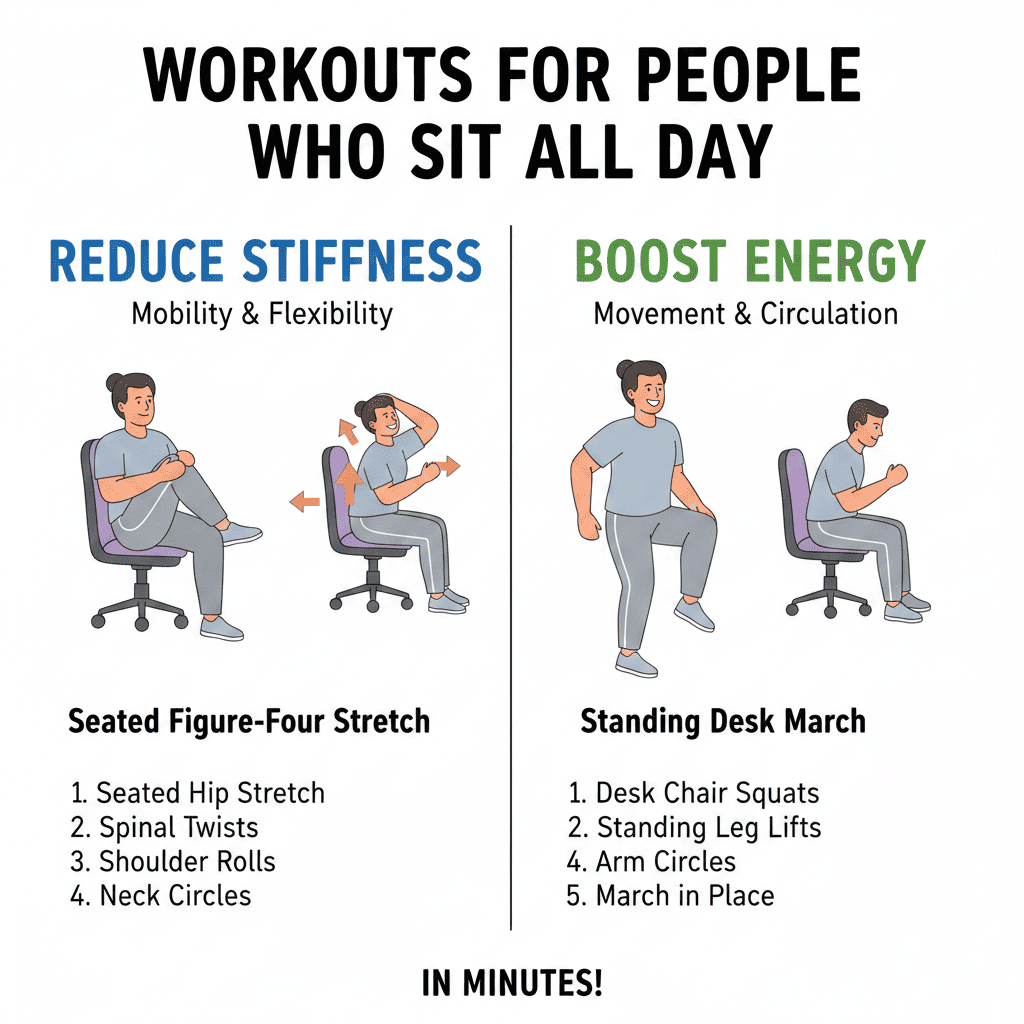
Modern life has transformed most of us into professional sitters. From the moment we wake up and sit down for breakfast, through eight-plus hours at a desk, followed by an evening on the couch, the average person now sits between nine and eleven hours daily. This sedentary lifestyle has earned sitting the ominous label of “the new smoking,” and for good reason. Prolonged sitting wreaks havoc on our bodies, leading to tight hip flexors, weakened glutes, rounded shoulders, lower back pain, and a cascade of metabolic issues that affect everything from energy levels to cardiovascular health.
The good news is that targeted movement can counteract these negative effects. You don’t need hours at the gym or expensive equipment to reverse the damage of sitting. The best workouts for people who sit all day are specifically designed to address the muscular imbalances, stiffness, and energy depletion that result from prolonged sitting. These movements open up compressed areas, strengthen neglected muscles, and restore the natural mobility your body craves.
This comprehensive guide presents strategic exercises and mini-workout routines that fit seamlessly into your daily schedule, whether you’re working from home, in an office, or anywhere else that requires extended sitting. Each movement targets the specific problems that sitting creates, offering immediate relief from discomfort while building long-term resilience against the effects of a sedentary lifestyle.
Understanding the Sitting Problem
Before exploring solutions, it’s important to understand exactly what sitting does to your body. This knowledge helps you appreciate why specific movements are so effective and motivates you to prioritize them throughout your day.
The Biomechanical Impact of Sitting
When you sit for extended periods, your hip flexors remain in a shortened position for hours. These muscles, which connect your thighs to your lower spine, gradually adapt to this shortened state, becoming tight and resistant to lengthening. Meanwhile, your glutes—the muscles responsible for hip extension and posterior support—spend the entire day in a stretched, inactive position, becoming weak and inhibited.
Your spine suffers equally. The natural S-curve of a healthy spine flattens into a C-curve as you slouch forward toward your computer screen. Your shoulders round forward, your chest collapses inward, and your head juts forward, placing tremendous strain on your neck muscles. Over time, these positions become your body’s new default, creating chronic pain and movement dysfunction even when you’re not sitting.
The Metabolic and Energy Consequences
The effects of sitting extend far beyond musculoskeletal problems. When you remain stationary, your metabolic rate drops dramatically. Blood flow slows, particularly to your lower extremities, reducing oxygen delivery to tissues and impairing waste removal. This sluggish circulation contributes to the afternoon energy crashes that plague office workers.
Prolonged sitting also impacts blood sugar regulation, decreases insulin sensitivity, and reduces the production of enzymes responsible for breaking down fat. These metabolic changes explain why people who sit all day often struggle with weight management, despite maintaining reasonable diets and exercising occasionally.
The Cumulative Nature of Sitting Damage
Perhaps most concerning is that the damage from sitting accumulates over time. Each day of prolonged sitting adds to the previous day’s impact, gradually shifting your body’s baseline toward dysfunction. This is why someone might feel fine in their twenties despite sitting constantly, only to develop chronic pain and movement limitations in their thirties and forties.
However, the cumulative nature of sitting damage works in reverse too. Consistent implementation of the best workouts for people who sit all day creates positive adaptation that compounds over time, progressively undoing the damage and building resilience against future sitting.
1. Hip Flexor Release and Strengthening Sequence
Your hip flexors are ground zero for sitting-related dysfunction. These powerful muscles at the front of your hips become chronically tight from remaining in a shortened position all day, contributing to lower back pain, poor posture, and limited mobility.
The Low Lunge Hip Flexor Stretch
Begin in a kneeling position with your right foot forward, knee bent at 90 degrees, and left knee on the ground. Place your hands on your right thigh for support. Gently press your hips forward while maintaining an upright torso, feeling a stretch through the front of your left hip. The key is to avoid arching your lower back excessively; instead, think about tucking your pelvis slightly under as you move forward.
Hold this position for 45 to 60 seconds, breathing deeply and allowing the muscle to gradually release. You should feel a strong but tolerable stretch through the front of your hip and possibly into your quad. Switch sides and repeat. This stretch directly counters the shortened position your hip flexors maintain during sitting, helping restore normal length and function.
Dynamic Hip Flexor Mobilization
After static stretching, perform dynamic movements to reinforce the newly gained mobility. From a standing position, march in place, lifting your knees high while maintaining an upright posture. Perform 20 to 30 repetitions per leg. Follow this with leg swings: stand beside a wall for balance, swing one leg forward and backward in a controlled manner, allowing your hip to move through its full range of motion. Complete 15 swings per leg.
These dynamic movements teach your nervous system to access the mobility you’ve created through stretching, making it more likely to persist throughout the day.
Glute Activation to Balance Hip Flexors
Strong glutes naturally inhibit overactive hip flexors through a process called reciprocal inhibition. Perform glute bridges: lie on your back with knees bent and feet flat on the floor. Press through your heels to lift your hips toward the ceiling, squeezing your glutes intensely at the top. Hold for two seconds, then lower with control. Complete three sets of 15 to 20 repetitions.
For added difficulty, try single-leg bridges or place your feet on an elevated surface. The key is feeling your glutes work hard while your lower back remains relatively relaxed.
2. Thoracic Spine Mobility Circuit
Your thoracic spine—the middle and upper back—becomes locked into flexion from hunching over a desk all day. Restoring extension and rotation to this region is crucial for eliminating upper back pain and improving overall posture. These movements are among the best workouts for people who sit all day because they directly address one of sitting’s most damaging effects.
Cat-Cow Spine Waves
Start on your hands and knees in a tabletop position. For the cat position, exhale as you round your spine toward the ceiling, tucking your chin and tailbone under. For the cow position, inhale as you arch your spine, lifting your chest and tailbone while allowing your belly to sink toward the floor. Move slowly between these positions for 10 to 12 complete cycles, focusing on moving each vertebra sequentially rather than just hinging at one point.
This fundamental movement restores flexion and extension mobility to your entire spine, with particular emphasis on the thoracic region that becomes so restricted from sitting.
Thoracic Extension Over Foam Roller
If you have a foam roller, lie on your back with the roller positioned horizontally across your mid-back, just below your shoulder blades. Support your head with your hands, elbows pointing toward the ceiling. Gently arch backward over the roller, extending your thoracic spine. Hold for five to ten seconds, then reposition the roller slightly higher or lower and repeat. Work through three to four positions along your mid-back.
Without a foam roller, you can perform standing wall extensions: stand facing a wall at arm’s length, place your hands on the wall at shoulder height, and push your chest toward the wall while maintaining a neutral lower back. This creates extension through your thoracic spine.
Thread the Needle Rotation
From a tabletop position, extend your right arm straight out to the side at shoulder height. Sweep this arm underneath your body, threading it through the space between your left arm and left knee. Your right shoulder and head will lower toward the floor as you rotate your torso. Hold for 20 to 30 seconds, feeling the stretch through your upper back and shoulder. Return to the starting position and repeat on the opposite side.
Perform two to three repetitions per side, moving slowly and breathing deeply into the rotation. This exercise addresses the rotational restrictions that develop from maintaining a fixed forward-facing position all day.
3. Desk Break Movement Snacks
Rather than attempting one long workout to counteract eight hours of sitting, strategically placed movement snacks throughout the day prove far more effective. These brief exercise bursts take just three to five minutes and can be performed without leaving your workspace, making them ideal best workouts for people who sit all day.
The Every-Hour Stand and Stretch
Set a timer to remind you to stand every hour. When it sounds, stand up and perform this quick sequence: reach your arms overhead and take three deep breaths, lengthening your spine; perform 10 bodyweight squats to activate your glutes and legs; do 10 standing torso twists, rotating from side to side; finish with shoulder rolls, moving your shoulders backward in large circles 10 times.
This two-minute routine interrupts prolonged sitting, stimulates circulation, and prevents your body from settling into dysfunctional positions.
Desk Push-Up and Shoulder Opener
Use your desk for incline push-ups. Place your hands on the edge of your desk slightly wider than shoulder-width. Step your feet back until your body forms a straight line from head to heels. Perform 10 to 15 push-ups, lowering your chest toward the desk and pressing back up with control.
Immediately follow with a doorway chest stretch. Stand in a doorway with your forearms resting on the door frame, elbows bent at 90 degrees. Step forward with one foot, allowing your chest to move through the doorway, feeling a stretch across your chest and front of your shoulders. Hold for 30 seconds. This combination strengthens your upper body while opening your chest, counteracting the rounded shoulder position.
Seated Spinal Twists and Side Bends
Even brief movements performed while sitting provide benefits. Sit tall in your chair with feet flat on the floor. Place your right hand on the outside of your left thigh and gently rotate your torso to the left, looking over your left shoulder. Hold for 15 seconds, then switch sides. Follow with side bends: reach your right arm overhead and lean to the left, stretching through the right side of your body. Hold for 15 seconds and switch sides.
These seated movements can be performed during phone calls or while reading documents, making them extremely practical for busy work days.
4. Lower Body Activation and Strengthening
Your legs and glutes suffer tremendously from sitting, as they remain inactive for hours while compressed against your chair. Reactivating these large muscle groups not only improves musculoskeletal health but also boosts metabolism and energy levels.
Squat Variations for Daily Integration
Bodyweight squats are foundational movements that should be performed multiple times throughout the day. Stand with feet shoulder-width apart, toes pointing slightly outward. Initiate the movement by pushing your hips backward as if sitting into a chair, then bend your knees to lower down. Keep your chest up and weight on your heels. Lower until your thighs are parallel to the ground, then press through your heels to stand back up.
Perform three sets of 15 to 20 squats during different times of the day. Variations include: narrow stance squats, wide stance squats, pulse squats where you hold the bottom position and perform small up-and-down movements, and jumping squats for an added cardiovascular challenge.
Lunge Series for Hip Mobility and Strength
Lunges address multiple sitting-related problems simultaneously. They stretch hip flexors, strengthen glutes, improve single-leg stability, and require balance and coordination. Perform forward lunges by stepping one foot forward and lowering your back knee toward the ground until both knees form 90-degree angles. Push through your front heel to return to standing. Complete 10 to 12 repetitions per leg.
Add reverse lunges, where you step backward instead of forward, and lateral lunges, where you step out to the side, pushing your hips back and bending the stepping leg while keeping the opposite leg straight. This multi-directional approach ensures comprehensive lower body engagement.
Calf Raises and Ankle Mobility
Your calves and ankles stiffen from remaining in a fixed position all day. Stand with feet hip-width apart and rise onto your toes, lifting your heels as high as possible. Hold for two seconds at the top, then lower with control. Perform three sets of 20 to 25 repetitions.
Follow with ankle circles: stand on one leg and draw circles in the air with your opposite foot, rotating through your ankle joint. Perform 10 circles in each direction for each ankle. These movements improve circulation to your lower legs and maintain ankle mobility.
5. Posture Correction and Upper Back Strengthening
Rounded shoulders and forward head posture create significant problems beyond mere aesthetics. They compress nerves, restrict breathing, cause headaches, and lead to chronic neck and upper back pain. These corrective exercises represent essential best workouts for people who sit all day.
Wall Angels for Scapular Control
Stand with your back against a wall, feet about six inches away from the base. Flatten your lower back against the wall by tilting your pelvis slightly. Raise your arms to form a W shape with elbows bent at 90 degrees, pressing your elbows, wrists, and back of hands against the wall. Slowly slide your arms upward, straightening them into a Y position while maintaining wall contact. Reverse the movement back to the W position.
Perform 10 to 15 slow, controlled repetitions, focusing on keeping your arms in contact with the wall throughout the entire range of motion. This exercise strengthens the muscles responsible for retracting your shoulder blades and correcting rounded shoulder posture.
Prone Y-T-A Raises
Lie face down on the floor or on a bench if available. For Y raises, extend your arms overhead at a 30-degree angle from your body, thumbs pointing upward. Lift your arms off the ground, squeezing your shoulder blades together. Hold for two seconds, then lower. Perform 12 repetitions. For T raises, extend your arms straight out to the sides perpendicular to your body. Lift, squeeze, and lower for 12 repetitions. For A raises, position your arms at your sides pointing down toward your feet at a 30-degree angle. Lift, squeeze, and lower for 12 repetitions.
This sequence comprehensively strengthens all the muscles responsible for healthy shoulder blade positioning and movement.
Chin Tucks and Neck Strengthening
Address forward head posture with chin tucks. Sit or stand with good posture. Without tilting your head up or down, draw your chin straight backward, creating a double chin. You should feel a stretch at the base of your skull and through the back of your neck. Hold for five seconds, relax, and repeat 10 times. Perform this exercise several times throughout the day.
Progress to resistance chin tucks by placing your hand against your forehead and pressing your head forward into your hand while simultaneously performing the chin tuck, creating isometric resistance. This strengthens the deep neck flexors that support proper head positioning.
6. Core Stabilization for Sitting Workers
A strong, stable core is essential for maintaining good posture during prolonged sitting and for protecting your spine during movement. Many people with desk jobs develop weak core muscles because they rely on their chair for support rather than engaging their own musculature.
Plank Progressions
The plank is a fundamental core exercise that builds endurance in the muscles responsible for spinal stability. Begin with a basic forearm plank: lie face down, prop yourself up on your forearms and toes, creating a straight line from head to heels. Engage your core by drawing your navel toward your spine and squeeze your glutes. Hold for 20 to 60 seconds, maintaining quality form.
As you build strength, progress to more challenging variations. Side planks target the obliques and lateral core stabilizers. High planks with shoulder taps add an anti-rotation challenge. Plank walkouts, where you walk your hands forward from a standing position into a plank and back, combine core strength with shoulder stability.
Dead Bug Variations
Lie on your back with arms extended toward the ceiling and knees bent at 90 degrees, shins parallel to the floor. This is your starting position. Slowly extend your right leg straight while simultaneously lowering your left arm overhead, keeping both hovering just above the ground. Return to the starting position and repeat on the opposite side. Complete 10 to 12 repetitions per side.
The dead bug teaches core stability while moving your limbs, which directly translates to maintaining good posture when reaching or moving during daily activities. Focus on keeping your lower back pressed against the floor throughout the movement.
Bird Dog for Posterior Chain Integration
The bird dog exercise, performed on hands and knees, simultaneously extends your opposite arm and leg while maintaining a stable, neutral spine. This movement pattern strengthens your entire posterior chain while improving coordination and balance. Perform three sets of 10 repetitions per side, holding each extension for three to five seconds.
7. Cardiovascular Interval Training
While stretching and strengthening address musculoskeletal issues, cardiovascular exercise combats the metabolic consequences of sitting. Brief, intense cardiovascular intervals throughout the day boost energy, improve circulation, and enhance metabolic function. These activities are crucial components of the best workouts for people who sit all day.
Desk-Friendly Cardio Bursts
You don’t need a treadmill or much space for effective cardiovascular exercise. Perform two-minute cardio bursts several times throughout the day. Options include: marching in place with high knees, performing jumping jacks or modified jacks if noise is a concern, doing mountain climbers in a plank position, or simply walking briskly up and down stairs if available.
The key is elevating your heart rate significantly for a brief period, then returning to work. These micro-cardio sessions accumulate throughout the day, providing substantial cardiovascular benefits while boosting energy and mental clarity.
The 7-Minute Workout Protocol
If you can carve out seven consecutive minutes, perform this proven protocol that delivers significant benefits in minimal time. Complete 30 seconds of each exercise with 10 seconds rest between exercises: jumping jacks, wall sits, push-ups, crunches, step-ups onto a chair, squats, tricep dips using a chair, plank, high knees running in place, lunges, and side planks.
This combination of cardio and strength exercises in rapid succession elevates your heart rate while working all major muscle groups. Perform this routine during your lunch break or before leaving the office to counteract the day’s sitting.
Walking Strategies for Office Workers
Walking is perhaps the most underutilized yet accessible form of cardiovascular exercise. Implement walking into your daily routine strategically. Take walking meetings when possible. Park farther from the building entrance. Walk during phone calls. Take the stairs instead of the elevator. Walk to colleagues’ desks rather than emailing.
Aim for at least 250 steps per hour during your workday. This modest goal dramatically reduces sitting time and provides continuous metabolic stimulation throughout the day.
8. Breathing and Diaphragm Exercises
Sitting restricts breathing mechanics, particularly when combined with slouched posture. Your diaphragm—the primary breathing muscle—becomes inhibited, forcing you to rely on shallow chest breathing that reduces oxygen intake and increases stress hormones.
Diaphragmatic Breathing Technique
Lie on your back or sit in a chair with good posture. Place one hand on your chest and the other on your belly. Inhale slowly through your nose, focusing on expanding your belly rather than lifting your chest. Your bottom hand should rise while your top hand remains relatively still. Exhale slowly through pursed lips, feeling your belly fall. Perform this breathing pattern for five to ten minutes, several times daily.
This practice retrains proper breathing mechanics, increases oxygen delivery to tissues, activates the parasympathetic nervous system to reduce stress, and improves core stability through proper diaphragm function.
Rib Cage Mobility Breathing
Sitting compresses your rib cage, restricting its ability to expand fully during breathing. Sit tall and place your hands on the sides of your rib cage. Take a deep breath, focusing on expanding your ribs outward into your hands. Hold for three seconds, then exhale completely, feeling your ribs draw inward. Repeat 10 times.
Progress to 3D breathing, where you focus on expanding your ribs in all directions—front, back, and sides—during inhalation. This comprehensive approach maximizes lung capacity and rib cage mobility.
Box Breathing for Energy and Focus
Box breathing provides immediate energy and mental clarity, making it perfect for afternoon slumps. Inhale for a count of four, hold your breath for four counts, exhale for four counts, and hold empty for four counts. This completes one cycle. Perform five to ten cycles whenever you need an energy boost or improved focus.
9. End-of-Day Full Body Reset
After a long day of sitting, your body needs a comprehensive reset that addresses all the accumulated tension and dysfunction. This 15-minute routine serves as one of the most valuable best workouts for people who sit all day, transitioning your body from work mode to evening relaxation.
Lower Body Release Sequence
Begin with a supine figure-four stretch for your hips. Lie on your back with knees bent. Cross your right ankle over your left thigh just above the knee. Thread your hands through your legs and pull your left thigh toward your chest, feeling a deep stretch in your right hip. Hold for 60 seconds, then switch sides.
Follow with a supine spinal twist. Lie on your back with arms extended out to the sides. Draw your right knee to your chest, then allow it to fall across your body to the left side while keeping your right shoulder on the ground. Your head can turn to the right. Hold for 60 seconds, breathing deeply, then switch sides.
Upper Body Opening Series
Move into child’s pose: kneel with your knees wide apart, sit your hips back toward your heels, and extend your arms forward on the ground. Rest your forehead on the floor and hold for 60 to 90 seconds, feeling a stretch through your back, shoulders, and hips.
Transition to a doorway chest stretch. Stand in a doorway with your forearms against the door frame, elbows at 90 degrees. Step forward, allowing your chest to open. Hold for 60 seconds. Adjust your arm height higher or lower to target different portions of your chest and shoulders.
Spinal Decompression and Relaxation
Finish with legs-up-the-wall pose. Lie on your back near a wall and extend your legs straight up, resting them against the wall. Your hips should be close to or touching the wall. Rest your arms at your sides, palms up. Close your eyes and hold this position for five to ten minutes, focusing on slow, deep breathing.
This inversion gently reverses blood flow, reduces swelling in the legs and feet, calms the nervous system, and provides gentle spinal decompression after a day of compression from sitting.
10. Morning Movement Preparation
Starting your day with intentional movement prepares your body for the sitting it will endure and creates a foundation of activation that persists throughout the day. This proactive approach proves far more effective than trying to undo damage after it’s already occurred.
Dynamic Warm-Up Sequence
Begin with five minutes of dynamic movement that takes your joints through full ranges of motion. Perform arm circles forward and backward, 10 in each direction. Complete 10 leg swings front to back and side to side for each leg. Do 10 cat-cow movements to mobilize your spine. Perform 10 bodyweight squats to activate your lower body. Finish with 10 world’s greatest stretch sequences: from a plank position, bring your right foot to the outside of your right hand, rotate your torso and extend your right arm toward the ceiling, return to plank, and repeat on the opposite side.
This comprehensive warm-up lubricates joints, activates muscles, and establishes good movement patterns for the day ahead.
Strength Foundation for the Day
After your dynamic warm-up, perform a brief strength circuit that activates all major muscle groups. Complete three rounds of: 10 push-ups or incline push-ups, 15 squats, 10 rows using a resistance band or household object, and a 30-second plank. Rest 30 seconds between rounds.
This 10-minute strength session primes your nervous system, boosts your metabolism, and provides a sense of accomplishment that carries into your workday.
Mobility and Mindfulness Integration
Conclude your morning routine with five minutes of yoga-inspired stretching combined with mindful breathing. Flow through downward dog to cobra pose several times, synchronizing movement with breath. Hold each position for several breaths, focusing on the sensations in your body. This practice connects physical preparation with mental centering, setting a positive tone for your entire day.
Creating Your Personalized Sitting-Solution Schedule
The best workouts for people who sit all day aren’t effective if they remain theoretical. Implementation requires a practical plan that fits your specific schedule and work environment. This section helps you create that plan.
Minimum Effective Dose Approach
If you’re starting from scratch, commit to these non-negotiables: stand and move for two minutes every hour during your workday, perform a 10-minute morning movement routine daily, complete a 15-minute end-of-day reset routine, and take a 10-minute walk during lunch. This basic framework addresses the most critical aspects of counteracting sitting.
As these habits solidify, gradually add more sophisticated elements like dedicated strength training sessions, longer stretching routines, or additional movement snacks throughout the day.
Office Environment Considerations
Your workplace environment influences what movements are practical. In a traditional office setting, focus on exercises that can be performed discreetly at your desk or in a private conference room. Keep resistance bands, a small foam roller, and comfortable shoes for walking at your desk.
For home office workers, you have more freedom. Set up a dedicated exercise space near your workspace. Keep equipment readily available. Schedule specific times for movement breaks in your calendar. The convenience of working from home should make movement more frequent, not less.
Accountability and Tracking Systems
Use technology to support your movement habits. Set hourly reminders on your phone or computer to prompt movement breaks. Use a fitness tracker to monitor daily steps and sedentary time. Consider accountability apps that prompt you to log completed exercises.
Many people find that announcing their movement intentions to colleagues or family members increases follow-through. Some offices have established walking groups or movement challenges that provide social support and motivation.
Conclusion
The reality of modern work demands that most people spend significant time sitting. While the ideal solution would be eliminating sitting entirely, that’s simply not practical for most careers and lifestyles. The next best approach—and a highly effective one—is implementing strategic movement interventions that counteract sitting’s negative effects.
The exercises and strategies presented in this guide represent the best workouts for people who sit all day because they specifically target the problems that prolonged sitting creates. They address tight hip flexors, weak glutes, restricted thoracic spine mobility, rounded shoulders, poor breathing mechanics, and metabolic sluggishness through focused, efficient movements that fit into even the busiest schedules.
Remember that perfection isn’t the goal—consistency is. You don’t need to perform every exercise in this guide every day. Choose the movements that address your most pressing issues and that fit most naturally into your routine. Start small, perhaps with just one movement break per hour, and gradually expand your movement practice as it becomes habitual.
Your body is remarkably adaptable. It has adjusted to excessive sitting by developing compensations and dysfunctions, but it will adjust equally well to regular movement by restoring proper function, eliminating pain, and enhancing energy. The question isn’t whether these interventions work—the science and countless success stories confirm they do. The only question is whether you’ll implement them consistently enough to experience the benefits yourself.
Also read this:
How to Build Fitness Habits That Stick Long-Term — Simple Strategy for Consistency
7 Best Evening Workouts for Weight Loss — Burn Fat Before Bed the Healthy Way
How to Increase Flexibility With Simple Stretches — 10-Minute Routine for Beginners