
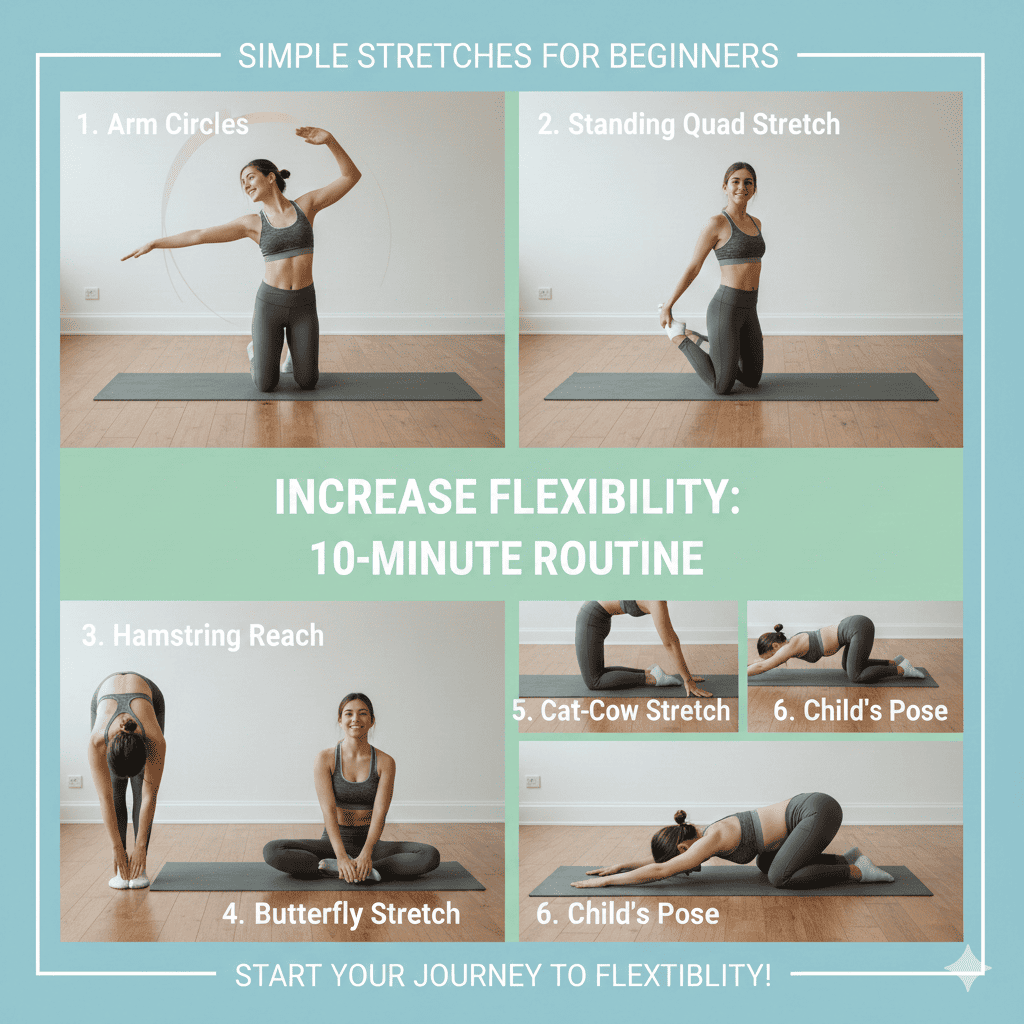
Flexibility is often the most neglected component of fitness, yet it plays a crucial role in maintaining a healthy, pain-free body throughout your life. Whether you struggle to touch your toes, feel stiff after sitting for long periods, or simply want to move more freely, learning how to increase flexibility with simple stretches can dramatically improve your quality of life.
Understanding the science behind flexibility helps explain why these stretches work. Flexibility refers to the range of motion available at a joint or group of joints. It’s determined by several factors including muscle length, connective tissue elasticity, joint structure, and nervous system regulation. When you regularly increase flexibility with simple stretches, you’re teaching your muscles to relax, lengthening connective tissue, and training your nervous system to allow greater ranges of motion without triggering protective tension.
The benefits of improved flexibility extend far beyond being able to touch your toes or do impressive yoga poses. Better flexibility reduces your risk of injury during daily activities and exercise, alleviates chronic pain particularly in the back and joints, improves posture and body alignment, enhances athletic performance, increases blood flow to muscles, reduces stress and promotes relaxation, and helps maintain independence as you age.
1. Understanding Flexibility Fundamentals
Before diving into specific stretches, it’s essential to understand the principles that make stretching effective and safe. This knowledge will help you increase flexibility with simple stretches more efficiently while avoiding common mistakes that can hinder progress or cause injury.
The Difference Between Flexibility and Mobility
While often used interchangeably, flexibility and mobility are distinct concepts. Flexibility refers to the ability of your muscles to lengthen passively, while mobility is the ability to move a joint actively through its full range of motion with control and strength.
Both qualities are important for optimal movement. You can have flexible muscles but poor mobility if you lack the strength to control that range of motion. The stretches in this guide primarily target flexibility, but many also contribute to improved mobility when performed mindfully.
Static vs. Dynamic Stretching
Static stretching involves holding a position for an extended period, typically 15 to 60 seconds. This is the most common type of stretching for improving overall flexibility and is best performed when muscles are already warm, such as after activity or a hot shower.
Dynamic stretching involves moving through ranges of motion repeatedly without holding positions. This type of stretching is ideal for warming up before exercise but is less effective for increasing baseline flexibility. For beginners looking to increase flexibility with simple stretches, static stretching should be the primary focus.
The Role of Consistency Over Intensity
Many beginners make the mistake of stretching too aggressively, thinking that more pain equals better results. This approach typically backfires, causing muscle guarding, soreness, and increased injury risk.
Effective flexibility training requires consistent, gentle practice over time. Stretching to the point of mild tension without pain, holding positions for adequate duration, and repeating this practice daily or near-daily produces far better results than occasional intense stretching sessions.
Breathing and Relaxation Techniques
Proper breathing is crucial when stretching. Holding your breath creates tension that works against the relaxation necessary for muscles to lengthen. Instead, breathe deeply and rhythmically, exhaling as you move deeper into stretches.
Many people find that imagining tension flowing out of their body with each exhale helps them relax more completely into stretches. This mind-body connection significantly enhances the effectiveness of your flexibility practice.
2. Neck and Shoulder Stretches
The neck and shoulders are common areas of tension for most people, especially those who work at desks or look at screens frequently. These stretches will help you increase flexibility with simple stretches in your upper body while relieving accumulated stress.
Neck Tilts and Turns
Sit or stand with good posture, shoulders relaxed. Gently tilt your head to the right, bringing your ear toward your shoulder without lifting the shoulder up. Hold for 20 to 30 seconds, then repeat on the left side.
Next, slowly turn your head to look over your right shoulder, holding for 20 to 30 seconds before repeating on the left. These gentle stretches release tension in the neck muscles and improve rotational mobility.
Avoid forcing the movement or pulling on your head with your hand initially. Let the weight of your head provide the stretch naturally.
Shoulder Rolls and Shrugs
Roll your shoulders backward in large circles 10 times, then forward 10 times. This movement increases blood flow and prepares the shoulder joints for deeper stretching.
Follow with shoulder shrugs: lift both shoulders up toward your ears, hold for 3 seconds, then release them down. Repeat 8 to 10 times. This action releases tension in the upper trapezius muscles that often hold stress.
Cross-Body Shoulder Stretch
Extend your right arm straight across your chest. Use your left hand to gently pull the right arm closer to your body, feeling a stretch in the back of your right shoulder. Hold for 30 seconds, then repeat on the opposite side.
Keep your shoulders down and squared forward throughout the stretch. This movement targets the posterior deltoid and upper back muscles that tighten from poor posture.
Doorway Chest Stretch
Stand in a doorway with your forearm placed against the door frame, elbow bent at 90 degrees. Step forward slightly until you feel a stretch across your chest and front shoulder. Hold for 30 seconds on each side.
This stretch counteracts the forward shoulder posture that develops from sitting and computer work. It opens the chest and improves shoulder mobility, contributing significantly to better posture.
3. Upper Back and Spine Stretches
A flexible spine is essential for pain-free movement and good posture. These stretches will help you increase flexibility with simple stretches throughout your back while reducing stiffness and discomfort.
Cat-Cow Stretch
Start on your hands and knees with wrists under shoulders and knees under hips. Arch your back, lifting your chest and tailbone toward the ceiling while letting your belly drop toward the floor. This is the cow position.
Then round your spine, tucking your tailbone under and bringing your chin toward your chest. This is the cat position. Flow smoothly between these two positions 10 to 15 times, coordinating movement with your breath.
This dynamic stretch mobilizes the entire spine and is particularly beneficial first thing in the morning or after periods of sitting.
Child’s Pose
From hands and knees, sit your hips back toward your heels while extending your arms forward on the ground. Rest your forehead on the floor or a cushion if needed. Hold this restful position for 60 to 90 seconds.
This gentle stretch lengthens the muscles along your spine, hips, and shoulders while promoting relaxation. Breathe deeply and allow your body to sink more heavily toward the ground with each exhale.
You can vary the arm position by reaching them alongside your body instead of forward, which changes the stretch sensation slightly.
Seated Spinal Twist
Sit on the floor with legs extended. Bend your right knee and place your right foot on the outside of your left knee. Place your right hand on the floor behind you and your left elbow on the outside of your right knee.
Gently twist your torso to the right, using your left elbow against your knee for leverage. Hold for 30 seconds, then repeat on the opposite side. This twist stretches the muscles along your spine and external hip rotators.
Keep your spine long and lifted throughout the twist rather than collapsing or hunching forward.
Thread the Needle Stretch
From hands and knees, reach your right arm underneath your body toward the left side, allowing your right shoulder and ear to rest on the ground. Your hips should remain stacked over your knees. Hold for 30 seconds, then repeat on the opposite side.
This stretch targets the upper back, shoulders, and neck while providing a gentle spinal rotation. It’s particularly effective for releasing tension between the shoulder blades.
4. Lower Back and Hip Flexor Stretches
The lower back and hip flexors are interconnected areas that often become tight from sitting. These stretches are crucial when you want to increase flexibility with simple stretches in areas that commonly cause discomfort.
Knee-to-Chest Stretch
Lie on your back with both legs extended. Bend your right knee and use your hands to gently pull it toward your chest. Keep your left leg extended on the ground or bent with foot flat if that’s more comfortable. Hold for 30 seconds, then repeat with the left leg.
This simple stretch releases tension in the lower back and glutes. For a deeper stretch, pull both knees to your chest simultaneously and gently rock side to side.
Supine Figure-Four Stretch
Lie on your back with knees bent and feet flat on the floor. Cross your right ankle over your left knee, creating a figure-four shape. Reach through the opening and grasp behind your left thigh, gently pulling your left leg toward your chest.
Hold for 30 to 45 seconds, then repeat on the opposite side. This stretch targets the piriformis and other deep hip rotators that often contribute to lower back tightness and sciatic discomfort.
Kneeling Hip Flexor Stretch
Kneel on your right knee with your left foot flat on the ground in front of you, creating a 90-degree angle at both knees. Keep your torso upright and gently press your hips forward until you feel a stretch in the front of your right hip and thigh.
Hold for 30 to 45 seconds, then switch sides. This stretch is essential for counteracting the hip flexor tightness that develops from prolonged sitting. Place a cushion under your kneeling knee for comfort if needed.
Supine Spinal Twist
Lie on your back with arms extended out to the sides. Bend your right knee and use your left hand to guide it across your body toward the left side, allowing your spine to twist. Keep both shoulders on the ground. Hold for 45 to 60 seconds, then repeat on the opposite side.
This gentle twist stretches the lower back, outer hip, and spine while promoting spinal mobility. It’s an excellent stretch to perform before bed as it helps release accumulated tension from the day.
5. Hamstring and Glute Stretches
Tight hamstrings are extremely common and can contribute to lower back pain and poor posture. Learning to increase flexibility with simple stretches for your hamstrings and glutes will significantly improve your overall mobility.
Standing Forward Fold
Stand with feet hip-width apart and slowly fold forward from your hips, allowing your arms to hang toward the ground. Bend your knees generously if needed to prevent strain. Hold for 45 to 60 seconds, breathing deeply.
Don’t worry about touching the ground or straightening your legs completely. The goal is to feel a gentle stretch in the backs of your legs. Over time, your flexibility will improve and you’ll be able to fold deeper.
Seated Forward Fold
Sit on the floor with legs extended straight in front of you. Hinge forward from your hips, reaching your hands toward your feet or ankles. Keep your spine long rather than rounding your back excessively. Hold for 45 to 60 seconds.
If you can’t reach your feet, use a towel looped around your feet to assist the stretch. Focus on tilting your pelvis forward rather than simply pulling your torso down with rounded shoulders.
Single-Leg Hamstring Stretch
Sit with your right leg extended and your left leg bent with the sole of your left foot against your right inner thigh. Fold forward over your extended right leg, reaching toward your right foot. Hold for 45 seconds, then repeat on the opposite side.
This variation allows you to focus more intensely on one hamstring at a time and can be more comfortable than stretching both simultaneously.
Reclined Hamstring Stretch
Lie on your back and extend your right leg up toward the ceiling, keeping your left leg extended on the ground or bent with foot flat. Loop a towel or strap around the ball of your right foot and gently pull your leg toward your body. Hold for 45 to 60 seconds per leg.
This is one of the most effective hamstring stretches because your back is supported, allowing you to relax completely into the stretch without strain.
6. Quadriceps and Front-Body Stretches
Balancing hamstring flexibility with quadriceps flexibility is essential for knee health and overall leg function. These stretches will help you increase flexibility with simple stretches in the front of your body.
Standing Quad Stretch
Stand on your left leg and bend your right knee, bringing your right foot toward your glutes. Grasp your right ankle or foot with your right hand and gently pull it closer to your body. Hold for 30 to 45 seconds, then repeat on the opposite side.
Keep your knees close together and your standing leg slightly bent for better balance. Hold onto a wall or chair with your free hand if needed for stability.
Kneeling Quad Stretch
Kneel on your right knee with your left foot flat in front of you. Reach back with your right hand to grasp your right foot, pulling it gently toward your glutes. Hold for 30 to 45 seconds per side.
This version provides a deeper stretch than the standing variation and allows you to focus more on the stretch without worrying about balance.
Cobra Pose
Lie face down with your hands placed under your shoulders. Press through your hands to lift your chest off the ground, extending your spine. Keep your elbows slightly bent and shoulders down away from your ears. Hold for 30 seconds.
This stretch opens the entire front body including the chest, abdominals, and hip flexors while promoting spinal extension, which counteracts the forward-curved posture most people develop.
Low Lunge with Quad Stretch
From a kneeling hip flexor stretch position, reach back with the hand on the same side as your kneeling knee to grasp that foot. This combines a hip flexor stretch with a quadriceps stretch for enhanced effectiveness. Hold for 30 seconds per side.
This integrated stretch addresses multiple tight areas simultaneously, making it highly efficient for a quick flexibility routine.
7. Inner Thigh and Groin Stretches
The inner thigh muscles, or adductors, often become tight and restricted. Opening this area will help you increase flexibility with simple stretches and improve hip mobility for activities like squatting and lateral movement.
Butterfly Stretch
Sit on the floor and bring the soles of your feet together, allowing your knees to fall out to the sides. Hold your feet with your hands and gently press your elbows against your inner thighs, encouraging them toward the floor. Hold for 60 seconds.
Keep your spine straight and imagine lengthening through the crown of your head. For a deeper stretch, lean forward from your hips while maintaining a long spine.
Wide-Legged Seated Forward Fold
Sit with your legs extended wide in a V-shape. Walk your hands forward between your legs, folding from the hips and keeping your spine long. Hold for 45 to 60 seconds.
This stretch targets the inner thighs and hamstrings simultaneously. Don’t force yourself to fold deeply; even a slight forward lean will provide beneficial stretching.
Kneeling Adductor Stretch
From hands and knees, extend your right leg straight out to the side, keeping your foot flat on the ground. Shift your hips back toward your left heel until you feel a stretch along your right inner thigh. Hold for 30 to 45 seconds per side.
This stretch allows you to control the intensity easily by adjusting how far you shift your hips back.
Reclined Bound Angle Pose
Lie on your back and bring the soles of your feet together, allowing your knees to fall open to the sides. Place your arms comfortably by your sides or overhead. Hold for 2 to 3 minutes.
This restorative stretch gently opens the inner thighs and hips while promoting relaxation. Place cushions or folded blankets under your knees if the position feels too intense.
8. Calf and Ankle Stretches
Tight calves can contribute to foot pain, shin splints, and limited ankle mobility. These stretches will help you increase flexibility with simple stretches in your lower legs and feet.
Wall Calf Stretch
Stand facing a wall with your hands against it. Step your right foot back, keeping both feet pointing forward. Keep your right heel on the ground and your right leg straight while bending your left knee. Hold for 30 to 45 seconds per side.
This classic stretch targets the gastrocnemius, the larger of the two main calf muscles. Keep your back heel firmly planted throughout the stretch for maximum effectiveness.
Bent-Knee Calf Stretch
From the same position as the wall calf stretch, bend your back knee while keeping your heel on the ground. This variation targets the soleus muscle, which lies beneath the gastrocnemius. Hold for 30 to 45 seconds per side.
Both calf stretches are important because these two muscles attach at different points and require different stretch positions to lengthen effectively.
Seated Toe Pull
Sit with legs extended and loop a towel around the ball of one foot. Keep your leg straight and gently pull the towel toward you, bringing your toes closer to your shin. Hold for 30 seconds per foot.
This stretch addresses both the calf muscles and the Achilles tendon, which is crucial for ankle flexibility and injury prevention.
Ankle Circles and Flexion
Sit in a chair or on the floor and extend one leg. Slowly rotate your ankle in circles, making the circles as large as possible. Complete 10 circles in each direction, then repeat with the other ankle.
Follow with ankle flexion: point your toes away from you, hold for 3 seconds, then flex your foot pulling toes toward your shin. Repeat 10 times per foot. These movements improve ankle mobility and circulation.
9. Full-Body Integration Stretches
Some stretches engage multiple muscle groups simultaneously, making them highly efficient when time is limited. These integrated movements help you increase flexibility with simple stretches throughout your entire body.
Downward-Facing Dog
Start on hands and knees, then lift your hips up and back, straightening your legs and arms to create an inverted V-shape. Your body should form a straight line from your hands to your hips. Hold for 45 to 60 seconds.
This fundamental yoga pose stretches the hamstrings, calves, shoulders, and back simultaneously. Bend your knees if needed to maintain length in your spine. Pedal your feet by alternately bending and straightening each leg to deepen the calf stretch.
Standing Side Bend
Stand with feet hip-width apart and reach both arms overhead. Grasp your right wrist with your left hand and gently pull as you lean to the left, creating a side bend. Hold for 30 seconds per side.
This stretch lengthens the muscles along the sides of your torso, including the obliques and latissimus dorsi. Keep both hips squared forward and avoid leaning forward or backward during the bend.
World’s Greatest Stretch
Step your right foot forward into a lunge position with your hands on the ground inside your front foot. Lower your left elbow toward the ground near your right foot, then rotate your torso and reach your right arm toward the ceiling. Return to the starting position and repeat 5 times per side.
This dynamic stretch addresses hip flexors, hamstrings, inner thighs, thoracic spine rotation, and shoulder mobility all in one movement.
Reclining Full-Body Stretch
Lie on your back and extend your arms overhead while straightening your legs. Point your toes and reach through your fingertips, creating length through your entire body. Hold for 10 seconds, then relax. Repeat 3 to 5 times.
This simple stretch provides a full-body lengthening sensation and is particularly refreshing first thing in the morning or after periods of inactivity.
10. The Complete 10-Minute Beginner Flexibility Routine
Now that you understand the individual stretches, here’s how to structure them into an effective daily routine that will help you increase flexibility with simple stretches efficiently and systematically.
Routine Structure and Flow
Your 10-minute routine should follow a logical progression from upper body to lower body, or from standing to floor-based stretches. This creates smooth transitions and allows you to work systematically through your entire body.
Perform each stretch for the recommended duration without rushing. Moving too quickly between stretches reduces their effectiveness. Set a timer if needed to ensure you’re holding each position long enough.
Sample 10-Minute Sequence
Begin with neck tilts and turns for 1 minute total to release upper body tension. Move to cross-body shoulder stretches for 30 seconds per side. Transition to cat-cow stretches for 1 minute to mobilize your spine. Follow with child’s pose held for 1 minute for deep relaxation.
Come to seated for a spinal twist, holding 30 seconds per side. Lie down for knee-to-chest stretches, 30 seconds per leg. Perform the figure-four stretch for 45 seconds per side to open your hips. Execute the reclined hamstring stretch using a towel for 45 seconds per leg.
Finish with butterfly stretch held for 1 minute and end with a brief reclining full-body stretch for 30 seconds. This sequence addresses all major muscle groups in exactly 10 minutes.
Warm-Up Considerations
While you don’t need an extensive warm-up before stretching, avoid stretching completely cold muscles, especially first thing in the morning. Take a few minutes to move gently—walk around, do arm circles, or perform light marching in place before beginning your stretches.
Alternatively, stretch after a hot shower when your muscles are already warm, or at the end of the day when your body has been moving and is naturally more pliable.
Tracking Progress and Adjusting
Keep a simple flexibility journal noting any improvements you observe, such as increased range of motion, reduced discomfort in daily activities, or the ability to hold stretches longer without strain.
Every two to three weeks, reassess which stretches feel easy and which remain challenging. Replace stretches that have become too easy with more advanced variations to continue progressing. This ensures your routine remains appropriately challenging.
Conclusion
Learning how to increase flexibility with simple stretches is one of the most accessible and immediately rewarding aspects of fitness. Unlike building strength or cardiovascular endurance, which can take weeks to notice changes, flexibility often improves noticeably within days of consistent practice.
The 10-minute routine outlined in this guide provides a complete, balanced approach to whole-body flexibility that fits easily into even the busiest schedule. By dedicating just this small amount of time each day, you’re investing in long-term mobility, reduced pain, better posture, and enhanced quality of life.
Remember that flexibility improvement is highly individual. Some people have naturally looser joints and connective tissue, while others are naturally tighter. Comparing yourself to others is counterproductive and can lead to pushing too hard or feeling discouraged. Your only meaningful comparison is with your own previous baseline.
The key to successfully improving flexibility is consistency over intensity. Stretching gently every day produces far better results than aggressive stretching once per week. Your muscles and connective tissue adapt gradually to the demands you place on them through regular practice.
Be patient with your body and celebrate small victories along the way. Perhaps you can reach a few inches closer to your toes this week than last week, or maybe you can hold a stretch for 45 seconds when previously 30 seconds felt challenging. These incremental improvements compound over time into significant changes.
Pay attention to how your body feels rather than focusing solely on how far you can stretch. Flexibility work should produce a sensation of gentle tension, never sharp pain. If a stretch causes pain, back off immediately and either modify the position or skip that particular stretch for now.
Consider that flexibility is a lifelong practice rather than a destination to reach. Even professional dancers and gymnasts must maintain regular stretching routines to preserve their flexibility. The good news is that once you’ve achieved a level of flexibility, maintaining it requires less effort than initially developing it.
As you continue your flexibility journey, you may want to explore yoga classes, either in-person or online, which provide structured flexibility work along with breathwork and mindfulness. Many people find that the meditative aspects of stretching become as valuable as the physical benefits.
The commitment to increase flexibility with simple stretches through this 10-minute daily routine represents a powerful investment in your physical well-being. Your future self will thank you for the time you spend today developing and maintaining a flexible, mobile body that serves you well throughout all of life’s activities and adventures.
Also read this:
Best Workouts to Improve Balance and Stability — Simple Exercises You Can Do at Home
How to Lose Inches Without Strict Dieting — Easy Daily Habits That Actually Work
15-Minute Beginner Cardio Routine Without Equipment — Burn Calories at Home Fast