
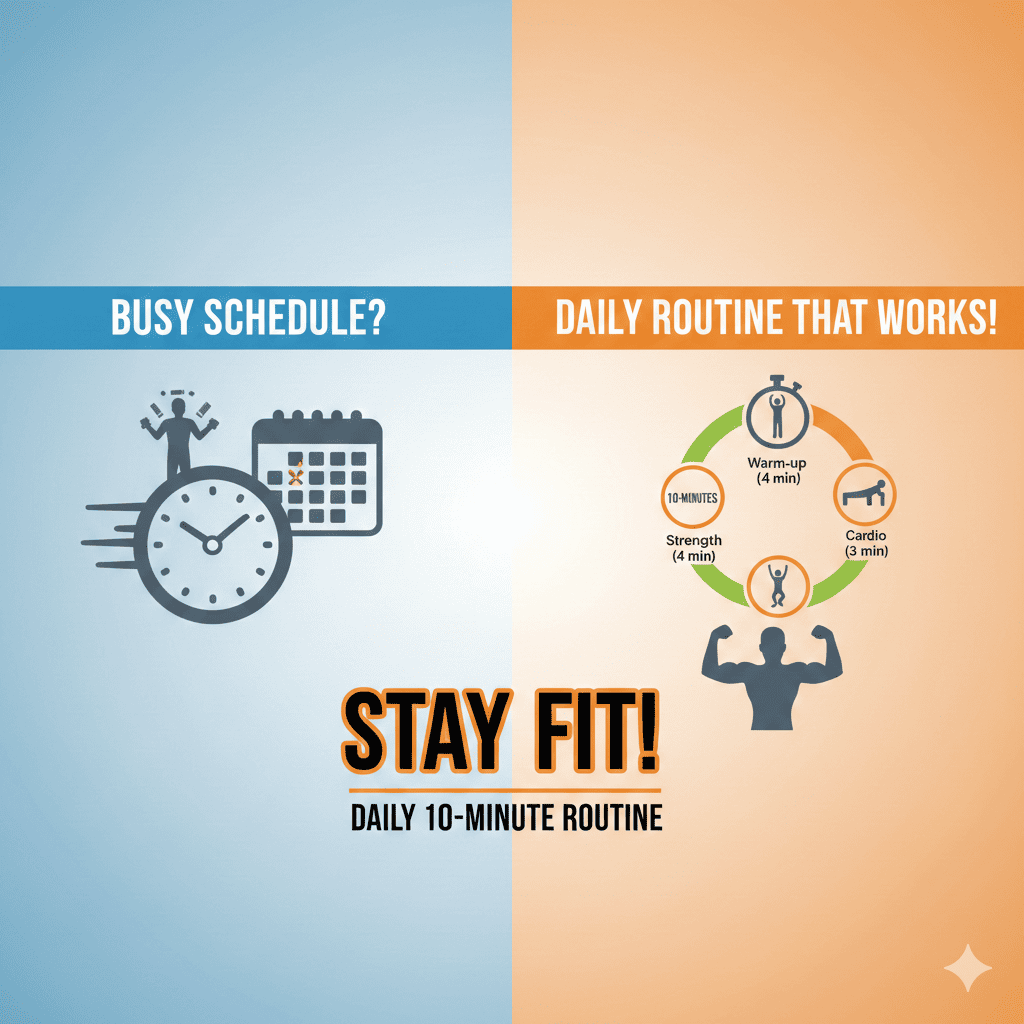
stay fit with a busy schedule Time is the most common excuse preventing people from exercising. Between demanding careers, family obligations, social commitments, household responsibilities, and the basic needs of daily life, finding an hour for the gym feels impossible. Yet the truth is that fitness doesn’t require hours of daily dedication—strategic, efficient exercise can maintain and even improve your fitness in just ten minutes per day. The key to learning how to stay fit with a busy schedule isn’t finding more time but rather using the limited time you have more intelligently.
This comprehensive guide demolishes the myth that busy people can’t be fit. You’ll discover scientifically-backed strategies for maximizing fitness results in minimal time, learn specific 10-minute workout routines that deliver measurable improvements, understand how to integrate movement seamlessly into your existing schedule, and master the mindset shifts that transform fitness from an overwhelming burden into a manageable daily practice. Whether you’re an executive working 60-hour weeks, a parent juggling multiple children’s schedules, a student balancing classes and part-time work, or anyone feeling crushed by competing demands, these strategies will show you how to stay fit with a busy schedule without adding overwhelming complexity to your already full life.
The science is clear: short, intense bouts of exercise provide remarkable health benefits. Ten minutes of focused training elevates your heart rate, strengthens muscles, improves cardiovascular health, enhances mood, boosts energy, and burns calories. When performed consistently, these brief sessions accumulate into substantial fitness improvements over weeks and months. The difference between fit busy people and unfit busy people isn’t available time—it’s the decision to prioritize ten minutes daily for intentional movement. Your schedule is full, but you can find ten minutes. Everyone can. The question is whether you’ll make fitness a non-negotiable priority or continue letting it be the thing that gets dropped when life gets hectic.
The Science Behind Short, Effective Workouts
Understanding Time-Efficient Training
Traditional fitness wisdom suggested that meaningful exercise required 45-60 minute sessions at moderate intensity. Recent research has revolutionized this understanding, demonstrating that high-intensity interval training and strategic resistance work produce equal or superior results in a fraction of the time. The key lies in intensity and structure rather than duration.
When you exercise intensely for brief periods, you create significant metabolic disturbance that requires extended recovery. Your body continues burning elevated calories for hours after a ten-minute workout through excess post-exercise oxygen consumption. This afterburn effect means your brief morning workout influences your metabolism throughout your entire workday—you’re burning additional calories during meetings, while commuting, and even while sitting at your desk.
High-intensity work also triggers powerful hormonal responses. Your body releases growth hormone, testosterone, and other anabolic hormones that support muscle building and fat loss. Exercise elevates endorphins, reducing stress and improving mood—benefits that persist for hours. These hormonal improvements occur even from brief workouts when intensity is sufficient, making ten-minute sessions genuinely effective rather than mere token gestures toward fitness.
The concept of minimum effective dose applies to fitness just as it does to medication. You don’t need maximum possible training volume—you need sufficient stimulus to trigger desired adaptations. For maintaining fitness, preventing disease, managing stress, and supporting healthy body composition, ten focused minutes provides that minimum effective dose. More exercise certainly offers additional benefits, but the difference between zero exercise and ten daily minutes is far more significant than the difference between ten minutes and sixty.
Metabolic and Cardiovascular Benefits
Even brief exercise sessions provide measurable cardiovascular improvements. Studies show that short bouts of intense exercise improve insulin sensitivity, reduce blood pressure, enhance cholesterol profiles, and decrease cardiovascular disease risk as effectively as longer moderate-intensity sessions. Your heart doesn’t know whether you’re ten minutes or sixty minutes into a workout—it responds to the intensity of demand placed on it.
Ten minutes of vigorous exercise substantially elevates your heart rate, forcing your cardiovascular system to adapt by becoming more efficient. Over time, your resting heart rate decreases, your heart’s stroke volume increases, and your body develops more capillaries to deliver oxygen to working muscles. These adaptations accumulate through consistent brief sessions just as they do through occasional long workouts.
Metabolically, short intense workouts excel at improving your body’s ability to utilize glucose and burn fat for fuel. This metabolic flexibility—efficiently switching between fuel sources based on availability—is a hallmark of metabolic health and protects against diabetes, obesity, and metabolic syndrome. Brief daily exercise maintains this flexibility even when your schedule prevents longer training sessions.
Psychological Benefits of Consistency
Perhaps the most underappreciated aspect of brief daily workouts is their psychological impact. A ten-minute commitment is mentally manageable even on your most overwhelming days. This accessibility prevents the all-or-nothing thinking that sabotages fitness for busy people. You can’t find an hour, so you do nothing. But you can always find ten minutes, which means you can always maintain consistency.
Consistency is the most powerful variable in fitness success. Someone exercising ten minutes daily will achieve far better results than someone planning hour-long workouts but executing them sporadically due to schedule conflicts. The person doing ten daily minutes accumulates 70 minutes weekly—more than someone doing one 60-minute session—while building an unbreakable habit that becomes as automatic as brushing teeth.
Short workouts also provide daily wins that build momentum and self-efficacy. Each completed session reinforces your identity as someone who exercises regularly. This psychological reinforcement makes continuing easier and extends beyond fitness—if you can maintain this commitment despite your busy schedule, you develop general confidence in your ability to follow through on intentions.
1. The Ultimate 10-Minute Full-Body Routine
Structure and Timing
This routine requires zero equipment and minimal space, making it executable anywhere—your bedroom before showering, your office during lunch, a hotel room while traveling, or your living room before dinner. The structure alternates between lower body, upper body, and core movements, allowing localized muscle recovery while maintaining elevated heart rate throughout.
Timing Protocol: Perform each exercise for 40 seconds at maximum sustainable intensity, followed by 20 seconds of transition and brief rest. This work-to-rest ratio is challenging yet manageable, creating the intensity necessary for adaptation while allowing you to complete all exercises without complete exhaustion.
The Complete Sequence
Warm-Up (90 seconds) Never skip warming up, even for brief workouts. March in place with high knees for 30 seconds, perform 10 arm circles forward and backward, do 5 bodyweight squats focusing on full range of motion, and finish with 10 torso twists. This brief preparation increases blood flow, lubricates joints, and prepares your nervous system for intense work.
Exercise 1: Jump Squats (40 seconds) Stand with feet shoulder-width apart. Squat down by pushing hips back and bending knees, keeping chest up. Explosively jump upward, reaching arms overhead. Land softly with bent knees and immediately descend into the next squat. If jumping is inappropriate due to space or joint concerns, perform rapid bodyweight squats instead, focusing on speed and depth.
Jump squats engage your entire lower body—quadriceps, hamstrings, glutes, and calves—while elevating heart rate substantially. The explosive power requirement recruits fast-twitch muscle fibers that contribute disproportionately to metabolic rate.
Exercise 2: Push-Ups (40 seconds) Assume plank position with hands under shoulders. Lower your chest to within a few inches of the floor by bending elbows. Push back to starting position. Modify on knees if necessary, or elevate hands on a sturdy surface to reduce difficulty. Focus on controlled movement through full range of motion rather than rushed partial repetitions.
Push-ups develop chest, shoulders, triceps, and core while teaching your body to maintain stability under load—a functional strength pattern applicable to daily activities.
Exercise 3: Mountain Climbers (40 seconds) From plank position, rapidly drive your knees toward your chest in an alternating pattern, like running in place horizontally. Maintain strong plank position throughout—don’t allow hips to pike upward or sag downward. This combines core stability with cardiovascular challenge and hip flexor engagement.
Exercise 4: Reverse Lunges (40 seconds) Stand tall, step one leg backward, and lower your back knee toward the floor while keeping your torso upright. Push through your front heel to return to standing. Alternate legs. Reverse lunges are often easier on knees than forward lunges while providing equivalent muscle engagement.
This unilateral movement builds balanced leg strength while challenging stability and coordination.
Exercise 5: Tricep Dips (40 seconds) Sit on the edge of a sturdy chair or step, place hands beside your hips, and slide forward off the edge. Lower your body by bending elbows to 90 degrees, keeping elbows pointed backward. Press back up to starting position. This targets triceps specifically while also engaging shoulders and chest.
Exercise 6: High Knees (40 seconds) Run in place, driving your knees as high as possible toward your chest with each step. Pump your arms vigorously. This cardiovascular burst elevates heart rate while engaging hip flexors and improving running mechanics.
Exercise 7: Plank Hold (40 seconds) Assume plank position on forearms and toes, body forming a straight line from head to heels. Engage your core by pulling belly button toward spine and squeezing glutes. Hold this position, resisting any hip sagging or piking. This static hold builds tremendous core strength and endurance.
Exercise 8: Burpees (40 seconds) From standing, place hands on floor, jump or step feet back to plank position, perform a push-up (optional), jump or step feet back to hands, and explosively jump upward. This full-body movement combines strength and cardio into one brutally effective exercise.
Burpees are exhausting but remarkably efficient—they engage virtually every muscle while creating substantial metabolic demand.
Cool-Down (90 seconds) Walk in place for 30 seconds to gradually lower heart rate. Perform gentle stretches for major muscle groups: quadriceps, hamstrings, chest, and shoulders, holding each for 15 seconds. Finish with several deep breaths.
This complete routine takes exactly ten minutes and provides comprehensive full-body stimulus. Performed consistently, it maintains cardiovascular fitness, builds functional strength, and supports healthy body composition—all the essential elements of learning how to stay fit with a busy schedule.
2. Strategic Exercise Timing Throughout Your Day
Finding Your Optimal Window
The best time to exercise is whenever you’ll actually do it consistently. While morning workouts offer certain advantages—elevated metabolism throughout the day, consistent execution before daily chaos begins, and the psychological win of accomplishing something positive before facing responsibilities—any consistent time works.
Assess your schedule honestly. When do you have ten guaranteed minutes? For many people, this is immediately after waking before other family members rise or obligations intrude. For others, it’s during lunch break, providing a midday energy boost and mental refresh. Some find that evening workouts help decompress from work stress and create a boundary between professional and personal life.
Test different timing for two weeks each, tracking consistency. The time slot where you achieve the highest adherence rate is your optimal window, regardless of theoretical advantages of other times. An evening workout you complete consistently beats a theoretically superior morning workout you skip half the time.
Leveraging Dead Time
Beyond dedicated workout sessions, busy schedules contain pockets of underutilized time that can accommodate movement. These micro-workouts don’t replace your primary ten-minute session but supplement it, helping you stay fit with a busy schedule by maximizing total daily activity.
Morning Routine Integration Perform squats while brushing teeth, calf raises while preparing coffee, or wall push-ups while waiting for breakfast to cook. These brief activities don’t feel like exercise but accumulate into meaningful movement.
Work Break Movement Take a five-minute movement break every two hours during work. This could be climbing stairs, walking briskly around the building, or performing a quick circuit of desk-appropriate exercises—chair squats, desk push-ups, and standing core twists. These breaks improve focus and productivity while increasing daily activity.
Evening Habit Stacking Perform planks during television commercial breaks, or hold a wall sit while talking on the phone. Attach movement to existing habits, making it automatic rather than requiring separate decisions.
Active Commuting If feasible, walk or bike part of your commute. Park farther from destinations or exit public transit a stop early to add walking. These strategies integrate activity into necessary travel rather than requiring separate time allocation.
Creating Backup Plans
Life disrupts even the best-laid plans. Your primary workout window might occasionally be unavailable due to early meetings, sick children, or unexpected obligations. Having predetermined backup plans prevents these disruptions from derailing your fitness entirely.
Backup Plan A: If your usual time is impossible, identify your secondary time option. If mornings don’t work, you’ll exercise during lunch. If lunch is disrupted, you’ll work out before bed.
Backup Plan B: If no ten-minute block is available, you’ll perform five two-minute movement bursts spread throughout the day. Five micro-workouts totaling ten minutes provides similar benefits to one continuous session.
Backup Plan C: On truly chaotic days, you’ll complete a minimal effective routine—even just three minutes of intense exercise maintains your habit streak and provides meaningful stimulation.
Having these predetermined contingencies eliminates the decision paralysis that occurs when your primary plan fails. You don’t waste mental energy determining what to do—you execute Backup Plan A, B, or C depending on circumstances.
3. Nutrition Strategies for Busy People
Simplifying Healthy Eating
Nutrition is equally important as exercise for fitness, yet busy schedules often lead to convenience-based food choices that undermine training efforts. The solution isn’t complicated meal prep requiring hours of weekend cooking but rather simple strategies that make healthy eating the path of least resistance.
Template Meals: Create three to five meal templates you enjoy and can prepare quickly. For example, a breakfast template might be eggs with vegetables and whole grain toast. A lunch template could be grilled protein over mixed greens with olive oil dressing. A dinner template might include baked chicken, roasted vegetables, and quinoa.
Having these templates eliminates daily decision-making about what to eat. You rotate through your templates based on preference and available ingredients. Once you’ve prepared these meals several times, they become quick and automatic—no recipe consultation required.
Strategic Batch Cooking: Dedicate 30-60 minutes weekly to preparing components that make healthy meals quick to assemble. Cook several chicken breasts, hard-boil a dozen eggs, chop vegetables for the week, and prepare a large batch of quinoa or rice. Store these in clear containers for easy access.
When mealtime arrives, you’re not starting from scratch—you’re assembling prepped components into meals. This dramatically reduces preparation time while ensuring healthy options are readily available.
Protein Prioritization
Adequate protein intake supports muscle maintenance, controls hunger, and enhances the results of your training. Busy schedules often lead to protein-deficient eating—grabbing a bagel for breakfast, eating a large salad for lunch, and then overeating at dinner because you’re ravenously hungry.
Prioritize protein at every meal. Include eggs, Greek yogurt, or protein powder at breakfast. Ensure lunch contains substantial protein—chicken, fish, tofu, or legumes. Make protein the centerpiece of dinner. This structure controls hunger throughout the day, supports muscle maintenance despite minimal training time, and prevents the evening overeating that sabotages many busy people’s fitness efforts.
Keep convenient protein options available for emergencies: protein bars, jerky, hard-boiled eggs, Greek yogurt, or pre-portioned nuts. When unexpected schedule changes prevent planned meals, these options prevent defaulting to nutrient-poor convenience foods.
Hydration Habits
Dehydration impairs exercise performance, increases fatigue, and is often confused with hunger, leading to unnecessary snacking. Yet busy people frequently neglect hydration until they’re significantly dehydrated and feeling the consequences.
Create hydration triggers throughout your day. Drink water immediately upon waking—16 ounces to rehydrate after sleep. Keep a water bottle visible on your desk and aim to refill it specific times—once before lunch, once mid-afternoon. Drink water before meals, which also helps with portion control by creating partial fullness.
Set phone reminders if necessary until drinking regularly becomes automatic. Many people find that simply having water readily available dramatically increases consumption—the friction of accessing water was the primary barrier, not lack of desire to drink it.
4. The Mindset of Fit Busy People
Reframing Fitness as Essential
Busy people prioritize what they deem essential and defer everything else indefinitely. The fundamental mindset shift for learning how to stay fit with a busy schedule is redefining fitness as essential rather than optional.
You don’t skip brushing your teeth because you’re busy. You don’t neglect showering for weeks when work gets hectic. These activities are non-negotiable elements of daily routine. Fitness must occupy this same mental category. It’s not something you do if time allows—it’s a foundational practice you protect regardless of competing demands.
This isn’t about fitness being more important than work or family—it’s about recognizing that your physical health and energy enable everything else. When you’re fit, you have more energy for work, more patience with family, better stress resilience, and improved cognitive function. Fitness isn’t competing with other priorities—it’s supporting them.
Frame your ten-minute workout as an investment in being able to serve all your other responsibilities more effectively. This reframe eliminates guilt about “taking time away” from other obligations. You’re not being selfish—you’re maintaining your capacity to meet all your responsibilities.
Embracing Imperfect Action
Perfectionists struggle with fitness because they believe workouts should be comprehensive, optimal, and executed flawlessly. When busy schedules prevent “proper” workouts, they skip exercise entirely rather than accepting modified versions. This all-or-nothing thinking prevents the consistency necessary for success.
Fit busy people embrace imperfect action. Ten imperfect minutes beats zero perfect minutes. A rushed morning routine completed while children clamor for attention is better than no routine. Modifications due to fatigue or time constraints are better than skipping entirely.
The goal isn’t perfect execution—it’s consistent practice. You’re building a habit that becomes as automatic as any other daily routine. Habits aren’t built through occasional perfect execution but through repeated imperfect practice. Every completion, regardless of quality, reinforces the habit and makes future adherence easier.
Building Systems Over Relying on Motivation
Motivation is unreliable—some days you’ll feel eager to exercise, other days exhausted and resistant. Successful busy people don’t depend on motivation. They build systems that ensure consistency regardless of feeling.
Remove decision points: Decide once, at the beginning of each week, when you’ll exercise. Don’t decide daily—this creates opportunities to skip. Your decision is made. Your only job is execution.
Eliminate barriers: Lay out workout clothes the night before. Keep a yoga mat unrolled in your bedroom. Remove every obstacle between intention and action. The easier you make starting, the more consistent you’ll be.
Create accountability: Tell someone about your ten-minute commitment. Share workout completions on social media. Use a habit-tracking app. External accountability compensates for flagging internal motivation.
Link to existing habits: Attach your workout to an established routine through habit stacking. “After I pour my morning coffee, I’ll complete my workout.” This connection makes the new behavior automatic rather than requiring separate motivation.
5. Adapting Your Routine for Travel and Disruption
Maintaining Fitness While Traveling
Travel disrupts routine more than almost anything else, yet busy people often travel frequently for work or family obligations. Learning to maintain fitness during travel is essential for long-term success.
Hotel Room Workouts: The ten-minute routine described earlier requires no equipment and minimal space, making it perfect for hotel rooms. Many people find that exercising immediately after arriving at their hotel, before unpacking or checking work email, ensures completion before travel fatigue or obligations interfere.
Leverage Hotel Amenities: If your hotel has a gym, even a mediocre one, use it. Ten minutes of treadmill intervals or basic resistance machines maintains your routine. The specific exercises matter less than the consistency of daily movement.
Explore Actively: When traveling, walking extensively to explore new areas provides both fitness benefit and enjoyable tourism. Aim for 10,000+ daily steps through active sightseeing rather than relying solely on transportation. This doesn’t replace your dedicated workout but supplements it meaningfully.
Prepare for Challenges: Pack resistance bands, jumping rope, or suspension trainers if you want equipment options. Download workout videos to your phone for guided sessions. Prepare more thoroughly than you think necessary—travel always presents unexpected challenges, and over-preparation prevents these from derailing your fitness.
Managing Illness and Injury
Even with perfect consistency, illness and injury occur. Knowing how to navigate these disruptions without completely abandoning fitness is crucial for learning how to stay fit with a busy schedule over the long term.
The Neck Check: Use this simple rule for exercising while sick. If symptoms are above the neck—runny nose, sneezing, mild sore throat—light to moderate exercise is typically fine and might even help. If symptoms are below the neck—chest congestion, body aches, fever—rest completely until recovered.
When exercising while mildly ill, reduce intensity substantially. Your goal is maintaining the habit, not achieving personal records. A gentle ten-minute movement session preserves your routine without compromising recovery.
Injury Modification: Most injuries don’t require complete exercise cessation. Lower body injury? Focus on upper body work. Shoulder problem? Emphasize leg training. Work around injuries rather than using them as excuses for complete inactivity.
Consult healthcare professionals for serious injuries, but for minor issues, strategic modification allows continued training. Often, appropriate exercise actually accelerates recovery by maintaining blood flow and preventing deconditioning.
The Two-Day Rule: Never skip more than two consecutive days without exercise unless seriously ill or injured. One missed day is a disruption. Two consecutive days starts breaking the habit. Three consecutive days substantially increases the likelihood of complete abandonment.
If you miss two days for any reason, day three is absolutely non-negotiable. Even if you can only manage five minutes of gentle movement, do something. This prevents disruptions from becoming permanent derailment.
6. Tracking Progress and Maintaining Motivation
Meaningful Metrics Beyond Weight
Many people judge fitness progress solely by scale weight, leading to frustration when weight doesn’t change despite consistent exercise and healthy eating. Weight is influenced by hydration, food volume, hormonal fluctuations, and muscle gain alongside fat loss—it’s a poor exclusive metric for fitness improvement.
Track multiple indicators that reveal true fitness progress:
Performance improvements: Can you complete more push-ups than last month? Hold a plank longer? Perform jump squats for the full 40 seconds without stopping when you previously needed breaks? These performance metrics directly reflect fitness improvements.
Energy levels: Do you feel more energetic throughout the day? Less afternoon fatigue? More mental clarity? These subjective improvements often manifest before objective physical changes and indicate that your fitness routine is working.
Stress resilience: Does exercise noticeably improve your mood and stress management? Are you handling daily challenges with more equanimity? This psychological benefit is as valuable as any physical change.
Body composition: How do your clothes fit? Are certain garments looser in the waist or tighter in the shoulders? Take monthly progress photos—visual changes often precede scale changes and provide powerful motivation.
Consistency: Track workout completion rate. Successfully completing 90% of planned workouts represents tremendous progress regardless of other metrics. Consistency is the ultimate predictor of long-term success.
Creating Milestone Celebrations
Long-term fitness is a marathon, and marathons require periodic milestones to maintain motivation. Create specific achievements to celebrate along your journey.
Consistency milestones: Celebrate completing ten consecutive days of workouts. Then 30 days. Then 100 days. These streak achievements acknowledge the most important variable—showing up consistently regardless of circumstances.
Performance milestones: Set specific strength or endurance goals. Achieving 20 consecutive push-ups, a two-minute plank hold, or 50 continuous jump squats represent concrete achievements worth celebrating.
Health milestones: Improved blood pressure, better cholesterol levels, or enhanced blood sugar control as measured by your physician validate your efforts. These medical improvements often matter more than aesthetic changes.
Celebrations don’t need to be elaborate or expensive. Buying new workout gear, treating yourself to a massage, or simply acknowledging your achievement with friends and family reinforces your success and motivates continued effort.
Finding Community and Accountability
While your ten-minute routine is performed individually, connecting with others pursuing similar goals provides valuable support and accountability. Busy people often feel isolated in their fitness struggles, believing everyone else has more time or finds exercise easier.
Online communities: Join social media groups or fitness forums focused on time-efficient training or fitness for busy professionals and parents. Seeing others navigate similar challenges normalizes your experience and provides practical strategies.
Accountability partners: Find one person—friend, family member, or colleague—to share daily workout completion with. A simple text confirming you completed your routine creates external accountability that compensates when internal motivation wanes.
Lead by example: Share your approach with other busy people in your life. Teaching others reinforces your own commitment while potentially improving the health of people you care about. Creating a culture of fitness within your social circle makes consistency easier for everyone.
7. Sustainable Long-Term Integration
Building Antifragility Into Your Fitness
Nassim Taleb introduced the concept of antifragility—systems that not only withstand stress but actually improve because of it. Apply this concept to your fitness practice. Rather than creating a rigid routine that collapses when disrupted, build flexibility and adaptability into your approach.
Multiple backup plans: As discussed earlier, having predetermined contingencies for when your primary plan fails creates resilience. Disruptions don’t end your fitness—they simply activate alternative approaches.
Varied routine options: While having a default ten-minute workout provides consistency, developing several routine variations prevents boredom and allows adaptation to different circumstances. Have a standard routine, a quiet routine for early mornings when others are sleeping, a cardio-focused routine for high-energy days, and a stretching and mobility routine for recovery days.
Progressive complexity: As fitness becomes ingrained, gradually add complexity if desired. Your base commitment remains ten minutes daily, but on days with more time or energy, you might extend to 15 or 20 minutes. This optional expansion maintains your minimum commitment while allowing growth when circumstances permit.
Redefining Success
For busy people learning how to stay fit with a busy schedule, success isn’t achieving professional athlete status or competitive bodybuilding physiques. Success is maintaining functional fitness, good health, manageable stress, and the energy to fulfill your various life roles effectively.
Reframe your fitness goals around capabilities rather than aesthetics. Can you play actively with your children without exhaustion? Carry groceries without strain? Walk up several flights of stairs without breathlessness? Handle physical demands of your work without fatigue? These functional capabilities matter more than six-pack abs or impressive biceps.
This reframe removes the frustration many busy people feel when comparing themselves to individuals with fewer obligations who can dedicate hours to fitness. You’re not competing with them. You’re maintaining the physical capacity necessary for your life, which requires far less time than most people believe.
The Compounding Benefits of Consistency
The most powerful aspect of brief daily exercise isn’t any single workout’s impact but the compounding effect of consistency. One ten-minute workout provides modest benefits. Ten workouts over two weeks create noticeable improvements. Fifty workouts over three months transform fitness levels. Two hundred workouts over a year produce remarkable changes in strength, endurance, body composition, and health.
Each workout builds on previous ones, creating cumulative adaptation that dramatically exceeds what any individual session provides. This is why consistency matters more than intensity, duration, or exercise selection. Someone consistently completing ten-minute workouts will achieve better long-term results than someone sporadically doing hour-long sessions.
View your fitness journey as a compounding investment. Small daily deposits accumulate into substantial returns over time. Missing individual deposits isn’t catastrophic, but consistent contribution creates wealth. Your physical health is wealth that supports everything else you value in life.
Your Transformation Starts With Ten Minutes
You now possess comprehensive understanding of how to stay fit with a busy schedule through efficient, strategic training that requires only ten minutes daily. You understand the science validating brief intense workouts, have specific routines to follow, know how to integrate fitness into your existing schedule, and have learned the mindset and habits that separate people who maintain fitness despite busy lives from those who perpetually struggle.
The difference between this knowledge and actual fitness is action. Ten minutes daily. Not someday when your schedule calms down—schedules never calm down. Not when you have more time—you’ll never have more time. Starting today with the time you have right now.
Your busy schedule is real. Your obligations are genuine. Your lack of time is legitimate. None of this changes the fact that you can find ten minutes. You can wake ten minutes earlier. You can use ten minutes of your lunch break. You can exercise for ten minutes before bed. The time exists. The question is whether you’ll prioritize using it for fitness.
Three months from now, you could be significantly fitter than you are today. You could have completed 90 workouts, each building on the previous one. You could have more energy, better stress management, improved health markers, and the confidence that comes from consistently following through on commitments to yourself. Or you could still be planning to start exercising when your schedule allows.
Your schedule will never allow it—you must decide to do it regardless. Make today the day you begin your ten-minute practice. Not perfectly. Not optimally. Just consistently, one day at a time, proving to yourself that even impossibly busy people can stay fit with a busy schedule through strategic, efficient action. The transformation you want is ten minutes away. Every day. Starting now.
Also read this:
Healthy Eating Plan for Weight Loss Without Dieting — Easy, Sustainable & Beginner-Friendly
How to Increase Body Strength at Home: Simple No-Equipment Exercises for Beginners
8 Best Morning Exercises to Boost Metabolism and Burn Calories All Day