
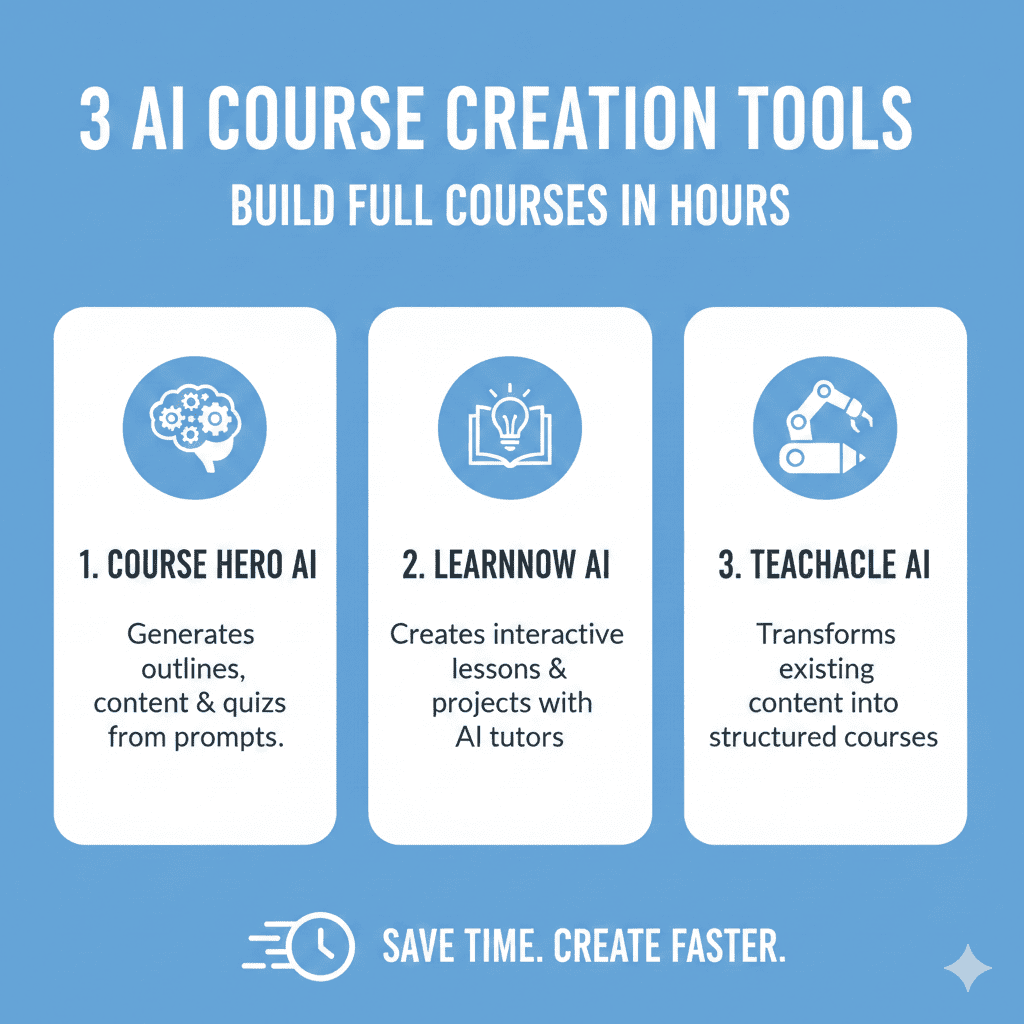
The online education industry has exploded into a multi-billion dollar marketplace, yet creating comprehensive, engaging courses remains one of the most time-consuming challenges facing educators, entrepreneurs, and subject matter experts. Traditional course development requires months of planning, content creation, video production, assessment design, and technical implementation. Now, AI course creation tools are revolutionizing this landscape, compressing timelines from months to mere hours while maintaining quality and engagement standards that rival traditionally produced content.
The emergence of artificial intelligence in educational content development represents more than simple automation—it’s a fundamental transformation in how knowledge transfer is designed, packaged, and delivered. AI course creation tools leverage natural language processing, machine learning, and intelligent content generation to handle the heavy lifting of instructional design, allowing creators to focus on their unique expertise and insights rather than wrestling with technical implementation or pedagogical frameworks they may not fully understand.
For subject matter experts who possess valuable knowledge but lack formal instructional design training, these tools democratize course creation. For established educators looking to scale their impact, AI course creation tools multiply productivity exponentially. For entrepreneurs building education businesses, these platforms compress time-to-market and enable rapid iteration based on student feedback. Regardless of your specific context, understanding how to leverage these powerful platforms can transform your ability to share knowledge and generate revenue through educational content.
This comprehensive guide explores three cutting-edge AI course creation tools that are genuinely capable of producing complete, professional courses in hours rather than months. We’ll examine their capabilities, explore best practices for maximizing results, and provide strategic guidance for choosing and implementing the solution that best fits your needs, expertise level, and educational goals.
1. CourseAI: Complete Course Generation from Simple Topics
CourseAI stands at the forefront of AI course creation tools, offering an end-to-end platform that transforms simple topic ideas into comprehensive, structured courses complete with lessons, assessments, multimedia suggestions, and even marketing materials. The platform’s sophisticated algorithms understand instructional design principles and apply them automatically, ensuring that AI-generated courses follow proven pedagogical frameworks without requiring creators to possess formal education training.
Intelligent Course Outline Generation
CourseAI’s process begins with topic analysis. You provide a course subject—anything from “Python Programming for Beginners” to “Advanced Social Media Marketing Strategies” to “Mastering Watercolor Painting Techniques”—and the AI analyzes the domain, identifies key concepts, determines optimal learning sequences, and generates comprehensive course outlines that progress logically from foundational concepts to advanced applications.
The generated outlines aren’t generic templates but contextually appropriate structures that reflect the specific subject matter. Technical courses receive different organizational frameworks than creative courses. Beginner-level content structures differently than advanced material. This contextual intelligence ensures that when you use AI course creation tools like CourseAI, the resulting structure serves the content rather than forcing content into rigid templates.
Each course outline includes suggested module breakdown, lesson titles, learning objectives for each section, estimated completion times, and recommended content formats. This comprehensive planning eliminates the blank-page paralysis that often stalls traditional course development, providing clear roadmaps that guide subsequent content creation.
Automated Lesson Content Development
Once you approve the course outline, CourseAI generates detailed lesson content for each section. The AI produces explanatory text, creates examples and case studies, designs practice exercises, and suggests visual elements that support learning objectives. This automated content generation dramatically accelerates development timelines while maintaining educational coherence and engagement.
The platform’s natural language generation capabilities produce content that reads naturally rather than obviously AI-generated. Explanations flow logically, examples illustrate concepts effectively, and technical accuracy remains high across diverse subject areas. While human review and refinement improve results, the AI-generated foundation provided by these AI course creation tools is typically 70-80 percent complete, requiring only subject matter expert validation and personalization rather than creation from scratch.
Content customization options allow adjusting tone, complexity level, content depth, and teaching style. Create conversational courses that feel like one-on-one coaching or formal academic courses with scholarly rigor. Adjust reading levels from middle-school accessibility to graduate-level sophistication. These flexibility options ensure AI-generated content aligns with your target audience’s needs and expectations.
Assessment and Quiz Generation
Effective courses require assessments that verify learning and provide feedback. CourseAI automatically generates quizzes, assignments, and assessments aligned with each lesson’s learning objectives. The AI creates multiple-choice questions, true-false items, short answer prompts, and project assignments that test both knowledge retention and practical application.
Assessment difficulty calibrates appropriately to content complexity and target audience level. Introductory lessons receive foundational questions that verify basic comprehension, while advanced sections include challenging scenarios that test deeper understanding and practical application. This intelligent assessment design ensures that AI course creation tools produce courses with meaningful evaluation components rather than perfunctory testing.
Detailed answer explanations accompany each quiz question, transforming assessments from mere testing instruments into additional learning opportunities. When students answer incorrectly, they receive explanations that clarify misconceptions and reinforce correct understanding, enhancing the overall educational experience.
Multimedia Integration Suggestions
Modern online courses require more than text—video, audio, infographics, interactive elements, and visual aids enhance engagement and accommodate diverse learning preferences. CourseAI doesn’t generate multimedia directly but provides detailed suggestions for visual elements, video content, interactive components, and supplementary resources that would enhance each lesson.
These suggestions include specific recommendations for what to illustrate visually, concepts that benefit from video demonstration, topics suitable for interactive exercises, and external resources that provide additional depth. This guidance helps non-technical creators understand where multimedia investment delivers maximum educational impact when they use AI course creation tools to develop their content.
2. Coursebox: AI-Powered Learning Management with Course Generation
Coursebox combines intelligent course generation with complete learning management system functionality, providing an all-in-one platform for creating, hosting, and delivering online education. Unlike tools that focus solely on content generation, Coursebox provides the entire infrastructure needed to launch and operate educational programs, making it particularly valuable for those building education businesses rather than simply creating content for existing platforms.
Rapid Course Drafting from Documents
Coursebox’s most distinctive feature is its ability to generate course structures and content from existing materials. Upload documents, presentations, videos, or even website links, and the AI analyzes the content, extracts key concepts, organizes information into logical learning sequences, and generates complete course drafts. This capability is revolutionary for subject matter experts who have existing content but haven’t structured it for formal education delivery.
The platform identifies redundancies, fills gaps, suggests improved sequencing, and transforms raw information into pedagogically sound learning experiences. Industry reports become professional development courses. Research papers transform into academic modules. Business presentations evolve into training programs. This content transformation capability makes Coursebox one of the most versatile AI course creation tools for professionals with existing expertise but limited time for traditional course development.
Document analysis goes beyond simple text extraction. The AI identifies hierarchies in information, recognizes relationships between concepts, and determines which ideas serve as prerequisites for others. This intelligent analysis ensures that generated courses present information in orders that facilitate genuine understanding rather than arbitrary sequences that may confuse learners.
AI Tutor and Student Engagement
Coursebox includes an AI tutor that provides personalized support to students enrolled in courses created on the platform. This virtual assistant answers questions, provides additional explanations, offers encouragement, and guides students through difficult concepts. The AI tutor understands course content and can respond to student inquiries with contextually appropriate information drawn from lesson materials.
This automated support capability extends the reach of course creators dramatically. Instead of personally answering repetitive questions or providing individual support, creators can rely on AI tutors to handle routine inquiries while they focus on complex questions requiring human expertise. This scalability makes AI course creation tools like Coursebox particularly valuable for those aiming to serve large student populations without proportionally scaling support resources.
The AI tutor learns from interactions, improving response quality over time and identifying common confusion points that might indicate content requiring clarification or additional explanation. These insights help creators continuously improve course quality based on actual student experience rather than assumptions about where learners might struggle.
Integrated Assessments and Certificates
Coursebox automatically generates assessments aligned with course content and tracks student progress through integrated analytics. The platform creates quizzes that verify comprehension, assignments that encourage application, and final assessments that comprehensively evaluate learning outcomes. All assessment components integrate seamlessly with the learning management system, providing automated grading, instant feedback, and progress tracking.
Certificate generation rewards course completion, providing students with credentials they can share professionally. Customizable certificate designs maintain brand consistency while recognizing student achievement. This professional credentialing capability transforms courses from simple information delivery into recognized learning experiences that students value for career development, making AI course creation tools with integrated LMS functionality particularly attractive for professional development and corporate training applications.
White-Label and Branding Options
Coursebox provides white-label functionality that allows presenting courses under your own branding without platform attribution. Custom domains, branded interfaces, personalized email communications, and tailored visual designs ensure that student experiences reflect your brand identity rather than generic platform aesthetics.
This branding capability is essential for education entrepreneurs building recognizable brands, corporations developing internal training programs, or professionals establishing authority in their industries. The ability to create, host, and deliver fully branded educational experiences using AI course creation tools eliminates the need for complex technical infrastructure while maintaining professional presentation standards.
3. Mini Course Generator: Streamlined Creation for Focused Learning Modules
Mini Course Generator takes a different approach than comprehensive course platforms, focusing specifically on creating concise, focused learning modules that can be completed in single sessions. This specialization makes it ideal for microlearning applications, lead magnets, introductory content, or supplementary training materials that complement more extensive educational programs.
Rapid Microlearning Content Creation
Mini Course Generator excels at producing compact, focused courses that teach specific skills or concepts in 30-60 minutes. These bite-sized learning experiences align with modern consumption preferences where learners increasingly favor focused, immediately applicable content over extensive programs requiring long-term commitment.
The platform guides you through defining learning objectives, identifying key concepts, and determining the minimum information necessary to achieve stated outcomes. This disciplined focus ensures that generated courses remain concise and practical rather than wandering into peripheral topics or unnecessary detail. The result exemplifies how AI course creation tools can serve specific pedagogical approaches—in this case, microlearning—rather than attempting to be all things to all applications.
Content generation emphasizes clarity and actionability. Lessons include clear takeaways, practical exercises, and immediate application opportunities. This action-oriented approach makes Mini Course Generator particularly effective for skill-based training, software tutorials, process documentation, and professional development applications where learners seek specific capabilities rather than comprehensive domain mastery.
Interactive Elements and Engagement Features
Despite their brevity, courses created with Mini Course Generator include interactive elements that maintain engagement and verify comprehension. Quick knowledge checks, interactive scenarios, reflection prompts, and practical exercises break up content delivery and provide active learning opportunities.
These engagement features transform passive content consumption into active learning experiences. Rather than simply reading or watching, students interact, respond, and apply concepts throughout their learning journey. This active engagement improves retention and ensures that even brief courses deliver genuine educational value rather than superficial information exposure through AI course creation tools designed for quick delivery.
The platform includes gamification elements like progress indicators, achievement badges, and completion rewards that provide psychological satisfaction and encourage course completion. These motivational features prove particularly important for self-paced learning where external accountability mechanisms may be absent.
Lead Generation and Marketing Integration
Mini Course Generator includes built-in lead generation and marketing features that make courses valuable business development tools beyond their educational merit. Integrate email capture forms, connect to marketing automation platforms, trigger follow-up sequences based on course completion, and track conversion metrics from educational content to paid products or services.
This marketing integration makes Mini Course Generator particularly valuable for entrepreneurs, consultants, coaches, and service providers using education as client acquisition strategy. Free or low-cost mini-courses demonstrate expertise, provide value, build trust, and create natural transitions to paid services or comprehensive programs. The ability to create these lead generation assets using AI course creation tools in hours rather than weeks dramatically accelerates marketing development timelines.
Analytics track not just learning outcomes but business metrics—conversion rates, email capture success, downstream purchases, and engagement patterns. These insights help optimize courses for both educational effectiveness and business performance, ensuring that content serves dual purposes of knowledge transfer and commercial success.
Simple Deployment and Sharing
Courses created with Mini Course Generator deploy through simple links that work across devices without requiring special software or platform accounts. This frictionless access maximizes completion rates by eliminating technical barriers that might prevent interested learners from accessing content.
Sharing options include direct links, embeddable widgets for websites, social media integration, and QR codes for offline promotion. This versatile distribution makes courses created with these AI course creation tools accessible wherever your audience exists, whether that’s email lists, social platforms, websites, or physical marketing materials.
4. Best Practices for Using AI Course Creation Tools Effectively
While AI course creation tools dramatically accelerate development timelines, strategic approaches maximize their effectiveness and ensure that AI-generated courses deliver genuine educational value and achieve your specific objectives.
Start with Clear Learning Objectives
The quality of AI-generated courses depends heavily on the clarity of input provided. Before engaging any platform, define specific learning objectives—what should students know, understand, or be able to do after completing your course? These objectives guide AI content generation, ensuring that produced materials serve defined purposes rather than wandering into tangential topics.
Well-defined objectives also enable effective quality evaluation. You can objectively assess whether AI-generated content addresses stated goals, identify gaps requiring additional material, and recognize superfluous content that dilutes focus. This objective-driven approach ensures that AI course creation tools produce purposeful content aligned with educational intentions rather than generic information dumps.
Frame objectives using action verbs that specify observable outcomes—”students will be able to create,” “analyze,” “evaluate,” “implement,” or “design” rather than vague intentions like “understand” or “learn about.” This specificity provides concrete targets that guide both content generation and subsequent assessment design.
Review and Refine AI-Generated Content
AI-generated content provides excellent foundations but typically requires human refinement to achieve optimal quality. Review generated materials for accuracy, add personal anecdotes and examples that reflect your unique experience, adjust tone to match your communication style, and incorporate current examples that may postdate the AI’s training data.
This human refinement transforms good AI-generated content into great courses that reflect your expertise and personality. Students enroll in courses not just for information—which they could find freely online—but for the unique perspective, practical insights, and authentic expertise that only you can provide. Adding these elements to foundations created by AI course creation tools creates courses that combine AI efficiency with human authenticity.
Pay particular attention to examples and case studies. AI often generates generic illustrations that lack the specificity and relevance that make concepts memorable and applicable. Replace generic examples with industry-specific cases, current events, or personal experiences that resonate with your target audience and demonstrate real-world application.
Add Multimedia to Enhance Engagement
Text-based content forms the foundation of most AI-generated courses, but multimedia elements dramatically improve engagement and accommodate diverse learning preferences. Supplement AI-generated text with video explanations, audio narration, infographics, screen recordings, or interactive simulations that bring concepts to life.
You don’t need Hollywood production quality—authentic, clear communication matters more than technical polish. Simple screen recordings, webcam videos, or smartphone footage often prove more effective than overproduced content that feels impersonal or intimidating. The key is using AI course creation tools to handle content structure and text generation while you focus human effort on multimedia elements that showcase your personality and expertise.
Consider where multimedia adds most value. Complex processes benefit from video demonstrations. Statistical information becomes more digestible through visual infographics. Abstract concepts clarify through animated explanations. Strategic multimedia placement maximizes impact while managing production time and costs efficiently.
Test with Real Students Before Full Launch
Even the most sophisticated AI course creation tools cannot predict how real students will experience your course. Before investing in extensive marketing or committing to large student cohorts, test courses with small groups who provide feedback on clarity, pacing, difficulty, and engagement.
Beta testing reveals confusion points that seemed clear during creation, identifies content gaps that need addressing, surfaces technical issues that impede learning, and provides insights into how long lessons actually take to complete. This feedback enables refinement that transforms adequate courses into excellent learning experiences.
Offer beta access at reduced rates or free in exchange for detailed feedback. This approach builds your initial student base, generates testimonials and reviews, and provides valuable improvement insights before full launch. The rapid development enabled by AI tools makes this iterative refinement approach practical—quickly generate course versions, test, refine, and re-release based on learner feedback.
Maintain Consistent Updates and Improvements
Online course markets are increasingly competitive, and static courses quickly become dated. Leverage the efficiency of AI course creation tools to maintain courses current with regular updates that incorporate new developments, respond to student feedback, address emerging questions, and refresh examples to maintain relevance.
Regular updates signal to prospective students that courses remain current and that you’re actively engaged in maintaining quality. This ongoing attention builds trust and justifies premium pricing compared to abandoned courses that haven’t been touched since initial creation.
Use AI tools to rapidly generate content addressing new topics, create supplementary materials responding to common questions, or develop advanced modules for students who complete initial courses and want deeper exploration. This content expansion capability transforms single courses into comprehensive learning pathways that serve students through multiple stages of development.
5. Monetization Strategies for AI-Generated Courses
Creating courses efficiently matters little if they don’t generate revenue or achieve intended business objectives. These strategies help convert courses created with AI course creation tools into profitable assets that support your business goals.
Tiered Pricing Models
Offer courses at multiple price points with different feature sets. Basic tiers provide core content at accessible prices, attracting budget-conscious learners and those uncertain about value. Premium tiers add coaching calls, personalized feedback, exclusive communities, or advanced modules, serving students willing to invest more for enhanced experiences and support.
This tiered approach maximizes revenue by capturing both price-sensitive and premium segments. Some students gladly pay premium prices for additional support and access, while others prefer self-study at lower price points. Offering both options maximizes total addressable market without leaving money on table from students willing to pay more.
Use AI course creation tools to rapidly create content variations that serve different tiers. Generate basic courses quickly, then add supplementary materials, advanced modules, or implementation guides that justify premium pricing for students seeking deeper engagement.
Subscription and Membership Models
Rather than selling individual courses, offer subscription access to course libraries that grow over time. This recurring revenue model provides predictable income streams, increases customer lifetime value, and creates incentives for continuous content creation that serves subscriber needs.
The rapid development enabled by AI course creation tools makes subscription models practical by enabling regular content releases that justify ongoing membership fees. Commit to monthly or quarterly new course additions, keeping libraries fresh and providing continuing value that discourages cancellation.
Community features complement subscription models by adding social learning dimensions that students value beyond content access alone. Membership communities where students interact, share experiences, and support each other’s learning create additional value that reduces price sensitivity and improves retention.
Corporate Training and Licensing
Companies invest heavily in employee training and development. Courses created with AI course creation tools can serve corporate markets through licensing arrangements where organizations pay for employee access, custom versions tailored to company-specific processes, or white-label versions branded for internal deployment.
Corporate pricing typically exceeds consumer pricing significantly, reflecting the business value of employee skill development and organizations’ larger budgets. A course selling for $99 to individuals might license to corporations for thousands or tens of thousands of dollars depending on employee count and customization requirements.
Approach corporate sales by demonstrating how your courses address specific business challenges—improving sales effectiveness, reducing onboarding time, enhancing customer service quality, or ensuring regulatory compliance. Frame value in business outcomes rather than just educational content.
Lead Generation for High-Ticket Services
Free or low-cost courses serve as powerful lead generation tools for coaching, consulting, or service businesses. Use AI course creation tools to rapidly create introductory courses that demonstrate expertise, provide immediate value, build trust, and naturally lead to discovery calls for premium services.
This educational marketing approach attracts qualified prospects who self-identify through course enrollment, pre-qualifies leads by demonstrating serious interest, builds relationship and trust before sales conversations, and positions you as expert authority. Students who complete courses and find value are exponentially more likely to purchase premium services than cold prospects.
Structure lead generation courses to naturally surface opportunities for deeper engagement. Identify common challenges that arise during implementation and offer consulting to address them. Include assessments that help students understand where they need additional support. Create frameworks that work at basic levels but deliver exponentially better results with expert guidance.
6. Common Mistakes to Avoid with AI Course Creation Tools
Understanding pitfalls helps you navigate the course creation process more effectively and avoid disappointments that undermine the powerful capabilities these platforms provide.
Accepting AI Output Without Critical Review
The most dangerous mistake is treating AI-generated content as final product without human review. While AI course creation tools produce impressive results, they occasionally include inaccuracies, outdated information, or generic content that doesn’t reflect your unique expertise and perspective.
AI lacks your specific industry experience, recent developments that postdate training data, nuanced understanding of target audience challenges, and personal teaching style that makes your courses distinctive. These human elements transform good courses into great ones that students enthusiastically recommend and review positively.
Establish review processes where you critically evaluate all AI-generated content for accuracy, relevance, currency, and alignment with your teaching philosophy before publishing. This quality assurance prevents embarrassing mistakes and ensures courses truly represent your expertise rather than generic AI output.
Over-Complicating Course Structure
AI can generate extensive, complex course structures that cover topics comprehensively but may overwhelm students and reduce completion rates. Bigger isn’t always better—focused courses that students actually complete often generate better outcomes than ambitious programs that discourage learners through excessive scope.
When using AI course creation tools, resist the temptation to include everything AI suggests. Edit ruthlessly, removing content that doesn’t directly serve core learning objectives. Break overly ambitious courses into focused modules that students can complete and feel accomplished about rather than comprehensive programs that intimidate through sheer scope.
Monitor completion rates and student feedback to identify where courses may be too long, too complex, or too ambitious. Simplify when appropriate, even if it means removing content you’ve created. Completed shorter courses deliver more value than abandoned comprehensive programs.
Neglecting Course Marketing
Creating courses quickly with AI course creation tools provides no value if nobody enrolls. Allocate substantial energy to marketing—building audiences, creating compelling offers, demonstrating value, and driving enrollments. Many creators focus entirely on creation while neglecting promotion, resulting in excellent courses that few people discover.
Develop marketing plans before completing course creation. Identify target audiences, determine where they consume information, create content that attracts attention, build email lists of interested prospects, and establish authority in your subject area. These marketing foundations ensure that completed courses reach receptive audiences rather than launching to silence.
Use course creation speed enabled by AI tools to experiment with different topics, identifying which subjects attract most interest before investing heavily in any single direction. Create multiple mini-courses on related topics, measure engagement and enrollment, then develop comprehensive programs around subjects that prove most popular.
Ignoring Student Feedback and Data
AI course creation tools enable rapid course creation, but data-driven refinement determines long-term success. Student feedback, completion rates, assessment scores, and engagement metrics reveal what works and what doesn’t, guiding improvements that enhance educational effectiveness and business performance.
Implement systems for gathering feedback systematically—post-lesson surveys, completion questionnaires, email check-ins, or community discussions where students share experiences. Analyze this qualitative feedback alongside quantitative metrics to develop comprehensive understanding of student experience.
Act on insights rather than just collecting data. If students consistently struggle with specific concepts, add clarification or alternative explanations. If engagement drops at certain points, investigate causes and address them. If assessments reveal knowledge gaps, adjust content to better address those areas. This continuous improvement approach ensures courses evolve toward excellence rather than remaining static at initial AI-generated quality levels.
7. The Future of AI in Course Creation
Understanding emerging trends helps you make strategic decisions about platforms, capabilities, and approaches that will serve your educational goals long-term as AI course creation tools continue evolving.
Personalized Learning Paths
Next-generation AI tools will create personalized learning experiences that adapt to individual student needs, backgrounds, and learning speeds. Rather than delivering identical content to all students, these systems will adjust explanations, provide targeted practice, offer additional support where needed, and accelerate through material students already understand.
This personalization will make courses created with AI course creation tools more effective by ensuring optimal challenge levels for each learner—difficult enough to promote growth but not so challenging that students become frustrated and quit. Adaptive systems maximize learning efficiency while improving completion rates and student satisfaction.
Multimedia Generation Capabilities
Current AI course creation tools primarily generate text content, with multimedia creation remaining human responsibility. Emerging capabilities in AI video generation, voice synthesis, and interactive content creation will soon enable platforms to produce complete multimedia courses including video lessons, audio narrations, and interactive simulations—all generated automatically from topic descriptions.
These capabilities will further compress course creation timelines while making professional-quality multimedia accessible to creators without video production skills or budgets. However, the most effective courses will still likely combine AI-generated foundations with authentic human elements that showcase creator personality and expertise.
Real-Time Content Updates
AI systems will monitor subject areas for new developments, emerging best practices, and updated information, automatically suggesting or even implementing course updates that keep content current without manual monitoring and revision. This proactive maintenance will ensure courses remain relevant in rapidly evolving fields where information quickly becomes outdated.
Integration with Virtual and Augmented Reality
As VR and AR technologies become mainstream, AI course creation tools will incorporate these immersive formats, enabling creation of experiential learning environments where students practice skills in simulated environments, explore concepts in three-dimensional space, or interact with virtual representations that make abstract ideas concrete and memorable.
Conclusion: Transforming Education Through AI-Powered Course Creation
The three AI course creation tools examined—CourseAI, Coursebox, and Mini Course Generator—represent the cutting edge of educational content development, enabling subject matter experts, educators, and entrepreneurs to create comprehensive courses in hours rather than months. This dramatic acceleration doesn’t compromise quality but instead applies artificial intelligence to handle technical and pedagogical frameworks, allowing creators to focus on their unique expertise and insights.
Success with these platforms requires understanding both their capabilities and limitations. AI course creation tools provide outstanding foundations, handling structure, generating initial content, and implementing instructional design principles automatically. However, human refinement, personal insights, current examples, and authentic teaching personality transform good AI-generated courses into exceptional learning experiences that students value, complete, and recommend enthusiastically.
The democratization of course creation through AI technology means that expertise no longer remains locked in the minds of subject matter experts due to creation barriers. Anyone with valuable knowledge can now share it effectively, building education businesses, establishing authority, generating passive income, or simply contributing to collective human knowledge by making expertise accessible to those who need it.
Start your course creation journey by selecting the platform that best aligns with your specific needs, learning its capabilities thoroughly, creating your first course using AI assistance, gathering feedback from real students, refining based on that feedback, and iterating toward excellence. The efficiency of AI course creation tools makes this experimental, iterative approach practical—try ideas quickly, measure results, and double down on what works while adjusting or abandoning what doesn’t.
The future of education is personalized, accessible, and created at scale by experts across every domain leveraging AI assistance to share knowledge efficiently. These tools provide everything you need to participate in this transformation, turning your expertise into educational experiences that serve learners worldwide while building sustainable businesses around your knowledge and passion.
Also read this:
5 AI Automation Tools That Build Complete Business Systems