
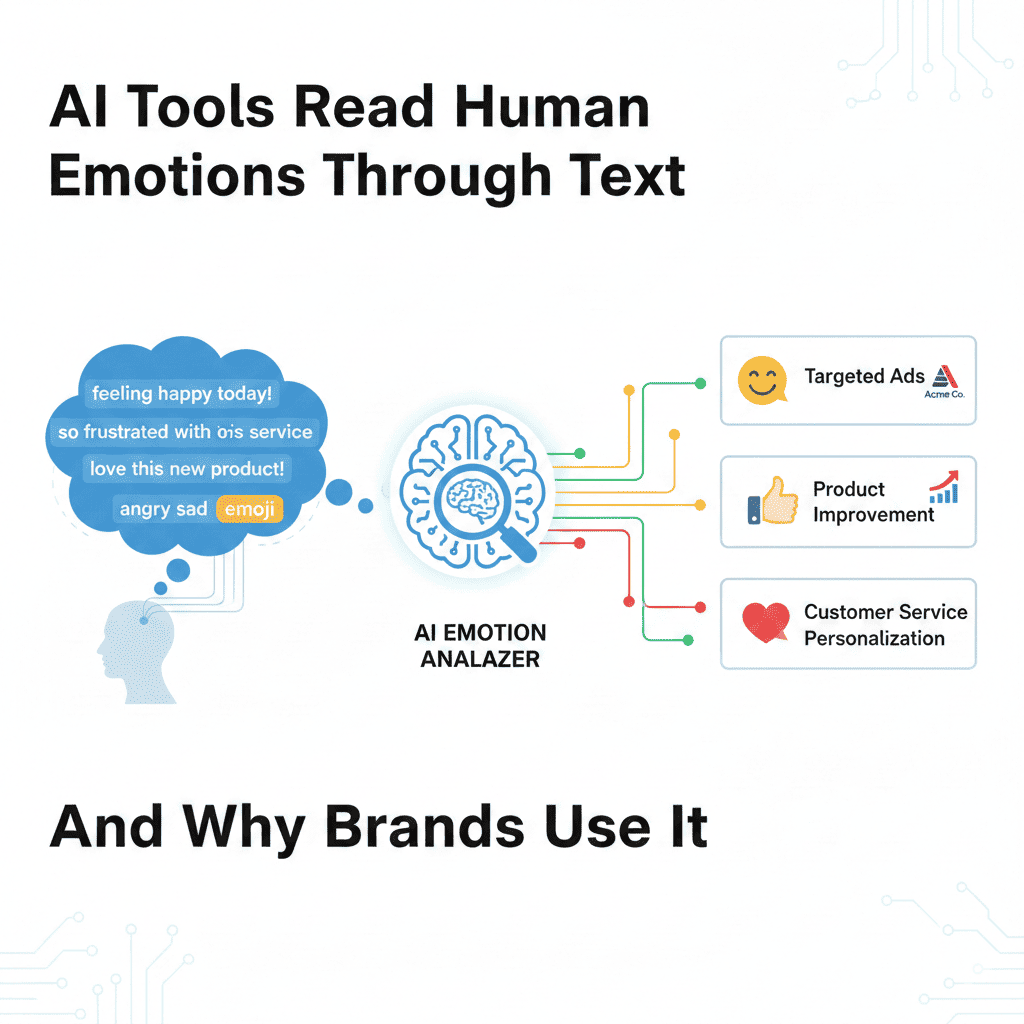
AI tools can now Read Human Emotions Through Text Human communication has always been more than words. When we speak face-to-face, we rely heavily on tone of voice, facial expressions, body language, and countless subtle cues to understand not just what someone is saying, but how they feel about it. Yet in our increasingly digital world, most communication happens through text—emails, messages, social media posts, reviews, and comments—where these emotional signals seem to disappear. Or do they?
The truth is that emotions leave traces in text, even when we’re not consciously expressing them. Word choices, sentence structures, punctuation patterns, and linguistic rhythms all encode emotional information that trained observers can detect. But human analysts can only process limited amounts of text, and their interpretations vary based on their own emotional states and biases. This is where artificial intelligence transforms the landscape. AI tools can now Read Human Emotions Through Text with remarkable accuracy, analyzing thousands of messages in seconds to detect subtle emotional patterns that might take human analysts days to identify.
This capability extends far beyond simple positive-negative sentiment classification. Modern AI systems can detect complex emotional states like anxiety, frustration, excitement, confusion, trust, and skepticism. They can track how emotions shift throughout a conversation, identify when someone is masking their true feelings, and even predict emotional responses before they’re explicitly stated. For businesses, researchers, mental health professionals, and anyone who needs to understand how people truly feel, these tools represent a revolutionary advancement in emotional intelligence at scale.
1. The Science Behind Emotional Text Analysis
Understanding how AI can Read Human Emotions Through Text requires exploring the linguistic markers that reveal emotional states, even when writers try to appear neutral.
Lexical Emotional Signals
The most obvious emotional indicators are the words themselves. Beyond explicit emotion words like “happy” or “angry,” people reveal feelings through their vocabulary choices. Someone experiencing anxiety might use more words related to uncertainty, caution, and future concerns. A confident person uses more definitive language and fewer hedging terms like “maybe,” “possibly,” or “I think.”
AI systems trained on millions of emotionally labeled texts learn these associations with nuanced precision. They recognize that “fine” often signals dissatisfaction rather than genuine contentment, especially when paired with certain contextual markers. They understand that excessive politeness sometimes masks frustration, and that very brief responses can indicate disengagement or anger depending on context.
Syntactic and Structural Patterns
How people construct sentences reveals emotional state as clearly as word choice. Anxious or stressed individuals tend to write longer, more complex sentences with multiple qualifications and caveats. Angry people often use shorter, more forceful sentences with emphatic punctuation. Depressed individuals might show reduced linguistic complexity and less varied vocabulary.
AI analyzes sentence length distribution, grammatical complexity, use of passive versus active voice, and patterns of subordination. These structural elements create an emotional fingerprint that sophisticated systems can read even when the explicit content seems neutral.
Temporal and Rhythm Signals
The rhythm of communication—response times, message frequency, length variations—carries emotional information. Someone becoming disengaged gradually sends shorter messages with longer delays. Excited individuals respond quickly with increasing message length. Anxious people might over-communicate, sending multiple messages in rapid succession.
Advanced AI tracks these temporal patterns across conversations, identifying emotional trajectories that single-message analysis would miss. The system recognizes when someone’s emotional state is escalating, stabilizing, or declining based on communication rhythm changes.
Contextual and Relational Markers
Emotion isn’t absolute—it’s contextual. The phrase “that’s interesting” might express genuine curiosity in one context and polite dismissal in another. AI systems trained on contextual data learn to interpret expressions based on what came before, who’s speaking, what relationship exists between communicators, and what situation they’re discussing.
This contextual awareness allows AI to distinguish between similar expressions that carry different emotional weight depending on circumstances. The same words from a customer and a colleague might signal entirely different emotional states based on relational and situational context.
2. Core Technologies Powering Emotion Detection
Multiple AI technologies work together to enable systems that Read Human Emotions Through Text with increasing sophistication and accuracy.
Natural Language Processing Foundations
Modern emotion detection builds on advanced natural language processing that understands not just individual words but their relationships, roles, and contextual meanings. NLP systems parse grammar, identify entities and actions, resolve ambiguous references, and understand how different parts of text relate to each other.
This foundational understanding allows emotion detection systems to recognize that “I’m fine with that decision” and “I’m totally fine with that decision” carry different emotional undertones despite similar wording—the intensifier “totally” often signals the opposite of genuine acceptance.
Machine Learning Classification Models
AI emotion detection uses supervised learning on massive datasets of text labeled with emotional states. These models learn patterns connecting linguistic features to emotional classifications, continuously refining their accuracy as they process more examples.
The most sophisticated systems use deep learning architectures that can discover non-obvious patterns humans might never explicitly identify. The AI might learn that a particular combination of word frequency, sentence structure, and punctuation predicts anxiety, even if no individual feature would indicate that emotion alone.
Sentiment Analysis Evolution
Early sentiment analysis simply classified text as positive, negative, or neutral. Modern systems recognize dozens of distinct emotional states with varying intensities. They can detect that someone is not just “negative” but specifically frustrated versus disappointed versus angry, and they can quantify emotional intensity on continuous scales.
AI tools can now Read Human Emotions Through Text This granular emotion detection provides actionable insights that broad positive-negative classifications miss. Knowing a customer is frustrated rather than merely dissatisfied suggests very different response strategies.
Transfer Learning and Pre-trained Models
State-of-the-art emotion detection leverages transfer learning, where models pre-trained on general language understanding are fine-tuned for emotion detection. These models arrive with sophisticated understanding of language structure and meaning, allowing them to achieve high accuracy even with relatively limited emotion-specific training data.
This approach makes powerful emotion detection accessible beyond just the largest tech companies with massive proprietary datasets. Researchers and businesses can now deploy highly capable emotion detection using publicly available pre-trained models adapted to their specific needs.
3. Practical Applications Across Industries
The ability of AI to Read Human Emotions Through Text creates value across virtually every domain where understanding human feelings matters.
Customer Service and Support
Customer service teams receive thousands of messages daily. AI emotion detection automatically prioritizes messages showing high frustration, anger, or distress, ensuring these customers receive immediate attention before situations escalate. The system can also detect when customers express satisfaction despite raising issues, allowing agents to focus on resolution rather than emotional management.
Beyond triage, emotion AI guides agent responses in real-time. When the system detects escalating frustration, it might suggest empathetic language or flag the conversation for supervisor involvement. This emotional awareness transforms customer service from reactive problem-solving to proactive emotional support.
Marketing and Brand Management
Marketing teams use emotion detection to understand how audiences respond to campaigns, products, and brand messaging. Rather than simply counting mentions or categorizing sentiment, they understand the specific emotions their brand evokes—trust, excitement, nostalgia, aspiration—and how these emotions vary across demographics and contexts.
This emotional intelligence informs creative strategy, message testing, and crisis management. When emotion AI detects shifting sentiment in real-time, brands can respond to emerging issues before they become full crises, or capitalize on positive emotional momentum while it’s building.
Human Resources and Workplace Culture
HR teams analyze employee communications—engagement surveys, exit interviews, internal social platforms—to understand workforce emotional health. The AI detects early warning signs of disengagement, identifies teams experiencing stress or conflict, and recognizes when organizational changes are creating anxiety or excitement.
This analysis remains anonymous and aggregated to protect privacy while providing leadership with emotional intelligence about organizational health that individual managers might miss or be too close to assess objectively.
Healthcare and Mental Health Support
Mental health professionals use emotion detection as a screening and monitoring tool. The AI analyzes patient messages, journal entries, or therapy session transcripts to track emotional patterns over time, identify concerning shifts, and flag indicators of crisis that might emerge between sessions.
This doesn’t replace clinical judgment but augments it, helping therapists understand patient emotional trajectories more completely and catch warning signs earlier. For large-scale mental health support like crisis hotlines, emotion AI ensures the most urgent cases receive immediate attention.
Education and Student Support
Educational institutions use emotion detection to understand student engagement, identify struggling learners who might not ask for help, and recognize when students experience confusion, frustration, or disengagement with course material.
In online learning environments where traditional classroom cues are absent, this emotional awareness helps instructors adapt pacing, provide targeted support, and create more responsive learning experiences that address emotional barriers to learning.
4. Key AI Tools and Platforms
Various specialized tools and platforms enable organizations to Read Human Emotions Through Text at scale with different capabilities and focus areas.
Enterprise Sentiment Analysis Platforms
Major platforms like IBM Watson Tone Analyzer, Google Cloud Natural Language API, and Microsoft Azure Text Analytics provide emotion detection as part of broader text analysis suites. These enterprise solutions offer robust APIs, can process high volumes, and integrate with existing business systems.
These platforms typically detect multiple emotion categories, provide confidence scores, and can be customized for industry-specific language and emotion patterns. They’re designed for organizations processing large volumes of customer feedback, social media data, or internal communications.
Specialized Customer Experience Tools
Tools like Clarabridge, Medallia, and Qualtrics integrate emotion detection specifically into customer experience workflows. They don’t just analyze emotion—they route conversations based on emotional content, trigger alerts for concerning emotional patterns, and provide dashboards showing emotional trends across customer touchpoints.
These specialized tools understand customer service contexts deeply, recognizing patterns specific to support interactions and providing insights tailored to CX improvement rather than general text analysis.
Social Media Monitoring Solutions
AI tools can now Read Human Emotions Through Text Platforms like Brandwatch, Sprinklr, and Hootsuite Insights use emotion detection to understand how audiences respond to brands on social media. They track emotional reactions to posts, campaigns, and brand mentions across platforms, providing real-time emotional intelligence about brand perception.
These tools excel at processing high-velocity social media data and understanding platform-specific communication styles where language might be more casual, abbreviated, or emoji-laden than formal business communications.
Research and Academic Tools
Tools like LIWC (Linguistic Inquiry and Word Count), VADER (Valence Aware Dictionary and Sentiment Reasoner), and various Python libraries provide emotion detection for research applications. These tools often emphasize transparency and scientific validation over ease of use, making them valuable for academic research but requiring more technical expertise to deploy.
Researchers use these tools to study emotional patterns in everything from political discourse to mental health forums to literary texts, advancing our understanding of how emotions manifest in language.
Custom AI Models and Frameworks
Organizations with specific needs and technical capabilities build custom emotion detection models using frameworks like TensorFlow, PyTorch, and Hugging Face Transformers. This approach allows complete customization for industry-specific language, proprietary emotional categories, and integration with unique workflows.
While requiring more expertise to implement, custom models can achieve higher accuracy for specific use cases and provide competitive advantages that commercial off-the-shelf solutions can’t match.
5. Understanding Accuracy and Limitations
While AI tools that Read Human Emotions Through Text have become remarkably capable, understanding their limitations ensures appropriate application and realistic expectations.
The Accuracy Question
Modern emotion detection AI achieves accuracy rates between 60-90% depending on the emotional complexity being detected, the text length available, and how well the training data matches the application context. Basic positive-negative sentiment detection approaches 90% accuracy in many contexts, while detecting specific complex emotions like “anxious hopefulness” or “reluctant acceptance” remains more challenging.
This accuracy significantly exceeds what untrained humans achieve at scale, but it’s not perfect. Organizations should treat AI emotion detection as highly informative input rather than definitive truth, especially for high-stakes decisions affecting individuals.
Context and Cultural Challenges
Emotional expression varies across cultures, age groups, and communication contexts. Sarcasm, irony, cultural references, and context-specific language use can confuse even sophisticated AI. A system trained primarily on American English might misinterpret expressions common in British English or other English variants.
The most effective implementations either use models trained on appropriately diverse data or are fine-tuned on data from the specific populations and contexts where they’ll be deployed. Generic emotion detection works reasonably well broadly but specialized contexts benefit from specialized training.
The Cold Start Problem
Emotion detection works best when analyzing substantial text—paragraphs or extended conversations rather than single brief messages. A one-word “fine” provides limited signal compared to a paragraph explaining a situation. This creates challenges in contexts where communications are naturally brief.
Systems partially address this by analyzing patterns across multiple messages over time, building emotional profiles that help interpret individual brief messages within broader conversational context.
Privacy and Ethical Considerations
Analyzing emotional content from text raises privacy concerns that organizations must address thoughtfully. People might not realize their emotional states are being monitored, or they might find such monitoring intrusive even if aware. There’s also risk of emotional data being misused for manipulation rather than genuine service improvement.
Responsible implementation requires transparency about emotion detection usage, clear policies limiting how emotional data is used, and often aggregation that provides insights about groups rather than individuals to protect privacy.
6. Best Practices for Implementation
Successfully deploying AI that Reads Human Emotions Through Text requires thoughtful implementation that maximizes benefits while minimizing risks and limitations.
Define Clear Objectives
Start with specific goals for emotion detection rather than generic “we want to understand emotions better.” Are you trying to improve response times to frustrated customers? Identify employees at risk of burnout? Understand market reception of product launches? Clear objectives guide tool selection, accuracy requirements, and success metrics.
Different objectives might require different emotion detection approaches. Customer service might prioritize detecting frustration and anger accurately, while market research might need nuanced detection of excitement, skepticism, and trust.
Choose Appropriate Tools
Match tools to your specific needs, considering factors like volume of text to analyze, required emotion categories, integration requirements, budget, and technical expertise available. Enterprise platforms suit organizations processing high volumes with integration needs, while smaller-scale applications might use simpler tools or research-grade solutions.
Consider whether you need real-time emotion detection or can batch process text periodically. Real-time applications require more robust infrastructure but enable immediate response to emotional signals.
Train and Validate Models
If using customizable tools or building custom models, invest in training data that represents your specific context. Text from your customer base, industry, or community will contain language patterns that generic models might miss. Validate accuracy on held-out test data before deploying, and continue monitoring accuracy over time.
Remember that language and emotional expression evolve, so models need periodic retraining to maintain accuracy as communication patterns shift.
Combine AI with Human Judgment
Use emotion detection to inform and augment human decision-making rather than automate it completely. The AI might flag messages as highly frustrated, but humans should verify this interpretation and determine appropriate responses. For sensitive applications like mental health support or HR decisions, always maintain human oversight.
This human-in-the-loop approach leverages AI’s scale and pattern recognition while preserving human judgment for nuance, context, and ethical considerations that AI might miss.
Establish Ethical Guidelines
Develop clear policies about how emotional data will be used, who has access, how long it’s retained, and what uses are prohibited. Be transparent with people whose emotions are being analyzed—ideally obtaining consent for emotion monitoring and explaining how insights will be used.
Consider establishing review boards or ethical oversight for sensitive applications, particularly those affecting employment, mental health treatment, or other high-stakes contexts.
Monitor and Iterate
Regularly review emotion detection outputs to identify patterns in errors or limitations. Are certain types of expressions consistently misclassified? Do certain demographic groups or communication styles show lower accuracy? Use these insights to refine your implementation, retrain models, or adjust how insights are used.
Gather feedback from users interacting with systems informed by emotion detection. Customer service agents can report whether emotion flags accurately reflect customer states, helping validate and improve the system.
7. Advanced Capabilities and Emerging Trends
The field of AI Reading Human Emotions Through Text continues evolving rapidly, with new capabilities emerging that extend beyond basic emotion classification.
Emotional Trajectory Tracking
Advanced systems don’t just identify current emotional state—they track how emotions evolve throughout conversations or over longer periods. This trajectory analysis reveals whether someone’s frustration is escalating or resolving, whether treatment is improving a patient’s emotional health, or whether organizational changes are leading to increasing employee anxiety.
These temporal patterns often matter more than single-point emotion measurements, providing predictive insights about where situations are heading rather than just describing current states.
Emotion-Cognition Integration
Emerging systems integrate emotion detection with cognitive state analysis, identifying not just how someone feels but also their level of understanding, decision readiness, cognitive load, and confidence. This combined emotional and cognitive intelligence provides richer insights for applications like customer support, education, and decision-making processes.
Understanding that someone is both confused and frustrated suggests very different interventions than detecting frustration alone.
Multi-Modal Emotion Analysis
While this article focuses on text, cutting-edge systems integrate text-based emotion detection with voice analysis, facial expression recognition, and physiological signals where available. This multi-modal approach achieves higher accuracy and robustness than any single modality alone.
Even within text, systems are beginning to analyze not just words but also communication timing, typing patterns, emoji usage, and other signals that provide additional emotional information.
Predictive Emotional Modeling
The most advanced systems don’t just detect current emotions—they predict likely emotional responses to proposed communications or events. This predictive capability helps organizations anticipate how customers will respond to pricing changes, how employees will react to policy updates, or how audiences will feel about marketing messages before they’re sent.
This shifts emotion AI from reactive analysis to proactive emotional intelligence that informs decisions before they’re made.
8. The Future of Emotional Text Analysis
Looking ahead, the capability of AI to Read Human Emotions Through Text will continue advancing in ways that expand both power and ethical complexity.
Increased Accuracy and Nuance
Models will continue improving in accuracy while detecting increasingly subtle and complex emotional states. Future systems might reliably detect mixed emotions, identify when expressed emotions don’t match underlying feelings, and understand cultural and contextual nuances that currently challenge even sophisticated AI.
This increased capability will make emotion AI useful for more sensitive and nuanced applications while also raising stakes for ethical implementation.
Personalized Emotional Baselines
Rather than using population-average emotional patterns, future systems will develop personalized baselines understanding how specific individuals express emotions. This personalization will dramatically improve accuracy by recognizing that different people express the same emotions through different linguistic patterns.
Your AI assistant might learn that when you use short responses, you’re focused rather than angry, while someone else’s short responses typically indicate frustration.
Emotional Intelligence Democratization
As tools become more accessible and easier to use, emotional text analysis capabilities will extend beyond large organizations to small businesses, individual practitioners, and personal applications. You might use emotion detection to understand how your own emotional patterns shift in your journal entries, or to gauge how your professional communications land emotionally with recipients.
This democratization will make emotional intelligence at scale available to anyone who needs to understand how written communication affects others emotionally.
Regulatory and Ethical Frameworks
As emotion AI becomes more powerful and prevalent, expect increasing regulatory attention and ethical framework development. Organizations may need to meet specific standards for transparency, consent, and appropriate use of emotional data, particularly in sensitive domains like employment, healthcare, and education.
These frameworks will help ensure emotion AI benefits society while protecting against misuse for manipulation or discrimination.
Conclusion
The ability of AI to Read Human Emotions Through Text represents a profound expansion of our capacity to understand each other at scale. In a world where billions of messages flow daily across digital channels, these tools provide emotional intelligence that would be impossible through human analysis alone. They help businesses serve customers more empathetically, support mental health professionals in tracking patient wellbeing, enable educators to respond to student needs, and allow organizations to understand workforce emotional health.
Yet this power comes with responsibility. Emotional information is deeply personal, and analyzing it raises questions about privacy, consent, and appropriate use. The most successful implementations will be those that use emotion AI to genuinely serve people better—more responsive customer service, more supportive work environments, more effective mental health care—rather than to manipulate, control, or exploit emotional vulnerabilities.
As these tools become more sophisticated and accessible, emotional literacy in digital communication will become as important as reading the emotional cues in face-to-face interaction once was. Understanding not just what people say but how they feel when saying it enables more compassionate, effective, and human-centered approaches to everything from business to healthcare to education.
The technology for Reading Human Emotions Through Text with AI will continue advancing rapidly, but the human elements—empathy, ethical judgment, and commitment to using emotional insights constructively—will determine whether this capability ultimately makes digital communication more human or less so. The choice about how we use these powerful tools will define whether they help us understand each other better or simply become another vector for algorithmic manipulation.
Those who embrace emotion AI thoughtfully, combine it with genuine empathy, and maintain strong ethical guardrails will find it transforms their ability to connect with and serve the people who matter to their work. The future of digital communication isn’t less emotional than face-to-face interaction—it’s differently emotional, and AI is helping us learn to read and respond to emotions even when we can’t see faces or hear voices.
Also read this:
AI Tools That Reverse-Engineer Viral Posts to Predict Your Next Hit