
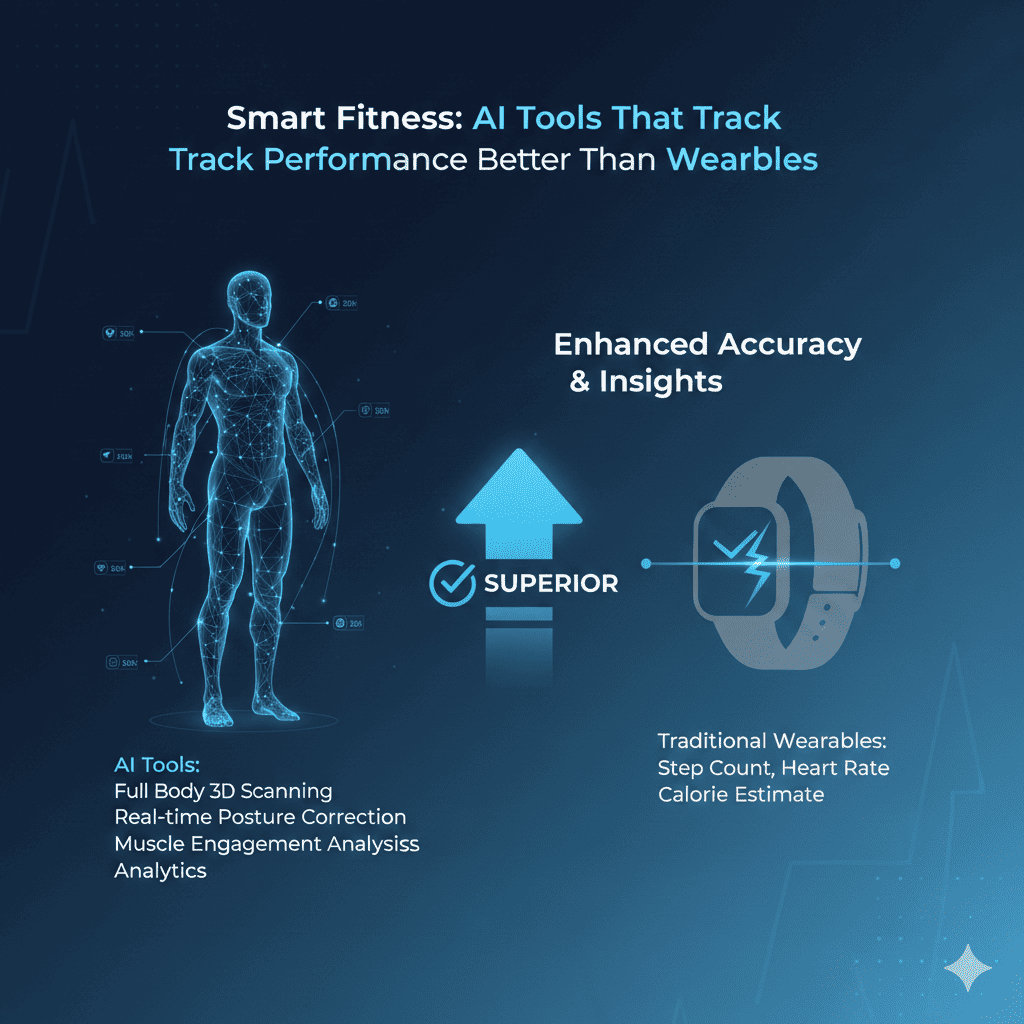
The fitness tracking landscape is experiencing a paradigm shift. For years, wearable devices like fitness watches and heart rate monitors dominated the performance tracking market, promising comprehensive insights into your training and health. However, a new generation of Smart Fitness technology powered by artificial intelligence is proving that you don’t always need specialized hardware strapped to your body to gain deep insights into your performance. In fact, in many ways, these AI-powered tools are providing more meaningful, actionable data than traditional wearables ever could.
This revolution in Smart Fitness tracking uses computer vision, machine learning, and advanced analytics to monitor aspects of your training that wearables simply cannot measure. From analyzing exercise form and movement quality to tracking workout consistency and predicting optimal training loads, AI tools are redefining what meaningful fitness tracking looks like. The result is a more comprehensive, nuanced understanding of your fitness journey that goes beyond simple metrics like steps and heart rate.
1. Beyond Heart Rate: What AI Tracks That Wearables Miss
Traditional wearables excel at measuring physiological metrics, but Smart Fitness AI tools capture critical aspects of training that biosensors cannot detect. Understanding these unique capabilities reveals why AI tracking complements or even surpasses wearable technology in many contexts.
Movement Quality and Exercise Form
While wearables can tell you that you completed a workout, they cannot assess whether you performed exercises correctly. Smart Fitness AI systems using computer vision analyze your actual movement patterns, identifying form breakdowns, asymmetries, and technique issues that directly impact your results and injury risk.
This movement quality data is arguably more valuable than knowing your heart rate during exercises. Perfect heart rate zones mean nothing if you’re performing movements incorrectly, risking injury while limiting effectiveness. AI provides the missing piece by ensuring not just that you’re training, but that you’re training properly.
Range of Motion and Mobility Assessment
AI tracking systems measure your actual range of motion during exercises, documenting whether you’re achieving full depth on squats, complete extension on presses, or adequate stretch during flexibility work. This objective measurement removes guesswork from self-assessment.
Over time, Smart Fitness technology tracks changes in your mobility, showing whether your range of motion is improving, declining, or remaining static. This longitudinal mobility data helps identify developing movement restrictions before they become problematic, something wearables cannot provide.
Exercise Tempo and Time Under Tension
The speed at which you perform exercises significantly impacts training outcomes. AI systems track repetition tempo precisely, measuring both the concentric and eccentric phases of each movement. This data ensures you’re training at appropriate speeds for your goals, whether that’s explosive power development or controlled muscle building.
Time under tension, a critical variable for muscle hypertrophy, is calculated automatically by Smart Fitness AI based on your movement tempo and repetition count. This metric provides insight into the actual mechanical stimulus your muscles receive, which cannot be inferred from wearable data alone.
Movement Asymmetries and Imbalances
AI-powered tracking identifies left-right asymmetries in how you move and perform exercises. Perhaps your right side does more work during squats, or one shoulder moves differently than the other during presses. These subtle imbalances often escape conscious notice but contribute to injury risk and performance limitations.
By quantifying these asymmetries, Smart Fitness technology helps you address imbalances proactively through targeted corrective work. Wearables worn on one wrist or in a central chest location cannot capture this bilateral comparison data.
Exercise Execution Consistency
AI tracks how consistently you perform exercises across sets and sessions. Does your squat depth decrease as you fatigue? Does your push-up form deteriorate in later repetitions? This consistency data reveals patterns that indicate when fatigue is affecting performance and when you might need to adjust training loads or volume.
2. Computer Vision Technology: The Eyes of Smart Fitness AI
The foundation of advanced Smart Fitness tracking is computer vision technology that can “see” and interpret human movement. Understanding how this technology works illuminates why it’s so powerful for fitness applications.
Pose Estimation and Skeletal Mapping
Computer vision algorithms identify anatomical landmarks on your body, creating a skeletal model that represents your position and posture. This happens in real-time during workouts, with the AI tracking multiple points across your body simultaneously at high frame rates.
This skeletal mapping allows Smart Fitness systems to calculate joint angles, measure distances between body parts, and track movement trajectories with precision. The technology works through standard cameras without requiring special markers or sensors attached to your body.
3D Movement Reconstruction
Advanced AI systems reconstruct your movements in three dimensions from two-dimensional camera footage. This computational process allows the system to understand depth and spatial relationships, providing a more complete picture of how you’re moving through space.
This 3D reconstruction capability means Smart Fitness technology can analyze complex movement patterns from multiple perspectives, identifying issues that might only be apparent from certain angles. The system effectively gives you a virtual trainer watching from all directions simultaneously.
Multi-Person Tracking in Group Settings
Sophisticated computer vision systems can track multiple people simultaneously, making Smart Fitness AI useful in group training contexts. The technology distinguishes between different individuals, maintaining separate tracking profiles even when multiple people are visible in the camera frame.
This capability extends AI tracking benefits beyond solo training, enabling group classes or partner workouts where everyone receives individualized performance feedback despite working out together.
Environmental Adaptability
Unlike wearables that require consistent body placement and can be affected by sweat or movement, computer vision AI adapts to various environmental conditions. The technology works in different lighting situations, from different camera angles, and with various backgrounds.
This environmental flexibility makes Smart Fitness tracking more practical for diverse workout settings, from home gyms to outdoor spaces, without requiring controlled laboratory conditions.
3. Training Volume and Load Tracking: Precision Without Sensors
One of the most valuable aspects of Smart Fitness AI is its ability to track training volume and mechanical load without requiring sensors in your equipment or on your body.
Automatic Repetition and Set Counting
AI systems count your repetitions automatically by recognizing complete movement cycles. This eliminates manual tracking, allowing you to focus entirely on exercise execution while the system handles documentation. The technology distinguishes between full repetitions and partial movements, ensuring accuracy.
This automatic counting is more reliable than manually tracking sets between exercises while fatigued. Smart Fitness AI never loses count or forgets whether you completed your fifth or sixth set, maintaining perfect workout records effortlessly.
Volume Load Calculations
By combining repetition counts with weight information (either input by you or detected through computer vision of plates and dumbbells), AI calculates your total volume load for each exercise and workout. This metric, representing the total pounds or kilograms lifted, is a key indicator of training stimulus.
Tracking volume load over time reveals whether your training demand is increasing appropriately for continued progress or whether you’ve plateaued. Smart Fitness technology makes these calculations automatically, providing insights that would require tedious manual computation otherwise.
Training Density Analysis
Training density refers to how much work you complete in a given time period. AI systems track rest intervals between sets and exercises, calculating your workout density and comparing it across sessions. This metric is particularly valuable for understanding training intensity beyond simple load measurements.
For goals like fat loss or conditioning, training density can be more important than volume load. Smart Fitness AI tracks both, giving you a comprehensive picture of your training stimulus that wearables measuring only heart rate and duration cannot provide.
Progressive Overload Monitoring
Progressive overload is fundamental to continued fitness improvement. AI systems track whether your training is progressing appropriately by monitoring increases in weight, repetitions, volume, or training density over time. The technology identifies when progress has stalled and suggests specific strategies for advancing your training.
This systematic tracking of progression variables ensures you’re applying progressive overload principles effectively rather than randomly varying your training without strategic purpose.
4. Recovery and Readiness Assessment Through Movement Analysis
While wearables assess recovery through physiological markers like heart rate variability and sleep quality, Smart Fitness AI offers unique recovery insights through movement analysis.
Movement Quality as Recovery Indicator
How you move reveals your recovery status. When inadequately recovered, movement quality often deteriorates subtly before you consciously feel fatigued. AI systems detect these quality decreases in real-time during warm-ups or early workout sets.
By identifying movement quality degradation, Smart Fitness technology can alert you that you’re not fully recovered before you push into high-intensity training that might lead to injury or counterproductive stress. This provides an actionable recovery indicator based on how you’re actually performing rather than passive monitoring.
Range of Motion Changes
Recovery status affects flexibility and range of motion. AI tracking systems measure your range of motion during dynamic warm-ups or mobility assessments, comparing current values to your baselines. Significant decreases often indicate incomplete recovery, muscle tightness, or developing issues.
This movement-based recovery assessment complements physiological markers from wearables, providing a more complete picture of whether you’re ready for hard training.
Performance Consistency Patterns
AI analyzes your performance consistency across workouts, identifying patterns that correlate with recovery status. Perhaps your form remains consistent when well-recovered but shows more variability when fatigued. These patterns become personalized readiness indicators unique to how your body responds to training stress.
Smart Fitness systems learn your individual patterns over time, making increasingly accurate assessments about whether you should train hard, modify your workout, or prioritize recovery on any given day.
Fatigue Detection During Training
As you progress through a workout, AI monitors for signs of accumulating fatigue including movement speed decreases, form deterioration, and reduced range of motion. This real-time fatigue assessment helps you understand when to end a workout or reduce intensity to prevent pushing into counterproductive overtraining territory.
This within-workout fatigue monitoring is something wearables cannot provide effectively, as physiological metrics like heart rate often remain elevated even as mechanical performance declines.
5. Technique Refinement: Granular Performance Feedback
The most distinctive advantage of Smart Fitness AI over wearables is the granular technique feedback that helps you continuously improve movement quality.
Joint Angle Analysis
AI systems measure specific joint angles throughout exercises, comparing them to optimal positions for your body proportions and goals. You receive feedback about hip and knee angles during squats, elbow positioning during presses, and spine angles during hinges.
This precision angle measurement allows Smart Fitness technology to provide specific, actionable corrections rather than general feedback. Instead of “improve your squat,” you receive “increase your hip flexion angle by 15 degrees at the bottom position.”
Movement Path Tracking
The trajectory your body or limbs follow during exercises significantly impacts effectiveness and safety. AI tracks these movement paths, identifying deviations from ideal patterns. For example, the bar path during a squat or deadlift should follow a relatively vertical line, and AI can show you exactly when and where your path deviates.
This visual representation of movement paths makes technique issues immediately obvious and trackable over time as you work to improve them.
Velocity-Based Training Metrics
Movement velocity is a powerful training variable that AI can measure precisely. The speed at which you perform exercises indicates proximity to failure, training intent, and power output. AI systems track bar velocity or movement speed, providing data that informs loading decisions.
Smart Fitness technology using velocity-based training principles helps optimize your training by ensuring you’re working at appropriate intensities and stopping sets at the right time rather than training to arbitrary repetition targets.
Bilateral Comparison and Symmetry Tracking
AI provides detailed comparison between how your left and right sides perform during unilateral exercises or bilateral movements. This symmetry tracking identifies strength imbalances, mobility differences, and coordination issues that contribute to injury risk and performance limitations.
Over time, you can track whether corrective work is successfully reducing asymmetries, something impossible to measure accurately without technology specifically designed to compare bilateral movement patterns.
6. Data Integration and Holistic Performance Analysis
Advanced Smart Fitness AI platforms don’t operate in isolation but integrate multiple data sources to provide comprehensive performance insights that exceed what any single tracking method can offer.
Combining AI Tracking with Wearable Data
The most sophisticated approach combines Smart Fitness AI movement tracking with physiological data from wearables. Computer vision provides movement quality and performance data while wearables contribute heart rate, heart rate variability, sleep quality, and continuous activity monitoring.
This integration creates a complete picture of your training and recovery, with each technology contributing unique information. The AI can contextualize your movement performance against your physiological state, providing more nuanced training recommendations than either technology alone.
Training History and Longitudinal Analytics
AI systems maintain comprehensive training histories, tracking not just individual workouts but patterns across weeks, months, and years. This longitudinal perspective reveals training rhythms, identifies optimal periodization approaches for you individually, and highlights correlations between training variables and outcomes.
Smart Fitness platforms with sophisticated analytics can show you which training approaches historically produced your best results, which exercises you progress fastest on, and when you typically experience performance decreases that might indicate overtraining.
Predictive Performance Modeling
By analyzing your historical training data and current performance trends, AI systems can predict future performance and identify optimal training adjustments. The technology might forecast when you’re likely to plateau, suggest when to implement deload weeks, or predict when you’ll achieve specific performance milestones based on current progression rates.
This predictive capability transforms Smart Fitness tracking from descriptive documentation of what happened to prescriptive guidance about what should happen next.
Comparative Benchmarking
AI platforms can compare your performance against relevant benchmarks, whether that’s your own historical data, population norms for your age and experience level, or goals you’ve set. This contextual comparison helps you understand whether your progress is appropriate or whether adjustments are needed.
These comparisons are more meaningful than simple absolute numbers because they account for your individual context and provide actionable insights about whether you’re on track toward your objectives.
7. Motivation and Engagement Through Intelligent Feedback
Beyond pure performance tracking, Smart Fitness AI enhances motivation and engagement through intelligent feedback systems that keep you invested in your training.
Achievement Recognition and Progress Visualization
AI systems identify meaningful achievements in your training including performance improvements, consistency milestones, and technique refinements. By recognizing and celebrating these accomplishments, the technology provides motivational reinforcement that encourages continued adherence.
Progress visualization through charts, graphs, and visual representations of your improvement makes abstract progress concrete and satisfying. Smart Fitness platforms present your journey in compelling ways that highlight how far you’ve come, motivating continued effort.
Personalized Challenge Systems
AI generates personalized challenges based on your current capabilities and goals. These challenges are calibrated to be achievable yet difficult, creating optimal motivation. Unlike generic challenges that may be too easy or impossibly hard, AI-generated challenges adapt to your individual performance level.
This personalized challenge framework keeps training engaging by providing regular, attainable targets that give direction and purpose to individual workouts.
Social Comparison and Community Features
Many Smart Fitness platforms include social features that allow comparing your performance with friends or community members pursuing similar goals. This social context adds motivation for many people while maintaining privacy around sensitive data you prefer to keep private.
The AI can facilitate meaningful comparisons by matching you with similar individuals rather than making inappropriate comparisons that would be demotivating.
Adaptive Encouragement and Coaching
AI systems learn what types of feedback and encouragement work best for you individually. Some people respond well to challenging, intense coaching while others prefer supportive, gentle encouragement. Smart Fitness AI adapts its communication style to your preferences and psychological profile.
This personalized motivational approach makes the technology feel more like a personal coach who understands you rather than a generic app delivering one-size-fits-all feedback.
8. Cost and Accessibility Advantages Over Wearables
Beyond performance advantages, Smart Fitness AI offers practical benefits regarding cost and accessibility that make it appealing compared to wearable-dependent tracking.
No Hardware Purchase Required
The most obvious advantage is that camera-based AI tracking requires no specialized hardware beyond a smartphone or computer you likely already own. Quality fitness wearables cost anywhere from fifty to several hundred dollars, creating a barrier to entry that AI tracking eliminates.
This accessibility democratizes advanced fitness tracking, making sophisticated performance monitoring available regardless of financial resources.
No Battery Management or Charging
Wearables require regular charging, and dead batteries mean lost tracking data. Smart Fitness AI using your phone or computer camera doesn’t add another device to your charging routine. You’re not dependent on remembering to charge yet another gadget before workouts.
This practical convenience removes one more friction point that can interfere with consistent tracking and training.
Equipment-Free Versatility
Wearables are designed for specific wear locations—wrists, chest, arms—which can be uncomfortable or restrictive during certain activities. AI tracking requires no equipment on your body, providing complete freedom of movement during any activity.
This versatility makes Smart Fitness AI tracking suitable for activities where wearables are impractical, uncomfortable, or prohibited, expanding the contexts in which you can gather performance data.
No Device Limitations
Wearables have technical specifications that limit their capabilities—sensor accuracy, battery life, water resistance, and durability. AI tracking software improves continuously through updates without hardware limitations. As AI algorithms advance, your tracking capabilities improve without purchasing new devices.
This future-proofing aspect means Smart Fitness AI tracking becomes more valuable over time rather than becoming obsolete as technology advances.
9. Privacy and Data Ownership Considerations
In an era of increasing concern about personal data, Smart Fitness AI offers unique privacy advantages over cloud-dependent wearables.
Local Processing Options
Many AI fitness applications process video and movement data entirely on your device without uploading to external servers. This local processing means your workout footage never leaves your phone or computer, providing maximum privacy.
While wearables constantly sync data to manufacturer servers, local Smart Fitness AI gives you complete control over your information and eliminates concerns about where your data is stored or who might access it.
Selective Data Sharing
AI platforms typically provide granular control over what data is shared, with whom, and for what purposes. You might share aggregate statistics with a community while keeping detailed video analysis private, or share specific achievements with friends while maintaining privacy around other aspects of your training.
This selective sharing capability gives you agency over your fitness data in ways that wearable ecosystems often don’t, where data sharing is more all-or-nothing.
No Corporate Health Profiles
Major wearable manufacturers build comprehensive health profiles from the data their devices collect across millions of users. While this enables interesting population-level research, it also means corporations possess detailed information about your health, activity patterns, and lifestyle.
Smart Fitness AI platforms, especially those using local processing, don’t necessarily build these corporate profiles. Your fitness information remains yours rather than becoming part of a commercial health data asset.
Open Standard Compatibility
Many AI fitness tools work with open data standards that give you true ownership of your information. You can export your data in standard formats and move it between platforms rather than being locked into proprietary ecosystems that make leaving difficult.
This data portability ensures you maintain control over your fitness history even if you switch tracking platforms.
10. The Future of Smart Fitness AI: What’s Coming Next
The Smart Fitness AI field is evolving rapidly, with emerging developments that will make these tools even more powerful and comprehensive.
Augmented Reality Integration
Future Smart Fitness applications will integrate with AR glasses and headsets, overlaying real-time feedback directly in your field of vision during workouts. Imagine seeing form cues, target movement paths, and performance metrics without looking at a screen, all presented contextually as you exercise.
This AR integration will make AI feedback even more immediate and actionable while keeping your attention focused on your training rather than divided between exercising and watching a display.
Advanced Biomechanical Analysis
Emerging AI systems will provide increasingly sophisticated biomechanical analysis that approaches clinical gait analysis and movement assessment quality. These systems will identify subtle movement dysfunction, predict injury risk based on movement patterns, and provide detailed corrective strategies.
This clinical-grade analysis will blur the line between fitness tracking and physical therapy assessment, providing Smart Fitness tools that support both performance optimization and injury prevention.
Multimodal Sensor Fusion
The future involves combining computer vision AI with other sensing technologies including pressure sensors in flooring, audio analysis of movement sounds, and environmental sensors. This sensor fusion will provide even more comprehensive understanding of training performance.
The resulting Smart Fitness systems will integrate diverse data streams, creating holistic performance pictures that far exceed what any single tracking method provides.
Genetic and Biological Integration
As genetic testing becomes more accessible, future AI platforms may integrate this information to provide truly personalized training recommendations based on your genetic predispositions. The system might recognize that your genetics suggest you’ll respond better to higher volume training or that you require more recovery time than average.
This biological integration will make Smart Fitness recommendations even more individualized, moving beyond population averages to genuinely unique programming.
Social and Collaborative Intelligence
Future platforms will enable collaborative training where AI coordinates group workouts, matches training partners with complementary goals and schedules, and facilitates virtual training communities that feel genuinely connected despite physical distance.
These social Smart Fitness features will combine the analytical power of AI with the motivational benefits of community, creating engaging training experiences that promote long-term adherence.
Conclusion: Embracing the Smart Fitness Revolution
The emergence of AI-powered fitness tracking represents a fundamental evolution beyond wearable-centric performance monitoring. While wearables provide valuable physiological data, Smart Fitness AI captures critical performance dimensions that biosensors cannot measure—movement quality, technique precision, training execution, and performance patterns that directly determine your results.
This technology democratizes access to sophisticated performance analysis previously available only through expensive biomechanical laboratories or expert coaching. Using nothing more than a standard camera, AI provides feedback that helps you train more effectively, safely, and intelligently.
The most powerful approach combines technologies rather than choosing between them. Smart Fitness AI tracking movement and performance while wearables monitor physiology creates comprehensive insight into both what you’re doing and how your body is responding. This integrated approach provides the deepest understanding of your training and the most actionable guidance for optimization.
As AI technology continues advancing, these tools will become even more sophisticated, accurate, and valuable. The Smart Fitness revolution is not replacing wearables but expanding the definition of meaningful fitness tracking to encompass the qualitative aspects of training that matter as much as quantitative metrics.
Whether you’re a beginner seeking guidance on proper exercise execution or an advanced athlete pursuing marginal performance gains, Smart Fitness AI offers insights that enhance your training. The technology transforms subjective aspects of fitness like movement quality and technique into objective, trackable data that drives continuous improvement.
The future of fitness tracking is intelligent, comprehensive, and accessible. By embracing Smart Fitness AI alongside or instead of traditional wearables, you gain unprecedented insight into your training that helps you achieve your goals more effectively than ever before possible. The only question is whether you’re ready to experience what truly smart fitness tracking can do for your performance.
Also read this
AI Tools That Build Personalized Home Workout Plans in Seconds: Transform Your Home Fitness Journey
AI Fitness Coaches That Design Perfect Workouts for Your Goals: The Future of Personal Training