
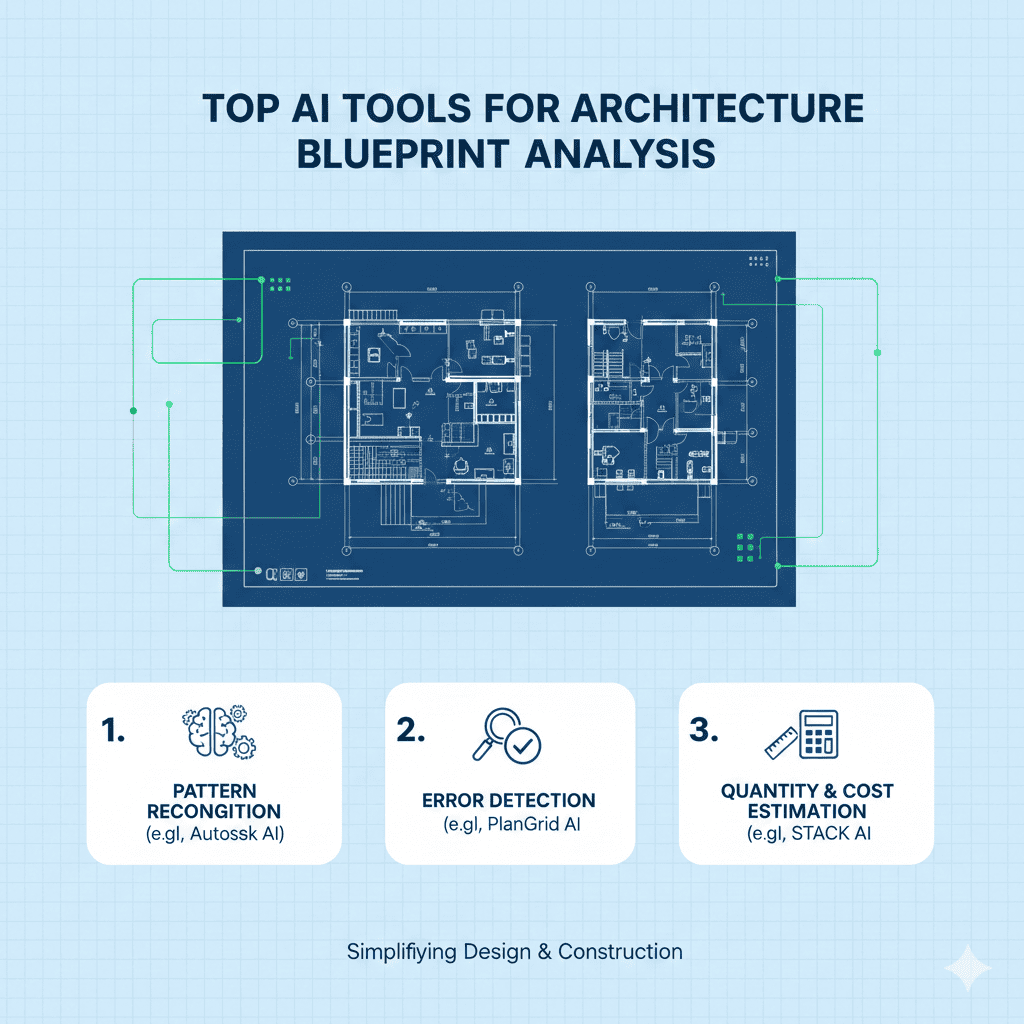
The architecture industry is experiencing a profound transformation driven by artificial intelligence. Traditional methods of reviewing, analyzing, and optimizing blueprints—once requiring countless hours of manual inspection—are being revolutionized by AI-powered solutions. Architecture Blueprint Analysis has evolved from a time-intensive process into an intelligent, automated workflow that enhances accuracy, speeds up project timelines, and uncovers insights that human eyes might miss.
In this comprehensive guide, we’ll explore the most advanced AI tools transforming Architecture Blueprint Analysis and how architects, engineers, and construction professionals can leverage them to deliver superior projects more efficiently.
The Critical Importance of AI in Architecture Blueprint Analysis
Before examining specific tools, it’s essential to understand why Architecture Blueprint Analysis powered by AI has become indispensable for modern architectural practices. Traditional blueprint review requires meticulous examination of every detail—structural integrity, code compliance, spatial relationships, material specifications, and countless other elements. Even experienced professionals can overlook critical issues buried within complex drawings.
AI-driven analysis systems process blueprints with superhuman speed and consistency, identifying potential problems, code violations, design conflicts, and optimization opportunities that might escape manual review. The benefits extend far beyond error detection: reduced project timelines, lower construction costs through early problem identification, improved collaboration between stakeholders, enhanced sustainability analysis, and the ability to explore design alternatives rapidly.
Modern architectural firms implementing AI-powered Architecture Blueprint Analysis report significant competitive advantages, including faster turnaround times, fewer costly construction-phase corrections, and higher client satisfaction through more refined designs.
1. Computer Vision-Based Blueprint Analysis Tools
Computer vision technology forms the foundation of intelligent blueprint analysis, enabling AI systems to “see” and interpret architectural drawings with remarkable accuracy.
Reconstruct
Reconstruct leverages computer vision and machine learning to analyze construction documentation, including blueprints, site photos, and BIM models. The platform excels at progress tracking by comparing actual construction against original plans, identifying discrepancies early when corrections are least expensive.
For Architecture Blueprint Analysis, Reconstruct’s AI automatically detects elements within drawings—walls, doors, windows, structural components—and tracks their implementation throughout the construction lifecycle. The system generates alerts when site conditions deviate from blueprint specifications, enabling immediate corrective action.
The platform’s reality capture integration creates comprehensive digital twins of construction projects, allowing stakeholders to visualize how blueprints translate into physical spaces. This capability proves invaluable during client presentations and for identifying constructability issues before breaking ground.
SmartVid.io
SmartVid.io applies artificial intelligence to visual construction data, including blueprint analysis, site photography, and video documentation. The platform’s computer vision algorithms automatically identify safety hazards, quality issues, and progress milestones without manual tagging or categorization.
When analyzing blueprints, SmartVid.io’s AI recognizes specific building elements and cross-references them with actual construction documentation. This automated verification ensures that built conditions match design intent, significantly reducing rework and change orders that plague construction projects.
The platform’s strength lies in its ability to learn from your specific project types and standards, continuously improving recognition accuracy as it processes more data from your firm’s projects.
OpenSpace
OpenSpace combines 360-degree photo documentation with AI-powered blueprint analysis to create navigable digital records of construction progress. The platform automatically maps photos to corresponding blueprint locations, enabling instant verification of whether construction matches design specifications.
For architects conducting site visits, OpenSpace eliminates the need for extensive manual documentation. The AI automatically captures and organizes visual data, linking it directly to relevant blueprint sections. This streamlined approach to Architecture Blueprint Analysis saves hours per week while creating comprehensive project records valuable for future reference and dispute resolution.
2. Building Information Modeling (BIM) Integration Tools
BIM has revolutionized architectural design, and AI-enhanced BIM tools take blueprint analysis to unprecedented levels of sophistication.
Autodesk Construction IQ
Autodesk Construction IQ integrates directly with BIM 360, applying machine learning to predict project risks by analyzing blueprints, schedules, and historical project data. The platform identifies potential quality and safety issues before they materialize on construction sites.
The AI examines blueprint complexity, project specifications, and team experience to generate risk scores for different project phases. For Architecture Blueprint Analysis, this predictive capability enables proactive design adjustments that prevent future construction challenges.
Construction IQ learns from millions of construction projects, recognizing patterns that correlate with delays, cost overruns, or quality issues. When your blueprints exhibit similar characteristics, the system alerts you to potential problems and suggests mitigation strategies based on successful approaches from comparable projects.
Revit with AI Extensions
Autodesk Revit remains the industry standard for BIM, and numerous AI-powered extensions enhance its Architecture Blueprint Analysis capabilities. Tools like Generative Design, Insight, and various third-party plugins add intelligent analysis layers to the core Revit platform.
Generative Design explores thousands of design alternatives based on your constraints and goals, effectively analyzing how blueprint modifications affect performance metrics like cost, structural efficiency, daylighting, and circulation patterns. This AI-driven approach reveals optimization opportunities that manual analysis would never uncover.
Revit’s AI-enhanced clash detection automatically identifies where different building systems—structural, mechanical, electrical, plumbing—conflict within blueprints. The system prioritizes clashes by severity and suggests resolution strategies, dramatically reducing coordination issues that cause construction delays.
Navisworks with AI Analytics
Navisworks specializes in 4D simulation and coordination, enhanced by AI analytics that examine blueprint constructability. The platform simulates construction sequences, identifying logistical challenges and spatial conflicts before they impact actual building.
For Architecture Blueprint Analysis, Navisworks’ AI evaluates whether your designs can be physically constructed in the sequence planned. The system considers equipment access, material delivery logistics, temporary support requirements, and crew movement patterns—factors that blueprints alone don’t fully capture.
The quantification capabilities automatically extract material quantities from blueprints with high accuracy, enabling precise cost estimation and procurement planning. Machine learning improves extraction accuracy over time as the system learns your firm’s drawing standards and conventions.
3. Code Compliance and Regulatory Analysis Tools
Ensuring blueprint compliance with building codes represents one of the most critical and time-consuming aspects of architectural design. AI tools are transforming this essential process.
UpCodes
UpCodes combines comprehensive building code databases with AI-powered search and compliance checking. The platform provides instant access to relevant code sections while analyzing blueprints for potential violations.
The AI understands natural language queries, allowing architects to ask questions like “What are the egress requirements for this assembly occupancy?” and receive specific, jurisdiction-appropriate answers. For Architecture Blueprint Analysis, this contextual intelligence eliminates hours spent searching through code books.
UpCodes’ compliance checking features automatically flag blueprint elements that may violate applicable codes, highlighting specific concerns like inadequate egress widths, improper fire separation, or accessibility deficiencies. The system explains why each issue matters and suggests compliant alternatives.
Plan Check AI
Plan Check AI specializes in automated code compliance review, analyzing submitted blueprints against local building codes and generating comprehensive compliance reports. The platform reduces plan review cycles from weeks to hours while improving consistency and accuracy.
For architects, Plan Check AI functions as an intelligent pre-submission review tool, identifying compliance issues before official submission. This proactive approach to Architecture Blueprint Analysis prevents costly revision cycles and accelerates permitting timelines.
The machine learning algorithms continuously update as codes change, ensuring compliance checks reflect the most current requirements. The system also learns from reviewer feedback, improving its accuracy with each analyzed project.
TestFit
TestFit uses AI to rapidly generate code-compliant site plans and building configurations, analyzing how different design approaches maximize developable area while meeting all regulatory requirements. The platform considers zoning codes, parking requirements, setbacks, and building height restrictions simultaneously.
During early design phases, TestFit’s Architecture Blueprint Analysis capabilities help architects understand feasibility constraints before investing significant time in detailed designs. The AI generates multiple compliant alternatives in seconds, enabling data-driven conversations with clients about tradeoffs between different design approaches.
4. Structural Analysis and Engineering Tools
Structural integrity forms the foundation of architectural design, and AI-enhanced analysis tools provide unprecedented insight into how blueprint designs will perform under real-world conditions.
Spacemaker AI
Spacemaker AI, now part of Autodesk, applies machine learning to site analysis and early-stage design optimization. The platform evaluates thousands of design variations against multiple performance criteria including structural efficiency, daylighting, wind patterns, and noise exposure.
For Architecture Blueprint Analysis, Spacemaker helps architects understand how site conditions and building orientation affect structural requirements. The AI identifies configurations that minimize structural complexity while maximizing desirable characteristics like natural light and outdoor space access.
The platform’s analysis considers regulatory constraints, generating only viable alternatives that comply with applicable codes. This intelligent filtering ensures architects focus creative energy on genuinely feasible options rather than designs that will ultimately prove impractical.
Karamba3D
Karamba3D brings parametric structural analysis directly into the Grasshopper environment, enabling real-time structural feedback as architects modify blueprints. The AI-enhanced optimization algorithms explore structural configurations that minimize material usage while maintaining safety factors.
When analyzing blueprints, Karamba3D calculates stress distributions, deflections, and buckling behavior for complex geometries. The immediate feedback loop allows architects to make structurally-informed design decisions during creative development rather than discovering structural inadequacies during later engineering review.
The tool’s evolutionary optimization capabilities automatically refine structural designs to meet multiple objectives simultaneously—minimizing weight, controlling deflections, and managing costs—producing solutions that human designers might never conceptualize.
ClearCalcs
ClearCalcs provides AI-assisted structural calculations specifically formatted for building permit submissions. The platform guides users through appropriate calculation methods while automatically checking for common errors and code violations.
For Architecture Blueprint Analysis, ClearCalcs enables architects to perform preliminary structural assessments without waiting for engineering consultants. The AI suggests appropriate member sizes, connection details, and foundation requirements based on blueprint geometry and loading conditions.
The cloud-based platform maintains calculation libraries that learn from user patterns, suggesting relevant calculation types based on project characteristics. This intelligent assistance accelerates the structural documentation process while maintaining engineering rigor.
5. Energy Performance and Sustainability Analysis
Sustainable design has moved from optional to essential, and AI tools provide sophisticated analysis of how blueprint designs affect building energy performance and environmental impact.
Cove.tool
Cove.tool delivers AI-powered energy modeling and cost-benefit analysis integrated directly with architectural design workflows. The platform analyzes blueprints to predict energy consumption, daylight availability, thermal comfort, and operational costs under various design scenarios.
For Architecture Blueprint Analysis focused on sustainability, Cove.tool’s machine learning algorithms identify which design modifications deliver the greatest energy savings relative to cost. The system considers climate data, utility rates, material properties, and building systems to generate actionable optimization recommendations.
The platform’s automation handles complex energy modeling tasks in minutes rather than days, enabling architects to explore sustainability implications of design decisions throughout the development process rather than only at completion when modifications are expensive.
Sefaira
Sefaira provides real-time energy and daylight analysis within Revit and SketchUp, giving architects immediate feedback on how blueprint modifications affect building performance. The AI-enhanced analysis considers building orientation, window placement, shading strategies, and envelope specifications.
The platform’s optimization engine automatically explores design variations to identify configurations that meet specific performance targets like LEED certification or net-zero energy. For Architecture Blueprint Analysis, this intelligent exploration reveals opportunities that manual analysis would overlook.
Sefaira’s comparative analysis features allow architects to evaluate multiple design alternatives simultaneously, understanding tradeoffs between competing priorities like natural daylighting and thermal performance. This data-driven approach supports informed decision-making during client presentations.
IES Virtual Environment
IES VE represents one of the most comprehensive building performance analysis platforms, enhanced by AI-driven optimization and prediction capabilities. The software analyzes blueprints for energy consumption, daylighting, thermal comfort, natural ventilation, and HVAC system performance.
The platform’s machine learning algorithms calibrate simulation models against actual building performance data, improving prediction accuracy over time. When analyzing new blueprints, the system applies insights learned from similar completed projects, providing increasingly reliable performance forecasts.
IES VE’s parametric optimization explores thousands of design variations, identifying configurations that achieve specific sustainability goals at minimum cost. This capability proves invaluable for architects committed to high-performance building design.
6. Quantity Takeoff and Cost Estimation
Accurate cost estimation depends on precise material quantity extraction from blueprints—a process dramatically improved by AI automation.
PlanSwift
PlanSwift uses AI-enhanced pattern recognition to automatically identify and quantify building elements within blueprints. The software learns to recognize walls, doors, windows, fixtures, and other components, extracting quantities with minimal manual intervention.
For Architecture Blueprint Analysis during budget development, PlanSwift enables rapid generation of detailed quantity takeoffs. The AI handles repetitive counting and measuring tasks, freeing estimators to focus on pricing strategy and risk assessment.
The platform’s assembly library allows firms to define standard building configurations with associated costs. When the AI identifies these assemblies within blueprints, it automatically applies appropriate unit costs, dramatically accelerating the estimation process.
Togal.AI
Togal.AI specializes in AI-powered blueprint analysis for construction estimating, using computer vision to automatically detect and quantify virtually any building element. The platform handles both 2D blueprints and 3D models with impressive accuracy.
The machine learning algorithms distinguish between different spaces, materials, and systems within complex blueprints, generating organized quantity takeoffs ready for pricing. For architects providing preliminary cost estimates, Togal.AI eliminates the bottleneck of manual quantity extraction.
The platform’s comparison capabilities identify differences between blueprint revisions, automatically quantifying how design changes affect material requirements and costs. This change tracking proves invaluable during design development when frequent modifications occur.
Buildots
Buildots applies computer vision to construction progress validation, comparing actual built conditions against blueprint specifications. The platform uses 360-degree cameras and AI analysis to verify that construction matches design intent.
For Architecture Blueprint Analysis during construction administration, Buildots automatically identifies deviations from blueprints, generating reports that highlight specific locations requiring attention. The system quantifies progress completion percentages for different blueprint elements, providing objective data for payment applications.
The AI learns to recognize project-specific elements and conditions, improving recognition accuracy as it processes more data from your sites. This continuous learning delivers increasingly valuable insights throughout project duration.
7. Collaboration and Markup Tools
Effective blueprint review requires clear communication between stakeholders, and AI-enhanced collaboration tools streamline this essential process.
Bluebeam Revu with Studio
Bluebeam Revu remains the industry standard for PDF-based blueprint markup and collaboration. The Studio features enable real-time collaborative review sessions where multiple stakeholders analyze blueprints simultaneously, with AI assistance for markup organization and search.
The platform’s AI capabilities include optical character recognition that makes even scanned blueprints fully searchable, and intelligent markup summarization that organizes comments by discipline, location, or priority. For Architecture Blueprint Analysis involving multiple consultants, these features ensure no feedback gets overlooked.
Bluebeam’s comparison tools use AI to identify differences between blueprint versions, automatically highlighting changes for reviewer focus. This intelligent change tracking accelerates revision review cycles while ensuring nothing significant slips through unnoticed.
Procore
Procore’s construction management platform includes sophisticated blueprint management and markup capabilities enhanced by AI-driven insights. The system automatically routes blueprints to appropriate reviewers, tracks review status, and flags potential issues based on comment patterns.
The platform’s AI analyzes markup trends across projects, identifying common issues that appear during blueprint review. This pattern recognition helps architectural firms understand systemic problems in their design processes and implement quality improvements.
For Architecture Blueprint Analysis involving contractors and subcontractors, Procore’s coordination tools ensure everyone works from current blueprint versions while maintaining complete revision histories. The AI flags when team members access outdated drawings, preventing costly errors from version control failures.
PlanGrid (Autodesk Build)
PlanGrid, now integrated into Autodesk Build, provides mobile-first blueprint access with AI-enhanced search and navigation. Field teams can instantly locate specific details within massive blueprint sets using natural language queries.
The platform’s AI recognizes blueprint elements and automatically generates hyperlinks between related drawings—if you’re viewing a floor plan, the system suggests relevant detail sheets, sections, and specifications. This intelligent navigation dramatically improves field team efficiency.
PlanGrid’s issue tracking connects directly to blueprint locations, creating visual databases of construction challenges. The AI analyzes these issues to identify correlations between blueprint characteristics and construction problems, providing valuable feedback for future design improvement.
8. Generative Design and Optimization
Generative design represents AI’s most transformative application in architecture, exploring design possibilities far beyond human capacity for manual analysis.
Autodesk Forma
Autodesk Forma (formerly Spacemaker) brings AI-powered generative design to urban planning and site development. The platform analyzes site conditions, regulatory constraints, and performance goals to generate optimized building configurations automatically.
For Architecture Blueprint Analysis during conceptual design, Forma explores thousands of massing alternatives in minutes, evaluating each against criteria like unit mix, daylight access, views, wind comfort, and construction feasibility. The AI identifies non-obvious solutions that balance competing priorities effectively.
The platform’s analysis considers contextual factors—neighboring buildings, street networks, topography—ensuring generated designs respond appropriately to site conditions. This holistic approach produces blueprints that work both functionally and contextually.
Finch 3D
Finch 3D provides real-time generative design directly within popular architectural modeling environments. As architects modify building geometry, the AI continuously generates optimized alternatives that respect design intent while improving performance metrics.
The platform excels at space planning, automatically generating efficient layouts that meet program requirements while optimizing circulation, daylighting, and views. For Architecture Blueprint Analysis during design development, Finch reveals layout possibilities architects might not conceptualize through traditional methods.
The tool’s constraint-based approach ensures generated alternatives remain architecturally viable rather than producing mathematically optimal but impractical designs. This balance between optimization and design intent distinguishes truly useful AI tools from academic exercises.
TestFit (Generative Design Module)
TestFit’s generative capabilities specifically target multifamily residential and commercial site planning, automatically generating code-compliant building configurations that maximize developable area and unit count.
The AI considers parking requirements, setbacks, unit mix, and amenity space requirements simultaneously, exploring configurations that human planners would require days to develop manually. For Architecture Blueprint Analysis during feasibility studies, TestFit enables rapid evaluation of site potential under various scenarios.
The platform’s financial analysis integrates with generative design, automatically calculating development costs and pro forma returns for each generated alternative. This economic intelligence helps architects guide clients toward financially optimal design approaches.
9. Augmented Reality and Visualization
Understanding how blueprints translate into physical space challenges even experienced architects. AR tools enhanced by AI bridge this comprehension gap.
IrisVR (now Prospect by IrisVR)
IrisVR transforms blueprints and BIM models into immersive virtual reality experiences, enabling stakeholders to “walk through” designs before construction. The platform’s AI assists with model optimization, automatically simplifying complex geometries for smooth VR performance without losing essential detail.
For Architecture Blueprint Analysis during design review, immersive visualization reveals spatial relationships and scale that 2D blueprints obscure. Clients and contractors gain intuitive understanding of design intent, reducing misunderstandings that cause expensive change orders.
The platform’s measurement and markup tools allow reviewers to identify issues while immersed in the virtual building, creating spatially-referenced feedback that precisely communicates concerns to designers.
ARki
ARki brings blueprint visualization to mobile devices using augmented reality, overlaying proposed designs onto existing site conditions through smartphone cameras. The AI handles spatial registration, ensuring virtual buildings remain properly aligned with physical context as users move.
For client presentations, ARki enables architects to demonstrate how blueprint designs respond to actual site conditions—sightlines, solar orientation, contextual relationships. This tangible visualization builds client confidence and facilitates more informed decision-making.
The platform’s AI automatically simplifies complex blueprint geometries for mobile rendering while preserving architectural character, ensuring smooth performance across consumer devices.
Enscape
Enscape provides real-time rendering integrated with Revit, SketchUp, Rhino, and ArchiCAD, using AI-enhanced rendering algorithms that produce photorealistic visualizations from blueprint data in seconds rather than hours.
The platform’s virtual reality mode enables immersive blueprint review where stakeholders can evaluate design decisions at full scale. The AI optimizes rendering quality based on viewing distance and context, maintaining fluid performance while maximizing visual fidelity.
For Architecture Blueprint Analysis focused on materiality and lighting, Enscape’s accurate physical rendering reveals how design decisions affect experiential qualities that blueprints alone cannot convey.
10. Document Management and Search
Large architectural projects generate thousands of blueprint sheets, and AI-powered document management ensures information accessibility when needed.
Asite
Asite provides comprehensive document control for construction projects, with AI-enhanced search that understands context and intent rather than just matching keywords. Users can query the system using natural language—”show me all structural blueprints for the third floor mechanical room”—and receive precisely relevant results.
The platform’s AI automatically extracts metadata from blueprints during upload, eliminating manual tagging while ensuring comprehensive categorization. For Architecture Blueprint Analysis across large document sets, this intelligent organization dramatically improves information accessibility.
Asite’s change management capabilities use AI to identify which blueprints are affected by design changes, automatically notifying relevant stakeholders and ensuring everyone works from current information.
Newforma Project Center
Newforma specializes in document management for architecture, engineering, and construction firms, with AI features that automatically organize email threads, RFIs, submittals, and blueprints into coherent project histories.
The platform’s AI recognizes blueprint references within email communications, automatically linking messages to relevant drawings. This contextual organization ensures comprehensive Architecture Blueprint Analysis includes all related correspondence and decisions.
Newforma’s search algorithms understand architectural terminology and relationships, producing more relevant results than generic document management systems. The AI learns from user behavior, continuously improving search relevance for your firm’s specific vocabulary and project types.
Box for Architecture
Box provides enterprise content management with AI-enhanced preview, search, and classification capabilities specifically valuable for blueprint management. The platform’s computer vision automatically detects blueprint content, making even raster images searchable by elements they contain.
The AI-powered classification suggests appropriate folder structures and metadata tags based on blueprint content and naming patterns, ensuring consistent organization across projects. For firms managing decades of archived blueprints, Box’s AI makes historical information newly accessible.
Implementing AI-Powered Architecture Blueprint Analysis
Successfully integrating AI tools into architectural practice requires thoughtful strategy beyond simply purchasing software licenses.
Begin by identifying the specific blueprint analysis challenges consuming most time in your firm—code compliance review, quantity takeoff, design optimization, or coordination. Select AI tools that directly address these bottlenecks rather than accumulating features you won’t use.
Implement gradually, starting with a pilot project where you can evaluate tool effectiveness and develop best practices before firm-wide rollout. This measured approach prevents workflow disruption while building internal expertise.
Invest in training to ensure team members understand both tool capabilities and limitations. AI assists human expertise rather than replacing it—users must know when to trust algorithmic recommendations and when human judgment should prevail.
Establish quality control protocols that verify AI analysis results, especially during initial implementation. As tools prove reliable on your specific project types, oversight can become less intensive while maintaining appropriate validation.
The Future of Architecture Blueprint Analysis
Architecture Blueprint Analysis continues evolving as AI capabilities advance. Emerging technologies like quantum computing for structural optimization, advanced natural language processing for requirements extraction, and federated learning that improves AI accuracy while protecting proprietary design data will create new possibilities.
The architectural firms that thrive in coming years will be those treating AI as a collaborative partner that amplifies human creativity and judgment rather than viewing it as either threat or magic solution. The goal isn’t eliminating human expertise but directing it toward higher-value creative and strategic decisions while AI handles routine analysis and documentation tasks.
Conclusion
The AI revolution in Architecture Blueprint Analysis represents a fundamental shift in how architects design, document, and deliver projects. The tools explored in this guide enable individual practitioners to perform analyses that previously required entire teams, while large firms achieve unprecedented levels of quality and efficiency.
Success in modern architectural practice requires embracing these AI-powered capabilities. The firms implementing intelligent Architecture Blueprint Analysis today will lead their markets tomorrow through superior quality, faster delivery, and design optimization that manual methods cannot match.
Also read this:
Top AI Tools for Affiliate Marketing Automation: Transform Your Business in 2025
Top AI Tools for Automated Webinar Hosting: Scale Your Presentations Without the Scheduling Hassle
12 Best AI Tools for Online Course Content Creation: Build Engaging Educational Experiences Faster