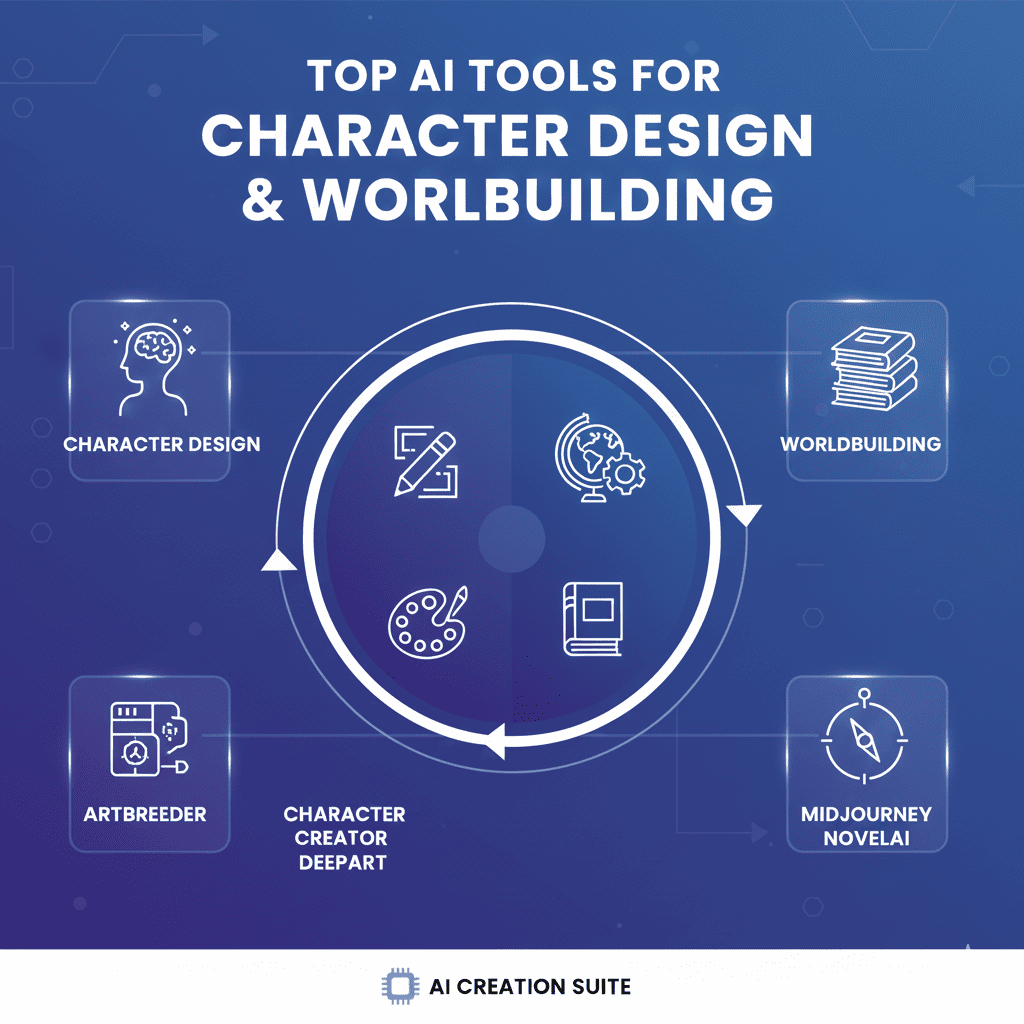
The creative landscape has been revolutionized by artificial intelligence, offering writers, game developers, artists, and storytellers unprecedented tools to bring their imaginative worlds to life. Character Design & Worldbuilding has evolved from a time-consuming manual process into an exciting collaboration between human creativity and AI capabilities. Whether you’re crafting the next epic fantasy series, developing an indie game, or building immersive tabletop RPG campaigns, AI tools can accelerate your creative workflow while maintaining artistic authenticity.
This comprehensive guide explores the most powerful AI tools available for Character Design & Worldbuilding, helping you create compelling characters, detailed environments, and rich narrative universes that captivate your audience.
1. Midjourney: Visual Character Design Mastery
Midjourney has established itself as the premier AI tool for generating stunning visual character designs and environmental concepts. This powerful image generation platform transforms text descriptions into breathtaking artwork, making it invaluable for Character Design & Worldbuilding projects.
Key Features:
- Photorealistic and stylized character rendering
- Advanced prompt engineering for precise control
- Multiple artistic style emulation (anime, realistic, painterly, etc.)
- Consistent character generation across multiple images
- High-resolution upscaling for professional use
- Community gallery for inspiration and learning
Character Design Applications: Midjourney excels at creating detailed character portraits, full-body designs, costume concepts, and character variations. You can specify everything from facial features and body types to clothing styles and emotional expressions, generating dozens of iterations to find the perfect visualization of your character.
Worldbuilding Capabilities: Beyond characters, Midjourney creates stunning environment concepts, architectural designs, landscapes, and atmospheric scenes that help visualize your world’s unique aesthetics and cultural influences.
Best For: Visual artists, concept designers, game developers, and anyone needing high-quality visual references for their Character Design & Worldbuilding projects.
2. ChatGPT: AI-Powered Narrative Architecture
ChatGPT has become an indispensable tool for writers and worldbuilders, offering sophisticated language processing that helps develop character backstories, dialogue, cultural systems, and intricate world mechanics for comprehensive Character Design & Worldbuilding.
Key Features:
- Deep character personality development
- Complex backstory generation
- Dialogue writing and character voice refinement
- Cultural and societal system creation
- Historical timeline development
- Magic system and technology framework design
- Interactive brainstorming sessions
Character Development: ChatGPT helps you explore character motivations, fears, desires, and growth arcs. It can generate detailed psychological profiles, relationship dynamics, and character evolution patterns that feel authentic and compelling.
World System Creation: From economic structures and political systems to religious beliefs and social hierarchies, ChatGPT assists in building logically consistent world frameworks that add depth and realism to your creative universe.
Best For: Writers, game masters, narrative designers, and storytellers focused on deep, text-based Character Design & Worldbuilding.
3. Artbreeder: Collaborative Character Portrait Creation
Artbreeder uses generative adversarial networks (GANs) to create and evolve character portraits through an intuitive mixing and breeding interface, offering unique possibilities for Character Design & Worldbuilding through collaborative AI art generation.
Key Features:
- Gene-based character trait manipulation
- Blend multiple characters to create new designs
- Precise control over facial features, age, and ethnicity
- Style mixing for unique artistic looks
- Animation capabilities for character expressions
- Community collaboration and sharing
Unique Breeding Mechanic: Artbreeder’s distinctive approach lets you “breed” characters together, combining traits from multiple designs to create offspring with inherited characteristics. This makes it perfect for designing related characters like family members or distinct ethnic groups within your world.
Consistent Character Evolution: Track character aging, explore alternate versions, or design characters at different life stages while maintaining recognizable core features.
Best For: Character designers needing family resemblances, portrait artists, and creators wanting intuitive control over facial features in their Character Design & Worldbuilding work.
4. World Anvil: Comprehensive Worldbuilding Platform
World Anvil combines traditional worldbuilding organization with AI-enhanced features, creating a centralized hub for all your Character Design & Worldbuilding needs, from characters and locations to histories and magic systems.
Key Features:
- Structured templates for characters, locations, and organizations
- Interactive maps with pinned articles
- Timeline and historical event tracking
- Relationship mapping between characters
- Private and public sharing options
- Integration with AI writing assistants
- Campaign management tools for RPGs
Organization Excellence: World Anvil’s greatest strength is keeping complex worldbuilding projects organized. Every character, location, item, and event can be cross-referenced, creating a rich, interconnected web of information.
AI Integration: Recent updates include AI-powered content generation suggestions, helping fill in gaps in your worldbuilding and offering creative prompts when you’re stuck.
Best For: Large-scale worldbuilding projects, RPG campaign management, novel series planning, and collaborative Character Design & Worldbuilding efforts.
5. Stable Diffusion: Open-Source Visual Creation
Stable Diffusion provides powerful, open-source image generation that can be customized and fine-tuned for specific Character Design & Worldbuilding needs, offering flexibility that proprietary tools cannot match.
Key Features:
- Completely open-source and customizable
- Local installation for unlimited generation
- ControlNet for precise pose and composition control
- DreamBooth for training custom character models
- Inpainting and outpainting for iterative design
- No usage restrictions or content policies
Custom Model Training: Stable Diffusion’s standout feature is the ability to train custom models on your specific art style or character designs, ensuring consistency across hundreds or thousands of generated images.
Advanced Control: ControlNet integration allows you to use reference poses, depth maps, and edge detection to maintain precise control over character positioning and composition.
Best For: Technical users, studios needing consistent character generation, and creators wanting complete control over their Character Design & Worldbuilding visual assets.
6. Campfire Write: AI-Enhanced Writing Suite
Campfire Write specializes in narrative worldbuilding with integrated AI features designed specifically for fiction writers working on Character Design & Worldbuilding for novels, screenplays, and game narratives.
Key Features:
- Character profile templates with AI suggestions
- Relationship and connection mapping
- Location and setting development tools
- Plot planning and story arc visualization
- Manuscript writing with worldbuilding sidebar
- AI-powered content generation and expansion
- Export to various formats
Character Relationship Mapping: Visualize complex character relationships, alliances, conflicts, and connections in an intuitive graph format that helps maintain consistency throughout your narrative.
Integrated Writing Environment: Unlike standalone worldbuilding tools, Campfire Write keeps your reference material accessible while you write, reducing context-switching and maintaining creative flow.
Best For: Novelists, screenwriters, and narrative game designers needing integrated Character Design & Worldbuilding alongside their writing process.
7. Leonardo.AI: Production-Ready Asset Generation
Leonardo.AI focuses on creating game-ready and production-quality assets, making it ideal for professional Character Design & Worldbuilding projects requiring consistent, usable artwork.
Key Features:
- Fine-tuned models for specific art styles
- Canvas editor for precise modifications
- Prompt magic for enhanced generation quality
- Multiple image variations from single prompts
- Commercial licensing included
- Texture generation for 3D assets
- Real-time canvas painting with AI assistance
Consistency Tools: Leonardo.AI includes features specifically designed to maintain visual consistency across character designs and environmental assets, crucial for professional game development and animation projects.
Asset Production Pipeline: The platform integrates smoothly into production workflows, generating sprites, concept art, textures, and promotional materials that maintain cohesive visual identity.
Best For: Game developers, animation studios, and professional artists requiring production-ready Character Design & Worldbuilding assets.
8. NovelAI: Storytelling-Focused AI Platform
NovelAI combines advanced language models with image generation specifically tailored for fiction writers and storytellers engaged in detailed Character Design & Worldbuilding for narrative projects.
Key Features:
- Story-focused language model fine-tuned on fiction
- Anime and fantasy-style character art generation
- Lorebook system for worldbuilding consistency
- Memory and context management
- Module training on specific genres
- Text adventure and interactive fiction modes
- Customizable AI writing styles
Lorebook System: NovelAI’s lorebook feature allows you to define characters, locations, magic systems, and cultural details that the AI references when generating text, ensuring consistency throughout your narrative worldbuilding.
Genre Specialization: The platform excels at fantasy, science fiction, and anime-inspired content, making it particularly valuable for creators working in these popular Character Design & Worldbuilding genres.
Best For: Fantasy and sci-fi writers, visual novel creators, and storytellers focused on narrative-driven Character Design & Worldbuilding.
9. Krita AI Diffusion: Artist-Integrated Character Design
Krita AI Diffusion brings AI generation directly into the professional digital painting software Krita, allowing seamless integration of AI assistance into traditional Character Design & Worldbuilding art workflows.
Key Features:
- Native integration with Krita painting software
- Layer-based AI generation
- Selection-based inpainting and outpainting
- Real-time preview and adjustment
- Multiple AI model support
- Maintains traditional painting workflow
- Custom model integration
Artist-Friendly Approach: Unlike standalone AI generators, Krita AI Diffusion works within the familiar environment of professional painting software, letting artists use AI as just another tool in their creative process.
Iterative Refinement: Generate base concepts with AI, then refine them with traditional digital painting techniques, or paint rough sketches and use AI to add detail and rendering quality.
Best For: Digital artists, illustrators, and concept artists who want to integrate AI into their traditional Character Design & Worldbuilding painting workflow.
10. Sudowrite: AI Writing Partner for Worldbuilders
Sudowrite functions as an intelligent writing assistant specifically designed for creative fiction, offering unique features that enhance Character Design & Worldbuilding through contextual understanding and creative suggestion.
Key Features:
- “Describe” feature for sensory detail expansion
- “Brainstorm” for character and plot development
- “Rewrite” with tone and style control
- “Expand” for scene development
- Character voice consistency tools
- Story bible and notes organization
- Beat sheet and structure planning
Sensory Worldbuilding: Sudowrite’s describe function excels at adding rich sensory details to environments and character descriptions, bringing your Character Design & Worldbuilding to life with vivid imagery.
Character Voice Development: The AI learns your characters’ distinct voices and helps maintain consistency across dialogue and internal monologue throughout your narrative.
Best For: Fiction writers, novelists, and storytellers who need AI assistance maintaining consistency in their Character Design & Worldbuilding during the writing process.
11. Inkarnate: Fantasy Map Creation Platform
Inkarnate specializes in creating beautiful fantasy maps with AI-assisted tools, providing essential visual worldbuilding for any Character Design & Worldbuilding project requiring geographical context.
Key Features:
- Intuitive map creation interface
- Thousands of fantasy assets and stamps
- Multiple map styles (world, regional, battle maps)
- Terrain generation and modification
- Custom asset uploading
- Layering and organization tools
- High-resolution export for printing
AI-Enhanced Terrain: Recent updates include AI-assisted terrain generation that creates realistic landmasses, river systems, and mountain ranges following geological principles.
Scale Flexibility: Create everything from continent-spanning world maps to detailed city layouts and dungeon plans, maintaining visual consistency across scale levels.
Best For: Tabletop RPG creators, fantasy writers, and game developers needing professional maps for their Character Design & Worldbuilding projects.
12. Character.AI: Interactive Character Development
Character.AI enables creators to build interactive AI personas of their characters, allowing for dynamic conversation and personality testing that enriches Character Design & Worldbuilding through emergent behavior.
Key Features:
- Create custom AI characters with specific personalities
- Conversational testing of character voice and behavior
- Multi-character interactions and dynamics
- Memory of previous conversations
- Public and private character options
- Community character library
- Room creation for group interactions
Character Personality Testing: By creating an AI version of your character and conversing with them, you can explore how they’d react to different situations, discover unexpected personality nuances, and ensure dialogue authenticity.
Relationship Dynamics: Place multiple character AIs in conversation rooms to explore relationship dynamics, conflicts, and chemistry before writing critical scenes.
Best For: Writers, game designers, and storytellers who want to deeply understand their characters through interactive conversation during Character Design & Worldbuilding.
Integration Strategies: Combining Tools for Maximum Impact
The most effective Character Design & Worldbuilding workflows combine multiple AI tools, leveraging each platform’s strengths:
Visual + Narrative Integration: Use Midjourney or Leonardo.AI for character portraits, then import those images into ChatGPT or Sudowrite to develop backstories that match the visual aesthetic.
Character Consistency Pipeline: Create base character designs in Artbreeder, refine variations in Stable Diffusion, and use Character.AI to test personality consistency across different scenarios.
World Documentation: Develop world systems with ChatGPT, organize everything in World Anvil, create visual references with Midjourney, and generate maps with Inkarnate for comprehensive documentation.
Writing Workflow: Plan stories in Campfire Write with AI assistance, develop rich descriptions with Sudowrite, and reference your organized worldbuilding from World Anvil during manuscript writing.
Best Practices for AI-Assisted Character Design & Worldbuilding
To maximize the benefits of AI tools while maintaining creative authenticity in your Character Design & Worldbuilding:
Start with Strong Foundations: AI tools work best when you provide clear creative direction. Develop core concepts, themes, and character archetypes before using AI to expand and refine them.
Iterate and Refine: Rarely will AI generate perfect results on the first try. Use AI output as starting points, then iterate, combine elements, and add your personal creative touch.
Maintain Consistency: Create style guides, character sheets, and world bibles to ensure AI-generated content remains consistent with your established creative vision.
Respect Copyright: Understand the licensing terms of each AI platform. Most allow commercial use of generated content, but verify before publishing or selling your work.
Preserve Your Voice: AI should enhance, not replace, your creative vision. Use these tools to handle time-consuming tasks while focusing your energy on the creative decisions that make your world unique.
Document Your World: Keep detailed records of AI-generated elements, prompts that worked well, and established facts about your world to maintain consistency across large projects.
The Future of Character Design & Worldbuilding with AI
The integration of AI into Character Design & Worldbuilding continues to evolve rapidly, with exciting developments on the horizon:
3D Character Generation: Emerging tools will generate fully rigged 3D character models from text descriptions, streamlining game development and animation pipelines.
Interactive World Simulation: AI will enable dynamic world simulation where characters, cultures, and environments evolve based on established rules, creating living, breathing fictional universes.
Voice and Personality Synthesis: Advanced AI will generate unique character voices and speaking patterns, bringing characters to life through audio that matches their personality profiles.
Collaborative Worldbuilding AI: Future platforms will support multiple creators working simultaneously on shared worlds, with AI maintaining consistency and suggesting connections between different creators’ contributions.
Real-Time Adaptation: AI tools will analyze your writing or design style and automatically adapt their output to match, creating seamless integration between human creativity and AI assistance.
Overcoming Common Challenges in AI-Assisted Worldbuilding
While AI tools offer tremendous benefits for Character Design & Worldbuilding, creators often encounter specific challenges:
Generic Output Problem: AI sometimes produces bland, stereotypical results. Combat this by providing highly specific, detailed prompts that include unique cultural influences, unusual trait combinations, and unexpected elements.
Consistency Issues: Maintaining visual or narrative consistency across large projects can be difficult. Create reference libraries, use consistent seed values in image generators, and maintain detailed style guides.
Over-Reliance Risk: Don’t let AI replace your creative decision-making. Use it for inspiration and acceleration, but apply critical judgment to every AI-generated element.
Learning Curve: Each tool has unique interfaces and prompt syntax. Invest time in tutorials, experiment freely, and join community forums to accelerate your mastery of these platforms.
Building Your AI Worldbuilding Toolkit
Selecting the right combination of tools for your Character Design & Worldbuilding needs depends on several factors:
Project Scope: Small personal projects might only need one or two tools, while professional game development or novel series benefit from comprehensive toolkits.
Budget Considerations: Many AI tools offer free tiers with limitations. Evaluate which premium features are essential for your specific workflow before committing to subscriptions.
Technical Comfort: Some tools like Stable Diffusion require technical setup, while platforms like Midjourney and ChatGPT work immediately through web interfaces.
Creative Medium: Visual creators prioritize image generation tools, while writers focus on language models and organizational platforms. Most projects benefit from both.
Collaboration Needs: If working with teams or co-creators, prioritize tools with sharing, export, and collaboration features built-in.
Conclusion: Embracing the AI Creative Revolution
The rise of AI has fundamentally transformed Character Design & Worldbuilding, making it faster, more accessible, and more creatively expansive than ever before. These tools don’t replace human creativity—they amplify it, handling technical execution and generating possibilities while you focus on the creative vision that makes your world unique.
Whether you’re crafting sprawling fantasy epics, designing characters for indie games, building tabletop RPG campaigns, or developing animated series, AI tools provide unprecedented support throughout your creative journey. From the initial spark of inspiration to final production-ready assets, Character Design & Worldbuilding has never been more exciting or achievable.
The key to success lies in viewing AI as a collaborative partner rather than a replacement for human creativity. Combine the speed and versatility of AI generation with your unique creative vision, cultural perspective, and emotional intelligence to create characters and worlds that resonate deeply with your audience.
Start experimenting with these tools today, discover which combinations work best for your creative process, and join the revolution that’s redefining what’s possible in Character Design & Worldbuilding. Your most ambitious creative projects are now within reach—the only limit is your imagination, and with AI as your creative partner, even that boundary continues to expand.
Also read this:
Best AI Tools for Student Performance Analytics: Transform Educational Outcomes with Data
Best AI Tools for Market Research Automation: Transform Data Into Strategic Insights
Best AI Tools for TikTok/Reels Content Automation: Create Viral Videos in Minutes