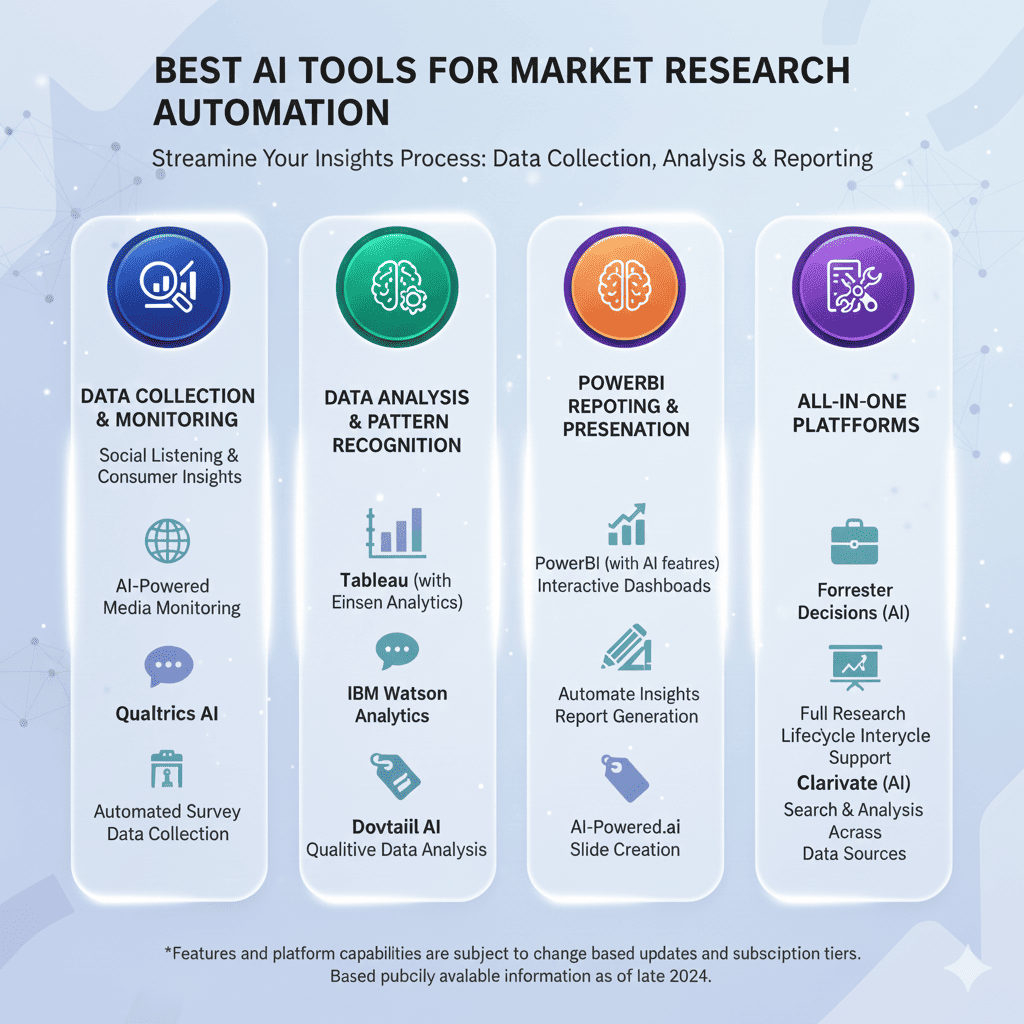
In today’s fast-paced business environment, market research automation has become essential for companies seeking competitive advantages. Traditional market research methods—manual surveys, lengthy data analysis, and time-consuming report compilation—are being revolutionized by artificial intelligence. The right AI tools can transform weeks of work into hours, uncovering insights that would be impossible to detect manually.
This comprehensive guide explores the most powerful AI tools for market research automation that are reshaping how businesses understand their markets, competitors, and customers. Whether you’re a startup founder, marketing director, or market research professional, these platforms will help you make data-driven decisions faster and more accurately than ever before.
Why Market Research Automation Matters Now
Before diving into specific tools, let’s understand why market research automation has become a critical business function:
- Speed to Insight: Reduce research timelines from weeks to days or hours
- Scalability: Analyze thousands of data points simultaneously
- Cost Efficiency: Decrease research costs by up to 70% compared to traditional methods
- Real-Time Intelligence: Monitor market changes as they happen
- Deeper Analysis: Uncover patterns invisible to manual analysis
- Competitive Edge: React to market shifts before competitors
- Resource Optimization: Free your team for strategic work instead of data collection
1. Crayon: Competitive Intelligence Powerhouse
Crayon stands out as one of the most comprehensive AI tools for market research automation, specifically designed for competitive intelligence. This platform monitors your competitors across dozens of channels, automatically surfacing the insights that matter most.
Key Features:
- Automated Competitor Tracking: Monitors competitor websites, social media, job postings, and more
- AI-Powered Analysis: Identifies significant changes and trends automatically
- Battlecards: Creates sales enablement materials based on competitive intelligence
- Custom Alerts: Notifies you when competitors make important moves
- Integration Capabilities: Connects with Salesforce, Slack, and other business tools
Best For:
- B2B companies with multiple competitors
- Sales teams needing competitive positioning insights
- Marketing teams tracking competitor campaigns
- Product teams monitoring feature releases
Strategic Applications:
Use Crayon to track pricing changes, new feature launches, and messaging shifts from competitors. The AI automatically categorizes and prioritizes intelligence, ensuring your team focuses on actionable insights rather than drowning in data. Set up custom triggers for specific competitor actions like leadership changes or funding announcements.
2. Brandwatch: Social Listening and Consumer Intelligence
Brandwatch has established itself as a leader in market research automation through its sophisticated social listening and consumer intelligence capabilities. This platform analyzes billions of online conversations to understand consumer sentiment, emerging trends, and brand perception.
Key Features:
- Real-Time Social Monitoring: Tracks mentions across social platforms, forums, and news sites
- Sentiment Analysis: AI determines emotional tone of conversations at scale
- Trend Detection: Identifies emerging topics before they become mainstream
- Audience Segmentation: Automatically categorizes consumers by behavior and preferences
- Visual Analytics: Transforms data into compelling, shareable visualizations
Best For:
- Consumer brands monitoring brand health
- Marketing teams tracking campaign performance
- Product developers identifying customer pain points
- Crisis management teams needing early warning systems
Implementation Strategy:
Configure Boolean search queries to capture relevant conversations about your brand, competitors, and industry. Use the AI’s demographic analysis to understand who’s talking about different topics. Set up automated reports that deliver weekly insights to stakeholders, eliminating manual report compilation.
3. Tableau with Einstein Analytics: Data Visualization Meets AI
Tableau with Einstein Analytics brings powerful market research automation capabilities to data visualization, transforming raw market data into actionable insights through AI-powered analysis and predictive modeling.
Key Features:
- Natural Language Processing: Ask questions in plain English and get instant visualizations
- Predictive Analytics: AI forecasts trends based on historical data
- Automated Insights: Discovers hidden patterns without manual exploration
- Data Blending: Combines multiple data sources seamlessly
- Mobile Intelligence: Access insights anywhere on any device
Best For:
- Data-driven organizations with multiple data sources
- Market researchers analyzing complex datasets
- Executive teams needing dashboard access
- Analysts combining market data with internal metrics
Advanced Usage:
Connect Tableau to your CRM, web analytics, sales data, and external market research sources. Use Einstein’s “Explain Data” feature to understand anomalies automatically. Create predictive models that forecast market demand, customer churn, or sales trends based on market conditions.
4. Qualtrics XM: Experience Management and Research Platform
Qualtrics XM revolutionizes market research automation by combining survey research with advanced AI analytics, creating a comprehensive experience management platform that goes far beyond traditional survey tools.
Key Features:
- Intelligent Survey Design: AI suggests optimal question types and flows
- Text Analytics: Automatically analyzes open-ended responses
- Statistical Significance Testing: AI identifies meaningful patterns
- Predictive Intelligence: Forecasts customer behavior and market trends
- Automated Reporting: Generates insights-driven reports without manual analysis
Best For:
- Market researchers conducting regular surveys
- Customer experience teams measuring satisfaction
- Product teams validating concepts
- Brand managers tracking brand perception
Research Excellence:
Use Qualtrics’ AI to optimize survey response rates by testing different question orders and formats. The platform’s text iQ feature analyzes thousands of open-ended responses, categorizing themes and sentiments automatically. Combine survey data with behavioral data for comprehensive market understanding.
5. SEMrush: Digital Marketing Intelligence
SEMrush provides essential market research automation for digital-first businesses, offering comprehensive insights into online market dynamics, competitor strategies, and search trends that reveal consumer intent.
Key Features:
- Keyword Research: AI identifies valuable search terms and trends
- Competitor Analysis: Tracks competitor digital strategies automatically
- Market Explorer: Analyzes market landscape and identifies opportunities
- Traffic Analytics: Estimates competitor website traffic and sources
- Content Gap Analysis: Identifies topics competitors rank for that you don’t
Best For:
- Digital marketing teams optimizing online presence
- SEO specialists tracking keyword opportunities
- Content marketers identifying trending topics
- E-commerce businesses analyzing competitor strategies
Market Intelligence Applications:
Use the Market Explorer tool to identify your total addressable market and key players. Track competitor advertising spend and messaging across search and display networks. Analyze seasonal search trends to time product launches and campaigns optimally.
6. Consensus: AI-Powered Survey Analysis
Consensus specializes in market research automation for qualitative research, using AI to analyze video interviews, focus groups, and open-ended survey responses at a scale previously impossible.
Key Features:
- Video Analysis: Transcribes and analyzes video interviews automatically
- Theme Extraction: Identifies recurring themes across qualitative data
- Sentiment Mapping: Tracks emotional responses throughout interviews
- Collaboration Tools: Teams can tag and share insights efficiently
- Multi-Language Support: Analyzes research in multiple languages
Best For:
- Qualitative researchers conducting interviews
- UX researchers analyzing user testing sessions
- Brand strategists exploring brand perception
- Innovation teams gathering customer insights
Workflow Optimization:
Upload recorded focus groups or customer interviews, and Consensus automatically transcribes, tags themes, and identifies sentiment shifts. Use the collaborative features to have multiple team members review and annotate findings simultaneously, accelerating insight generation from weeks to days.
7. Cradle: AI Research Assistant
Cradle represents the next generation of market research automation, functioning as an AI-powered research assistant that conducts desk research, synthesizes findings, and generates reports autonomously.
Key Features:
- Autonomous Research: AI conducts comprehensive web research independently
- Source Evaluation: Assesses credibility and relevance of sources
- Synthesis and Summarization: Creates coherent reports from multiple sources
- Citation Management: Automatically cites sources properly
- Custom Research Briefs: Follows specific research methodologies
Best For:
- Market researchers with limited time for desk research
- Strategy consultants gathering market intelligence
- Investment analysts researching industries
- Business development teams evaluating opportunities
Research Process:
Provide Cradle with a research question like “What are the emerging trends in sustainable packaging for the food industry?” The AI searches multiple sources, evaluates credibility, synthesizes findings, and produces a comprehensive report with proper citations—work that would traditionally take days completed in hours.
8. Crimson Hexagon (Brandwatch Consumer Research): Advanced Social Analytics
Crimson Hexagon, now part of Brandwatch, offers sophisticated market research automation focused on understanding consumer behavior through social media analysis using proprietary AI algorithms.
Key Features:
- Image Recognition: Analyzes brand logos and products in social images
- Emotion Analysis: Goes beyond sentiment to identify specific emotions
- Demographic Inference: Estimates age, gender, and location of social users
- Trend Prediction: Forecasts which topics will gain momentum
- Historical Analysis: Analyzes social data going back over a decade
Best For:
- CPG brands tracking product reception
- Fashion and lifestyle brands monitoring visual trends
- Market researchers analyzing long-term trends
- Brand managers measuring share of voice
Strategic Insights:
Use image recognition to understand how consumers actually use your products versus intended use. Analyze emotional responses to product launches or campaigns. Track how conversations about your category evolved over years to inform long-term strategy.
9. MonkeyLearn: Custom Text Analysis
MonkeyLearn democratizes market research automation by allowing anyone to build custom AI models for text analysis without coding, making sophisticated natural language processing accessible to all researchers.
Key Features:
- No-Code Model Building: Create custom classifiers and extractors
- Pre-Built Models: Access templates for sentiment, keyword extraction, and more
- Integration Friendly: Connects to surveys, support tickets, social media
- Real-Time Analysis: Processes text data as it arrives
- Custom Dashboards: Visualizes analysis results automatically
Best For:
- Market researchers analyzing survey responses
- Customer success teams categorizing feedback
- Social media managers monitoring mentions
- Product teams organizing feature requests
Customization Power:
Train MonkeyLearn to categorize customer feedback into custom categories specific to your industry. Create extractors that pull product names, complaint types, or feature requests from unstructured text. Connect to your survey platform to analyze responses in real-time as they arrive.
10. Gong: Conversation Intelligence
Gong brings market research automation to sales conversations, using AI to analyze customer calls and meetings, uncovering market insights directly from customer interactions at scale.
Key Features:
- Call Recording and Transcription: Captures all customer conversations
- Deal Intelligence: Identifies factors that win or lose deals
- Competitive Mentions: Tracks when competitors come up in conversations
- Customer Sentiment: Analyzes emotional tone throughout conversations
- Market Signals: Detects emerging customer needs and pain points
Best For:
- B2B companies with sales teams
- Product teams seeking unfiltered customer feedback
- Market researchers wanting direct customer voice
- Sales leaders optimizing messaging and positioning
Voice-of-Customer Mining:
Analyze hundreds of sales calls to identify the most common objections, questions, and concerns prospects raise. Track which competitive comparisons come up most frequently. Identify emerging market needs mentioned by multiple customers before they become obvious trends.
11. Attest: Consumer Survey Platform
Attest streamlines market research automation by connecting brands with consumers for surveys while using AI to analyze responses and generate actionable insights rapidly.
Key Features:
- Rapid Panel Access: Reach target audiences in 58+ countries within hours
- AI-Powered Analysis: Automatically identifies significant findings
- Template Library: Pre-built survey templates for common research needs
- Real-Time Results: See responses and analysis as surveys complete
- Comparative Benchmarking: Compare results against industry standards
Best For:
- Brands needing quick consumer feedback
- Marketing teams testing concepts or messaging
- Product teams validating ideas
- Market researchers without existing panels
Speed-to-Insight:
Launch a brand awareness study targeting specific demographics across multiple markets in the morning, and receive AI-analyzed results with recommendations by evening. Use templates to standardize recurring research like brand tracking or ad testing.
12. Synthesio: Global Social Intelligence
Synthesio excels at market research automation for global brands, monitoring social conversations across languages and regions while using AI to identify cultural nuances and regional trends.
Key Features:
- Multi-Language Monitoring: Tracks conversations in 80+ languages
- Cultural Context: AI understands regional idioms and context
- Influencer Identification: Finds key voices in your category
- Crisis Detection: Alerts to potential issues before they escalate
- Custom Dashboards: Role-specific views for different stakeholders
Best For:
- Global brands operating in multiple markets
- International market researchers
- PR teams managing reputation across regions
- Market entry teams researching new countries
Global Intelligence:
Monitor how your brand is discussed differently across regions. Identify region-specific concerns or preferences that might not be apparent from aggregated data. Track cultural moments and conversations that present marketing opportunities in specific markets.
How to Build Your Market Research Automation Stack
Selecting the right tools for market research automation depends on your specific needs, budget, and existing infrastructure:
Assess Your Research Needs:
- Competitive Intelligence: Crayon, SEMrush
- Consumer Sentiment: Brandwatch, Crimson Hexagon
- Survey Research: Qualtrics, Attest
- Qualitative Analysis: Consensus, MonkeyLearn
- Sales Insights: Gong
- Data Visualization: Tableau
Consider Integration Requirements:
Choose tools that integrate with your existing tech stack. Most modern market research automation platforms offer APIs and pre-built connectors to CRMs, marketing automation platforms, and analytics tools.
Evaluate Budget and Scale:
- Enterprise Solutions: Qualtrics, Brandwatch, Gong ($20,000-$100,000+/year)
- Mid-Market Options: Crayon, SEMrush, Attest ($5,000-$20,000/year)
- Startup-Friendly: MonkeyLearn, basic Tableau licenses ($500-$5,000/year)
Plan for Team Adoption:
Select tools appropriate for your team’s technical sophistication. User-friendly platforms like Attest and Qualtrics require minimal training, while tools like Tableau and MonkeyLearn benefit from dedicated power users.
Best Practices for Market Research Automation
1. Start with Clear Objectives
Define what decisions your research will inform before selecting automation tools. Market research automation should answer specific business questions, not just generate data.
2. Ensure Data Quality
Garbage in, garbage out applies to AI just as it does to traditional analysis. Validate data sources, clean datasets, and verify that automated classifications are accurate before relying on them.
3. Combine Automated and Human Analysis
AI excels at processing volume and identifying patterns, but human researchers provide context, skepticism, and strategic interpretation. The best insights come from combining both.
4. Create Feedback Loops
Regularly review AI-generated insights against actual outcomes. When predictions or categorizations prove wrong, understand why and adjust your approach.
5. Democratize Insights
Market research automation works best when insights reach everyone who needs them. Create dashboards, automated reports, and alerts that deliver the right information to the right people at the right time.
6. Protect Privacy and Ethics
Ensure your automation tools comply with GDPR, CCPA, and other privacy regulations. Be transparent about data collection and use AI ethically.
7. Continuously Update Your Stack
The market research automation landscape evolves rapidly. Regularly evaluate new tools and capabilities. What required three tools last year might be accomplished by one today.
Measuring ROI of Market Research Automation
Justify investment in market research automation by tracking these metrics:
Time Savings
Calculate hours saved on research tasks. If automation reduces a weekly research process from 20 hours to 5 hours, that’s 780 hours saved annually per researcher.
Decision Speed
Measure how much faster you can make data-driven decisions. Faster insights mean quicker reactions to market opportunities or threats.
Research Costs
Compare the cost of automated tools versus traditional research methods, including personnel, software, and external research vendor fees.
Insight Quality
Track whether automated research leads to better business outcomes—more successful product launches, higher campaign ROI, or improved competitive win rates.
Coverage Expansion
Measure how much more market territory you can monitor. Automation might allow you to track 50 competitors instead of 5, or analyze 10,000 customer comments instead of 100.
The Future of Market Research Automation
The evolution of market research automation continues to accelerate. Here are emerging trends:
Predictive Market Intelligence
AI will increasingly forecast market changes before they occur, analyzing weak signals across data sources to predict shifts in consumer behavior, competitive moves, or market disruptions.
Autonomous Research Agents
Next-generation AI will conduct entire research projects independently, from defining methodology to collecting data, analyzing findings, and presenting recommendations.
Real-Time Market Dashboards
Businesses will operate with continuously updated market intelligence dashboards that adjust automatically as conditions change, eliminating periodic research in favor of always-on monitoring.
Emotional AI
Advanced sentiment analysis will detect subtle emotional nuances in text, voice, and video, providing deeper understanding of consumer feelings beyond simple positive/negative classifications.
Synthetic Research
AI will simulate consumer responses to concepts or scenarios, allowing rapid testing before investing in actual consumer research—while being validated against real consumer studies.
Common Pitfalls to Avoid
Over-Reliance on Automation
Don’t eliminate human judgment entirely. AI can miss context, humor, sarcasm, or cultural nuances that humans catch immediately.
Analysis Paralysis
Market research automation can generate overwhelming amounts of data. Focus on the insights that drive decisions rather than consuming every piece of available intelligence.
Ignoring Data Provenance
Understand where your data comes from. Social media sentiment might not represent your actual customer base. Survey panels might skew toward certain demographics.
Set-It-and-Forget-It Mentality
Automated systems need ongoing management. Review classifications, update keywords, and adjust parameters as markets and language evolve.
Siloed Tools
Ensure your automation tools communicate with each other. Insights are most powerful when you can correlate competitive intelligence with customer sentiment and sales performance.
Getting Started with Market Research Automation
Ready to embrace market research automation? Follow this roadmap:
Month 1: Audit and Plan
- Document your current research processes and pain points
- Identify which processes would benefit most from automation
- Research tools that address your specific needs
- Calculate potential ROI for different scenarios
Month 2: Pilot Program
- Select one or two tools for initial testing
- Start with a limited use case to prove value
- Train a small group of power users
- Measure results against manual processes
Month 3: Expand and Optimize
- Roll out successful tools to wider teams
- Create documentation and best practices
- Integrate with existing systems
- Begin building your full automation stack
Ongoing: Iterate and Improve
- Regularly review what’s working and what isn’t
- Stay updated on new capabilities and tools
- Gather feedback from users
- Continuously optimize processes
Conclusion: The Competitive Imperative of Market Research Automation
In an era where markets shift overnight and consumer preferences evolve rapidly, market research automation isn’t a luxury—it’s a competitive necessity. The businesses that thrive will be those that can understand their markets faster, deeper, and more accurately than competitors.
The AI tools for market research automation covered in this guide represent the cutting edge of market intelligence. From social listening platforms that monitor millions of conversations to AI assistants that conduct comprehensive desk research autonomously, these technologies transform how businesses understand their markets.
The key to success isn’t simply adopting every available tool. It’s thoughtfully building an automation stack that addresses your specific research needs, integrates with your workflows, and delivers insights that drive better decisions. Start with your most time-consuming or critical research processes, prove value with pilot programs, then expand your market research automation capabilities systematically.
Remember that automation amplifies rather than replaces human insight. The most powerful approach combines AI’s ability to process vast amounts of data with human researchers’ strategic thinking, contextual understanding, and creative interpretation.
The future belongs to organizations that can turn market data into strategic action faster than their competitors. With the right market research automation tools, your business can be among them. The question isn’t whether to automate your market research—it’s how quickly you can get started and how effectively you can leverage these powerful capabilities.
Also read this:
Best AI Tools for Comic & Manga Creation: Transform Your Creative Vision into Reality
Best AI Tools for Stress Monitoring and Relief: Your Complete Guide to Mental Wellness
Top AI Tools for Real-Time Translation & Subtitles: Breaking Language Barriers in 2025