
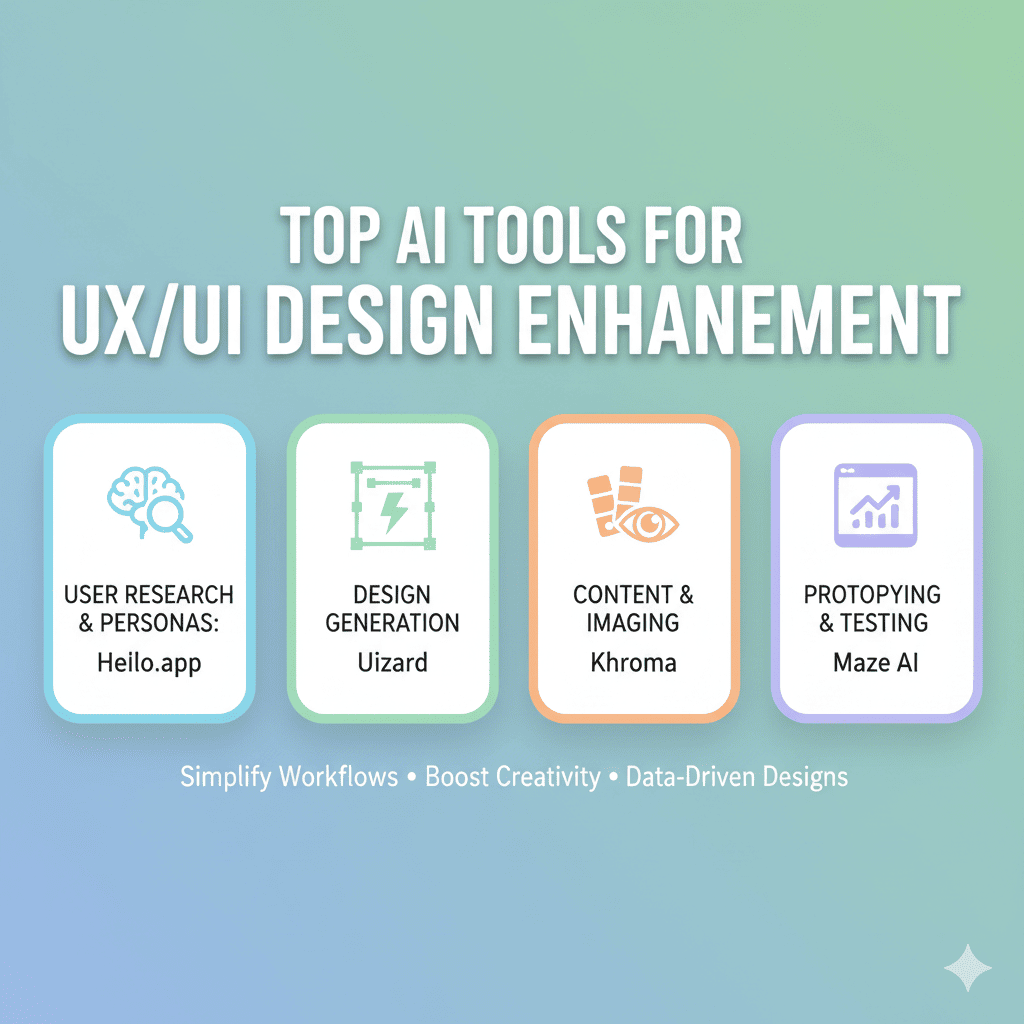
The design landscape has undergone a dramatic transformation with the integration of artificial intelligence. What once required hours of manual work, countless iterations, and extensive design expertise can now be accomplished with remarkable speed and precision using modern technology. AI Tools for UX/UI Design Enhancement are revolutionizing how designers approach their craft, enabling them to create more intuitive, accessible, and visually stunning digital experiences.
From automating repetitive tasks to generating intelligent design suggestions, AI Tools for UX/UI Design Enhancement are empowering designers to focus on creativity and strategic thinking rather than mundane execution. These intelligent systems can analyze user behavior, predict design outcomes, generate layouts, optimize color schemes, and even create entire design systems in minutes. The result is a new era of design efficiency where human creativity is amplified by machine intelligence.
Whether you’re a seasoned designer looking to streamline your workflow or a newcomer seeking to level up your design capabilities, understanding and leveraging AI Tools for UX/UI Design Enhancement has become essential. This comprehensive guide explores the most powerful AI-driven design tools available today, their unique capabilities, and how they can transform your design process from ideation to final implementation.
The AI Revolution in Design: Understanding the Impact
Before diving into specific tools, it’s important to understand how artificial intelligence is fundamentally changing the UX/UI design paradigm. AI Tools for UX/UI Design Enhancement aren’t just making existing processes faster—they’re introducing entirely new possibilities that were previously unimaginable.
Traditional design workflows often involve tedious tasks like resizing assets for multiple devices, creating design variations for A/B testing, maintaining design consistency across platforms, and generating documentation for developers. AI eliminates these bottlenecks, allowing designers to iterate rapidly and experiment freely without worrying about implementation logistics.
Moreover, AI Tools for UX/UI Design Enhancement bring data-driven insights into the creative process. Instead of relying solely on intuition and best practices, designers can now leverage AI algorithms that analyze millions of user interactions to suggest optimal layouts, predict user behavior, and recommend accessibility improvements. This marriage of creativity and data science is producing digital experiences that are both beautiful and highly effective.
The democratization of design is another significant impact. AI-powered tools are lowering the barrier to entry for design, enabling non-designers to create professional-quality interfaces and empowering small teams to produce work that rivals large design studios. This shift is fostering innovation across industries and making good design accessible to everyone.
1. AI-Powered Design Generation and Ideation Tools
The beginning of any design project involves ideation, conceptualization, and initial mockup creation. AI Tools for UX/UI Design Enhancement in this category help designers overcome blank canvas syndrome and rapidly explore multiple design directions.
Galileo AI: Text-to-Design Interface Generation
Galileo AI represents a breakthrough in design generation technology. This AI Tool for UX/UI Design Enhancement allows designers to describe an interface in natural language and instantly receive high-fidelity design mockups complete with images, copy, and functional layouts.
The platform uses advanced large language models trained on thousands of exceptional design examples to understand design intent and generate appropriate solutions. Simply type “create a modern fitness app dashboard with activity tracking and progress charts” and watch as Galileo produces multiple design variations that you can immediately refine and customize.
What makes Galileo particularly powerful is its understanding of design principles, patterns, and best practices. The AI doesn’t just place elements randomly—it considers visual hierarchy, spacing, color theory, and usability conventions to create designs that feel professionally crafted. Designers can then use these AI-generated mockups as starting points, saving hours of initial wireframing and layout work.
The tool also includes an intelligent editing system that maintains design consistency as you make changes. Modify one element’s styling, and Galileo can automatically adjust related components to maintain visual coherence. This feature dramatically accelerates the design iteration process and ensures consistency across screens.
Uizard: Rapid Prototyping with AI Assistance
Uizard combines multiple AI capabilities into a comprehensive design platform that accelerates every stage of the UX/UI process. This AI Tool for UX/UI Design Enhancement offers text-to-design generation, screenshot-to-design conversion, and hand-drawn sketch digitization.
The screenshot conversion feature is particularly valuable for competitive analysis and redesign projects. Upload a screenshot of any interface, and Uizard’s AI converts it into editable design components. This capability enables rapid prototyping based on existing interfaces while allowing for customization and improvement.
Uizard’s hand-drawn sketch recognition is equally impressive. Draw rough wireframes on paper, photograph them with your phone, and watch as the AI transforms your sketches into digital, production-ready designs. This feature bridges the gap between traditional brainstorming methods and digital design workflows, allowing designers to maintain their preferred creative process while benefiting from digital tools.
The platform also includes AI-powered theme generation. Describe your brand or design direction, and Uizard creates comprehensive design systems with color palettes, typography scales, component libraries, and spacing guidelines. This feature is invaluable for maintaining consistency across large projects or quickly establishing design foundations for new products.
Attention Insight: Predictive Visual Analytics
Attention Insight uses AI to predict how users will visually interact with your designs before any actual user testing. This AI Tool for UX/UI Design Enhancement employs eye-tracking algorithms and attention heatmap technology to show exactly where users will look, in what order, and what elements might be overlooked.
The platform’s AI is trained on thousands of real eye-tracking studies, enabling it to predict user attention patterns with remarkable accuracy. Upload your design mockups, and within seconds, receive heatmaps showing attention distribution, clarity scores indicating how easy your design is to understand, and specific recommendations for improving visual hierarchy.
This predictive capability is transformative for design validation. Instead of waiting for user testing sessions to identify problems, designers can catch attention and clarity issues during the design phase. The AI highlights overlooked call-to-action buttons, confusing layouts, and competing visual elements that distract from primary content.
Attention Insight also enables rapid comparison between design alternatives. Test multiple versions of a landing page or app screen to see which layout most effectively guides user attention toward conversion elements. This data-driven approach to design decision-making reduces guesswork and improves outcomes.
2. Intelligent Design Automation and Optimization Tools
Once initial designs are created, optimization becomes critical. AI Tools for UX/UI Design Enhancement in this category automate tedious tasks, ensure consistency, and optimize designs for various platforms and devices.
Figma AI: Contextual Design Assistance
While Figma is primarily known as a collaborative design platform, its AI features make it one of the most powerful AI Tools for UX/UI Design Enhancement available. Figma AI provides intelligent layout suggestions, automatic component organization, and smart design system recommendations.
The platform’s AI-powered auto-layout feature automatically adjusts designs for different screen sizes and orientations. Design once for desktop, and Figma AI can intelligently adapt your layouts for tablet and mobile views, maintaining visual hierarchy and readability across devices. This responsive design capability dramatically reduces the time spent creating device-specific variations.
Figma’s AI also excels at pattern recognition within design files. It identifies repetitive elements and suggests converting them into reusable components, helping teams build more maintainable design systems. The AI can detect inconsistencies in spacing, typography, or color usage and recommend corrections to maintain visual consistency.
Recent additions include AI-powered image generation and editing directly within Figma. Generate placeholder images that match your design aesthetic, remove backgrounds automatically, or create design variations with different visual styles—all without leaving your design environment.
Designify: Intelligent Image Processing
Designify revolutionizes how designers work with images and visual assets. This AI Tool for UX/UI Design Enhancement uses advanced computer vision and machine learning to automatically enhance, edit, and optimize images for digital interfaces.
The platform’s automatic background removal is exceptionally accurate, even with complex subjects like hair, fur, or transparent objects. Upload product photos, team headshots, or any other images, and Designify instantly removes backgrounds while maintaining edge quality. This feature alone saves designers countless hours compared to manual background removal in traditional photo editing software.
Designify also includes AI-powered shadow and lighting effects that make isolated subjects look naturally integrated into designs. The AI analyzes the subject and automatically generates appropriate shadows, reflections, and lighting adjustments that match your design’s aesthetic. These smart enhancements ensure visual consistency across image assets.
The platform can also automatically enhance image quality, adjusting exposure, color balance, and sharpness to ensure images look professional in any design context. Batch processing capabilities allow designers to process hundreds of images simultaneously, maintaining consistent visual quality across entire image libraries.
Khroma: AI Color Palette Generation
Khroma approaches color selection with machine learning sophistication. This AI Tool for UX/UI Design Enhancement learns your color preferences and generates infinite palette combinations that match your aesthetic sensibilities.
The platform begins by showing you 50 color options. As you select colors you like, Khroma’s neural network learns your preferences and generates personalized palette recommendations. The more you use the tool, the better it understands your style, producing increasingly relevant color combinations.
Khroma’s AI generates palettes specifically optimized for digital interfaces, considering factors like contrast ratios for accessibility, color harmony principles, and contemporary design trends. Each generated palette includes variations for primary, secondary, and accent colors, complete with specific use case recommendations.
The platform also provides context-aware palette applications. See your color schemes applied to typography, gradients, images, and UI components to understand how they’ll look in real designs. This preview capability helps designers make confident color decisions before implementing schemes in actual projects.
3. User Experience Research and Testing AI Tools
Understanding user behavior is fundamental to creating effective interfaces. AI Tools for UX/UI Design Enhancement in this category help designers gather insights, conduct usability testing, and make data-driven design decisions.
Maze: AI-Powered User Testing Platform
Maze combines traditional usability testing with AI-enhanced analytics to provide unprecedented insights into user behavior. This AI Tool for UX/UI Design Enhancement enables designers to conduct rapid testing on prototypes and live products, receiving AI-generated insights and recommendations.
The platform’s AI analyzes user testing sessions to identify patterns, frustration points, and success metrics automatically. Instead of manually reviewing hours of session recordings, designers receive AI-generated summaries highlighting critical usability issues, common user paths, and unexpected behaviors.
Maze’s predictive analytics capabilities are particularly valuable. The AI can predict potential usability issues before testing begins by analyzing your design against established UX patterns and accessibility guidelines. This proactive approach helps designers address problems during the design phase rather than discovering them through user testing.
The platform also includes AI-powered question generation for user surveys and interviews. Describe your research objectives, and Maze’s AI suggests relevant questions, optimal survey structures, and appropriate testing methodologies. This feature ensures comprehensive user research even for teams without dedicated UX researchers.
Hotjar AI: Behavioral Analytics Enhancement
Hotjar has integrated AI capabilities that transform raw user behavior data into actionable design insights. This AI Tool for UX/UI Design Enhancement analyzes heatmaps, session recordings, and user feedback to identify usability problems and optimization opportunities automatically.
The platform’s AI-powered anomaly detection identifies unusual user behavior patterns that might indicate design problems. For example, if users repeatedly click non-interactive elements or exhibit excessive scrolling behavior, Hotjar’s AI flags these issues with specific recommendations for improvement.
Hotjar AI also segments users automatically based on behavior patterns, identifying different user personas and their distinct interaction preferences. Understanding these segments enables designers to create more targeted experiences that serve diverse user needs effectively.
The platform’s AI generates natural language summaries of user sessions, making it easy to communicate findings to stakeholders without requiring them to watch lengthy recordings. These summaries highlight key moments, user frustrations, and successful interactions, providing clear narratives from raw behavioral data.
UserTesting AI Insights: Qualitative Analysis at Scale
UserTesting has enhanced its platform with AI capabilities that analyze qualitative user research at unprecedented scale. This AI Tool for UX/UI Design Enhancement processes video recordings, transcripts, and user feedback to extract themes, sentiment, and actionable insights automatically.
The platform’s AI can analyze dozens of user testing sessions simultaneously, identifying common themes, pain points, and positive experiences across participants. Natural language processing algorithms extract key quotes, categorize feedback, and highlight consensus opinions, dramatically reducing analysis time.
Sentiment analysis provides quantitative metrics from qualitative feedback. The AI determines whether user reactions are positive, negative, or neutral for specific features, screens, or interactions. This emotional intelligence helps designers prioritize improvements based on user satisfaction impact.
UserTesting AI also generates highlight reels automatically, creating compilation videos that showcase specific themes or issues across multiple testing sessions. These AI-curated videos make it easy to share research findings with stakeholders and build empathy for user experiences throughout product teams.
4. Accessibility and Inclusive Design AI Tools
Creating accessible, inclusive designs is both an ethical imperative and legal requirement. AI Tools for UX/UI Design Enhancement in this category help designers identify and fix accessibility issues automatically.
Stark: Comprehensive Accessibility Checking
Stark integrates directly into popular design tools to provide real-time accessibility guidance. This AI Tool for UX/UI Design Enhancement uses AI to automatically detect contrast issues, suggest WCAG-compliant alternatives, and simulate how designs appear to users with various visual impairments.
The platform’s AI-powered contrast checker goes beyond simple ratio calculations. It analyzes entire designs to identify all text and background combinations, flagging potential readability issues and suggesting specific color adjustments that maintain design aesthetics while meeting accessibility standards.
Stark’s vision simulator allows designers to experience their interfaces as users with color blindness, low vision, or other visual impairments see them. The AI applies accurate visual transformations based on medical research, helping designers understand real accessibility challenges and design more inclusively.
The platform also includes AI-generated accessibility annotations that automatically document contrast ratios, touch target sizes, and keyboard navigation paths. These annotations streamline collaboration between designers and developers, ensuring accessibility considerations are implemented correctly.
accessiBe: Automated Accessibility Remediation
While primarily focused on web implementation, accessiBe’s AI technology offers valuable insights for designers. This AI Tool for UX/UI Design Enhancement uses machine learning to identify accessibility issues in designs and suggest specific improvements.
The platform’s AI analyzes interface elements to ensure they meet WCAG guidelines for keyboard navigation, screen reader compatibility, and interactive element accessibility. It provides specific recommendations for ARIA labels, semantic HTML structures, and alternative text that designers can communicate to development teams.
accessiBe’s AI also evaluates cognitive accessibility, analyzing content complexity, navigation clarity, and information architecture. The system suggests simplifications for overly complex interfaces and recommends improvements to reduce cognitive load for users with learning disabilities or attention difficulties.
The platform includes accessibility performance scoring that quantifies how accessible designs are and tracks improvement over time. This metrics-driven approach helps design teams set accessibility goals and demonstrate progress to stakeholders.
5. Prototyping and Interaction Design AI Tools
Bringing designs to life with realistic interactions and animations is crucial for user testing and stakeholder presentations. AI Tools for UX/UI Design Enhancement in this category streamline the prototyping process and generate sophisticated interactions automatically.
Framer AI: Intelligent Interaction Design
Framer has evolved into a powerful design and prototyping platform with extensive AI capabilities. This AI Tool for UX/UI Design Enhancement generates responsive layouts, creates realistic prototypes, and even produces production-ready code automatically.
The platform’s AI-powered layout generation creates fully responsive designs that adapt intelligently to different screen sizes. Unlike simple scaling, Framer’s AI reorganizes content, adjusts visual hierarchy, and maintains readability across devices. This intelligent responsiveness reduces the need for manually designing separate mobile and desktop versions.
Framer AI also generates realistic prototypes with sophisticated interactions and animations. Describe the interaction you want—like “create a smooth page transition with parallax scrolling”—and the AI produces the necessary code and animations. This capability enables designers to create high-fidelity prototypes without extensive coding knowledge.
The platform includes an AI assistant that helps with design tasks through natural language commands. Ask the assistant to “adjust all heading sizes for better visual hierarchy” or “create a dark mode version of this design,” and it executes your request intelligently, understanding design context and maintaining consistency.
Principle: AI-Enhanced Animation
Principle focuses on creating fluid, realistic animations for mobile interfaces. While not purely AI-driven, its intelligent automation features make it an essential AI Tool for UX/UI Design Enhancement for interaction designers.
The platform’s smart animation system analyzes your design elements and suggests appropriate animation styles and timing. The AI understands common mobile patterns like swipe gestures, pull-to-refresh, and card transitions, automatically applying industry-standard animation curves and durations.
Principle’s AI also optimizes animation performance automatically. It analyzes complex animations and suggests simplifications that maintain visual appeal while ensuring smooth rendering on mobile devices. This performance optimization is crucial for creating animations that feel native and responsive.
The platform includes machine learning-powered motion prediction. When you begin animating an element, the AI predicts your intent and offers to complete the animation automatically. This predictive capability accelerates the animation process while maintaining natural, physics-based motion.
ProtoPie: Advanced Interaction Simulation
ProtoPie enables designers to create sophisticated prototypes with sensor integrations, conditional logic, and realistic data. Its AI features make it a powerful AI Tool for UX/UI Design Enhancement for designers creating complex interactive experiences.
The platform’s AI suggests interaction patterns based on your design context. Building a music player? ProtoPie’s AI recommends appropriate gesture controls, feedback animations, and state transitions commonly found in successful music applications. This pattern suggestion accelerates prototyping while ensuring adherence to platform conventions.
ProtoPie’s AI also generates realistic prototype data automatically. Instead of manually creating dozens of sample contacts, messages, or products, the AI generates contextually appropriate dummy data that makes prototypes feel authentic during user testing.
The platform includes intelligent troubleshooting that identifies issues in complex interactions. When interactions don’t behave as expected, the AI analyzes your prototype logic and suggests potential problems and solutions, dramatically reducing debugging time.
6. Design System Management and Documentation AI Tools
Maintaining consistent, scalable design systems is challenging for growing teams. AI Tools for UX/UI Design Enhancement in this category help teams create, manage, and enforce design systems effectively.
Zeroheight: AI-Powered Documentation
Zeroheight has integrated AI capabilities that automatically generate and maintain design system documentation. This AI Tool for UX/UI Design Enhancement connects to design files and produces comprehensive documentation with minimal manual effort.
The platform’s AI analyzes design components and automatically generates usage guidelines, property descriptions, and code examples. When you create a button component in Figma, Zeroheight’s AI documents all its variants, states, and properties automatically, saving hours of manual documentation work.
Zeroheight’s AI also maintains documentation accuracy as designs evolve. When you update components in your design files, the system detects changes and automatically updates relevant documentation. This automated synchronization ensures documentation never becomes outdated, a common problem with manually maintained design systems.
The platform includes AI-generated style guides that extract color palettes, typography scales, spacing systems, and other design tokens from your files automatically. These style guides ensure consistency across products and provide clear references for designers and developers.
Supernova: Design-to-Code with AI Intelligence
Supernova bridges the gap between design and development with AI-powered code generation. This AI Tool for UX/UI Design Enhancement analyzes designs and produces production-ready code for multiple platforms and frameworks.
The platform’s AI understands design intent and generates semantic, maintainable code rather than just converting visual properties to CSS. It recognizes common UI patterns and implements them using appropriate components and best practices for your target framework, whether React, Flutter, SwiftUI, or native code.
Supernova’s AI also maintains design token systems automatically. It extracts colors, typography, spacing, and other design decisions from your files and generates synchronized token files for design and development. When designers update colors in design files, developers automatically receive updated token files, ensuring perfect consistency.
The platform includes intelligent component mapping that connects design components to code implementations. This mapping enables true single-source-of-truth design systems where changes propagate from design to production automatically, dramatically reducing design-development handoff friction.
7. Content Creation and Copywriting AI Tools
Compelling copy is integral to effective UX/UI design. AI Tools for UX/UI Design Enhancement in this category help designers generate, refine, and optimize interface copy.
Copy.ai: UX-Focused Content Generation
Copy.ai has developed specialized features for interface copywriting. This AI Tool for UX/UI Design Enhancement generates microcopy, button labels, error messages, and onboarding text that matches your brand voice and UX best practices.
The platform’s AI understands the constraints and conventions of interface copy. It generates concise, action-oriented button text, helpful error messages that guide users toward solutions, and onboarding copy that explains features without overwhelming users. This specialized understanding produces copy that feels native to digital interfaces.
Copy.ai also generates multiple variations for A/B testing. Creating alternative headline or call-to-action options enables designers to test which copy most effectively drives user engagement and conversions. The AI considers psychological principles and conversion optimization techniques when generating test variations.
The platform includes tone adjustment capabilities powered by AI. Transform formal copy to conversational, technical to friendly, or serious to playful with single-click transformations. This flexibility helps teams maintain consistent brand voice across diverse products and user touchpoints.
ChatGPT for Design: Conversational Design Assistant
ChatGPT has become an invaluable AI Tool for UX/UI Design Enhancement when used strategically. Designers leverage its conversational AI for brainstorming, generating user personas, writing design briefs, and creating realistic interface content.
The platform excels at generating user research materials. Describe your product and target audience, and ChatGPT produces detailed user personas complete with demographics, goals, pain points, and usage scenarios. These AI-generated personas provide valuable starting points for user-centered design processes.
ChatGPT also helps designers articulate design decisions and create compelling case studies. The AI assists with writing design rationales, documenting design processes, and creating portfolio content that effectively communicates design thinking and outcomes.
For interface content, ChatGPT generates realistic sample text in appropriate contexts and quantities. Need realistic product descriptions, user reviews, or notification messages for your prototype? ChatGPT produces contextually appropriate content that makes prototypes feel authentic during testing and presentations.
Maximizing the Value of AI Tools in Your Design Workflow
Successfully integrating AI Tools for UX/UI Design Enhancement requires strategic thinking about where AI adds most value. Start by identifying bottlenecks and repetitive tasks in your current workflow—these are prime candidates for AI automation.
Experiment with multiple tools to find combinations that complement your design process. Many designers use AI for initial ideation, manual refinement for creative direction, AI again for optimization and accessibility checking, and manual oversight for final quality assurance. This hybrid approach leverages both AI efficiency and human creativity.
Stay updated on AI capabilities as they evolve rapidly. AI Tools for UX/UI Design Enhancement are improving continuously, with new features and capabilities released frequently. Regularly exploring tool updates ensures you’re leveraging the latest innovations to streamline your workflow.
Remember that AI Tools for UX/UI Design Enhancement are assistants, not replacements for design expertise. Use AI to handle mundane tasks and generate options, but rely on your design judgment, user empathy, and creative vision to make final decisions. The most successful designers combine AI efficiency with human insight.
Conclusion: Embracing the AI-Enhanced Design Future
The integration of AI Tools for UX/UI Design Enhancement represents a fundamental shift in how digital experiences are created. These intelligent systems enable designers to work faster, experiment more freely, and create more accessible, user-centered interfaces than ever before.
From initial ideation through final implementation, AI Tools for UX/UI Design Enhancement touch every aspect of the design process. They generate design variations, predict user behavior, automate tedious tasks, ensure accessibility compliance, and bridge the gap between design and development. The result is a more efficient, data-driven, and ultimately more effective design process.
The designers who thrive in this new landscape will be those who embrace AI Tools for UX/UI Design Enhancement while maintaining focus on the human elements that AI cannot replicate—empathy, creativity, strategic thinking, and understanding of human behavior. AI handles the mechanics; designers provide the vision.
As these tools continue evolving, the gap between imagination and implementation will continue shrinking. What once required weeks of work can now be accomplished in hours. This efficiency doesn’t diminish the importance of designers—it elevates their role, enabling them to focus on solving complex problems, innovating new interaction patterns, and creating experiences that genuinely improve people’s lives.
Also read this:
Best AI Cybersecurity Tools for Maximum Protection: Your Complete 2025 Guide
Best AI Fraud Detection Tools for Online Security: Protect Your Business in 2025
Top AI Tools for Real Estate Lead Generations: Transform Your Business in 2025