
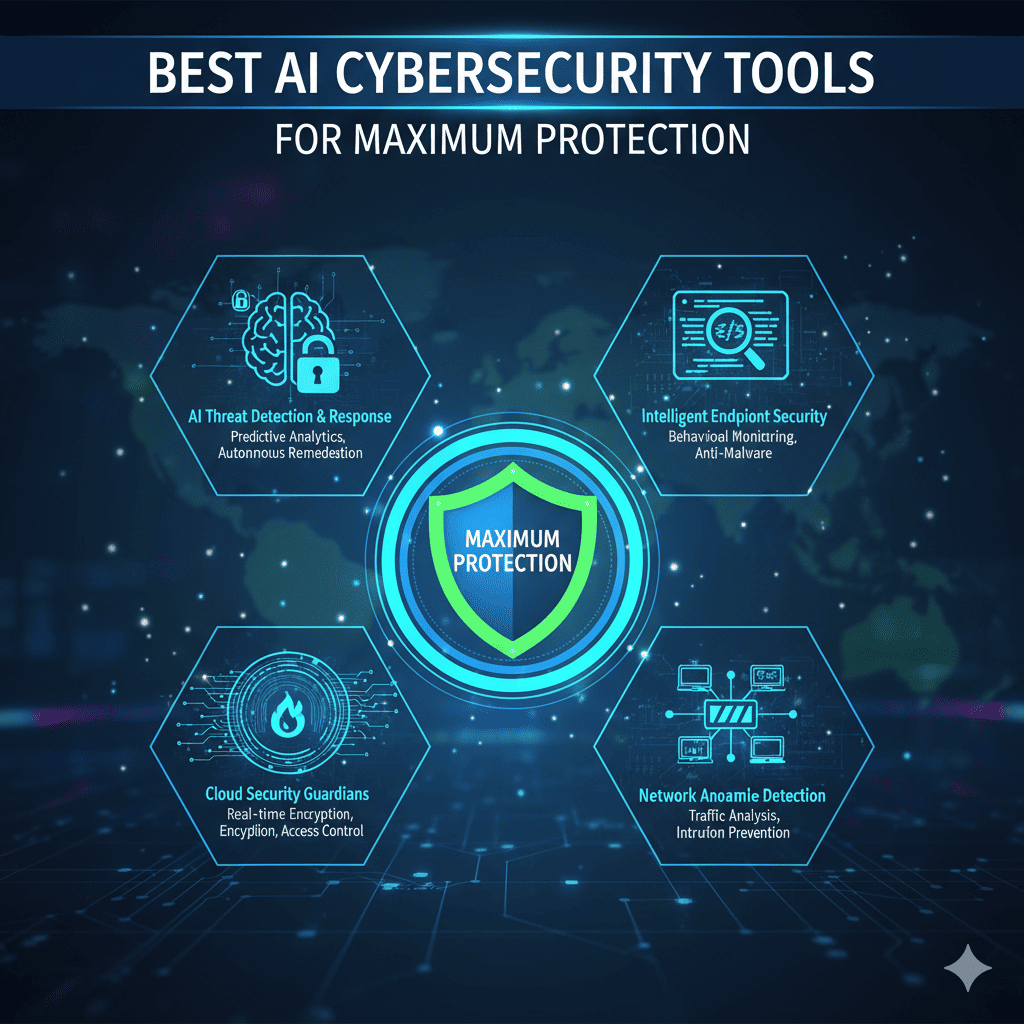
In today’s digital landscape, cyber threats are evolving at an unprecedented pace. Traditional security measures are no longer sufficient to protect against sophisticated attacks that adapt and learn. This is where AI Cybersecurity Tools come into play, revolutionizing how organizations and individuals defend their digital assets. These intelligent systems leverage machine learning, deep learning, and predictive analytics to identify, prevent, and respond to threats in real-time.
The integration of artificial intelligence into cybersecurity has transformed the industry from reactive to proactive defense mechanisms. AI Cybersecurity Tools can analyze millions of data points per second, detect anomalies that human analysts might miss, and automatically respond to threats before they cause damage. This comprehensive guide explores the best AI-powered security solutions available today and how they can provide maximum protection for your digital infrastructure.
Understanding the Power of AI in Cybersecurity
Before diving into specific tools, it’s essential to understand why AI Cybersecurity Tools have become indispensable in modern security strategies. Artificial intelligence brings several game-changing capabilities to the cybersecurity arena that traditional methods simply cannot match.
First, AI systems excel at pattern recognition. They can learn what normal network behavior looks like and instantly flag deviations that might indicate a breach or attack. This capability is particularly valuable in detecting zero-day exploits and previously unknown threats that signature-based security systems would miss entirely.
Second, AI Cybersecurity Tools operate at machine speed. While human analysts need time to investigate alerts and determine appropriate responses, AI systems can make decisions in milliseconds. This speed is critical when dealing with automated attacks that can compromise systems in seconds.
Third, AI never gets tired or distracted. Security operations centers often struggle with alert fatigue, where analysts become overwhelmed by the sheer volume of notifications. AI systems can tirelessly monitor networks 24/7, freeing human experts to focus on strategic security initiatives and complex threat investigations.
1. Advanced Threat Detection and Prevention Systems
The foundation of any robust cybersecurity strategy lies in detecting and preventing threats before they can infiltrate your systems. Modern AI Cybersecurity Tools in this category use sophisticated algorithms to identify malicious activity with remarkable accuracy.
Darktrace: Autonomous Response Technology
Darktrace stands out as one of the most advanced AI Cybersecurity Tools available today. Using its proprietary “Enterprise Immune System” technology, Darktrace learns the unique patterns of every user, device, and network within an organization. This self-learning AI can detect subtle deviations that indicate emerging threats.
What makes Darktrace particularly impressive is its Autonomous Response capability. When the system detects a threat, it doesn’t just alert human operators—it takes immediate action to neutralize the danger. This might involve isolating infected devices, throttling suspicious connections, or blocking malicious file transfers, all while maintaining business operations.
The platform excels at identifying insider threats, ransomware attacks, and advanced persistent threats (APTs) that might remain undetected by traditional security tools. Its AI algorithms continuously evolve, learning from new attack patterns and adapting defenses accordingly.
CrowdStrike Falcon: Cloud-Native Protection
CrowdStrike Falcon represents the next generation of endpoint protection, combining AI-powered threat detection with cloud-native architecture. This AI Cybersecurity Tool protects workloads across on-premises, virtualized, and cloud-based environments from a single lightweight agent.
The platform’s AI engine analyzes over one trillion events per week, building a comprehensive understanding of global threat patterns. This massive data analysis enables CrowdStrike to predict and prevent attacks before they occur. The system uses indicator of attack (IOA) methodology rather than traditional indicator of compromise (IOC) detection, focusing on adversary behavior rather than malware signatures.
CrowdStrike’s machine learning models can identify never-before-seen malware variants and fileless attacks that evade conventional security measures. The platform also includes threat intelligence capabilities, providing context about attackers, their motivations, and their tactics, techniques, and procedures (TTPs).
Cylance: Predictive Prevention
Cylance, now part of BlackBerry, pioneered the use of artificial intelligence for malware prevention. This AI Cybersecurity Tool uses mathematical models trained on hundreds of millions of malware and benign software samples to predict whether a file is malicious before execution.
Unlike signature-based antivirus solutions that rely on known threat databases, Cylance’s AI can identify brand-new malware variants with high accuracy. The system analyzes millions of file characteristics in milliseconds, making real-time prevention decisions without requiring constant updates or cloud connectivity.
This predictive approach is particularly effective against polymorphic malware that changes its signature with each infection and zero-day exploits that target previously unknown vulnerabilities. Cylance’s lightweight agent has minimal impact on system performance, making it ideal for resource-constrained environments.
2. Intelligent Network Security Solutions
Network security has evolved far beyond simple firewalls and intrusion detection systems. Modern AI Cybersecurity Tools for network protection use deep learning to understand traffic patterns, identify anomalies, and prevent data exfiltration attempts.
Vectra AI: Network Detection and Response
Vectra AI specializes in using artificial intelligence to detect cyberattacks in real-time across cloud, data center, and enterprise environments. This AI Cybersecurity Tool employs advanced machine learning algorithms to identify attacker behaviors and techniques rather than relying on signatures or rules.
The platform continuously learns what constitutes normal behavior for every workload, device, and user account in your environment. When it detects behavior consistent with known attack patterns, it generates high-fidelity alerts that security teams can act upon immediately. Vectra’s AI reduces false positives by up to 95%, ensuring analysts focus on genuine threats.
One of Vectra’s standout features is its ability to track the entire lifecycle of an attack, from initial reconnaissance to data exfiltration. This comprehensive visibility enables security teams to understand the full scope of a breach and remediate effectively. The system also prioritizes threats based on certainty and severity, helping teams address the most critical risks first.
Fortinet FortiAI: Integrated Security Fabric
Fortinet has integrated AI capabilities throughout its Security Fabric platform, creating a unified ecosystem of AI Cybersecurity Tools that work together seamlessly. FortiAI serves as the central intelligence hub, analyzing threat data from all Fortinet security components.
The system uses both supervised and unsupervised machine learning to identify threats. Supervised learning helps classify known malware variants, while unsupervised learning detects previously unknown threats based on behavioral patterns. This dual approach provides comprehensive coverage against both established and emerging threats.
FortiAI also includes predictive analytics capabilities that forecast potential attack vectors based on current threat trends and organizational vulnerabilities. This forward-looking intelligence enables proactive security measures rather than reactive responses. The platform’s integration across network, endpoint, cloud, and application security creates a cohesive defense strategy.
Cisco Stealthwatch: Behavioral Analytics
Cisco Stealthwatch leverages network traffic analysis and behavioral modeling to detect threats that evade perimeter defenses. This AI Cybersecurity Tool uses machine learning to establish baseline behaviors for users, devices, and applications across the network.
The system excels at identifying lateral movement, which occurs when attackers move through a network after initial compromise. By detecting unusual communication patterns between internal systems, Stealthwatch can alert teams to ongoing breaches that might otherwise remain hidden for months.
Stealthwatch also includes encrypted traffic analysis capabilities, enabling threat detection even when attackers use encryption to hide their activities. The AI algorithms can identify malicious behavior patterns in encrypted traffic without actually decrypting the data, preserving privacy while maintaining security.
3. AI-Powered Email Security Platforms
Email remains the primary attack vector for most cyberattacks, from phishing scams to ransomware delivery. AI Cybersecurity Tools designed for email security use natural language processing and machine learning to identify malicious messages with exceptional accuracy.
Abnormal Security: Behavioral AI for Email
Abnormal Security represents a revolutionary approach to email security, using behavioral AI to understand how organizations communicate and detect deviations that indicate attacks. Unlike traditional email security tools that focus on analyzing email content and attachments, Abnormal learns the unique communication patterns of every employee.
This AI Cybersecurity Tool builds comprehensive behavioral profiles by analyzing sender-recipient relationships, communication frequency, writing styles, and business processes. When an email deviates from expected patterns—such as a finance employee suddenly requesting unusual wire transfers or a vendor contact using slightly different language—the system flags it as suspicious.
Abnormal’s AI is particularly effective against business email compromise (BEC) attacks, which cost organizations billions annually. These sophisticated attacks often use no malware or malicious links, making them invisible to conventional security tools. By focusing on behavioral anomalies, Abnormal can detect and block these attacks before they succeed.
Proofpoint: Advanced Threat Protection
Proofpoint combines multiple AI technologies to create a comprehensive email security solution. This AI Cybersecurity Tool uses machine learning for URL defense, attachment analysis, and impostor detection, providing multi-layered protection against email-borne threats.
The platform’s AI analyzes billions of emails, URLs, and attachments daily, building a constantly updated understanding of the global threat landscape. This massive data analysis enables Proofpoint to identify emerging attack campaigns and protect customers before threats reach their inboxes.
Proofpoint also includes advanced anti-phishing capabilities powered by computer vision and natural language processing. The system can detect phishing attempts that impersonate legitimate brands, even when attackers use sophisticated techniques like lookalike domains or newly registered websites.
Mimecast: Integrated Cloud Email Security
Mimecast offers a comprehensive cloud-based email security solution that incorporates AI throughout its platform. This AI Cybersecurity Tool protects against malware, spam, phishing, and data leaks while also providing email continuity and archiving capabilities.
The platform’s AI engine analyzes email content, sender reputation, and attachment behavior to identify threats. Machine learning algorithms continuously improve detection accuracy by learning from new attack patterns and false positives. Mimecast also uses AI for data loss prevention, identifying sensitive information in outbound emails and preventing accidental or malicious data exposure.
One notable feature is Mimecast’s impersonation protection, which uses AI to detect attempts to spoof executive identities or trusted partners. The system analyzes header information, domain similarities, and display name variations to identify spoofing attempts that might trick employees into revealing sensitive information or making fraudulent payments.
4. Cloud Security and CASB Solutions
As organizations migrate to cloud infrastructure and adopt SaaS applications, securing these environments becomes critical. AI Cybersecurity Tools designed for cloud security provide visibility, threat detection, and policy enforcement across multi-cloud deployments.
Microsoft Defender for Cloud: Comprehensive Azure Protection
Microsoft Defender for Cloud (formerly Azure Security Center) provides integrated security management and threat protection for Azure, AWS, and Google Cloud Platform resources. This AI Cybersecurity Tool uses machine learning to detect suspicious activities and vulnerabilities across cloud workloads.
The platform’s AI capabilities include anomaly detection for unusual resource usage patterns, which might indicate compromised accounts or cryptojacking attacks. Machine learning algorithms analyze network traffic, authentication logs, and resource configurations to identify security risks. Defender for Cloud also provides automated responses to common threats, such as blocking suspicious IP addresses or isolating compromised virtual machines.
Integration with Microsoft’s global threat intelligence network gives Defender for Cloud access to signals from billions of devices and hundreds of cloud services. This massive data repository enables the AI to identify emerging threats and protect customers proactively.
Netskope: Intelligent Cloud Access Security
Netskope pioneered the cloud access security broker (CASB) market and continues to lead with advanced AI capabilities. This AI Cybersecurity Tool provides visibility and control over cloud applications, protecting data and preventing threats across SaaS, IaaS, and PaaS environments.
The platform uses machine learning to analyze user behavior and identify anomalies that might indicate account compromise or insider threats. For example, if an employee suddenly downloads large volumes of sensitive data or accesses unusual applications, Netskope’s AI flags this activity for investigation.
Netskope also employs AI for data classification and protection. The system can automatically identify sensitive information like credit card numbers, social security numbers, or intellectual property in cloud applications and apply appropriate security policies. This automated classification is far more accurate and scalable than manual approaches.
Palo Alto Networks Prisma Cloud: Multi-Cloud Security
Prisma Cloud from Palo Alto Networks provides comprehensive security across the full cloud native stack, from infrastructure to applications. This AI Cybersecurity Tool uses machine learning for threat detection, vulnerability prioritization, and compliance management.
The platform’s AI analyzes cloud configurations to identify security misconfigurations and policy violations that create vulnerabilities. Machine learning algorithms prioritize these findings based on actual risk, considering factors like public exposure, data sensitivity, and exploitability. This intelligent prioritization helps security teams focus on the most critical issues first.
Prisma Cloud also includes runtime protection for containers and serverless functions, using behavioral AI to detect and block malicious activities in cloud-native applications. The system learns normal application behavior and can identify attacks like code injection, privilege escalation, or lateral movement attempts.
5. User and Entity Behavior Analytics (UEBA)
Understanding normal behavior patterns is crucial for detecting insider threats and compromised accounts. AI Cybersecurity Tools in the UEBA category use machine learning to profile user and entity behaviors, identifying anomalies that indicate security risks.
Exabeam: Behavioral Analytics and Automation
Exabeam specializes in using AI to detect abnormal user behavior and automate security operations. This AI Cybersecurity Tool builds detailed behavioral profiles for every user and entity in an environment, tracking activities like login patterns, resource access, and data transfers.
The platform’s machine learning algorithms establish baseline behaviors during normal operations and calculate risk scores when activities deviate from these norms. For example, if an employee who typically works 9-5 suddenly logs in at 3 AM from a new location, Exabeam flags this as suspicious and adjusts the user’s risk score accordingly.
What sets Exabeam apart is its automatic timeline generation for security investigations. When an alert triggers, the system assembles a comprehensive timeline of the user’s activities before, during, and after the suspicious event. This automated investigation capability dramatically reduces the time security analysts spend gathering information and enables faster response to threats.
Splunk UBA: Advanced Anomaly Detection
Splunk User Behavior Analytics uses machine learning and statistical models to detect threats that rule-based systems miss. This AI Cybersecurity Tool analyzes data from multiple sources including authentication logs, network traffic, and endpoint activities to identify anomalous behaviors.
The platform employs over 30 different machine learning algorithms, each specialized for detecting specific threat types. This ensemble approach provides comprehensive coverage against various attack scenarios, from credential abuse to data exfiltration. Splunk UBA also uses peer group analysis, comparing users with similar roles to identify outliers.
One powerful feature is the system’s ability to detect compromised accounts even when attackers try to mimic legitimate user behavior. By analyzing subtle patterns in keystroke dynamics, mouse movements, and navigation habits, Splunk UBA can identify when someone other than the authorized user is accessing an account.
Gurucul: Risk-Based Security Analytics
Gurucul provides a unified security and risk analytics platform powered by machine learning. This AI Cybersecurity Tool combines UEBA, threat detection, and risk quantification capabilities into a single solution.
The platform’s AI builds risk scores for users, accounts, and assets based on behavior patterns, access privileges, and contextual factors. These risk scores help security teams prioritize their efforts, focusing on the highest-risk entities first. Gurucul also uses graph analytics to map relationships between users, systems, and data, identifying unusual access patterns that might indicate privilege abuse or data theft.
Machine learning algorithms continuously adapt to changing behavior patterns, reducing false positives while maintaining high detection accuracy. The system also includes predictive analytics capabilities that forecast potential security incidents based on current risk trends and historical attack patterns.
6. Vulnerability Management and Patch Prioritization
With thousands of new vulnerabilities discovered annually, security teams struggle to prioritize patching efforts effectively. AI Cybersecurity Tools for vulnerability management use machine learning to assess actual risk and recommend optimal remediation strategies.
Kenna Security: Risk-Based Vulnerability Management
Kenna Security (now part of Cisco) pioneered the use of data science and machine learning for vulnerability prioritization. This AI Cybersecurity Tool analyzes massive amounts of threat intelligence data to predict which vulnerabilities are most likely to be exploited.
Rather than relying solely on CVSS scores, which don’t account for real-world exploit activity, Kenna’s AI considers factors like exploit availability, active exploitation in the wild, vulnerability age, and asset criticality. This risk-based approach helps organizations focus patching efforts on vulnerabilities that pose genuine threats rather than attempting to fix everything.
The platform’s machine learning models continuously improve as they learn from new exploit patterns and vulnerability disclosures. Kenna also provides remediation timeline recommendations, helping teams schedule patches based on risk levels and operational constraints.
Qualys VMDR: Continuous Risk Assessment
Qualys Vulnerability Management, Detection and Response (VMDR) uses AI to provide continuous visibility into vulnerabilities across on-premises, endpoint, cloud, and container environments. This AI Cybersecurity Tool combines asset discovery, vulnerability assessment, and threat prioritization in a unified platform.
The system’s AI analyzes vulnerability data alongside threat intelligence, asset criticality, and compensating controls to calculate true risk. Machine learning algorithms identify vulnerabilities with active exploits or those targeted by ransomware groups, enabling teams to prioritize patches that prevent actual attacks rather than just reducing scan findings.
Qualys also uses AI for asset categorization and criticality assessment. The system automatically identifies business-critical systems and adjusts risk scores accordingly, ensuring that vulnerabilities on essential assets receive immediate attention.
7. Security Orchestration, Automation and Response (SOAR)
Automating security operations is essential for dealing with the volume and speed of modern cyber threats. AI Cybersecurity Tools in the SOAR category use AI to orchestrate security workflows, automate response actions, and assist analysts in investigations.
Palo Alto Networks Cortex XSOAR: Intelligent Automation
Cortex XSOAR provides comprehensive security orchestration and automation capabilities powered by machine learning. This AI Cybersecurity Tool integrates with hundreds of security products, creating automated workflows that respond to threats without human intervention.
The platform’s AI capabilities include incident classification, which automatically categorizes alerts based on threat type and severity. Machine learning algorithms also recommend response playbooks based on historical incident data and successful remediation strategies. As the system processes more incidents, its recommendations become increasingly accurate.
Cortex XSOAR includes a virtual security analyst powered by AI that assists human analysts with investigations. This virtual analyst can gather information from multiple sources, correlate data, and present findings in a digestible format, dramatically reducing investigation time and improving decision-making.
IBM Security QRadar SOAR: Cognitive Security Operations
IBM’s SOAR platform incorporates Watson AI technology to provide cognitive security operations capabilities. This AI Cybersecurity Tool uses natural language processing and machine learning to automate complex security workflows and provide intelligent recommendations.
The platform’s AI can parse unstructured data from threat reports, security advisories, and incident notes, extracting actionable intelligence automatically. This capability eliminates manual information gathering and ensures analysts have complete context for decision-making. Watson AI also powers a virtual assistant that answers analyst questions in natural language and provides guidance on threat response.
QRadar SOAR includes adaptive playbooks that use machine learning to optimize response workflows over time. The system analyzes which actions successfully resolve incidents and adjusts automated responses accordingly, continuously improving operational efficiency.
Making the Right Choice for Your Organization
Selecting the right AI Cybersecurity Tools requires careful consideration of your organization’s specific needs, existing infrastructure, and security maturity level. Start by assessing your current security gaps and identifying which attack vectors pose the greatest risk to your business.
Consider integration capabilities carefully. The most effective security strategies use multiple AI Cybersecurity Tools that work together seamlessly, sharing threat intelligence and coordinating responses. Platforms with open APIs and extensive integration ecosystems provide more flexibility and better overall protection.
Don’t overlook the importance of usability and analyst experience. Even the most sophisticated AI Cybersecurity Tools provide little value if security teams can’t use them effectively. Look for solutions with intuitive interfaces, clear documentation, and robust training resources.
Finally, remember that AI Cybersecurity Tools are enablers, not replacements for skilled security professionals. The most successful security programs combine AI automation with human expertise, using technology to amplify analyst capabilities rather than replace them entirely.
Conclusion: Embracing AI for Maximum Protection
The cybersecurity landscape continues to evolve at a rapid pace, with threats becoming more sophisticated and damaging. Traditional security approaches are no longer sufficient to protect modern digital infrastructures. AI Cybersecurity Tools represent the future of digital defense, providing the speed, scale, and intelligence necessary to combat advanced threats effectively.
By implementing the AI Cybersecurity Tools discussed in this guide, organizations can significantly enhance their security posture, reduce response times, and protect critical assets from increasingly sophisticated attacks. Whether you’re defending against phishing attempts, insider threats, or advanced persistent threats, AI-powered security solutions provide the capabilities needed for maximum protection.
Also read this:
Best AI Fraud Detection Tools for Online Security: Protect Your Business in 2025
Top AI Tools for Real Estate Lead Generations: Transform Your Business in 2025
Best AI Appointment Scheduling Tools for Businesses: Transform Your Booking Process in 2025