
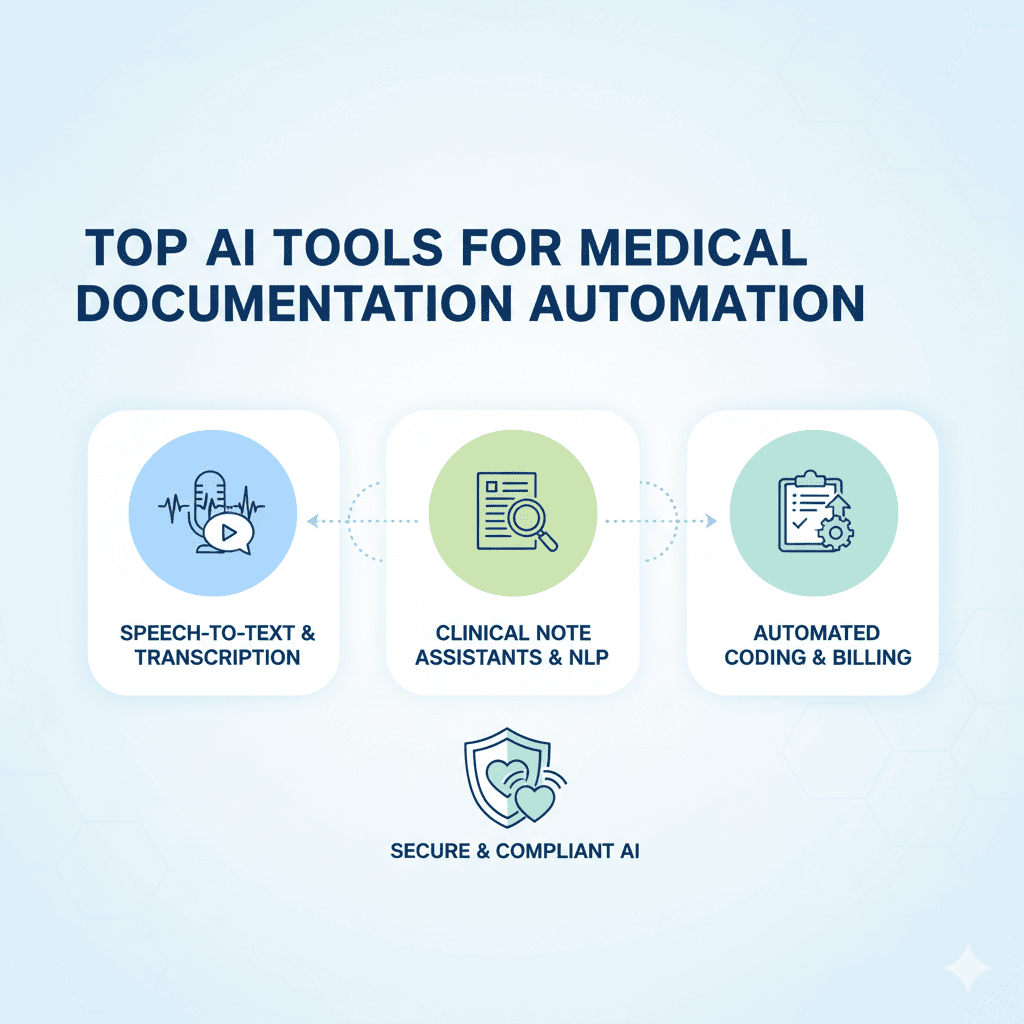
AI Tools for Medical Documentation Automation Healthcare professionals spend an alarming portion of their workday on administrative tasks, with clinical documentation consuming hours that could be devoted to patient care. Studies reveal that physicians spend nearly two hours on electronic health record (EHR) documentation for every hour of direct patient interaction—a ratio that contributes significantly to burnout and diminishes the quality of healthcare delivery. This administrative burden has reached crisis levels, prompting the healthcare industry to embrace AI tools for medical documentation automation as a transformative solution.
The emergence of sophisticated AI tools for medical documentation automation represents a paradigm shift in clinical workflow efficiency. These intelligent systems leverage natural language processing, machine learning, and voice recognition technology to capture patient encounters, generate clinical notes, extract relevant data, and populate EHR systems with minimal human intervention. The result is dramatically reduced documentation time, improved accuracy, enhanced physician satisfaction, and ultimately, better patient outcomes through increased face-to-face care time.
This comprehensive guide explores the leading AI tools for medical documentation automation available today, examining their capabilities, implementation considerations, and transformative impact on healthcare delivery. Whether you’re a solo practitioner seeking efficiency gains or a healthcare administrator evaluating enterprise solutions, understanding these technologies is essential for navigating the future of medical practice.
The Critical Need for Medical Documentation Automation
Before exploring specific solutions, it’s important to understand why AI tools for medical documentation automation have become indispensable in modern healthcare settings.
The Documentation Burden Crisis
The average physician spends 5-6 hours daily on EHR documentation and administrative tasks. This “pajama time”—work completed after clinic hours—contributes to burnout rates exceeding 50% in many specialties. The problem isn’t simply time consumption; poor documentation quality due to rushed entries, copy-paste errors, and incomplete records compromises patient safety and creates legal vulnerabilities.
Traditional documentation methods force physicians to choose between maintaining eye contact with patients and capturing detailed notes. This divided attention diminishes the therapeutic relationship while still producing incomplete documentation. AI tools for medical documentation automation resolve this conflict by allowing physicians to focus entirely on patients while technology handles note creation.
Regulatory and Reimbursement Pressures
Healthcare documentation must satisfy multiple stakeholders: meeting regulatory requirements, supporting accurate billing, facilitating continuity of care, and providing legal protection. The complexity of these requirements has increased dramatically with value-based care models demanding detailed outcome documentation.
Manual documentation struggles to consistently meet these multifaceted requirements. AI-powered solutions ensure comprehensive capture of relevant clinical information, appropriate coding support, and compliance with documentation standards—reducing claim denials and audit risks while supporting optimal reimbursement.
The ROI of Automation
Healthcare organizations implementing AI tools for medical documentation automation report impressive returns on investment: physicians seeing 2-4 additional patients daily, documentation time reduced by 50-70%, improved work-life balance leading to reduced turnover, and enhanced documentation quality supporting better clinical decision-making. These benefits justify investment even in resource-constrained healthcare environments.
1. Nuance DAX: Leading Ambient Clinical Intelligence
Nuance DAX (Dragon Ambient eXperience) represents the gold standard among AI tools for medical documentation automation, offering sophisticated ambient listening technology that captures natural patient-physician conversations and generates comprehensive clinical notes automatically.
Ambient Listening Technology
DAX uses advanced microphones and AI algorithms to capture entire patient encounters without requiring physicians to wear devices or interact with technology during visits. The system distinguishes between physician and patient voices, understands medical terminology across specialties, and filters irrelevant conversation while capturing clinically significant information.
This ambient approach allows completely natural patient interactions. Physicians can maintain eye contact, use body language effectively, and focus entirely on clinical assessment while DAX silently documents the encounter. Patients report improved satisfaction with visits where physicians aren’t distracted by computer screens.
Intelligent Note Generation
Within minutes of encounter completion, DAX generates structured clinical notes formatted according to specialty-specific templates and organizational preferences. The AI understands documentation requirements for different visit types—new patient consultations, follow-up visits, procedure notes—and structures information appropriately.
Generated notes include comprehensive histories, physical examination findings, assessment and plan sections, orders, and patient instructions. The AI extracts discrete data points for EHR population, supporting clinical decision support and quality metrics tracking.
Multi-Specialty Support and Customization
DAX supports diverse medical specialties, each with unique documentation requirements and terminology. Primary care, cardiology, orthopedics, psychiatry, and other specialties benefit from AI models trained on specialty-specific language and documentation patterns.
Organizations can customize documentation templates, preferred terminology, and workflow integration to match existing processes. This flexibility ensures DAX enhances rather than disrupts established clinical workflows.
Integration with Major EHR Systems
DAX integrates seamlessly with Epic, Cerner, and other major EHR platforms. Generated notes flow directly into appropriate sections of patient records, minimizing manual data transfer. This integration is crucial for adoption—physicians won’t embrace AI tools for medical documentation automation that create additional workflow steps.
The system also supports mobile access, allowing physicians to review and finalize notes from smartphones or tablets between patients or after clinic hours, providing flexibility for different work styles.
2. Suki AI: Voice-Powered Documentation Assistant
Suki AI offers physician-directed voice documentation that combines the speed of voice input with the intelligence of AI-powered content generation. This approach gives clinicians direct control over documentation while benefiting from significant automation.
Voice Command Interface
Suki operates through natural voice commands, allowing physicians to dictate findings, request information retrieval, and control EHR navigation hands-free. The system understands context—distinguishing between dictation content and system commands—enabling fluid interaction without precise phrasing requirements.
Physicians can speak naturally: “Patient presents with three days of productive cough and fever” and Suki converts this into appropriately formatted clinical documentation. The AI understands medical abbreviations, medication names, and clinical terminology, ensuring accurate transcription without constant corrections.
Contextual Documentation Assistance
Beyond simple dictation, Suki provides intelligent assistance by suggesting relevant documentation elements based on chief complaints and diagnoses. If a physician documents chest pain, Suki prompts for cardiac-specific history elements, relevant physical examination components, and appropriate diagnostic considerations.
This contextual awareness helps ensure comprehensive documentation while maintaining efficiency. Young physicians particularly benefit from this educational scaffolding, which reinforces thorough clinical assessment and complete documentation practices.
Learning and Personalization
Suki’s AI learns individual physician preferences, documentation styles, and commonly used phrases. Over time, the system becomes increasingly personalized, requiring fewer corrections and better anticipating each clinician’s needs.
This adaptive learning extends to practice patterns—understanding which orders a physician typically places for specific conditions, preferred medication choices, and standard patient instructions. This personalization accelerates documentation while supporting consistency in clinical practice.
Cost-Effective Implementation
Suki offers flexible pricing models suitable for solo practitioners through large healthcare systems. The per-provider subscription approach makes these AI tools for medical documentation automation accessible even to small practices without large capital investments.
Implementation is straightforward, typically requiring only app installation and brief training. This low-barrier entry allows physicians to quickly realize productivity benefits without prolonged IT implementations or workflow disruptions.
3. Abridge: AI-Powered Clinical Conversation Summarization
Abridge focuses specifically on converting clinical conversations into structured summaries, offering AI tools for medical documentation automation that emphasize simplicity and rapid implementation.
Real-Time Conversation Capture
Abridge records patient encounters through smartphone app or web browser, requiring minimal setup. Physicians simply start recording when patients enter and stop when visits conclude. The technology works across settings—clinic rooms, hospital wards, telehealth visits—providing consistent documentation support regardless of care location.
The system generates preliminary summaries in real-time, allowing physicians to review key points immediately after encounters while memories are fresh. This rapid feedback loop enables quick corrections before details fade.
Structured Summary Generation
Abridge’s AI extracts key information from conversations and organizes it into standard clinical documentation sections: chief complaint, history of present illness, review of systems, physical examination, assessment, and plan. The summaries highlight actionable items—orders needed, referrals, patient instructions—ensuring nothing falls through cracks.
The technology identifies medication changes, new diagnoses, and follow-up requirements, presenting them prominently for physician review. This safety-focused approach reduces the risk of overlooked clinical tasks.
Patient-Facing Features
Uniquely, Abridge offers patient access to visit summaries, promoting engagement and understanding. Patients receive plain-language summaries of their visits, medication changes, and follow-up instructions—improving adherence and reducing post-visit confusion.
This transparency strengthens the patient-physician relationship while reducing phone calls seeking visit clarification. Patients appreciate having reference materials for understanding their care plans and sharing information with family members or caregivers.
Privacy and Security
Abridge maintains strict HIPAA compliance with end-to-end encryption, secure cloud storage, and comprehensive audit trails. These security measures are essential for any AI tools for medical documentation automation handling sensitive health information.
The platform undergoes regular security audits and maintains compliance with healthcare data protection regulations across jurisdictions, providing peace of mind for providers concerned about legal and ethical obligations.
4. DeepScribe: Ambient AI Clinical Documentation
DeepScribe offers comprehensive ambient documentation services that combine AI technology with human quality review, ensuring accuracy while maximizing automation benefits.
Hybrid AI-Human Documentation Approach
DeepScribe’s distinctive feature is human expert review of AI-generated documentation. After AI creates initial notes from ambient encounter recordings, trained medical documentation specialists review and refine the output before delivery to physicians.
This hybrid approach achieves higher accuracy than purely automated systems while maintaining fast turnaround—typically delivering finalized notes within 2-4 hours. For physicians in high-stakes specialties where documentation precision is critical, this quality assurance provides valuable confidence.
Comprehensive Capture Methodology
DeepScribe captures complete patient encounters including conversations, examination sounds, and clinical observations. The AI identifies clinical findings from various audio cues—heart murmurs, breath sounds, patient descriptions of symptoms—ensuring comprehensive documentation beyond just verbal exchanges.
This multi-modal capture supports more thorough documentation than systems relying solely on conversational content, particularly valuable in specialties emphasizing physical examination findings.
Customizable Documentation Formats
Healthcare organizations can define custom documentation templates matching their preferred formats, specialty requirements, and EHR configurations. DeepScribe adapts to existing workflows rather than forcing physicians to adapt to standardized formats.
This customization extends to terminology preferences, abbreviation usage, and documentation detail levels. Organizations maintaining specific documentation standards for quality programs or legal reasons benefit from this flexibility.
Training and Support Services
DeepScribe provides comprehensive implementation support including workflow analysis, staff training, and ongoing optimization. This service-oriented approach helps organizations maximize AI tools for medical documentation automation value through proper integration into clinical operations.
Dedicated account management and responsive technical support ensure issues are addressed quickly, minimizing disruption to clinical operations during and after implementation.
5. Notable Health: Intelligent Data Structuring
Notable Health differentiates itself by focusing on intelligent data structuring and EHR workflow optimization, offering AI tools for medical documentation automation that enhance overall EHR efficiency beyond documentation alone.
Pre-Visit Planning Automation
Notable’s AI reviews upcoming appointments and automatically prepares charts by pulling relevant historical information, outstanding orders, and care gaps. This pre-charting saves significant time and ensures physicians enter encounters fully informed about patient status.
The system identifies patients due for preventive services, outstanding lab results requiring follow-up, and medication reconciliation needs—presenting this information prominently for encounter documentation.
Structured Data Extraction
Beyond generating narrative notes, Notable excels at extracting discrete data points for structured EHR fields. The AI populates diagnosis codes, vital signs, medications, and quality measure documentation automatically, supporting accurate billing and quality reporting without manual data entry.
This structured data extraction is particularly valuable for organizations participating in value-based care programs requiring detailed quality metrics documentation. Manual discrete data entry is time-consuming and error-prone; automation improves both efficiency and accuracy.
Workflow Optimization Intelligence
Notable analyzes physician EHR usage patterns and suggests workflow optimizations—identifying frequently used order sets, recommending smart phrase creation, and detecting inefficient documentation patterns. These insights help organizations continuously improve EHR efficiency beyond initial automation implementation.
The system also provides analytics on documentation time, note completion rates, and efficiency metrics, helping administrators identify physicians who might benefit from additional training or workflow support.
Enterprise-Scale Deployment
Notable is designed for healthcare system implementations, offering centralized administration, standardized configurations across departments, and comprehensive reporting for organizational leadership. This enterprise focus makes it ideal for large medical groups and hospital systems implementing AI tools for medical documentation automation across multiple sites and specialties.
Integration with major EHR platforms includes Epic, Cerner, and Allscripts, ensuring compatibility with existing technology investments.
6. Freed AI: Simplified Clinical Documentation
Freed AI offers streamlined documentation automation emphasizing ease of use and rapid implementation, making AI tools for medical documentation automation accessible to physicians with minimal technical expertise.
Minimalist Interface Design
Freed’s smartphone and web applications feature intuitive interfaces requiring virtually no training. Physicians start recording with single button press, and AI handles everything else automatically. This simplicity removes technology friction that often hinders adoption of clinical tools.
The deliberately minimal design philosophy extends to configuration—sensible defaults work well for most users, eliminating complex setup requirements while still offering customization for those desiring it.
Fast Note Generation
Freed generates preliminary clinical notes within 30-60 seconds of encounter completion. This near-instantaneous turnaround allows physicians to review notes between patients while encounter details remain fresh, enabling quick corrections and additions.
The rapid generation supports same-day note completion, improving clinical flow and reducing after-hours documentation burden. Physicians can finish clinic with all notes completed rather than facing evening documentation sessions.
Specialty-Agnostic Approach
While many AI tools for medical documentation automation require specialty-specific configurations, Freed’s AI adapts automatically to different specialties and visit types through conversation analysis. Primary care physicians, specialists, and proceduralists can use the same tool without specialty-specific setup.
This flexibility benefits practices with multiple specialties or physicians covering diverse clinical scenarios, eliminating the need for multiple documentation tools or complex configuration management.
Affordable Entry Point
Freed offers competitive pricing accessible to solo practitioners and small practices. The straightforward subscription model with no long-term contracts or setup fees allows physicians to try the service with minimal financial commitment.
This low-barrier entry democratizes access to AI tools for medical documentation automation previously available only to large healthcare organizations with substantial technology budgets.
7. Saykara: Voice-Enabled EHR Documentation
Saykara combines voice recognition with ambient listening to create a hybrid documentation approach that balances physician control with automation efficiency.
Voice-First Documentation Workflow
Saykara operates primarily through voice interaction, allowing physicians to speak naturally about patient encounters while AI structures information appropriately. The system understands commands like “chief complaint” or “assessment and plan,” organizing dictated content into correct note sections automatically.
This voice-first approach maintains physician autonomy—clinicians control documentation content and timing—while eliminating typing and mouse-clicking that disrupts patient interaction and slows workflow.
Ambient Mode for Natural Conversations
Beyond directed dictation, Saykara offers ambient mode capturing entire patient conversations. The AI identifies clinically relevant information from natural dialogue, extracting key points for documentation while filtering social conversation and irrelevant discussion.
Physicians can switch between directed dictation for efficient documentation and ambient capture for complex discussions, optimizing documentation approach for different encounter types and personal preferences.
Clinical Intelligence Integration
Saykara incorporates clinical decision support by cross-referencing documentation content against patient history, active medications, and clinical guidelines. The system alerts physicians to potential drug interactions, contradictory findings, or missing documentation elements required for specific diagnoses.
This intelligence layer adds safety value beyond simple documentation efficiency, helping prevent clinical errors and ensuring comprehensive care delivery.
Mobile-Optimized Functionality
Saykara’s mobile application enables documentation across clinical settings—inpatient rounds, home visits, nursing home consultations. The consistent interface and functionality across locations supports physicians practicing in multiple settings without learning different documentation systems.
Cloud-based architecture ensures documentation is accessible from any device, supporting workflow flexibility and enabling note review and finalization from anywhere.
8. Augmedix: Live Documentation Specialists with AI Support
Augmedix offers a unique model combining human documentation specialists with AI tools for medical documentation automation, providing real-time documentation services during patient encounters.
Live Remote Documentation
Augmedix assigns documentation specialists who join clinical encounters remotely via smartphone or Google Glass. These specialists listen to patient visits and create clinical notes in real-time, directly entering information into EHR systems during encounters.
This live documentation approach means notes are essentially complete when patients leave—no post-visit documentation required. Physicians review and finalize notes immediately, then move to next patients without documentation backlog.
AI-Enhanced Human Documentation
While human specialists create documentation, AI assists by suggesting relevant medical codes, identifying key clinical information, and ensuring documentation completeness. This human-AI collaboration combines accuracy and nuance of human understanding with efficiency and consistency of automation.
The approach particularly excels with complex encounters, unusual cases, or physicians who prefer human interaction over pure automation for quality assurance and professional confidence.
Specialty-Specific Expertise
Augmedix assigns documentation specialists with relevant specialty knowledge to appropriate physicians. Cardiology specialists understand cardiology terminology and documentation requirements; orthopedic specialists know orthopedic specifics. This matching ensures documentation quality and reduces correction requirements.
New physicians particularly benefit from experienced documentation specialists who can prompt for commonly overlooked documentation elements, essentially providing real-time documentation education.
Scalability and Flexibility
Organizations can start with select physicians and expand based on results. The service-based model—paying per documented encounter or physician—provides cost predictability and scalability without large capital investments in AI tools for medical documentation automation infrastructure.
Augmedix handles technology, training, and specialist management, minimizing administrative burden for healthcare organizations.
9. Robin Healthcare: AI Copilot for Clinicians
Robin Healthcare positions itself as an AI copilot, offering comprehensive clinical support extending beyond documentation to include care coordination and patient engagement.
Conversational AI Interface
Robin interacts with physicians through natural conversation, functioning more like a virtual assistant than traditional documentation software. Physicians can ask Robin to look up patient information, check medication dosing, or document specific findings through natural speech.
This conversational interface reduces cognitive load—physicians communicate with Robin as they would with a human assistant, without learning specialized commands or workflows. The natural interaction supports adoption even among physicians resistant to traditional technology.
Proactive Clinical Assistance
Beyond reactive documentation, Robin proactively offers assistance during encounters. The AI might remind physicians about overdue health maintenance, suggest relevant clinical guidelines, or note that documented symptoms could indicate specific conditions warranting consideration.
This proactive support enhances clinical decision-making while ensuring comprehensive documentation supporting quality care and appropriate billing.
Patient Communication Automation
Robin assists with patient communication by drafting after-visit summaries, prescription instructions, and follow-up reminders based on encounter documentation. These communications maintain consistency with clinical notes while being written in patient-friendly language.
Automated patient communication reduces staff workload while improving patient engagement and care plan adherence. Patients receive timely, clear information supporting their health management between visits.
Team-Based Care Support
For practices using team-based care models, Robin facilitates coordination by sharing relevant information with nurses, medical assistants, and care coordinators. The AI identifies tasks requiring follow-up, ensures appropriate team members are informed, and tracks task completion.
This coordination function makes Robin valuable beyond individual physician efficiency, improving overall practice operations and care quality.
10. Meditech Expanse Voice: Integrated EHR Voice Documentation
For organizations using Meditech EHR systems, Meditech Expanse Voice offers native AI tools for medical documentation automation designed specifically for seamless integration with Meditech’s electronic health records.
Native EHR Integration Advantages
As a native Meditech solution, Expanse Voice offers integration depth impossible for third-party tools. Voice commands directly control EHR navigation, documentation flows into correct fields without intermediary steps, and all functionality operates within familiar Meditech interfaces.
This seamless integration reduces training requirements—physicians already comfortable with Meditech find Expanse Voice intuitive. IT departments benefit from simplified support, managing one integrated system rather than coordinating between separate EHR and documentation tools.
Comprehensive Voice Control
Expanse Voice enables voice control of most EHR functions: opening patient charts, entering orders, documenting clinical notes, reviewing results, and communicating with colleagues. This comprehensive voice enablement supports truly hands-free EHR interaction.
For physicians with physical limitations or those prioritizing infection control (avoiding keyboard/mouse contact), complete voice control provides significant practical value beyond documentation efficiency.
Specialty-Specific Templates and Workflows
Meditech provides specialty-specific voice documentation templates optimized for different clinical scenarios. Emergency medicine, hospitalist medicine, surgical specialties, and outpatient practices benefit from templates designed for their unique documentation needs.
These templates include specialty-appropriate terminology recognition, preferred documentation structures, and relevant clinical decision support—ensuring voice documentation supports rather than hinders specialty-specific workflows.
Enterprise Deployment and Support
Healthcare systems already invested in Meditech EHR infrastructure can implement Expanse Voice system-wide with standardized configurations, centralized administration, and unified support through existing Meditech relationships.
This enterprise approach simplifies procurement, implementation, and ongoing management compared to integrating third-party AI tools for medical documentation automation across large healthcare organizations.
Implementation Considerations for Medical Documentation AI
Successfully implementing AI tools for medical documentation automation requires careful planning beyond simply selecting software. These considerations determine whether implementations achieve transformative results or disappoint.
Physician Engagement and Training
Technology succeeds or fails based on physician adoption. Involve physicians in selection processes, address concerns transparently, and provide comprehensive training that builds confidence and competence. Champions within physician ranks accelerate adoption through peer influence and practical troubleshooting support.
Recognize that physicians vary in technology comfort—some embrace AI immediately while others require substantial support. Tailor training and assistance to individual needs rather than assuming one-size-fits-all approaches work.
Workflow Integration and Optimization
AI tools for medical documentation automation should enhance existing workflows, not require workflow redesign. Analyze current processes before implementation, identify pain points AI can address, and configure tools to match physician preferences and practice patterns.
Post-implementation, monitor actual usage and gather physician feedback regularly. Technology often requires iterative refinement—initial configurations may need adjustment based on real-world experience.
EHR Compatibility and Technical Infrastructure
Verify that chosen AI tools for medical documentation automation integrate properly with existing EHR systems, meet technical requirements for network bandwidth and hardware, and comply with organizational security and privacy policies.
IT departments need adequate preparation time, clear technical documentation, and vendor support for integration challenges. Rushed implementations without proper technical preparation frequently encounter problems disrupting clinical operations.
Quality Assurance and Compliance
Establish processes for monitoring AI-generated documentation quality, ensuring clinical accuracy, appropriate coding, and regulatory compliance. While AI dramatically improves efficiency, human oversight remains essential for patient safety and legal protection.
Develop clear policies about physician responsibility for reviewing and finalizing AI-generated documentation. Legal and compliance teams should review these policies to ensure they adequately address liability concerns.
Cost-Benefit Analysis and ROI Measurement
Calculate expected return on investment including direct costs (software, implementation, training) and projected benefits (increased patient volume, reduced documentation time, decreased physician turnover, improved billing accuracy).
Establish metrics for tracking actual results post-implementation: documentation time per encounter, notes completed same-day, physician satisfaction scores, revenue capture improvements. These measurements justify continued investment and guide optimization efforts.
Privacy, Security, and Ethical Considerations
AI tools for medical documentation automation handling sensitive health information must address significant privacy, security, and ethical concerns.
HIPAA Compliance and Data Security
All medical documentation tools must maintain strict HIPAA compliance, including encryption of data in transit and at rest, secure user authentication, comprehensive audit logging, and business associate agreements. Organizations remain ultimately responsible for protecting patient information even when using third-party tools.
Evaluate vendors’ security practices, certifications, and incident response capabilities. Healthcare-specific security standards and regular third-party security audits provide additional confidence in vendor reliability.
AI Bias and Fairness
AI systems trained on historical data may perpetuate biases present in that data—potentially resulting in different documentation quality or clinical suggestions for patients from different demographic groups. Responsible vendors actively work to identify and mitigate bias in their AI systems.
Organizations should monitor for potential bias in AI-generated documentation, ensuring equitable care quality across all patient populations. Regular review of documentation from diverse patient encounters helps identify potential bias issues.
Transparency and Explainability
Physicians using AI tools for medical documentation automation should understand how AI generates documentation and recommendations. Black-box AI systems that can’t explain their reasoning create professional and legal risks when documentation questions arise.
Select tools offering transparency about AI decision-making and allowing physicians to understand why AI made specific documentation choices or suggestions.
Patient Consent and Awareness
While HIPAA generally permits recording clinical encounters for documentation purposes, best practices include informing patients that AI documentation tools are being used. Some organizations obtain explicit consent; others simply inform patients about documentation methods.
Consider patient comfort levels—some may appreciate documentation efficiency benefits while others might have concerns about AI handling their health information. Open communication supports trust and addresses concerns proactively.
The Future of Medical Documentation Automation
Current AI tools for medical documentation automation represent impressive achievements, but the technology continues evolving rapidly toward even more sophisticated capabilities.
Predictive Documentation and Clinical Decision Support
Future AI will anticipate documentation needs based on chief complaints and initial findings, suggesting relevant history questions, physical examination components, and diagnostic considerations. This predictive assistance will help ensure comprehensive care delivery while accelerating documentation.
Integration with clinical decision support will become seamless—documentation AI will simultaneously capture encounter information and provide relevant evidence-based recommendations, supporting both administrative efficiency and clinical quality.
Multimodal Data Integration
Next-generation AI tools for medical documentation automation will integrate diverse data sources: wearable device data, patient-generated health information, diagnostic imaging, laboratory results, and genetic information. Documentation will incorporate this comprehensive information automatically, creating truly holistic clinical records.
This integration will support population health management and precision medicine initiatives by ensuring all relevant patient data informs clinical decision-making and documentation.
Natural Language Understanding Advancement
AI language understanding continues improving, approaching human-level comprehension of medical conversations including nuance, context, and implied meaning. Future systems will require minimal correction, understanding complex cases and unusual presentations as effectively as straightforward encounters.
Multilingual capabilities will expand, supporting documentation in diverse languages and dialects—particularly valuable for healthcare systems serving multicultural populations.
Regulatory Evolution and Standardization
As AI tools for medical documentation automation become ubiquitous, regulatory frameworks will evolve to address AI-specific considerations: liability standards for AI-generated documentation, requirements for human oversight, and standards for AI system validation and monitoring.
Industry standardization around AI documentation quality, interoperability, and evaluation methods will emerge, helping organizations compare solutions and ensuring baseline quality across vendors.
Conclusion: Transforming Healthcare Through Documentation Innovation
The widespread adoption of AI tools for medical documentation automation represents one of healthcare’s most significant recent innovations, directly addressing a major contributor to physician burnout while improving care quality and efficiency. These technologies restore time for what matters most—meaningful patient interactions—while ensuring comprehensive documentation supporting clinical excellence and appropriate reimbursement.
Selecting appropriate AI tools for medical documentation automation requires understanding your specific needs, existing technology infrastructure, physician preferences, and organizational goals. No single solution fits all circumstances—solo practitioners need different capabilities than large healthcare systems, and different specialties have unique documentation requirements.
The healthcare organizations and individual physicians who thrive in coming years will be those who thoughtfully integrate these technologies, using AI tools for medical documentation automation to handle administrative complexity while maintaining focus on compassionate, evidence-based patient care. The technology handles what computers do best—processing information, pattern recognition, and documentation structuring—freeing humans to do what we do best: applying clinical judgment, building therapeutic relationships, and providing healing care.
Start by identifying your greatest documentation pain points. Evaluate solutions specifically addressing those challenges. Pilot selected AI tools for medical documentation automation with willing physician champions before broad implementation. Monitor results carefully, gather feedback continuously, and refine your approach based on real-world experience.
Also read this:
Top AI Photo Editing Tools for Instant Enhancement in 2025