
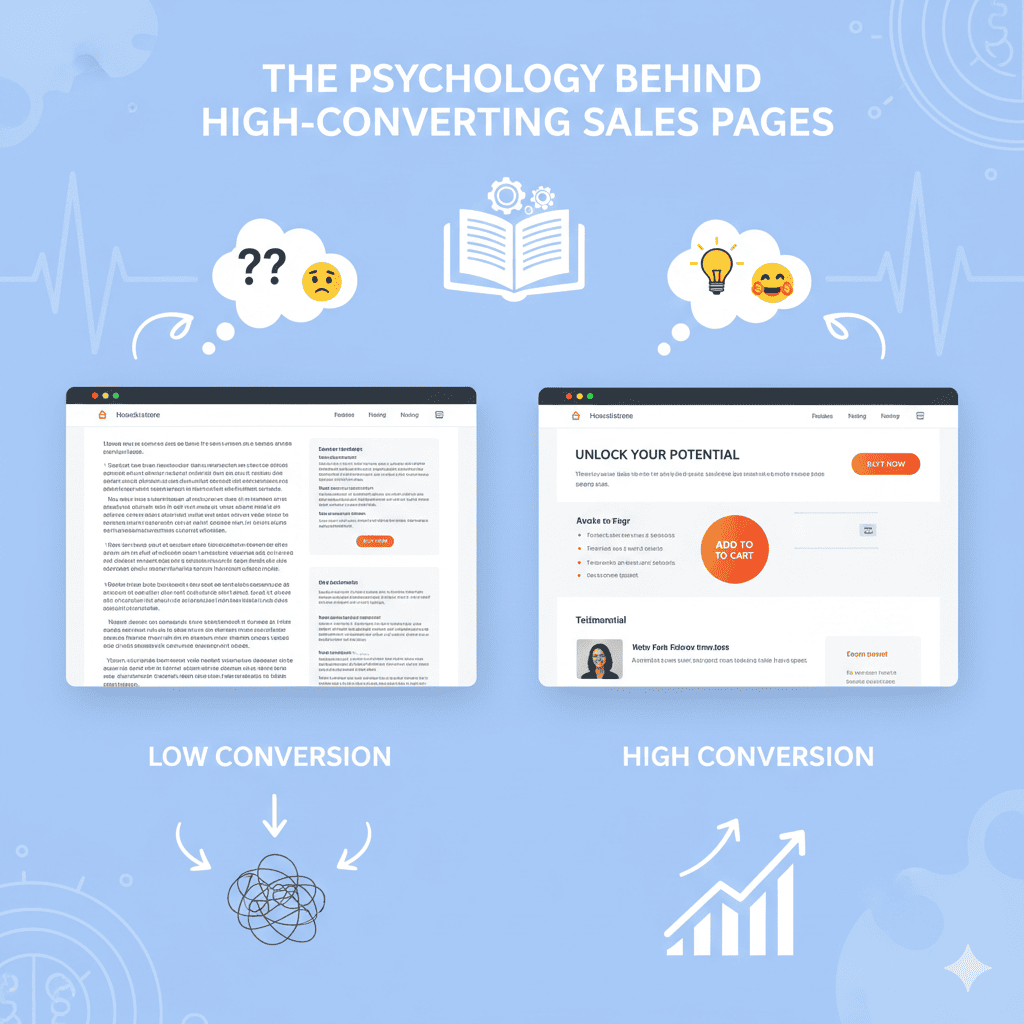
In the digital marketplace, your sales page is your most persuasive salesperson. It works 24/7, never takes a break, and has the potential to convert browsers into buyers consistently. But what separates a mediocre sales page from one that converts at astronomical rates? The answer lies in understanding the Psychology Behind High-Converting Sales and applying proven psychological principles that tap into human behavior and decision-making processes.
Every click, scroll, and purchase decision is influenced by deep-rooted psychological triggers. When you master these principles, you’re not manipulating—you’re simply presenting your offer in a way that naturally aligns with how the human brain processes information and makes buying decisions.
1. The Power of First Impressions: Capturing Attention Immediately
You have approximately 3-5 seconds to capture a visitor’s attention before they decide whether to stay or leave. This critical window is where the Psychology Behind High-Converting Sales begins to work its magic.
The Hero Section Matters
The top fold of your sales page—everything visible without scrolling—must immediately communicate value. This isn’t just about aesthetics; it’s about cognitive processing. The human brain is wired to make snap judgments about trustworthiness and value within milliseconds.
Your headline should trigger an immediate emotional response. Whether it’s excitement, relief, curiosity, or aspiration, that emotional connection is what keeps visitors engaged. Research shows that emotional responses to advertisements influence purchase intent more than the actual content of the ad itself.
Visual Hierarchy and Eye-Tracking Patterns
People naturally follow predictable eye-tracking patterns, with the F-pattern and Z-pattern being most common. Understanding these patterns allows you to strategically place your most important elements—headlines, benefits, and calls-to-action—exactly where eyes naturally land.
Use contrasting colors for your primary CTA buttons, but ensure they complement your overall design. The psychology of color plays a significant role: blue evokes trust, red creates urgency, green suggests growth or environmental consciousness, and orange combines the energy of red with the happiness of yellow.
2. Social Proof: Leveraging the Herd Mentality
Humans are inherently social creatures who look to others when making decisions. This principle, known as social proof, is one of the most powerful elements in the Psychology Behind High-Converting Sales.
Types of Social Proof That Convert
Testimonials and Reviews: Authentic customer testimonials work because they provide real-world validation. Include specific details—names, photos, locations, and concrete results. Generic testimonials like “Great product!” don’t carry the same weight as “This software helped me increase my email open rates by 47% in just three weeks.”
Case Studies: Detailed case studies go beyond simple testimonials by telling a complete story. They follow the problem-solution-result framework that allows potential customers to see themselves in the narrative.
User Count and Popularity: Statements like “Join 50,000+ satisfied customers” tap into the bandwagon effect. If thousands of people have chosen your product, it must be valuable. This reduces perceived risk and builds instant credibility.
Celebrity or Expert Endorsements: When recognized authorities in your industry endorse your product, they transfer their credibility to your offering. This is why “As featured in Forbes, TechCrunch, and Entrepreneur” badges are so effective.
Real-Time Activity: Showing live notifications of recent purchases or sign-ups creates urgency and validates that others are actively choosing your product right now.
3. Scarcity and Urgency: The Fear of Missing Out
The fear of missing out (FOMO) is a powerful psychological driver. When something is scarce or time-limited, our brain perceives it as more valuable. This is fundamental to understanding the Psychology Behind High-Converting Sales.
Implementing Scarcity Ethically
Limited Quantity: “Only 7 spots remaining” creates immediate pressure to act. This works because our brain’s loss aversion mechanism is stronger than our desire for gain—we’re more motivated to avoid losing an opportunity than to gain something new.
Time-Based Urgency: Countdown timers trigger a visceral response. As seconds tick away, the psychological pressure to act increases. However, this only works if the deadline is real. Fake scarcity damages trust and brand reputation.
Seasonal or Event-Based Scarcity: “Holiday Special” or “Launch Week Pricing” creates natural scarcity tied to real events, making the urgency feel authentic rather than manufactured.
The key is authenticity. Modern consumers are sophisticated and can detect artificial scarcity. When they do, it erodes trust and damages conversion rates long-term.
4. The Principle of Reciprocity: Give Before You Ask
Reciprocity is deeply embedded in human psychology. When someone gives us something of value, we feel psychologically obligated to give something back. This principle is essential in the Psychology Behind High-Converting Sales.
Providing Value Upfront
Free Content and Resources: Offering valuable content—whether it’s a comprehensive guide, video tutorial, or useful tool—without asking for payment first builds goodwill. When you eventually present your paid offer, visitors feel more inclined to reciprocate.
Free Trials and Samples: Letting potential customers experience your product firsthand removes risk and demonstrates confidence in your offering. Software companies that offer free trials typically see higher conversion rates because users become invested in the product before spending money.
Bonus Content: Unexpected bonuses create a sense of receiving more than expected. “Order now and receive these three exclusive bonuses worth $500” makes the primary offer feel more valuable.
The psychology here is straightforward: when you give first, you create a relationship foundation built on generosity rather than transaction, making the eventual sale feel natural rather than forced.
5. Authority and Credibility: Why Expertise Sells
People naturally defer to experts and authority figures. Establishing yourself or your brand as an authority dramatically increases conversion rates because it reduces the perceived risk of making a purchase decision.
Building Authority on Your Sales Page
Credentials and Qualifications: Display relevant certifications, degrees, awards, or professional memberships. These serve as mental shortcuts that signal expertise without requiring visitors to verify your competence independently.
Media Mentions and Publications: “As Seen On” sections featuring recognizable media outlets leverage borrowed authority. If the New York Times or CNN featured your story, you must be legitimate.
Author Photos and Bios: Putting a face to your brand humanizes it and builds trust. A detailed bio that showcases relevant experience and accomplishments reinforces authority.
Data and Statistics: Supporting your claims with concrete data demonstrates that your assertions aren’t just opinions but are backed by evidence. “Our method has been proven effective in 127 independent studies” carries significantly more weight than “Our method works great.”
Authority reduces the mental energy required for decision-making. When an expert recommends something, our brain takes a cognitive shortcut, trusting their judgment rather than analyzing every detail ourselves.
6. The Storytelling Framework: Emotional Connection Through Narrative
Humans are hardwired for stories. Our brains process stories differently than facts or data—we remember them better, they engage more neural pathways, and they create emotional connections that drive action. This narrative approach is central to the Psychology Behind High-Converting Sales.
The Hero’s Journey in Sales
The most effective sales pages follow a narrative structure where your customer is the hero, and your product is the guide that helps them overcome their challenges.
The Problem: Start by articulating the pain point so accurately that your visitor feels understood. This creates immediate rapport. “You’ve tried every diet plan, spent hours at the gym, but the weight just won’t come off. You’re frustrated, exhausted, and starting to lose hope.”
The Agitation: Deepen the emotional connection by exploring the consequences of inaction. “Every day that passes, you feel less confident, avoid social situations, and wonder if you’ll ever achieve the body you desire.”
The Solution: Present your product as the guide that provides the path to transformation. “What if there was a scientifically-proven approach that worked with your body’s natural metabolism instead of against it?”
The Transformation: Show the outcome—the “after” state that your customer aspires to achieve. Use vivid language that allows them to visualize and emotionally experience the result before purchasing.
Stories bypass our logical defenses and speak directly to our emotions. When someone sees themselves in your narrative, they’ve already mentally committed to the journey—purchasing becomes the natural next step.
7. Cognitive Biases: Understanding Mental Shortcuts
Our brains use cognitive biases—mental shortcuts—to process the overwhelming amount of information we encounter daily. Understanding these biases allows you to design sales pages that work with human psychology rather than against it.
Key Cognitive Biases in Sales Psychology
Anchoring Bias: The first number we see becomes an anchor point for all subsequent judgments. This is why showing the original price before the discounted price works so effectively. “Regular Price: $997, Today Only: $497” makes $497 feel like an exceptional deal.
Confirmation Bias: People seek information that confirms their existing beliefs. Your sales page should reinforce what your ideal customer already believes about their problem and the type of solution they need.
The Paradox of Choice: Too many options paralyze decision-making. Successful sales pages typically offer 2-3 clear options (Good, Better, Best) rather than overwhelming visitors with endless choices.
Loss Aversion: As mentioned earlier, humans are roughly twice as sensitive to losses as they are to equivalent gains. Framing your offer in terms of what they’ll miss out on if they don’t act is often more effective than emphasizing what they’ll gain.
The Decoy Effect: When presented with three options, people tend to choose the middle option more frequently. Strategic pricing with a “decoy” option can steer customers toward your preferred package.
Understanding these biases doesn’t mean manipulating people—it means presenting information in a way that aligns with natural human decision-making processes.
8. The Psychology of Pricing: Numbers That Influence Decisions
Pricing isn’t just about your profit margins—it’s a psychological tool that significantly impacts perceived value and conversion rates. The way you present your price is as important as the price itself.
Pricing Psychology Techniques
Charm Pricing: Prices ending in .99 or .97 consistently outperform round numbers. $19.99 is perceived as significantly less than $20, even though the difference is just one cent. This works because our brains process prices from left to right, focusing on the first digit.
Price Anchoring: Displaying a higher-priced option first makes subsequent options feel more affordable. Luxury brands often use this strategy, showing their premium products first to anchor customer expectations.
Payment Plans: “$997” feels like a significant investment, but “3 easy payments of $332” reduces the psychological barrier. Breaking larger amounts into smaller increments makes them feel more manageable, even though the total cost remains the same.
Relative Pricing: Comparing your price to everyday expenses helps rationalize the purchase. “For less than your daily coffee—just $3.99 per day—you can transform your productivity” reframes the value proposition.
Removing Currency Symbols: Studies show that removing the dollar sign reduces the pain of spending. “97” is processed differently than “$97” in our brains.
9. Trust Signals: Reducing Purchase Anxiety
Every purchase involves risk. Will the product work as promised? Is this website legitimate? What if I’m not satisfied? Addressing these concerns head-on through trust signals is crucial for conversion.
Essential Trust Elements
Money-Back Guarantees: A strong guarantee reverses risk, placing it on you rather than the customer. “If you’re not completely satisfied within 60 days, we’ll refund every penny—no questions asked” removes the biggest barrier to purchase.
Security Badges: SSL certificates, payment processor logos (Visa, Mastercard, PayPal), and security seals (Norton, McAfee) provide visual reassurance that transactions are safe.
Transparent Policies: Clearly displayed shipping, return, and privacy policies demonstrate that you have nothing to hide. Complexity or hidden policies trigger suspicion.
Contact Information: Providing multiple ways to reach you—phone number, email, live chat, physical address—shows you’re a real business with real people, not a fly-by-night operation.
Professional Design: While superficial, design quality serves as a proxy for business legitimacy. Poorly designed pages trigger distrust, regardless of product quality.
Trust is the foundation of all transactions. Without it, no amount of persuasive copy or psychological tactics will drive conversions.
10. The Call-to-Action: Directing the Next Step
After building desire and trust, you must explicitly tell visitors what to do next. Your call-to-action (CTA) is where the Psychology Behind High-Converting Sales culminates in action.
CTA Best Practices
Action-Oriented Language: Use first-person, action verbs that create momentum. “Get My Free Guide” performs better than “Submit” because it’s specific and personal.
Strategic Placement: Your primary CTA should appear multiple times throughout the page—at the top, middle, and bottom. Long-form sales pages typically benefit from CTAs every 500-700 words.
Color Psychology: Your CTA button should stand out through color contrast while remaining harmonious with your overall design. Test different colors to find what works best for your audience.
Size and White Space: Make your CTA button large enough to be easily clickable (especially on mobile) and surround it with white space to draw attention.
Risk Reversal in CTA: Including reassurance in or near your CTA reduces last-minute hesitation. “Start Your Risk-Free Trial” or “Get Instant Access—100% Money-Back Guarantee” addresses concerns at the moment of decision.
Avoid Negative Friction: Don’t ask for unnecessary information. Every additional form field reduces conversion rates. Request only what’s absolutely necessary to complete the transaction.
11. Mobile Optimization: Psychology for the Smaller Screen
With over 60% of web traffic coming from mobile devices, understanding mobile-specific psychology is essential. The Psychology Behind High-Converting Sales manifests differently on smaller screens.
Mobile-Specific Considerations
Thumb-Friendly Design: The majority of mobile users navigate with their thumbs. Place your primary CTAs in easy-to-reach zones—typically the center-bottom of the screen.
Simplified Navigation: Mobile users have limited cognitive bandwidth due to smaller screens and potential distractions. Simplify your design, remove unnecessary elements, and create a clear, linear path to conversion.
Speed Matters More: Mobile users are even more impatient than desktop users. Every additional second of load time significantly increases bounce rates. Optimize images, minimize code, and prioritize speed.
Click-to-Call Buttons: For service businesses, making it effortless to initiate a phone call removes friction from the conversion process.
Vertical Scrolling: Mobile users are comfortable with long-scrolling pages. Use this to your advantage by presenting information in a logical, compelling sequence.
12. The Power of Visual Content: Processing Information Faster
Our brains process visual information 60,000 times faster than text. Strategic use of images, videos, and graphics enhances the Psychology Behind High-Converting Sales by making complex information easier to digest.
Visual Elements That Convert
Product Images: High-quality images from multiple angles help customers visualize ownership. For digital products, use screenshots, mockups, or visual representations of what they’ll receive.
Videos: Product demonstration videos can increase conversions by up to 80%. Video creates a multi-sensory experience, builds connection through voice and personality, and allows you to demonstrate value in ways that text cannot.
Infographics: Complex information, comparisons, or processes become immediately understandable through well-designed infographics. They’re also highly shareable, extending your reach.
Before/After Images: Visual transformations are incredibly powerful, especially for products promising physical changes, results, or improvements.
Icons and Visual Breaks: Breaking up text with relevant icons and visual elements reduces cognitive load and makes the page easier to scan.
Conclusion: Implementing Psychology-Driven Sales Pages
Understanding the Psychology Behind High-Converting Sales pages isn’t about manipulation—it’s about aligning your message with how humans naturally process information and make decisions. Every element discussed here works because it taps into fundamental psychological principles that govern human behavior.
The most successful sales pages seamlessly integrate multiple psychological principles, creating a cohesive experience that guides visitors from curiosity to conviction to action. They build trust through social proof, create urgency through scarcity, establish authority through credentials, connect emotionally through storytelling, and remove barriers through strong guarantees.
As you implement these principles, remember that testing is essential. What works for one audience may not work for another. Use A/B testing to validate your assumptions, analyze user behavior through heatmaps and session recordings, and continuously refine your approach based on data.
The psychology of high-converting sales pages is both an art and a science. Master these principles, apply them authentically, and watch your conversion rates soar. Your sales page should feel less like a pitch and more like a conversation with a trusted advisor who genuinely understands your customer’s needs and has the perfect solution.
Also read this:
How to Create Content Faster Using AI