
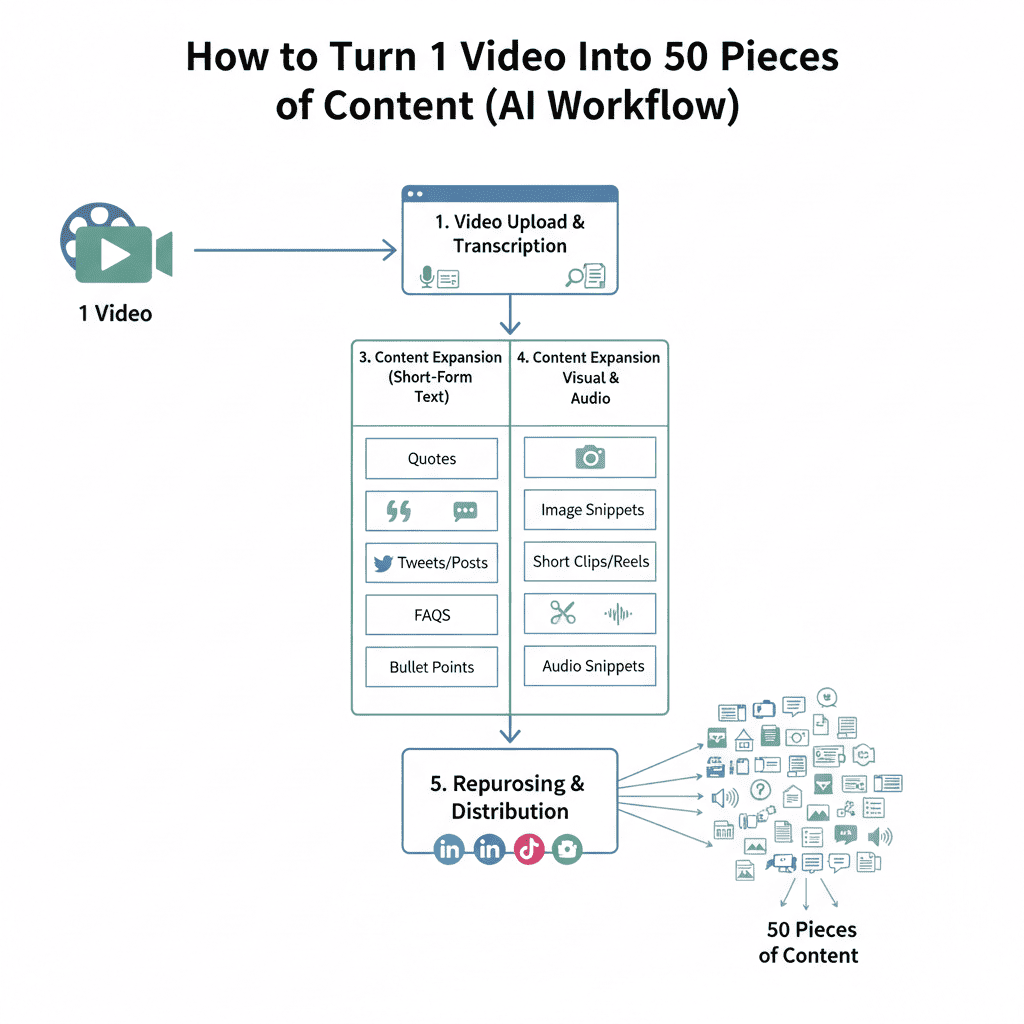
Content creation is exhausting. You pour hours into producing a single video, only to watch it disappear into the endless scroll within days. But what if that one video could fuel your entire content strategy for weeks? What if you could transform 1 Video Into 50 Pieces of Content without spending countless additional hours or hiring an expensive team?
Welcome to the revolutionary world of AI-powered content repurposing. In 2025, smart creators aren’t working harder—they’re working smarter. They’ve discovered that the real magic isn’t in creating more original content, but in strategically extracting maximum value from what they’ve already created. This comprehensive guide will show you exactly how to turn 1 Video Into 50 Pieces of Content using cutting-edge AI workflows that save time, amplify reach, and multiply your content’s impact across every platform.
Whether you’re a solo entrepreneur, content marketer, influencer, or business owner, mastering the art of turning 1 Video Into 50 Pieces of Content will transform your content strategy from overwhelming to effortless. Let’s dive into the complete workflow that top creators are using to dominate their niches without burning out.
1. The Strategic Foundation: Choosing the Right Video
Not all videos are created equal when it comes to repurposing potential. The success of turning 1 Video Into 50 Pieces of Content begins with selecting the right source material that contains rich, versatile content worth multiplying.
Identifying High-Value Content
The best videos for repurposing are those packed with valuable information, actionable insights, or compelling stories. Look for videos that contain multiple distinct topics, clear teaching moments, memorable quotes, or emotional peaks. Educational content, interviews, tutorials, presentations, and storytelling videos typically offer the richest material for extraction.
Your ideal source video should be comprehensive enough to contain diverse elements but focused enough to maintain cohesive themes. A 15-30 minute video typically provides the perfect sweet spot—long enough to contain substantial material but not so long that the extraction process becomes overwhelming.
Assessing Evergreen vs Trending Content
When choosing which video to transform into 1 Video Into 50 Pieces of Content, consider the lifespan of the information. Evergreen content about fundamental principles, timeless strategies, or universal truths will continue generating value for months or years. Trending content about current events or timely topics offers immediate impact but shorter longevity.
The most powerful approach combines both: use evergreen videos as your primary repurposing sources for sustained content flow, while quickly repurposing trending videos for immediate engagement spikes. This balanced strategy ensures you always have relevant content without constantly creating from scratch.
Quality and Production Value Considerations
Higher production quality generally yields better repurposing results. Clear audio is absolutely critical—if your AI tools can’t accurately transcribe the audio, the entire workflow suffers. Good lighting and framing make extracted clips more visually appealing for social media. However, don’t let perfectionism paralyze you. Even smartphone-recorded videos can be successfully transformed into dozens of content pieces if the information is valuable and audio is clear.
The goal isn’t perfection—it’s maximizing the return on your initial content investment by strategically multiplying its reach and impact across multiple platforms and formats.
2. AI Transcription: The Critical First Step
Transforming 1 Video Into 50 Pieces of Content begins with converting your video into text. Accurate transcription unlocks every subsequent repurposing possibility, making this step absolutely foundational to your workflow.
Choosing the Right Transcription Tool
Modern AI transcription tools have achieved remarkable accuracy, often exceeding 95% for clear audio. Popular options include Otter.ai, Rev.ai, Descript, and built-in features in video editing platforms like Riverside or SquadCast. Many tools now offer speaker identification, timestamp markers, and automatic punctuation that dramatically reduce editing time.
When selecting a transcription tool, prioritize accuracy over speed. A highly accurate transcript requires minimal manual correction, saving hours of tedious editing. Look for tools that handle industry-specific terminology, multiple speakers, and various accents well. Most premium tools allow you to upload custom vocabulary to improve accuracy for your niche.
Cleaning and Formatting the Transcript
Raw AI transcripts need refinement before they’re ready for repurposing. Remove filler words like “um,” “uh,” and “like” that clutter written content. Add proper punctuation and paragraph breaks to improve readability. Correct any misheard words or technical terms that the AI struggled with.
This cleaning process is crucial because this transcript becomes the foundation for dozens of content pieces. Investing an hour to create a polished, accurate transcript saves countless hours later when you’re extracting quotes, creating blog posts, or generating social media captions.
Structuring for Maximum Repurposing Potential
As you refine your transcript, organize it into clear sections with timestamps. Identify and label distinct topics, key insights, memorable quotes, and actionable takeaways. This structural organization makes the extraction process significantly faster and more effective.
Create a master document that includes the cleaned transcript, topic sections, and key moments marked with timestamps. This becomes your content repurposing bible—the single source of truth from which you’ll extract all 50 pieces of content.
3. Blog Content Creation: Long-Form Written Assets
One of the most valuable outputs when turning 1 Video Into 50 Pieces of Content is transforming your video into various long-form written pieces that drive search traffic and establish authority.
Converting to Comprehensive Blog Posts
AI writing tools like ChatGPT, Claude, or Jasper can transform your cleaned transcript into well-structured blog posts in minutes. The key is providing proper context and instructions. Don’t just paste the transcript—guide the AI to expand on key points, add relevant examples, include data or statistics, and optimize for search engines.
From a single 20-minute video, you can easily create 3-5 comprehensive blog posts by focusing each post on a different section or topic from your original content. Each post should stand alone while potentially linking to the others, creating a content cluster that boosts your SEO performance.
Creating Ultimate Guides and Pillar Content
Your video transcript can serve as the foundation for authoritative pillar content that positions you as an industry expert. Use AI to expand the transcript into a comprehensive ultimate guide that goes deeper than your video, adding additional context, research, case studies, and actionable frameworks.
These substantial pieces of pillar content become cornerstone assets that drive consistent organic traffic, generate backlinks, and establish topical authority in your niche. A single video can easily spawn 2-3 ultimate guides when you focus on different angles or dive deeper into specific subtopics.
Generating Educational Email Sequences
Transform sections of your transcript into educational email sequences that nurture your audience over days or weeks. Break down your video’s key insights into bite-sized daily lessons, actionable tips, or story-driven messages that keep subscribers engaged.
AI can help you convert dense transcript content into conversational, email-friendly copy that maintains your voice while optimizing for the inbox environment. A single video can easily generate a 5-7 day email course or a 10-part newsletter series.
4. Short-Form Video Clips: Platform-Specific Optimization
Video content dominates social media, and extracting short-form clips is essential when converting 1 Video Into 50 Pieces of Content for maximum reach across platforms.
Identifying Viral-Worthy Moments
Within your master video, certain moments naturally stand out: surprising statements, emotional peaks, actionable insights, or controversial opinions. AI tools with sentiment analysis can help identify these high-impact moments, but your human judgment remains crucial.
Look for 30-90 second segments that can stand alone without requiring additional context. These self-contained nuggets make perfect social media clips that stop the scroll and drive engagement. Pattern interrupts, bold claims, or cliff-hangers work particularly well.
Creating Platform-Specific Versions
Each social platform has unique optimal formats and audience expectations. From your master video, create clips specifically formatted for TikTok (9:16 vertical, 15-60 seconds), Instagram Reels (9:16 vertical, 15-90 seconds), YouTube Shorts (9:16 vertical, under 60 seconds), LinkedIn (square or 16:9 landscape, 30-90 seconds), and Twitter/X (16:9 landscape, under 2:20).
AI-powered editing tools like Opus Clip, Vizard, or Repurpose.io can automatically identify compelling segments and format them for different platforms. These tools analyze engagement patterns to predict which clips will perform best, saving hours of manual editing and guesswork.
Adding Captions and Text Overlays
Since most social media videos are watched without sound, burned-in captions are essential. AI captioning tools can automatically generate accurate, stylized captions that make your content accessible and engaging even on mute.
Strategic text overlays highlighting key phrases, statistics, or action steps increase retention and comprehension. AI design tools can suggest optimal placement and styling based on platform best practices and your brand guidelines.
5. Social Media Posts: Multi-Platform Distribution
Turning 1 Video Into 50 Pieces of Content requires strategic distribution across social platforms, and AI makes creating platform-specific posts remarkably efficient.
LinkedIn Professional Content
Transform your video’s insights into thought leadership posts for LinkedIn. AI can extract key business insights, professional lessons, or industry observations from your transcript and reformulate them into LinkedIn’s preferred tone—professional yet conversational, insightful yet accessible.
From a single video, create 5-7 LinkedIn posts: carousel posts with key frameworks, text-based thought leadership pieces, behind-the-scenes insights about the video creation, polls based on questions raised in the video, and discussion starters that reference video insights.
Instagram Multi-Format Strategy
Instagram offers diverse content formats, each serving different purposes. Use AI to generate Instagram feed post captions that summarize video insights, create carousel post copy for step-by-step processes discussed in your video, and develop Reel descriptions optimized for discovery.
Don’t forget Instagram Stories—create 5-10 story frames featuring quotes, statistics, or tips from your video with engaging visual backgrounds. AI design tools like Canva’s AI features can automatically generate visually cohesive story templates based on your brand.
Twitter Thread Masterpieces
Twitter threads remain powerful for sharing knowledge and driving engagement. AI excels at breaking down complex video content into digestible thread formats. Extract your video’s main points and convert them into compelling 8-12 tweet threads that tell a complete story or teach a complete concept.
Each thread should hook readers immediately, deliver value progressively, and end with a strong call-to-action—typically encouraging people to watch the full video. From one video, you can easily create 3-5 different threads by focusing on different angles or sections.
Facebook Community Building
Facebook’s algorithm favors content that sparks meaningful conversation. Use AI to identify discussion-worthy points from your video and craft posts that encourage comments and shares. Pose questions, share controversial takes, or request audience experiences related to your video topic.
Create native Facebook video posts using your short clips, community discussion posts referencing video insights, and Facebook Stories highlighting key moments. Each format serves different audience segments and maximizes your content’s reach within Facebook’s ecosystem.
6. Visual Content: Graphics and Infographics
When executing your strategy to turn 1 Video Into 50 Pieces of Content, visual assets dramatically extend your content’s reach and appeal to visual learners.
Quote Graphics That Stop the Scroll
Every compelling video contains memorable quotes worthy of standalone graphics. Use AI transcription to identify your most impactful statements, then leverage AI design tools to create visually striking quote graphics optimized for each platform.
From a single video, extract 10-15 powerful quotes and create multiple design variations—different color schemes, typography styles, or background images—effectively multiplying one quote into several unique posts for different platforms or future scheduling.
Data Visualization and Statistics
If your video contains statistics, research findings, or numerical data, transform these into engaging infographics or data visualizations. AI tools like Venngage, Piktochart, or Canva’s AI features can suggest optimal visualization formats based on your data type.
These visual representations make complex information more digestible and shareable. They also perform exceptionally well on Pinterest, LinkedIn, and in blog posts, extending your content’s reach to audiences who prefer visual learning styles.
Step-by-Step Process Graphics
Educational videos often contain processes, frameworks, or step-by-step instructions perfect for visual representation. Create carousel posts, PDF guides, or infographics that visually map out the processes explained in your video.
These resources provide standalone value while directing interested viewers back to your video for detailed explanations. They’re highly shareable and often saved for future reference, extending your content’s lifespan significantly.
7. Audio Content: Podcasts and Audio Snippets
The versatility of turning 1 Video Into 50 Pieces of Content includes transforming your video into pure audio formats that reach audiences in different consumption contexts.
Podcast Episode Creation
Extract the audio from your video to create podcast episodes with minimal additional effort. Many successful podcasters simultaneously record video and audio, then distribute across both YouTube and podcast platforms, effectively doubling their reach from a single recording session.
If your video includes visual elements essential to understanding, use AI to write a brief intro that provides necessary context for audio-only listeners. Add professional intro and outro music, and you’ve created a complete podcast episode from your existing video content.
Audiograms for Social Promotion
Audiograms combine audio clips with visual elements like waveforms, subtitles, and branded backgrounds. They’re perfect for promoting your content on social media while giving audiences a preview of your audio or video content.
Create 5-7 audiograms featuring the most compelling moments from your video. These work exceptionally well on LinkedIn, Twitter, and Instagram, driving traffic to your full-length content while providing value in a quickly consumable format.
Voice-Over Narration for Different Contexts
Use AI voice tools to create alternative narrations of your content—perhaps a faster-paced version for busy professionals or a simplified version for different audience segments. Some AI tools can even clone your voice, creating narrations in multiple languages without recording anything new.
This audio versatility allows you to reach international audiences, accessibility-focused listeners, and people who prefer consuming content while commuting, exercising, or doing household tasks.
8. Interactive Content: Quizzes, Polls, and Assessments
Engaging audiences through interactive content is a powerful strategy when transforming 1 Video Into 50 Pieces of Content into diverse, value-packed assets.
Educational Quizzes Based on Video Content
Transform your video’s educational content into interactive quizzes that test comprehension and reinforce learning. AI can analyze your transcript and automatically generate relevant questions with multiple-choice answers, true/false statements, or fill-in-the-blank challenges.
These quizzes serve multiple purposes: they increase engagement, provide value to your audience, capture email addresses when gated, and give you insights into which topics resonate most with your audience. From one video, create 2-3 different quizzes focusing on different aspects or difficulty levels.
Social Media Polls and Surveys
Extract debatable points, alternative approaches, or decision frameworks from your video and transform them into social media polls. Polls drive exceptional engagement because they’re quick to complete and satisfy people’s curiosity about how others think.
Create 5-10 polls across different platforms, each exploring a different aspect of your video content. Share the results in follow-up posts, creating a content cycle that keeps audiences engaged across multiple days.
Interactive Assessments and Scorecards
For how-to or educational videos, create interactive assessments where viewers can evaluate their own situation, skills, or knowledge related to your topic. These self-assessment tools provide personalized value while positioning you as an expert resource.
AI can help structure these assessments based on frameworks or criteria mentioned in your video, then generate personalized result interpretations that provide specific recommendations or next steps based on user responses.
9. SEO-Optimized Content: Capturing Search Traffic
Maximizing the value of 1 Video Into 50 Pieces of Content requires optimizing for search engines to capture ongoing organic traffic long after initial publication.
Keyword-Optimized Video Descriptions
Your video description is prime SEO real estate. Use AI to analyze your transcript and identify relevant keywords, then craft comprehensive descriptions that naturally incorporate these terms while accurately summarizing your content.
Include timestamps for key sections, links to related resources, and clear calls-to-action. A well-optimized video description improves search rankings while providing value to viewers seeking specific information within your content.
FAQ Content from Video Insights
Extract common questions addressed in your video and create dedicated FAQ pages or blog posts. Structure this content using FAQ schema markup to increase chances of appearing in Google’s featured snippets and “People Also Ask” sections.
From one comprehensive video, you can easily identify 10-15 questions and create individual answers that drive search traffic. Each answer links back to your video for those wanting deeper information, creating a self-reinforcing content ecosystem.
Long-Tail Keyword Blog Posts
AI keyword research tools can identify dozens of long-tail keyword opportunities related to your video topic. Create focused blog posts targeting these specific phrases, using your video transcript as source material while expanding on particular angles or subtopics.
These targeted posts may individually drive modest traffic, but collectively they create a powerful content network that establishes topical authority and captures traffic from highly specific searches where competition is lower.
10. Repurposing Automation: Scaling Your Workflow
The ultimate efficiency in turning 1 Video Into 50 Pieces of Content comes from automating repetitive tasks and creating systems that work while you focus on creativity and strategy.
Building Your AI Tool Stack
Effective automation requires selecting and integrating the right tools. Create a workflow that moves content seamlessly from transcription to editing to distribution. Tools like Zapier or Make can connect different platforms, automatically triggering actions when new content is created.
Your ideal stack might include: a transcription tool, an AI writing assistant, a video editing platform with AI features, a social media scheduling tool, a design platform with templates, and a project management system to track what content has been created and published.
Creating Content Templates
Develop templates for each content type you regularly create. These templates maintain brand consistency while dramatically reducing creation time. AI can populate these templates with content extracted from your video, requiring only minor customization before publishing.
Templates should cover social media posts, blog post structures, email formats, graphic designs, and video clip styles. This standardization creates a recognizable brand presence while making content creation feel effortless rather than overwhelming.
Scheduling and Distribution Systems
Once you’ve created 50 pieces of content from your single video, distribute them strategically over weeks or months. Use social media scheduling tools like Buffer, Hootsuite, or Later to queue content in advance, ensuring consistent presence without daily posting pressure.
Implement a content calendar that spaces out related content pieces, avoids platform fatigue, and aligns with optimal posting times for each platform. This systematic distribution maximizes reach while minimizing the time you spend on daily content management.
Analytics and Iteration
Track performance metrics for each content piece to understand what resonates with your audience. AI analytics tools can identify patterns in engagement, helping you refine your repurposing strategy over time.
Double down on formats and platforms that perform well while adjusting or eliminating underperforming content types. This data-driven approach ensures your workflow continuously improves, making each video you repurpose more valuable than the last.
Conclusion: Mastering the Art of Content Multiplication
Learning how to turn 1 Video Into 50 Pieces of Content isn’t just a productivity hack—it’s a fundamental shift in how you approach content creation. Instead of constantly chasing the next piece of content, you’re mining maximum value from what you’ve already created. This strategic approach reduces burnout, increases consistency, and amplifies your message across every platform where your audience lives.
The AI workflow outlined in this guide transforms content creation from an overwhelming treadmill into a sustainable system. By investing focused effort into creating one high-quality video, then systematically extracting and optimizing dozens of derivative pieces, you’re working smarter rather than harder.
The beauty of this approach is its scalability. Once you’ve mastered the process of turning 1 Video Into 50 Pieces of Content, you can apply it to every video you create. Your content library becomes an ever-expanding asset library, with each piece supporting and amplifying the others.
Start with one video. Follow this workflow systematically. Create your 50 pieces of content. Then watch as your reach expands, your authority grows, and your content strategy becomes not just manageable, but genuinely enjoyable.
Also read this:
6 Game-Changing AI Trends 2025 — How They’ll Revolutionize Work, Life & Business
AI Travel Planners: How Smart Trips Are Changing the Way We Explore in 2025
7 Realistic Ways to Get Paid to Travel in 2025: Turn Your Wanderlust Into Income