
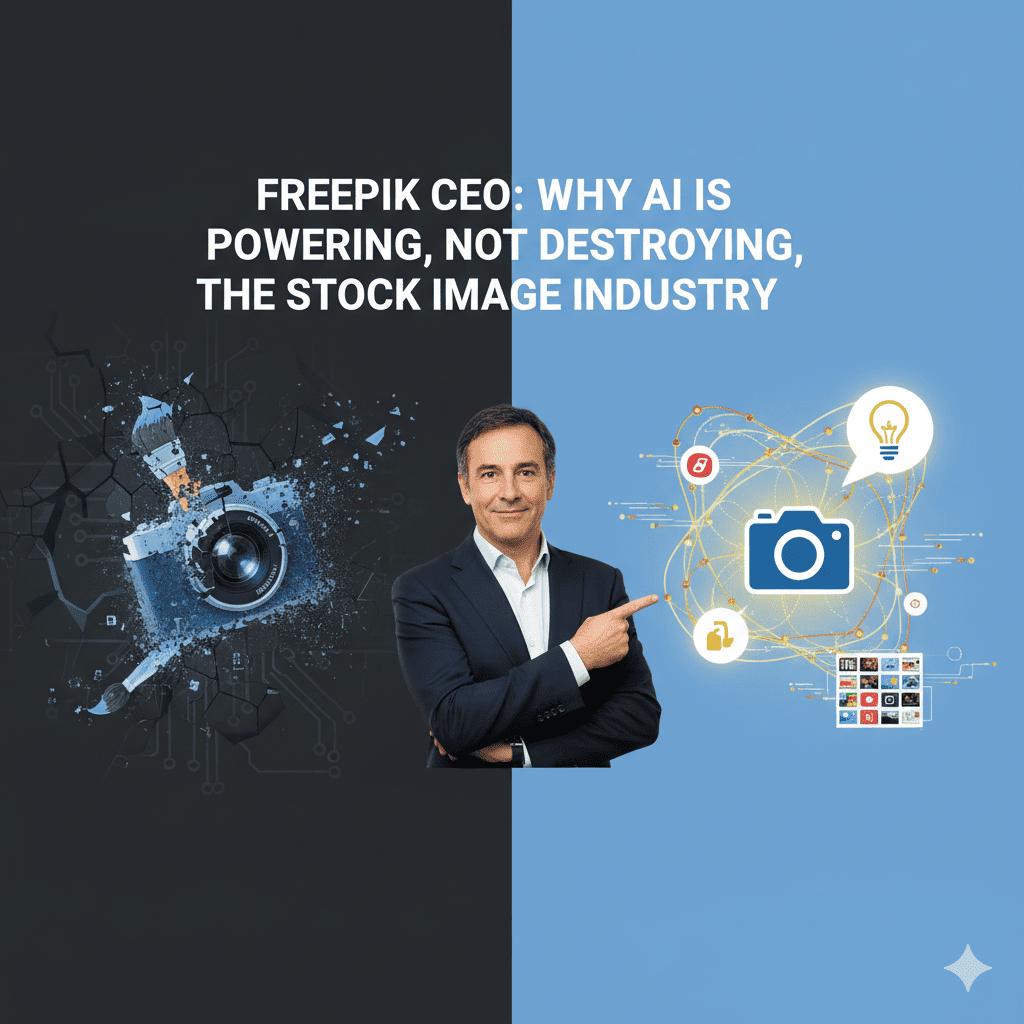
The stock image industry stands at a pivotal crossroads. While doomsayers predict the demise of traditional stock photography at the hands of artificial intelligence, Freepik CEO Joaquín Cuenca Abela offers a radically different perspective. According to the Freepik CEO, AI isn’t the villain in this story—it’s the hero that’s democratizing creativity and expanding the market exponentially.
In an era where AI-generated images can be created in seconds, many industry observers predicted the collapse of stock image platforms. Yet Freepik, under the leadership of its visionary Freepik CEO, has not only survived but thrived, transforming AI from a perceived threat into a powerful ally. This counterintuitive success story reveals profound truths about creativity, technology, and the future of visual content.
1. The AI Revolution: Threat or Opportunity?
When AI image generators burst onto the scene, panic rippled through the stock image industry. Traditional photographers and illustrators feared obsolescence. However, the Freepik CEO saw something different—an unprecedented opportunity to democratize design and multiply value for creators and users alike.
Understanding the Initial Fears
The concern was legitimate. AI tools like DALL-E, Midjourney, and Stable Diffusion could generate original images from text prompts in mere seconds. Why would anyone pay for stock images when they could describe what they wanted and have AI create it instantly?
This anxiety mirrored historical technological disruptions:
- When photography emerged, painters feared extinction
- When digital photography arrived, film photographers worried
- When stock photography platforms launched, commissioned photography seemed threatened
Yet in each case, the technology didn’t destroy the industry—it transformed and expanded it.
The Freepik Approach to AI Integration
Rather than resisting the inevitable, the Freepik CEO made a bold strategic decision: embrace AI completely and integrate it seamlessly into the platform. This wasn’t a defensive move—it was an offensive strategy to capture new market segments and enhance existing services.
Freepik launched AI-powered tools that complemented rather than replaced traditional stock content:
- AI Image Generator: Allowing users to create custom images from text descriptions
- AI Background Remover: Enabling quick, precise image editing
- AI Image Enhancer: Improving resolution and quality of existing images
- AI Style Transfer: Applying artistic styles to photographs
The Freepik CEO understood that these tools wouldn’t cannibalize stock image sales—they would expand the total addressable market by making visual content creation accessible to millions who previously lacked the skills or resources.
2. Democratization: Expanding the Creative Class
Perhaps the most significant insight from the Freepik CEO is that AI democratizes creativity rather than eliminating professional creators. This democratization creates a rising tide that lifts all boats.
Lowering Barriers to Entry
Historically, creating professional-quality visual content required:
- Expensive equipment (cameras, lighting, computers)
- Specialized software skills (Photoshop, Illustrator)
- Formal training or years of practice
- Significant time investment
AI has dramatically lowered these barriers. A small business owner with no design experience can now:
- Generate custom illustrations for their website
- Create social media graphics that match their brand
- Produce marketing materials without hiring a designer
- Experiment with visual concepts before committing to professional production
According to the Freepik CEO, this doesn’t steal work from professionals—it creates new work. These small businesses weren’t previously in the market for custom design services. They used generic templates or went without visual content entirely.
Creating New Market Segments
The Freepik CEO identifies several emerging user segments that didn’t exist before AI:
Micro-entrepreneurs: Solo business owners who need occasional design work but can’t justify hiring a designer or purchasing expensive software subscriptions.
Content creators: YouTubers, podcasters, and newsletter writers who need constant visual content but operate on razor-thin margins.
Students and educators: Academic projects, presentations, and educational materials that require professional-looking graphics but have zero budget.
Rapid prototypers: Startups and innovators who need to visualize concepts quickly during ideation phases before investing in professional production.
These segments represent millions of new potential customers who expand the overall market rather than redistributing existing revenue.
3. The Complementary Nature of AI and Human Creativity
A core thesis from the Freepik CEO is that AI-generated content and human-created stock images serve complementary rather than competing purposes. Understanding this distinction is crucial to grasping why AI strengthens rather than weakens the stock image industry.
When AI Excels
AI image generation is particularly powerful for:
Conceptual and abstract imagery: AI can create surreal, imaginative scenes that would be expensive or impossible to photograph.
Rapid iteration: Need to see 20 variations of a concept? AI generates them in minutes rather than days.
Customization: Specific color schemes, styles, or elements tailored to exact brand requirements.
Budget-conscious projects: When the perfect image isn’t critical, AI provides “good enough” solutions at minimal cost.
When Human-Created Content Is Essential
However, the Freepik CEO emphasizes that human-created stock images remain superior for:
Authenticity: Real people, real emotions, real situations. AI-generated people often have an “uncanny valley” quality that savvy viewers notice.
Legal and commercial use: Real model releases, property releases, and clear rights chains that satisfy legal departments.
Cultural accuracy: Genuine representations of specific cultures, locations, and situations that AI might misconstrue or stereotype.
Technical precision: Accurate depictions of products, medical procedures, scientific concepts, or technical subjects where errors are unacceptable.
Brand-critical applications: When image quality directly reflects on brand perception, human-created professional photography remains the gold standard.
The Freepik CEO notes that Freepik’s data shows both AI-generated images and traditional stock photos experiencing growth—not a zero-sum redistribution.
4. Quality Evolution: AI Pushes Standards Higher
Paradoxically, the Freepik CEO argues that AI competition has elevated rather than degraded the quality of human-created stock content.
The Rising Bar for Stock Photography
When AI can generate generic, adequate images instantly, what value do stock photographers provide? The answer, according to the Freepik CEO, is distinctiveness, authenticity, and artistic excellence.
Stock photographers and illustrators have responded to AI competition by:
Improving technical quality: Higher resolution, better composition, superior lighting and production values.
Increasing authenticity: More diverse, genuine representations of people and situations rather than overly-posed “stock photo” clichés.
Developing distinctive styles: Unique artistic voices that AI can’t easily replicate.
Specializing in niches: Deep expertise in specific subjects—medical imaging, industrial photography, specific cultural contexts—where accuracy and authenticity matter.
Capturing decisive moments: Genuine human emotion, spontaneous expressions, and real interactions that AI struggles to render convincingly.
The Freepik CEO views this quality evolution as healthy for the industry. The lowest tier of generic, forgettable stock images may indeed be replaced by AI. But this creates space for talented creators to focus on higher-value, more distinctive work.
Curation Becomes More Valuable
As the volume of available images—both AI-generated and human-created—explodes, curation becomes increasingly valuable. The Freepik CEO emphasizes that Freepik’s role evolves from mere content repository to trusted curator that helps users find exactly what they need among millions of options.
Effective curation requires:
- Understanding user intent and context
- Recognizing quality and relevance
- Organizing content with intuitive taxonomy
- Providing discovery tools that surface hidden gems
AI helps with this curation challenge through improved search algorithms and recommendation systems, but the Freepik CEO notes that human judgment remains essential for maintaining quality standards and ensuring appropriate content.
5. Business Model Innovation: Hybrid Monetization
The Freepik CEO has pioneered innovative business models that monetize both AI-generated and human-created content, creating multiple revenue streams and value propositions.
Subscription Tiers for Different Needs
Freepik offers subscription levels that provide different balances of AI credits and stock content downloads:
Free tier: Limited access to both stock images and AI generation, perfect for casual users and trial purposes.
Premium tier: Generous downloads of stock content plus moderate AI generation credits, serving regular users.
AI-focused tier: Emphasis on AI generation credits with stock content as a valuable supplement.
This tiered approach recognizes that different users have different needs. A graphic designer might prioritize stock photos while an entrepreneur might favor AI generation. The Freepik CEO has structured pricing to capture value from both segments.
Creator Compensation Models
A crucial question: How do human creators get paid when AI competes with their work?
The Freepik CEO has implemented several mechanisms:
Download-based compensation: Contributors earn when their content is downloaded, incentivizing quality and relevance.
Trending bonuses: Extra compensation for content that becomes particularly popular, rewarding creators who understand market needs.
Exclusive content premiums: Higher rates for exclusive content that isn’t available elsewhere, encouraging creators to give Freepik first rights.
Community recognition: Featuring top contributors, building their personal brands, and creating opportunities for direct commissions.
Importantly, the Freepik CEO notes that total compensation to creators has increased since AI integration, not decreased, because the expanded user base generates more total downloads.
6. The Data Advantage: Training Better AI
One often-overlooked advantage that the Freepik CEO emphasizes is that established stock image platforms possess invaluable data that makes their AI tools superior to standalone AI generators.
Understanding User Intent
Freepik has decades of data about:
- What users search for
- Which images get downloaded
- How users describe their needs
- Common use cases and contexts
- Seasonal and trending topics
This data trains AI systems that better understand creative intent. When a user types “professional business meeting,” Freepik’s AI understands the subtle distinctions between corporate, startup, casual, formal, diverse, and traditional interpretations based on millions of past searches and downloads.
The Freepik CEO considers this data moat a competitive advantage that pure-play AI companies lack.
Hybrid Search: Best of Both Worlds
Freepik’s search combines:
- Traditional keyword-based search
- Visual similarity search
- AI-powered semantic understanding
- User behavior patterns
When users search, they simultaneously access:
- Human-created stock images
- AI-generated options
- Hybrid results that combine elements
The Freepik CEO believes this integrated approach provides superior results compared to separate stock image sites or pure AI generators.
7. Ethical Considerations: Responsible AI Development
The Freepik CEO takes seriously the ethical questions surrounding AI and creator rights, implementing policies that balance innovation with fairness.
Training Data and Artist Rights
A major controversy in AI art generation involves training data. Did the AI learn from copyrighted images without permission?
The Freepik CEO has committed to:
Transparency: Clear disclosure about how AI models are trained.
Opt-in programs: Allowing contributors to specify whether their work can be used in AI training, with additional compensation for those who opt in.
Human creator support: Using AI revenue to fund programs that support human creators, including education, showcases, and marketing.
Clear labeling: Ensuring AI-generated images are clearly marked as such, preserving the value and distinction of human-created work.
Content Moderation and Bias
AI image generators can perpetuate biases present in training data or generate inappropriate content. The Freepik CEO has implemented:
Bias detection and correction: Active monitoring of AI outputs for demographic biases, stereotypes, or inappropriate content.
Diversity requirements: Ensuring AI training data includes diverse representations.
Content filters: Preventing generation of harmful, illegal, or inappropriate images.
Human review: Final quality checks on AI-generated content before making it available.
8. The Future Vision: AI-Human Collaboration
Looking forward, the Freepik CEO envisions an increasingly sophisticated collaboration between AI and human creators rather than replacement of one by the other.
Emerging Hybrid Workflows
The next generation of creative tools will seamlessly blend:
AI-assisted photography: Photographers use AI to enhance, retouch, and extend their work.
Style transfer from human to AI: AI learns from specific artists’ styles (with permission) to generate variations.
AI ideation, human execution: AI quickly generates concepts and rough drafts; humans refine and perfect.
Human direction, AI production: Creative directors specify exactly what they want; AI handles technical execution.
The Freepik CEO believes these hybrid workflows represent the future—not purely AI, not purely human, but collaborative processes that leverage the strengths of both.
Personalization at Scale
Future platforms will offer:
Personal style libraries: Users train AI on their brand guidelines, color palettes, and aesthetic preferences.
Contextual recommendations: AI understands project context and suggests both stock images and AI generation prompts.
Automated adaptations: Generate multiple size variations, color schemes, and style adaptations from a single image.
Interactive editing: Natural language instructions to modify images (“make the sky more dramatic,” “add a person in business attire”).
9. Market Expansion: Growing the Pie
Perhaps the most compelling argument from the Freepik CEO is quantitative: the market for visual content has dramatically expanded since AI integration, benefiting all participants.
Market Size Statistics
According to industry analysis and the Freepik CEO‘s internal data:
User base growth: Freepik’s user base has grown significantly since adding AI tools, attracting users who previously never used stock images.
Total downloads: Combined downloads of stock images and AI generations far exceed historical stock-only download rates.
Creator earnings: Total compensation paid to contributors has increased, not decreased, because the expanded user base generates more activity.
Use case expansion: AI has enabled applications that weren’t economically viable with stock images alone, such as creating unique images for every blog post or social media update.
Industry-Wide Growth
The Freepik CEO notes that competitors who embraced AI have also seen growth, while those who resisted have struggled. The entire stock image industry is experiencing renaissance, not decline:
Adobe Stock: Integrated AI generation with Firefly, seeing strong adoption.
Shutterstock: Partnered with OpenAI, launching AI generation tools while maintaining stock offerings.
Getty Images: Initially resistant but recently launched their own AI tool to avoid being left behind.
The consistent pattern: platforms that integrate AI grow faster than those that don’t.
10. Lessons for Other Industries
The Freepik CEO‘s experience offers valuable lessons for other industries facing AI disruption.
Embrace Rather Than Resist
Industries from writing to coding to music face similar AI disruption. The Freepik CEO‘s playbook suggests:
Integrate quickly: First movers gain competitive advantage and shape user expectations.
Complement, don’t replace: Position AI as a tool that enhances rather than replaces human expertise.
Expand the market: Focus on new user segments rather than protecting existing revenue.
Invest in quality: Use AI pressure as motivation to elevate human-created work to higher standards.
Build on Unique Advantages
The Freepik CEO leveraged Freepik’s existing strengths:
User relationships: Existing users trust Freepik; adding AI tools deepened these relationships.
Content library: Massive existing stock library remained valuable alongside AI.
Creator community: Human creators add distinctive value that pure AI companies lack.
Data and insights: Years of user behavior data made Freepik’s AI tools better.
Other industries should similarly identify unique advantages that AI can enhance rather than replace.
Focus on User Problems, Not Technology
Ultimately, the Freepik CEO succeeded by focusing on user needs:
Users need visual content that:
- Fits their specific requirements
- Meets quality standards
- Stays within budget
- Can be produced quickly
- Carries appropriate usage rights
Whether that content comes from AI, human creators, or hybrid approaches matters less than solving these user problems effectively.
Conclusion: The Symbiotic Future
The Freepik CEO‘s journey demonstrates that AI needn’t be the antagonist in technology disruption stories. Joaquín Cuenca Abela and his team have proven that thoughtful integration of AI can expand markets, elevate quality standards, and create win-win outcomes for platforms, creators, and users.
The stock image industry’s transformation under leaders like the Freepik CEO offers hope and practical guidance for other sectors facing similar AI disruption. Rather than a zero-sum battle between human and artificial intelligence, the future likely holds collaborative models where each enhances the other’s capabilities.
As the Freepik CEO has shown, the question isn’t whether AI will disrupt your industry—it’s whether you’ll harness that disruption as an opportunity for growth and transformation. Freepik’s success proves that with vision, adaptability, and focus on user value, AI can power rather than destroy even seemingly vulnerable industries.
Also read this:
Predictive Hiring: How Recruiters Will Use AI to Find You
How On-Device AI Will Replace Cloud Services by 2026
AI-Generated Voices That Sound 100% Human — The Ethics Debate