
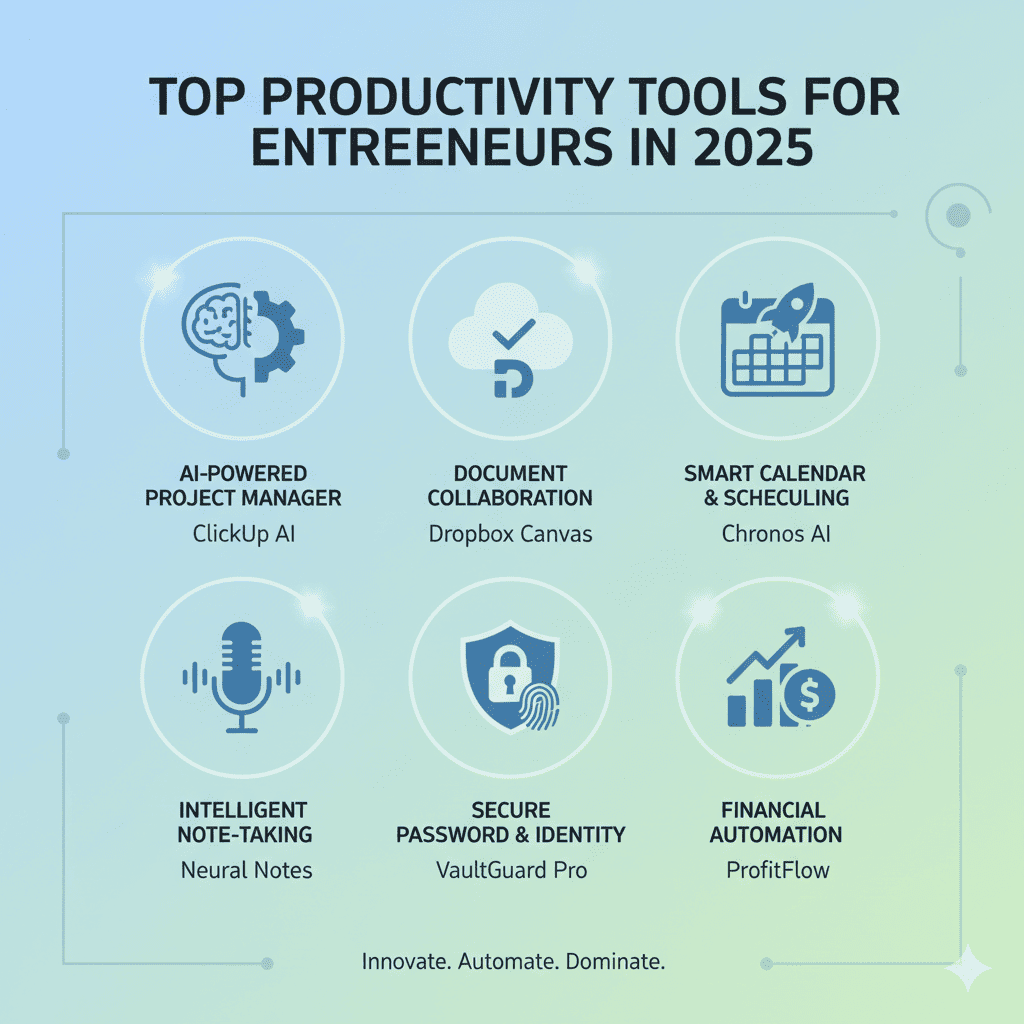
Running a successful business in 2025 requires more than just a great idea and determination. Entrepreneurs today need the right arsenal of productivity tools to stay competitive, manage their time effectively, and scale their operations efficiently. The digital landscape has evolved dramatically, and with it comes an incredible array of productivity tools designed specifically to help entrepreneurs work smarter, not harder.
In this comprehensive guide, we’ll explore the most powerful productivity tools for entrepreneurs that are transforming how business owners manage their workflows, collaborate with teams, and achieve their goals in 2025.
Why Productivity Tools Are Essential for Modern Entrepreneurs
Before diving into specific productivity tools, it’s crucial to understand why these solutions have become non-negotiable for entrepreneurial success. The modern entrepreneur juggles multiple roles simultaneously—CEO, marketer, salesperson, customer service representative, and more. Without the right productivity tools, this juggling act quickly becomes unsustainable.
Productivity tools help entrepreneurs:
- Automate repetitive tasks and free up valuable time
- Streamline communication across teams and time zones
- Organize projects and track progress efficiently
- Make data-driven decisions faster
- Reduce operational costs while scaling
- Maintain work-life balance and prevent burnout
The right combination of productivity tools can literally make the difference between a struggling startup and a thriving enterprise.
Project Management Productivity Tools
1. Monday.com – The Visual Workflow Master
Monday.com has established itself as one of the premier productivity tools for entrepreneurs who value visual organization. This platform transforms complex projects into clear, manageable workflows that anyone on your team can understand at a glance.
What makes Monday.com stand out among productivity tools is its incredible flexibility. You can customize boards to match your specific business processes, whether you’re managing product launches, content calendars, sales pipelines, or client projects. The color-coded system makes it easy to identify bottlenecks, track deadlines, and ensure nothing falls through the cracks.
Entrepreneurs love Monday.com because it scales beautifully. Start with a simple board for your solo projects, then expand to include multiple teams, departments, and complex workflows as your business grows. The automation features save countless hours by automatically assigning tasks, sending notifications, and updating statuses based on triggers you define.
2. Asana – The Task Organization Powerhouse
Asana has long been a favorite among productivity tools for entrepreneurs who need robust task management capabilities. This platform excels at breaking down large projects into manageable subtasks, making even the most ambitious goals feel achievable.
The Timeline view in Asana provides a Gantt chart-style overview that helps entrepreneurs visualize project dependencies and adjust schedules proactively. You can see exactly how delays in one area will impact your overall timeline, allowing for better resource allocation and deadline management.
What sets Asana apart from other productivity tools is its intuitive interface combined with powerful features. You can create custom fields, set recurring tasks, establish task dependencies, and integrate with hundreds of other applications. The mobile app ensures you stay connected to your projects even when you’re away from your desk.
3. Notion – The All-in-One Workspace
Notion has revolutionized how entrepreneurs think about productivity tools by combining notes, databases, wikis, and project management into one seamless platform. This versatility makes it perfect for entrepreneurs who want to centralize their entire business operations.
With Notion, you can create a company wiki to document processes, build databases to track customers or inventory, manage projects with Kanban boards, and take meeting notes—all within the same workspace. The ability to link pages and databases creates a powerful knowledge management system that grows with your business.
Entrepreneurs appreciate that Notion serves as both personal productivity tools and team collaboration software. You can maintain private pages for personal planning while sharing team spaces for collaborative work. The template gallery offers pre-built solutions for everything from OKR tracking to content calendars, giving you a head start on organization.
Communication and Collaboration Productivity Tools
4. Slack – Real-Time Team Communication
Slack has become synonymous with modern workplace communication, earning its place among essential productivity tools for entrepreneurs. This platform replaces scattered email threads with organized channels, making it easy to keep conversations focused and searchable.
The real power of Slack as one of the top productivity tools lies in its integration capabilities. Connect your project management software, CRM, analytics tools, and dozens of other applications to create a central hub where your team receives notifications and updates. This eliminates the need to constantly switch between different platforms.
Entrepreneurs can create channels for different projects, departments, or topics, ensuring that team members only see relevant conversations. The search functionality makes finding past decisions or shared files effortless, while threaded conversations keep discussions organized even in busy channels.
5. Zoom – Virtual Meeting Excellence
As remote and hybrid work continues to dominate, Zoom remains one of the most critical productivity tools for entrepreneurs. While many video conferencing solutions exist, Zoom’s reliability, ease of use, and feature set make it the gold standard.
Beyond basic video calls, Zoom offers breakout rooms for workshop-style meetings, screen sharing with annotation capabilities, virtual backgrounds, and recording options. These features make it suitable for everything from one-on-one client meetings to large webinars and team training sessions.
The integration with calendar applications and other productivity tools ensures that joining meetings requires minimal effort. Entrepreneurs can schedule recurring meetings, send automatic reminders, and even generate transcripts for later reference.
6. Loom – Asynchronous Video Communication
Loom represents a new category of productivity tools that address the challenges of asynchronous communication. Instead of scheduling yet another meeting, entrepreneurs can record quick video messages that explain concepts, provide feedback, or share updates.
This tool is particularly valuable for entrepreneurs managing distributed teams across different time zones. You can record your screen while narrating, add a camera bubble to provide personal connection, and share the video instantly. Recipients can watch at their convenience and respond with comments or their own Loom videos.
The time savings are substantial. What might require a 30-minute meeting can often be accomplished with a 5-minute Loom video. The recordings also serve as documentation, reducing the need to repeat explanations or instructions.
Time Management and Focus Productivity Tools
7. Todoist – Smart Task Management
Todoist has earned its reputation as one of the most effective productivity tools for personal task management. Its simplicity belies powerful features that help entrepreneurs capture, organize, and prioritize their to-do lists effectively.
The natural language processing feature allows you to quickly add tasks by typing phrases like “Follow up with client tomorrow at 2pm,” and Todoist automatically sets the due date and time. Labels, filters, and priority levels help you focus on what matters most, while the karma system gamifies productivity to keep you motivated.
What makes Todoist stand out among productivity tools is its availability across every platform imaginable. Whether you’re on your phone, tablet, computer, or even using a smart watch, your tasks sync instantly. This ubiquity ensures you can capture ideas and check off completed tasks regardless of where you are.
8. RescueTime – Automatic Time Tracking
Understanding how you spend your time is crucial for improvement, which is why RescueTime ranks among the most insightful productivity tools for entrepreneurs. This application runs in the background, automatically tracking how much time you spend on different applications and websites.
The detailed reports reveal patterns you might not notice otherwise. You might discover that you’re spending two hours daily on email when you thought it was only 30 minutes, or that social media distractions are more significant than you realized. This data-driven approach to productivity helps entrepreneurs make informed decisions about where to focus their time management efforts.
RescueTime also offers FocusTime, a feature that blocks distracting websites during scheduled periods, helping you maintain deep work sessions. The goal-setting functionality allows you to establish targets for productive time and receive alerts when you’re falling behind.
9. Forest – Gamified Focus Sessions
Forest takes a creative approach among productivity tools by gamifying the pomodoro technique. When you need to focus, you plant a virtual tree that grows while you work. If you leave the app to check social media or other distracting applications, your tree dies.
This simple concept proves surprisingly effective at maintaining focus. Over time, you build a forest that represents your productive sessions, creating a visual reminder of your accomplishments. The app also partners with real tree-planting organizations, so your virtual productivity translates into actual environmental impact.
Entrepreneurs appreciate Forest’s ability to make focus sessions feel rewarding rather than restrictive. The app works well for both individual deep work and team accountability, as you can share forests with colleagues and work together toward common goals.
Financial Management Productivity Tools
10. QuickBooks Online – Comprehensive Accounting
Financial management represents one of the most critical yet time-consuming aspects of entrepreneurship, making accounting productivity tools essential. QuickBooks Online has established itself as the industry standard, offering comprehensive features that grow with your business.
From invoicing and expense tracking to payroll processing and tax preparation, QuickBooks handles the full spectrum of financial tasks. The automation features save entrepreneurs countless hours by automatically categorizing expenses, sending payment reminders, and reconciling bank transactions.
The real-time dashboard provides instant insights into your business’s financial health. You can see cash flow, outstanding invoices, and expense trends at a glance, enabling better financial decision-making. Integration with your bank accounts and credit cards means transactions flow automatically into the system, reducing manual data entry.
11. Expensify – Simplified Expense Management
For entrepreneurs who travel frequently or manage team expenses, Expensify ranks among the most valuable productivity tools available. This application transforms the tedious process of expense reporting into something quick and painless.
Simply photograph your receipts, and Expensify’s SmartScan technology extracts the relevant information automatically. The app categorizes expenses, applies your company’s policy rules, and even submits reports on your behalf. For team management, you can set spending limits, approval workflows, and reimbursement schedules.
The mileage tracking feature uses GPS to automatically log business trips, eliminating the need to manually record distances. This alone saves entrepreneurs hours each month while ensuring accurate reimbursement claims and tax deductions.
Marketing and Social Media Productivity Tools
12. Buffer – Social Media Scheduling Simplified
Maintaining an active social media presence requires consistent posting, making scheduling productivity tools like Buffer indispensable. This platform allows entrepreneurs to plan and schedule content across multiple social networks from a single dashboard.
Buffer’s queue system is particularly clever. You establish posting times for each social network, then add content to your queue. The system automatically distributes your posts according to your schedule, ensuring consistent presence without requiring constant attention.
The analytics dashboard helps you understand which content resonates with your audience, informing your content strategy. You can see engagement metrics, reach, and clicks for each post, enabling data-driven decisions about what to share. The browser extension makes it easy to share interesting content you discover while browsing, adding it directly to your queue.
13. Canva – Design Made Accessible
Visual content dominates online engagement, making design productivity tools essential even for non-designers. Canva has democratized design by providing templates, graphics, and an intuitive interface that anyone can use to create professional-looking materials.
Entrepreneurs can create social media graphics, presentations, flyers, business cards, and countless other design assets without hiring a designer for every project. The template library provides starting points for virtually any project, while the drag-and-drop interface makes customization straightforward.
The Brand Kit feature ensures consistency by storing your brand colors, fonts, and logos in one accessible location. This consistency strengthens your brand identity across all materials. Canva’s collaboration features also allow team members to work together on designs, making it suitable for both solo entrepreneurs and growing teams.
14. Mailchimp – Email Marketing Automation
Email marketing remains one of the highest ROI marketing channels, making email productivity tools like Mailchimp crucial for entrepreneurial success. This platform combines ease of use with sophisticated automation capabilities.
The visual email builder allows entrepreneurs to create attractive newsletters without coding knowledge. Drag-and-drop elements, pre-designed templates, and mobile responsiveness ensure your emails look professional on any device.
Where Mailchimp truly shines among productivity tools is in automation. You can set up welcome sequences for new subscribers, abandoned cart reminders for e-commerce stores, birthday messages, and countless other automated campaigns. These sequences run in the background, nurturing leads and driving sales without requiring constant attention.
Content Creation Productivity Tools
15. Grammarly – Writing Enhancement
Clear communication is fundamental to business success, making writing productivity tools like Grammarly essential. This AI-powered assistant goes far beyond basic spell-checking to improve clarity, tone, and engagement in your writing.
Grammarly works everywhere you write—email clients, document editors, social media platforms, and messaging apps. It provides real-time suggestions for grammar, punctuation, style, and word choice. The tone detector helps ensure your messages convey the intended emotion, whether professional, friendly, or confident.
For entrepreneurs creating content, blog posts, or important communications, Grammarly’s advanced features check for plagiarism, suggest vocabulary enhancements, and provide clarity scores. These features help maintain professional standards even when you’re working quickly.
16. Descript – Audio and Video Editing Simplified
Content creation has become central to entrepreneurial marketing, making editing productivity tools like Descript game-changing. This platform allows you to edit audio and video by editing the transcript, making it accessible to entrepreneurs without technical editing skills.
Simply upload your recording, and Descript generates a transcript automatically. You can delete words, rearrange sentences, or remove filler words directly in the text, and the audio or video adjusts accordingly. This approach is dramatically faster than traditional timeline-based editing.
The overdub feature allows you to correct mistakes by typing the corrected text, and Descript generates audio in your voice. This eliminates the need to re-record entire sections for minor errors. For podcasters, YouTubers, or anyone creating audio or video content, Descript represents a massive productivity boost.
Customer Relationship Management Productivity Tools
17. HubSpot CRM – Comprehensive Customer Management
Managing customer relationships efficiently requires robust productivity tools, and HubSpot CRM has established itself as a leader in this space. The free tier offers surprising functionality, while paid tiers provide enterprise-level features.
HubSpot centralizes all customer interactions—emails, calls, meetings, and notes—in one accessible location. This complete history ensures you never forget important details about a customer or prospect. The visual sales pipeline helps you track deals through your sales process, identifying bottlenecks and forecasting revenue.
The automation capabilities save entrepreneurs significant time. You can automatically assign leads, send follow-up emails, create tasks, and update records based on customer actions. Integration with your email, calendar, and other productivity tools creates a seamless workflow that minimizes administrative tasks.
18. Calendly – Scheduling Without the Back-and-Forth
Schedule coordination consumes surprising amounts of time, making appointment productivity tools like Calendly incredibly valuable. Instead of endless email exchanges finding mutually convenient times, you simply share your Calendly link.
Recipients see your actual availability and book directly on your calendar. You can set different meeting types with varying durations, locations, and buffer times. The system automatically handles time zone conversions, sends confirmations and reminders, and adds meetings to your calendar.
For entrepreneurs who take many meetings—sales calls, consultations, interviews—Calendly eliminates the administrative burden of scheduling. The time saved compounds quickly, freeing you to focus on activities that directly drive business growth.
Knowledge Management Productivity Tools
19. Evernote – Digital Note-Taking Excellence
Capturing and organizing information effectively requires dedicated productivity tools, and Evernote has been a pioneer in digital note-taking. This platform allows entrepreneurs to collect thoughts, clip web articles, store documents, and organize research in one searchable system.
The web clipper browser extension makes it easy to save articles, images, or entire web pages directly to Evernote. The powerful search functionality can even find text within images, making every note searchable. Tags and notebooks provide organizational structure that grows with your needs.
For entrepreneurs juggling multiple projects and ideas, Evernote serves as an external brain. You can capture ideas on your phone, reference them on your tablet, and incorporate them into documents on your computer, all synchronized seamlessly across devices.
20. Pocket – Read-It-Later App
Information overload is a real challenge for entrepreneurs, making content curation productivity tools like Pocket valuable. When you find interesting articles but lack time to read them immediately, Pocket lets you save them for later.
The app strips away ads and distractions, presenting articles in a clean, readable format. You can listen to articles with the text-to-speech feature, turning your commute into productive learning time. Tags help organize saved articles by topic or project.
Pocket’s recommendation engine also surfaces quality content based on your interests, helping you discover valuable insights without endless searching. This curated approach to content consumption helps entrepreneurs stay informed without drowning in information.
Automation Productivity Tools
21. Zapier – The Automation Connector
Zapier represents a revolutionary category of productivity tools that connects your various applications and automates workflows between them. Without any coding knowledge, entrepreneurs can create “Zaps” that trigger actions across different platforms.
For example, you could automatically save email attachments to cloud storage, add new customers from your e-commerce platform to your email list, create tasks in your project management tool from form submissions, or post Instagram photos automatically to Twitter. The possibilities are virtually endless.
What makes Zapier so powerful among productivity tools is its extensive library of integrations. With connections to over 5,000 apps, you can automate almost any repetitive workflow. This automation frees entrepreneurs from mundane tasks, allowing focus on high-value activities that require human judgment and creativity.
22. IFTTT – Simple Automation for Everyday Tasks
IFTTT (If This Then That) offers another approach to automation among productivity tools, focusing on simplicity and accessibility. The platform uses applets—simple conditional statements that trigger actions based on specific events.
While similar to Zapier, IFTTT often provides simpler, consumer-focused automations. You can automatically save photos from Instagram to Dropbox, receive weather alerts before your commute, log work hours to a spreadsheet, or control smart home devices based on your location.
For entrepreneurs just beginning to explore automation, IFTTT’s straightforward interface provides an approachable entry point. The pre-built applet library offers inspiration and ready-made solutions for common automation needs.
Cloud Storage and File Management Productivity Tools
23. Google Drive – Collaborative Cloud Storage
Cloud storage has become fundamental to modern business, making platforms like Google Drive essential productivity tools. Beyond simple file storage, Google Drive integrates with Google’s suite of productivity applications—Docs, Sheets, Slides, and Forms.
The real-time collaboration features transform how teams work together. Multiple people can edit documents simultaneously, seeing each other’s changes instantly. Comments and suggestions enable feedback without multiple file versions cluttering your storage.
For entrepreneurs, Google Drive provides accessible, secure storage that scales affordably. The search functionality makes finding files easy, while sharing controls ensure sensitive documents remain protected. Integration with other productivity tools makes Google Drive a natural hub for business operations.
24. Dropbox – Reliable File Synchronization
Dropbox pioneered cloud storage and remains among the most reliable productivity tools for file synchronization. The platform works invisibly in the background, ensuring files are automatically backed up and accessible from any device.
Smart Sync feature is particularly valuable for entrepreneurs with limited local storage. You can see all your files in Finder or Explorer without them taking up space on your hard drive. Files download automatically when you open them, providing seamless access to your entire library.
Dropbox’s version history feature provides peace of mind. If you accidentally delete or overwrite a file, you can easily restore previous versions. The collaboration features, including Paper for document collaboration and Spaces for team organization, make Dropbox more than just storage.
Password Management Productivity Tools
25. 1Password – Security Meets Convenience
Managing dozens or hundreds of passwords securely requires dedicated productivity tools, and 1Password has established itself as a leader in password management. This application generates strong, unique passwords for every account and fills them automatically when you log in.
Beyond passwords, 1Password securely stores credit card information, secure notes, software licenses, and other sensitive data. The Watchtower feature alerts you to compromised passwords, weak passwords, and websites that have experienced data breaches.
For entrepreneurs, 1Password eliminates the security risk of reusing passwords while removing the friction of remembering or looking them up. The time savings compound across hundreds of logins monthly, while the security benefits provide essential protection for your business.
Health and Wellness Productivity Tools
26. Headspace – Mindfulness for Entrepreneurs
Mental health and focus require attention, making wellness productivity tools like Headspace valuable for sustainable entrepreneurship. This guided meditation app helps reduce stress, improve focus, and maintain mental clarity amid entrepreneurial challenges.
The app offers meditations ranging from three minutes to longer sessions, making it easy to fit into busy schedules. Specialized content addresses common entrepreneurial challenges like anxiety, focus, and sleep quality. The progress tracking provides motivation to maintain a consistent practice.
Entrepreneurs who invest in mental health maintenance report better decision-making, improved creativity, and greater resilience. Headspace makes mindfulness accessible, providing guidance for those new to meditation while offering depth for experienced practitioners.
27. Calm – Sleep and Relaxation
Quality sleep directly impacts productivity, making sleep productivity tools like Calm valuable investments. This app offers sleep stories, soundscapes, and guided meditations designed to improve sleep quality and reduce stress.
The business and workplace content addresses specific challenges entrepreneurs face, offering strategies for managing stress, improving focus, and maintaining work-life balance. Daily meditation programs provide structure for building sustainable practices.
For entrepreneurs burning the candle at both ends, Calm serves as a reminder that rest and recovery are essential components of sustained success. The app makes it easy to wind down, improving sleep quality and next-day performance.
Conclusion: Building Your Productivity Tool Stack
The landscape of productivity tools available to entrepreneurs in 2025 is both exciting and overwhelming. The key to success isn’t using every tool mentioned but rather carefully selecting productivity tools that address your specific needs and challenges.
Start by identifying your biggest productivity pain points. Are you drowning in email? Struggling with project organization? Losing track of expenses? Choose productivity tools that directly address these challenges first.
Remember that productivity tools work best when integrated into consistent workflows. Take time to learn each tool thoroughly, set up automations, and establish routines around their use. The initial investment in setup and learning pays dividends through long-term efficiency gains.
As your business grows, regularly reassess your productivity tools stack. What works for a solo entrepreneur may not serve a team of ten. Be willing to switch platforms or add new productivity tools as your needs evolve.
The most successful entrepreneurs in 2025 recognize that productivity tools aren’t about working more hours—they’re about working smarter, focusing on high-impact activities, and building sustainable systems that support business growth without sacrificing personal wellbeing.
By thoughtfully implementing the right combination of productivity tools for your unique situation, you position yourself and your business for success in an increasingly competitive marketplace. The time you invest in optimizing your productivity tools stack will return many times over through increased efficiency, reduced stress, and accelerated business growth.
Also read this:
How to Make $1,000/Week Using Free AI Tools (Full Guide)
Why Hyper-Niche Blogging Is the Secret to Gaining Traffic in 2025
How to Start a Faceless YouTube Channel with AI Tools (Complete 2025 Guide)