
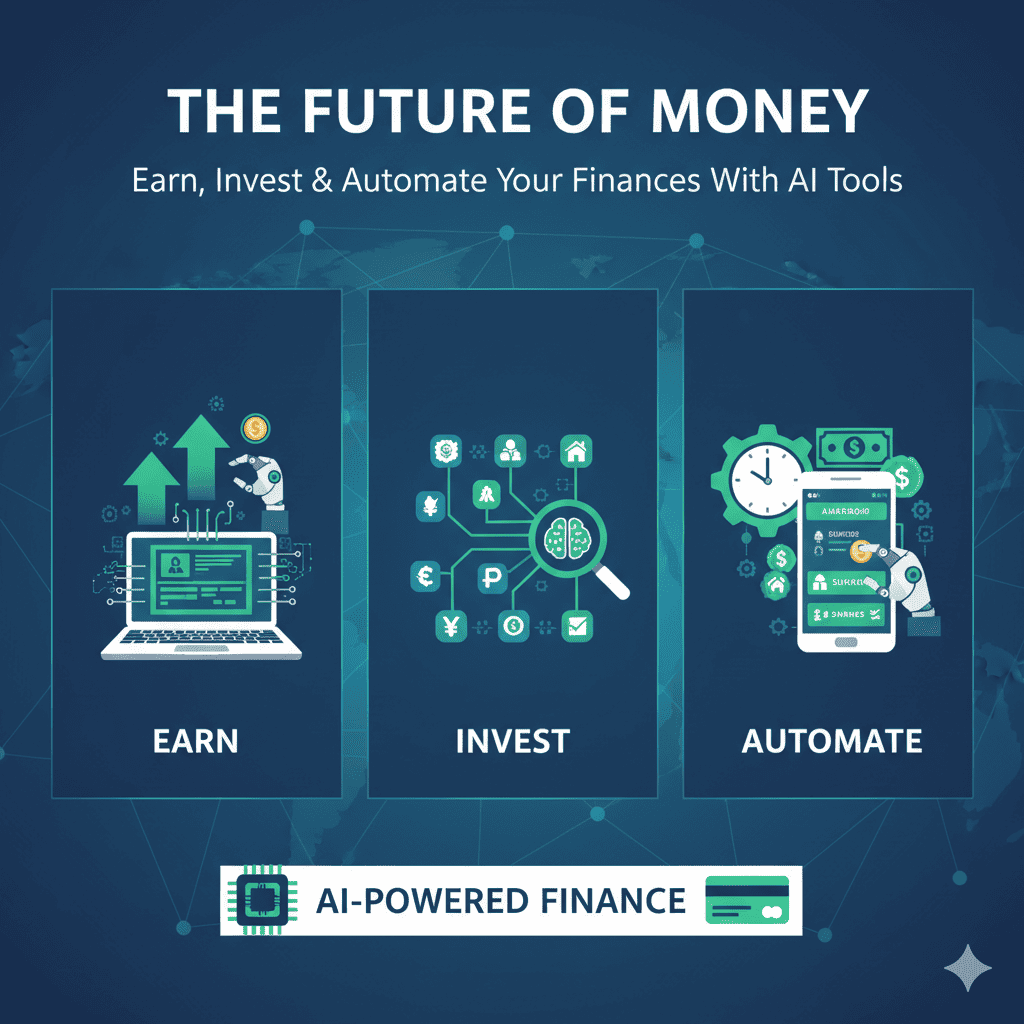
Imagine waking up to find your investments automatically rebalanced, your bills paid, savings optimized, and even side income generated—all while you slept. This isn’t science fiction. This is the future of money, and it’s happening right now through AI-powered financial tools that are transforming how we earn, invest, and manage wealth.
The financial landscape is undergoing its most dramatic transformation since the invention of credit cards. Artificial intelligence isn’t just changing banking—it’s revolutionizing every aspect of personal finance. From robo-advisors managing billion-dollar portfolios to AI tools helping gig workers maximize earnings, the future of money is intelligent, automated, and surprisingly accessible.
Why AI Is Redefining the Future of Money
Traditional finance was built on human limitations—bankers working 9-to-5, advisors managing limited clients, manual bookkeeping consuming hours of time. The future of money eliminates these constraints. AI operates 24/7, processes millions of data points instantly, learns from patterns, and makes split-second decisions that humans simply cannot match.
But here’s what makes this revolution different: it’s not just for the wealthy. The same AI technologies that power hedge funds are now available to everyday people through smartphone apps. A college student in Mumbai and a Wall Street trader now have access to similar AI-powered tools—that’s the democratizing power of the future of money.
The numbers are staggering. AI-powered financial tools manage over $1 trillion in assets globally. Robo-advisors have grown from managing virtually nothing in 2008 to projected assets of $2.5 trillion by 2025. Personal finance apps using AI have over 100 million active users worldwide. This isn’t a trend—it’s the future of money becoming the present.
Part 1: Earning Money in the AI Era—New Opportunities Await
The future of money isn’t just about managing what you have—it’s about creating new income streams powered by AI. Here’s how intelligent tools are opening earning opportunities that didn’t exist five years ago.
AI-Powered Freelancing Platforms: Smart Matching for Maximum Earnings
Traditional freelancing meant endless bidding on projects, often competing with hundreds of others. The future of money for freelancers looks radically different.
Upwork AI Matching System analyzes your skills, past performance, and client preferences to automatically match you with relevant projects. Instead of spending hours searching for work, AI brings opportunities to you. Freelancers using AI-optimized profiles report 40% higher earnings than those who don’t.
Fiverr’s Algorithm Optimization uses machine learning to understand which gig titles, descriptions, and pricing maximize conversions. The platform’s AI suggests optimal pricing based on your experience level, demand patterns, and competitor analysis. It’s like having a marketing consultant working for you 24/7.
Toptal and Expert AI Screening leverages AI to match top-tier professionals with premium clients willing to pay premium rates. The AI evaluates not just skills but communication style, reliability patterns, and cultural fit—ensuring better client relationships and repeat work.
Income Multiplication Strategy: Smart freelancers are using AI writing assistants like ChatGPT and Claude to increase output. A content writer who previously completed 5 articles per day now produces 12—not by working harder, but by letting AI handle research, outlines, and first drafts while focusing on refinement and client communication. That’s the future of money—working smarter, not longer.
AI Stock Photography and Digital Content Creation
The creator economy is exploding, and AI is the rocket fuel. The future of money includes earning from digital assets you create once and sell repeatedly.
Midjourney, DALL-E, and Stable Diffusion have created a new category of creators—AI artists generating stunning visuals without traditional artistic skills. These images sell on stock platforms, generate prints on Redbubble and Society6, and create merchandise designs. Creators report earning $500-$5,000 monthly from AI-generated artwork portfolios.
AI Video Creation using tools like Synthesia and Pictory allows anyone to produce professional videos without expensive equipment or editing skills. These videos monetize through YouTube, courses, and social media sponsorships. The barrier to entry for video content creation has essentially disappeared—welcome to the future of money in the creator economy.
Music Generation AI like Soundraw and AIVA enables musicians and non-musicians alike to create royalty-free music for licensing. Content creators desperately need background music, creating a multi-million dollar market where AI democratizes participation.
AI-Powered Trading and Market Analysis
Day trading was once the domain of financial professionals with expensive Bloomberg terminals and years of training. The future of money makes sophisticated market analysis accessible to everyone.
TradingView with AI Indicators provides retail traders with institutional-grade analysis. AI algorithms identify patterns, predict potential movements, and alert you to opportunities. While not guaranteeing profits, these tools level the playing field dramatically.
Cryptohopper and Automated Crypto Trading uses AI to execute trades based on predefined strategies, technical indicators, and market conditions. The bot trades 24/7, never gets emotional, and executes faster than humanly possible. Traders report consistent 10-30% monthly returns, though cryptocurrency remains highly volatile.
Stock Screening AI like those in Trade Ideas scan thousands of stocks instantly, identifying opportunities matching your criteria. What would take humans days happens in seconds—that’s the efficiency of the future of money.
Reality Check: AI trading tools amplify both gains and losses. They’re powerful but require education, risk management, and realistic expectations. They’re tools, not get-rich-quick schemes.
Gig Economy Optimization Through AI
For drivers, delivery personnel, and gig workers, the future of money means working fewer hours for the same or greater income through AI optimization.
Gridwise and Earnings Optimization analyzes ride-share and delivery demand patterns, suggesting optimal times and locations to work. Drivers using such tools report 25-40% higher hourly earnings by being in the right place at the right time.
Multi-App AI Coordinators like Mystro automatically accept the most profitable rides/deliveries across multiple platforms (Uber, Lyft, DoorDash), maximizing earnings per hour while minimizing downtime. It’s like having an operations manager optimizing your work schedule constantly.
Expense Tracking AI for gig workers automatically categorizes expenses, calculates mileage deductions, and maximizes tax savings. The average gig worker leaves $2,000-$5,000 in deductions unclaimed annually—AI ensures you capture every dollar you’re entitled to. This is the future of money for the independent workforce.
Part 2: Investing in the Future of Money—AI-Powered Wealth Building
If earning is the input, investing is the multiplication engine. The future of money transforms ordinary people into sophisticated investors through AI democratization.
Robo-Advisors: Professional Portfolio Management for Everyone
The wealth management industry charged 1-2% annually for portfolio management—pricing out anyone without $100,000+ to invest. The future of money changed everything.
Betterment: The Pioneer uses AI algorithms to build diversified portfolios, automatically rebalance based on market conditions, and harvest tax losses to minimize tax burden. Services start at just $10 minimum investment with 0.25% annual fees—making professional management accessible to college students and entry-level professionals.
Wealthfront’s Advanced AI goes beyond basic robo-advising. Its Path Planning feature uses AI to simulate thousands of financial scenarios, showing probability of achieving your goals based on current savings and market conditions. It’s like having a financial planner running Monte Carlo simulations on your behalf.
Indian Options: Smallcase and INDWealth bring robo-advisory services tailored to Indian markets, regulations, and tax structures. Smallcase uses AI to create thematic investment baskets (electric vehicles, digital banking, etc.) that automatically rebalance based on market conditions. This is the future of money adapted for local markets.
The Performance Difference: Studies show robo-advisors match or outperform 80% of human financial advisors after fees, primarily because they eliminate emotional decision-making and maintain discipline through market volatility.
AI Stock Picking and Analysis Tools
Want to pick individual stocks but lack Wall Street research capabilities? The future of money provides institutional-grade analysis to retail investors.
Tickeron’s AI Predictions analyzes over 10,000 technical indicators and fundamental factors to provide confidence ratings on stock movements. Their AI pattern recognition identifies formations humans easily miss, with reported 68-72% accuracy on directional predictions.
AlphaSense and Earnings Analysis uses natural language processing to analyze earnings calls, financial statements, and news sentiment in real-time. It identifies subtle language changes by executives that historically precede significant price movements—edge information previously available only to institutions.
Magnifi Personal combines AI analysis with human expertise. Ask natural language questions like “show me growing tech stocks under $100 with strong balance sheets” and AI instantly analyzes thousands of securities, providing customized recommendations. This is how the future of money makes complex research simple.
Portfolio Optimization AI analyzes your existing holdings, identifies concentration risks, suggests diversification opportunities, and rebalancing strategies to maximize returns for your risk tolerance. It’s continuous portfolio health monitoring that ensures your investment strategy stays aligned with goals.
Cryptocurrency and DeFi AI Tools
Cryptocurrency represents perhaps the most AI-intensive segment of the future of money, where 24/7 markets and massive volatility make automation essential.
Shrimpy Portfolio Rebalancing automatically maintains your desired crypto allocation across multiple exchanges. When Bitcoin gains 50% and now comprises too much of your portfolio, AI automatically sells portions and buys underweight assets, maintaining your risk profile without constant monitoring.
Cryptohopper Strategy Marketplace allows users to subscribe to AI trading strategies created by top performers. The AI executes these strategies on your behalf, learning from successful traders while you focus on other priorities. It’s democratized access to expert trading strategies—quintessentially the future of money.
DeFi Yield Farming Optimizers like Yearn Finance use AI to automatically move your crypto assets between lending protocols, maximizing yield while managing risk. What required hours of daily monitoring now happens automatically, with AI chasing the highest safe yields across the DeFi ecosystem.
Sentiment Analysis Bots scan millions of social media posts, news articles, and on-chain data to gauge market sentiment before it affects prices. Early sentiment shifts often predict price movements, giving AI-equipped traders an information advantage.
Risk Warning: Cryptocurrency remains highly speculative and volatile. AI tools reduce but don’t eliminate risk. Never invest more than you can afford to lose.
Real Estate Investment AI
Real estate, traditionally requiring massive capital and local expertise, is being transformed by AI into an accessible investment class—truly the future of money at work.
Roofstock AI analyzes thousands of rental properties, providing predicted cash flow, appreciation potential, and risk ratings. Its AI considers local employment trends, school quality changes, infrastructure development, and dozens of other factors to identify undervalued properties with strong rental potential.
Fundrise and AI-Driven REITs use machine learning to select commercial and residential properties for their real estate portfolios. Minimum investments start at $500, with AI optimizing property selection, timing, and diversification across geographies and property types.
RealtyShares Market Analysis (and similar platforms) employs AI to underwrite deals, assessing borrower credibility, property value trends, and market dynamics. This reduces default rates and improves returns for investors participating in real estate crowdfunding.
Zillow’s Zestimate AI (available for personal use) provides instant property valuations using machine learning trained on millions of transactions. While not perfect, it’s remarkably accurate for preliminary investment analysis—data that previously required expensive appraisals.
AI-Powered Retirement Planning
Retirement planning once required expensive financial planners and complex calculations. The future of money makes sophisticated retirement planning free and accessible.
Vanguard Personal Advisor combines robo-advisory with occasional human advice. AI handles day-to-day portfolio management and rebalancing, while human advisors assist with major life decisions. It’s the best of both worlds at a fraction of traditional advisory costs.
Blooom for 401(k) Optimization connects to your employer retirement plan and analyzes whether you’re properly diversified, paying excessive fees, or taking inappropriate risk for your age. Its AI provides specific recommendations to optimize returns within your existing plan—often increasing projected retirement wealth by 15-25%.
PersonalCapital Retirement Planner uses Monte Carlo simulations—running thousands of possible market scenarios—to show probability of retirement success. Its AI suggests specific adjustments to savings rates, asset allocation, or retirement timing to improve outcomes. This is the future of money ensuring your golden years are actually golden.
Part 3: Automating Your Finances—The AI Money Management Revolution
Earning and investing are critical, but daily financial management often determines real wealth accumulation. The future of money removes the friction and mistakes from day-to-day money management.
AI Budgeting and Expense Management
Budgeting typically fails because it requires constant attention and discipline. The future of money makes budgeting automatic and painless.
Mint’s AI Categorization automatically tags every transaction, tracks spending patterns, and alerts you when approaching budget limits. Its machine learning improves over time, understanding that “Shell Station” is fuel, not dining, and adjusting categories without manual intervention.
YNAB (You Need A Budget) with AI Insights goes beyond tracking to prediction. Its AI forecasts when you’ll exceed budgets based on current spending pace, recommends adjustments, and even suggests which discretionary categories to trim if unexpected expenses arise.
Cleo AI Chatbot provides conversational money management. Ask “Can I afford a $200 concert ticket?” and its AI analyzes upcoming bills, historical spending, and current balance to give honest advice. It’s like having a financially-savvy friend who knows your complete financial situation.
Trim and Bill Negotiation uses AI to analyze your subscriptions, identify unused services, and even negotiate lower bills on your behalf. Users report average savings of $300-$700 annually from services they didn’t realize they were paying for—that’s the future of money recovering wasted dollars.
Intelligent Savings and Investment Automation
The biggest barrier to wealth building is starting. The future of money eliminates that barrier through invisible automation.
Acorns Round-Up Investing links to your debit/credit cards and automatically invests spare change from purchases. Buy coffee for $4.50, and AI rounds to $5, investing the $0.50. These micro-investments compound remarkably—users average $30-$50 monthly invested without conscious effort.
Digit’s AI Savings analyzes your income, spending patterns, and upcoming bills to determine safe amounts to save. It transfers small amounts automatically—amounts you won’t miss—building savings without willpower. Digit users save average $2,500-$5,000 annually more than they would manually.
Qapital’s Rule-Based Savings lets you create “if-then” rules that AI executes. “If I skip my morning coffee, save $5” or “If market rises 2%, invest $20 extra.” The AI monitors triggers and executes automatically, turning good intentions into actual wealth building. This is the future of money aligning automation with personal goals.
Chime’s Automatic Savings rounds up purchases and moves the difference to savings, plus saves 10% of every direct deposit automatically. AI ensures you never overdraft while maximizing savings rate—users save 20-30% more than with traditional banks.
AI-Powered Credit Management
Credit scores dramatically affect borrowing costs, yet most people don’t actively manage them. The future of money includes AI credit optimization.
Credit Karma’s AI Recommendations analyzes your credit report and suggests specific actions to improve your score—which accounts to pay down first, optimal credit utilization ratios, and timing for new applications. Users following AI recommendations improve scores by average 40-60 points within six months.
Experian Boost uses AI to identify positive payment patterns (utilities, streaming services) typically not reported to credit bureaus and adds them to your credit file. This AI-driven approach instantly improves scores for people with limited credit history.
Kikoff Credit Building employs AI to create optimal credit-building strategies for individuals with poor or no credit. Its algorithms determine ideal spending amounts, payment timing, and account management to maximize score improvement while minimizing costs.
Debt Payoff Optimization tools like Tally use AI to determine optimal debt payoff strategies—whether avalanche (highest interest first), snowball (smallest balance first), or hybrid approaches yield fastest debt freedom. The AI adjusts strategies as circumstances change, ensuring you’re always on the most efficient path to debt freedom. This is the future of money liberating people from financial burden.
AI Tax Optimization and Preparation
Tax filing is complicated, time-consuming, and error-prone. The future of money makes tax optimization continuous and automatic.
TurboTax Live with AI combines software automation with on-demand expert help. AI handles data entry, identifies deductions, and flags potential issues while human CPAs review complex situations. It’s professional-grade tax preparation at DIY pricing.
FlyFin for Self-Employed uses AI to scan bank and credit card transactions, automatically identifying tax deductions. Its machine learning understands that meal expenses during work travel are deductible while personal dining isn’t. Self-employed users report finding $3,000-$8,000 in previously missed deductions annually.
Keeper Tax connects to your accounts and uses AI to identify every possible business expense, automatically categorizing and tracking them for tax time. It’s particularly powerful for gig workers and freelancers who often miss substantial deductions.
Year-Round Tax Loss Harvesting by robo-advisors like Betterment and Wealthfront uses AI to continuously scan your portfolio for strategic losses to offset gains, reducing tax burden. This sophisticated strategy, previously available only to ultra-wealthy investors, is now automated for everyone. That’s the future of money maximizing after-tax returns.
AI-Driven Insurance Optimization
Insurance is essential but confusing, leading to overpaying or inadequate coverage. The future of money simplifies insurance through intelligent analysis.
Policygenius AI Comparison analyzes hundreds of insurance policies across multiple providers, identifying optimal coverage for your specific situation at lowest cost. Its AI considers your health, age, assets, and liabilities to recommend appropriate coverage levels—often finding 20-40% savings compared to existing policies.
Root Insurance Usage-Based Pricing uses AI and smartphone sensors to monitor actual driving behavior, offering dramatically lower rates to safe drivers. Traditional insurance prices based on demographics; the future of money prices based on actual behavior, rewarding good habits.
Lemonade’s AI Claims Processing approves straightforward claims in seconds through AI analysis, paying claims before traditional insurers finish paperwork. This efficiency translates to lower premiums—tech-enabled insurance costs 20-30% less than traditional policies.
Part 4: AI Financial Education and Literacy
The future of money isn’t just about tools—it’s about knowledge. AI is democratizing financial education at unprecedented scale.
Personalized Learning Platforms
Khan Academy Financial Literacy uses AI to create customized learning paths based on your knowledge gaps. Struggling with compound interest? AI provides extra practice problems and alternative explanations until mastery.
ChatGPT and Claude as Financial Tutors answer money questions in conversational language 24/7. These AI assistants explain complex financial concepts using analogies tailored to your background and provide examples relevant to your specific situation. It’s like having a financial advisor for questions without hourly fees.
Investopedia’s AI Search helps users find relevant financial information instantly. Ask complex questions and AI surfaces appropriate articles, definitions, and examples—dramatically reducing time to learn important financial concepts.
AI-Powered Financial Coaching
Abraham AI Financial Coach provides personalized financial advice through conversation. Tell it your goals, and AI creates customized action plans, provides motivation during difficult periods, and celebrates milestones. It’s accountability coaching without expensive human coaches.
Cleo’s Personality-Based Advice adjusts communication style based on your preferences. Want tough love? Cleo’s AI delivers blunt assessments. Prefer gentle encouragement? It adapts. This personalization makes financial advice more effective by matching delivery to personality.
Part 5: Security, Privacy, and Risks in the Future of Money
The future of money is powerful but not without concerns. Understanding risks ensures you leverage AI safely.
Data Security Considerations
AI financial tools require extensive data access—bank connections, transaction history, personal information. Choose tools with:
- Bank-level encryption (256-bit SSL)
- Read-only access to financial accounts
- Two-factor authentication requirements
- Clear privacy policies about data usage
- Reputable backing from established financial institutions
Best Practice: Use unique, strong passwords for each financial service. Enable all available security features. Regularly review connected accounts and revoke access to unused services.
AI Limitations and Biases
AI systems learn from historical data, potentially perpetuating existing biases. Credit algorithms might discriminate based on zip codes. Investment AI might panic-sell during volatile periods. The future of money requires human oversight of AI recommendations.
Mitigation Strategy: Understand why AI recommends specific actions. Question recommendations that seem unusual. Use AI as advisor, not dictator. Maintain final decision-making authority.
Over-Automation Risks
Completely automated finances can create disconnection from money reality. When everything happens automatically, you might lose awareness of spending habits, investment performance, or financial health.
Balanced Approach: Automate routine tasks—bill payments, savings transfers, rebalancing. Maintain active involvement in significant decisions—major purchases, investment strategy changes, career/education spending. This is the future of money balanced with human wisdom.
Market and Technical Risks
AI trading bots can malfunction. Market conditions can change faster than algorithms adapt. Technical glitches can cause missed opportunities or incorrect transactions.
Risk Management: Never invest money you can’t afford to lose in AI-automated trading. Maintain emergency funds in traditional savings. Diversify across multiple tools and strategies. Monitor AI performance regularly rather than “set and forget.”
Part 6: Getting Started With Your AI Financial Future
Ready to embrace the future of money? Here’s your practical implementation roadmap.
Week 1: Assessment and Foundation
Day 1-2: Inventory your current financial situation. List all accounts, debts, income sources, and expenses. This baseline enables measuring AI impact.
Day 3-4: Identify pain points. What financial tasks do you avoid? Where do you waste time? What decisions cause stress? These are candidates for AI automation.
Day 5-7: Research tools matching your needs. Compare features, costs, security, and reviews. Choose 2-3 tools to start—don’t overwhelm yourself.
Week 2: Implementation Begins
Day 8-10: Set up chosen AI tools. Connect bank accounts (using secure, read-only connections). Configure preferences and goals.
Day 11-14: Learn tool interfaces. Explore features. Set up automations conservatively—you can always increase automation later.
Week 3-4: Optimization and Expansion
Day 15-21: Monitor AI recommendations without acting. Build trust by observing accuracy. Compare AI suggestions to your instincts.
Day 22-28: Gradually increase automation. Enable automatic savings transfers. Let robo-advisor manage a portion of investments. Set up bill payment automation.
Month 2 and Beyond: Advanced Integration
Expand to additional tools as you gain confidence. Increase automation for proven reliable areas. Maintain regular reviews to ensure AI alignment with evolving goals.
Recommended Starting Stack for Beginners
Essential Foundation:
- Mint or YNAB for budgeting and expense tracking
- Acorns or Betterment for automated investing
- Credit Karma for credit monitoring
Intermediate Addition: 4. Trim or Rocket Money for subscription management 5. Digit for intelligent savings automation 6. TurboTax for AI-assisted tax filing
Advanced Tools: 7. Personal Capital for comprehensive wealth management 8. Cryptohopper for automated crypto strategies (if interested) 9. Policygenius for insurance optimization
Cost Consideration: Start with free tiers. Many tools offer robust free versions. Upgrade to paid only when consistently using features and seeing value.
Real Success Stories: Lives Transformed by AI Finance
Priya’s Debt-Free Journey: A 28-year-old marketing professional in Bangalore carried ₹8 lakhs in credit card debt. Using Tally’s AI debt payoff optimizer and Mint’s expense tracking, she eliminated debt in 32 months—18 months faster than her original plan. The AI identified ₹12,000 monthly in reducible expenses and optimized payment strategy, saving ₹95,000 in interest.
James’ Retirement Rescue: At 45, James had just ₹2 lakhs in retirement savings—far behind peers. Betterment’s AI analyzed his situation and recommended specific actions: increasing contributions by ₹8,000 monthly (found by Trim identifying unnecessary subscriptions), optimizing asset allocation for his timeline, and tax-loss harvesting. Three years later, his retirement account grew to ₹18 lakhs—AI helping him catch up decades of missed savings.
Sarah’s Side Income Success: A single mother in Pune, Sarah used Upwork’s AI matching and ChatGPT to start freelance writing alongside her day job. AI tools helped her produce high-quality content efficiently, and smart matching connected her with premium clients. She now earns ₹45,000 monthly in side income—nearly matching her primary salary. This is the future of money creating opportunity.
The Martinez Family’s Wealth Building: Combined, the Martinez family used robo-advisors, automated savings, and AI expense optimization. Over five years, their net worth grew from ₹5 lakhs to ₹42 lakhs—not through higher income but through AI-optimized financial management. They project millionaire status within 12 years, something they never thought achievable.
The Future of Money: What Comes Next?
We’re in the early innings of the future of money. Here’s what’s emerging:
Predictive AI Financial Planning: Tools that predict life events (marriage, children, career changes) and adjust financial plans proactively. AI that anticipates needs before you articulate them.
Unified Financial Operating Systems: Single platforms managing every financial aspect—earning, investing, spending, insuring, tax optimization—with AI orchestrating holistically for maximum wealth building.
Biometric Payment Security: AI-powered facial recognition and behavioral biometrics making financial transactions simultaneously more convenient and more secure.
Tokenization and DeFi Integration: Traditional banking merging with decentralized finance, AI managing assets across both systems for optimal returns and liquidity.
Voice-First Financial Management: Conversational AI allowing complete financial management through natural speech—”Pay my bills, invest extra cash, tell me if I can afford vacation”—with AI handling everything.
Hyper-Personalization: AI understanding not just financial data but lifestyle, values, and psychological money behaviors, providing coaching aligned with your complete life, not just numbers.
Conclusion: Seizing Your Financial Future Today
The future of money isn’t waiting somewhere down the road—it’s here, accessible, and transforming lives right now. Every day without AI financial tools is a day of missed optimization, lost returns, and unnecessary financial stress.
The democratization of financial intelligence through AI represents perhaps the greatest wealth-building opportunity for ordinary people in history. Tools once available only to the ultra-wealthy—sophisticated portfolio management, tax optimization, personalized financial coaching—now cost dollars per month or are completely free.
But technology alone isn’t enough. The future of money requires your active participation—learning tools, implementing systems, maintaining oversight, and continuously improving your financial intelligence. AI amplifies effort; it doesn’t replace it.
The students topping competitive exams aren’t necessarily more intelligent—they’re studying smarter. Similarly, the people building substantial wealth aren’t necessarily earning more—they’re managing money smarter using AI. The future of money rewards intelligence, automation, and consistency over mere hard work.
Your financial future is being written right now. Every automated savings transfer, every optimized investment decision, every eliminated subscription compounds over time into significant wealth. The question isn’t whether to embrace AI financial tools—your competition already has. The question is how quickly you’ll start and how thoroughly you’ll implement.
The future of money is personalized, automated, optimized, and accessible. It’s waiting for you to claim it.
Start today. Start small. But start. Because somewhere, someone just set up their first robo-advisor, automated their first savings transfer, or optimized their first investment portfolio. Their journey toward financial freedom has begun with the future of money as their ally.
Make sure yours does too. Your wealthy future self will thank you.
Welcome to the future of money. Your transformation begins now.
Also read this:
Work From Anywhere: Best Remote Jobs, Tools & Lifestyle Tips for 2025
Content Creation Hacks: How I Scripted 30 Blog Posts in a Weekend
The Future of Work: Jobs That Will Survive (and Thrive) in an AI-Driven World