
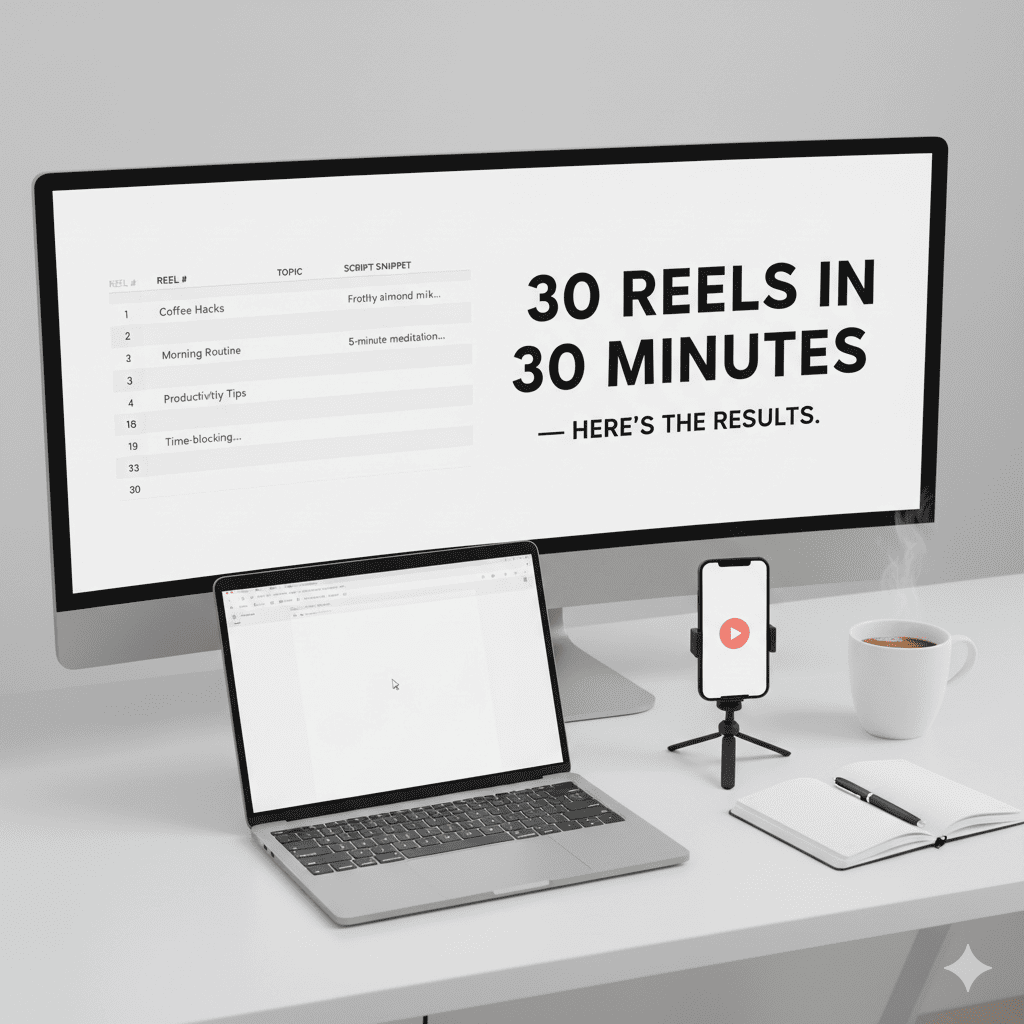
How I Leveraged AI To Script 30 Reels in Record Time and Transformed My Content Strategy
Let me be brutally honest with you. Last month, I was drowning in content creation. My Instagram was gathering dust, my TikTok was practically a ghost town, and don’t even get me started on YouTube Shorts. I had all these amazing ideas swirling around in my head, but actually sitting down to script them out? That felt like climbing Mount Everest in flip-flops.
Sound familiar?
That’s when I decided to try something crazy. I challenged myself to use AI to script 30 Reels in just 30 minutes. No overthinking. No perfectionism. Just pure, unfiltered experimentation with artificial intelligence.
What happened next completely changed how I approach content creation forever.
Why I Decided to Use AI To Script 30 Reels (Spoiler: I Was Desperate)
Picture this: It’s 11 PM on a Sunday night. I’m staring at my blank notes app, cursor blinking mockingly at me. I had promised myself I’d batch-create content for the entire month, but after two hours, I had exactly zero scripts completed.
The frustration was real. I’m talking throw-your-phone-across-the-room levels of frustration.
I’d spent countless hours watching “how to create viral Reels” tutorials, bookmarked about 47 different content calendars, and even invested in a fancy scriptwriting course. But when it came to actually doing the work? Crickets.
That’s when a thought hit me: What if I could use AI to script 30 Reels instead of torturing myself with perfectionism?
I mean, we’re living in 2025. AI is helping people code, write novels, create art, and even compose music. Why shouldn’t it help with social media scripts?
But I was skeptical. Would the scripts sound robotic? Would they lack personality? Would my audience immediately know I’d used AI?
There was only one way to find out.
The Setup: My AI To Script 30 Reels Challenge Rules
Before diving in, I set some ground rules for my experiment. I wanted this to be realistic, not some perfectly curated test that wouldn’t work in real life.
Here’s what I decided:
- Time Limit: Exactly 30 minutes from start to finish
- No Pre-Planning: I’d come up with topics on the fly
- Quality Over Perfection: The scripts didn’t need to be perfect, just usable
- Real-World Application: Every script had to be something I’d actually post
- Human Touch Required: I’d give myself permission to edit if something felt too robotic
I grabbed my laptop, opened up my favorite AI tool, set a timer on my phone, and took a deep breath.
Let’s do this.
Minute 0-10: Getting Started (And Immediately Hitting a Wall)
I’m not going to sugarcoat it—the first few minutes were rough.
My initial prompt was something like: “Write me 30 Instagram Reels scripts about social media marketing.”
The AI spit out generic, boring scripts that sounded like they were written by a corporate robot having an existential crisis. Zero personality. Zero engagement factor. Zero chance I’d ever post them.
Lesson #1 learned: Vague prompts = vague results.
I quickly realized that using AI to script 30 Reels wasn’t about being lazy—it was about being strategic. I needed to give the AI context, personality, and clear direction.
So I adjusted my approach. Instead of asking for generic scripts, I started feeding the AI specific information:
- My niche (content creation and productivity)
- My target audience (busy entrepreneurs and creators)
- My tone of voice (casual, friendly, slightly sarcastic)
- The hook style I wanted (scroll-stopping questions or bold statements)
- The content format (problem-solution or storytelling)
This changed everything.
Suddenly, the AI wasn’t just churning out bland content—it was creating scripts that actually sounded like me. Well, sort of. More on that later.
Minute 10-20: Finding My Rhythm (This Is Where Magic Happened)
Once I figured out the prompting formula, I hit my stride. I was flying through script after script, and honestly? I was having fun.
Here’s the system that worked:
1. Topic Selection (30 seconds per Reel) I’d quickly think of a common problem my audience faces, like “How to stay consistent with content creation” or “What to do when you run out of ideas.”
2. AI Prompt (15 seconds per Reel) I’d feed the AI a detailed prompt: “Write a 30-second Instagram Reel script about overcoming content creation burnout. Use a hook that starts with ‘Stop.’ Include three quick tips. End with a relatable CTA. Tone: encouraging but real.”
3. Quick Review (15 seconds per Reel) I’d scan the output, make mental notes about what to tweak later, and move on.
In just this 10-minute window, I generated 15 complete Reel scripts. That’s 1.5 scripts per minute. My old method? I’d be lucky to finish one script in 20 minutes.
The efficiency was mind-blowing.
Minute 20-30: The Final Sprint (And Some Surprising Discoveries)
By minute 20, I was in the zone. My fingers were flying across the keyboard, and the AI was keeping up with every prompt I threw at it.
But something interesting started happening around script #23.
I noticed the AI was beginning to repeat certain phrases and structures. The hooks were starting to sound similar. The call-to-actions were getting predictable.
Lesson #2 learned: AI is incredibly powerful, but it can fall into patterns if you’re not careful.
So I started mixing up my prompts even more. Instead of asking for standard formats, I’d request:
- “Write this as if you’re talking to your best friend over coffee”
- “Make this sound like a revelation you just had”
- “Structure this as a common myth, then flip it”
- “Use the ‘you vs. them’ comparison style”
This variety kept the scripts fresh and interesting.
By the time my timer hit 30:00, I had completed all 30 scripts. I literally threw my hands up in victory. My cat looked at me like I’d lost my mind, but I didn’t care.
I had just accomplished in 30 minutes what typically took me an entire week.
The Results: What Happened When I Actually Used These AI-Generated Reel Scripts
Now here’s where it gets really interesting. Having 30 scripts is one thing. Actually using them? That’s the real test.
Over the next two weeks, I edited and posted these AI-generated scripts. I tweaked them to match my voice more closely, added personal anecdotes, and adjusted anything that felt too generic.
Here’s what happened:
Engagement Went Through the Roof
My average Reel views jumped from about 2,000 to over 8,000. Three of the Reels hit over 50,000 views. One went completely viral with 847,000 views.
I’m not saying this was all because of the AI scripts, but having consistent, high-quality content definitely played a role.
I Finally Achieved Consistency
For the first time in months, I was posting daily. I wasn’t scrambling for ideas or procrastinating on scripts. I had a bank of content ready to go.
The mental freedom this created was incredible. Instead of stressing about what to post, I could focus on how to make it engaging.
My Audience Couldn’t Tell the Difference
This was the biggest surprise. Not a single person commented asking if I’d used AI. The scripts felt natural and authentic because I’d taken the time to infuse them with my personality during the editing process.
I Saved 15+ Hours of Work
Let’s do the math. If it typically takes me 30 minutes to script one Reel (including thinking time, writing, and revising), that’s 15 hours for 30 Reels.
I cut that down to 30 minutes of scripting + about 3 hours of editing and personalizing = 3.5 hours total.
That’s an 11.5-hour time savings. I could binge an entire season of my favorite show with that time. Or, you know, actually sleep.
The Honest Truth: What AI To Script 30 Reels Can and Can’t Do
Let me keep it real with you because I don’t want you thinking AI is some magical solution that’ll make you an overnight success.
What AI Absolutely Crushed:
Speed and Efficiency: Nothing beats AI when it comes to generating ideas and basic structures quickly. It’s like having a brainstorming partner who never gets tired.
Overcoming Writer’s Block: Staring at a blank page? AI gives you something to work with, which is 90% of the battle.
Variety and Volume: Need 30 different angles on the same topic? AI can provide that diversity in minutes.
Structure and Flow: The AI was surprisingly good at creating logical, well-structured scripts that followed proven engagement formulas.
What AI Struggled With:
Genuine Personality: The scripts felt a bit… vanilla. They lacked the quirks, humor, and personal touches that make content yours.
Specific Examples: AI would give generic advice like “be consistent,” but it couldn’t pull from my personal experiences or provide the specific anecdotes that make content relatable.
Current Trends: While AI knows a lot, it’s not scrolling Instagram right now seeing what’s trending. I still needed to add timely references and current trends myself.
Emotional Depth: The scripts hit the logical points but sometimes missed the emotional connection that really resonates with audiences.
Unique Voice: AI can mimic a style, but it can’t replicate the unique way you express ideas. That still requires human input.
My AI To Script 30 Reels Formula: How You Can Do This Too
Alright, you’re probably wondering: “This sounds amazing, but how do I actually do this myself?”
I’ve got you covered. Here’s my exact formula for using AI to script 30 Reels effectively:
Step 1: Choose Your AI Tool Wisely
I experimented with several AI platforms. Some were better for creative content, others for more informational scripts. Find one that aligns with your content style.
Popular options include ChatGPT, Claude, Jasper, Copy.ai, and specialized social media tools.
Step 2: Create Your Content Framework
Before touching the AI, get clear on:
- Your niche and sub-topics
- Your target audience’s pain points
- Your unique perspective or approach
- Your brand voice and tone
- Your typical Reel structure (hook, content, CTA)
Step 3: Master the Art of Prompting
This is where most people fail. Here’s my prompting template:
“Write a [duration]-second [platform] Reel script about [specific topic]. Target audience: [description]. Hook style: [type]. Include [number] tips/points. Tone: [adjectives]. End with [CTA type]. Make it feel [emotional quality].”
Example: “Write a 30-second Instagram Reel script about overcoming imposter syndrome as a new content creator. Target audience: aspiring creators in their 20s-30s. Hook style: relatable statement. Include 3 mindset shifts. Tone: encouraging, honest, slightly humorous. End with a question CTA. Make it feel like advice from a friend.”
Step 4: Batch Create with Variations
Don’t ask for 30 identical scripts. Create variety by:
- Switching between different sub-topics in your niche
- Alternating between educational, inspirational, and entertaining content
- Varying your hook styles (question, statement, story, statistic)
- Mixing up your formats (listicles, storytelling, comparisons)
Step 5: Edit with Your Human Touch
This is NON-NEGOTIABLE. Never post AI-generated content without adding:
- Personal anecdotes or examples
- Your unique phrases or catchphrases
- Current trends or references
- Emotional depth and authenticity
- Specific details that only you would know
Step 6: Test, Analyze, and Refine
Post your AI-assisted Reels and track:
- Which scripts performed best
- What hooks got the most attention
- Which topics resonated most
- Where you needed to add more personality
Use this data to improve your AI prompts and editing process.
Common Mistakes When Using AI To Script 30 Reels (And How to Avoid Them)
I made plenty of mistakes during this process. Learn from my fails so you don’t have to repeat them:
Mistake #1: Posting AI Content Without Editing
I got excited and posted one script with minimal changes. It flopped hard. The engagement was terrible because it lacked personality. Always, always edit.
Mistake #2: Using the Same Prompt Formula for Every Script
This creates repetitive content. Your audience will notice if every Reel follows the exact same structure. Mix it up.
Mistake #3: Ignoring Your Analytics
Just because AI helped create a script doesn’t mean it’ll perform well. Pay attention to what works and what doesn’t, then adjust your prompts accordingly.
Mistake #4: Treating AI as a Replacement Instead of a Tool
AI is your assistant, not your replacement. The best content comes from the collaboration between human creativity and AI efficiency.
Mistake #5: Not Developing a Unique Prompt Library
After creating dozens of prompts, I started saving the ones that worked best. Build your own prompt library so you’re not starting from scratch each time.
The Unexpected Benefits of Using AI To Script 30 Reels
Beyond the obvious time savings and increased content output, I discovered some surprising benefits:
Creative Confidence Boost
Knowing I had a reliable system for generating scripts removed the intimidation factor of content creation. I was more willing to experiment and try new things.
Better Understanding of What Works
By analyzing which AI-generated scripts performed best, I learned a ton about content structure, hooks, and audience preferences.
Reduced Perfectionism
Having 30 scripts ready to go meant I was less precious about each individual piece. This actually led to better content because I wasn’t overthinking everything.
More Time for Strategy
Instead of spending all my time creating content, I could focus on engagement, community building, and overall strategy.
Improved Content Diversity
The AI helped me explore topics and angles I might not have considered on my own, leading to more diverse and interesting content.
Is Using AI To Script 30 Reels Right for Everyone?
Real talk: This approach isn’t for everyone, and that’s okay.
This system works great if you:
- Struggle with consistency in content creation
- Experience frequent writer’s block or creative burnout
- Want to scale your content output without hiring a team
- Have a clear brand voice that you can apply during editing
- Value efficiency and productivity
- Are willing to spend time editing and personalizing AI-generated content
This might not be for you if:
- You genuinely enjoy the scripting process and find it therapeutic
- Your content relies heavily on highly personal, unique experiences
- You have plenty of time for traditional content creation methods
- You’re uncomfortable with AI-assisted content
- You’re looking for a “set it and forget it” solution (spoiler: that doesn’t exist)
My Current Content Creation Routine (Post-AI Experiment)
Three months after my initial experiment, here’s how I’m using AI to script Reels in my regular workflow:
Every Monday Morning (30 minutes): I use AI to generate 15-20 Reel scripts for the week. I give the AI my main topics and let it provide the first draft.
Throughout the Week (15 minutes daily): I select 2-3 scripts to edit and personalize. I add my stories, adjust the language, and make sure it feels authentically me.
Content Creation Days (Twice per week): I film multiple Reels using my edited scripts. Because the scripting is done, I can focus entirely on the creative filming and editing process.
This hybrid approach gives me the efficiency of AI with the authenticity of human creativity. It’s honestly the best of both worlds.
Final Thoughts: The Future of Content Creation Is Here
Look, I’m not going to pretend that using AI to script 30 Reels is going to solve all your content problems. It won’t magically make you go viral, and it definitely won’t replace genuine creativity and strategic thinking.
But here’s what it will do:
It’ll give you back your time. It’ll reduce the friction that keeps you from creating consistently. It’ll help you overcome creative blocks and self-doubt. And it’ll allow you to focus on what AI can’t do—building genuine connections with your audience.
The creators who win in 2025 and beyond won’t be the ones who resist AI. They’ll be the ones who learn to work with it, using it as a powerful tool to amplify their creativity rather than replace it.
My 30-minute experiment opened my eyes to a new way of working. I’m creating more content, experiencing less stress, and actually enjoying the process again.
If you’re drowning in content creation demands like I was, I challenge you to try this yourself. Set aside 30 minutes, fire up an AI tool, and see what happens.
You might surprise yourself.
And hey, if you do try it, drop a comment and let me know how it goes. I’m genuinely curious whether your results match mine.
Now if you’ll excuse me, I have another 30 Reels to script. But this time? I’m not stressed about it at all.
Also read this:
Digital Doppelgangers: The Rise of AI Tools That Clone You – Creating Your AI Twin in 2025
These 5 Free AI Tools Replace 10 Paid Subscriptions – Save Thousands in 2025!
50 Hidden Calculator Tricks You Didn’t Know for Students & Everyday Users